
Ludwig Enterprises Advances mRNA Diagnostics with Upcoming Revealia™ Breast Test Launch
Ludwig Enterprises prepares to initiate clinical trials for its pioneering mRNA-based breast cancer screening test amid liquidity challenges.
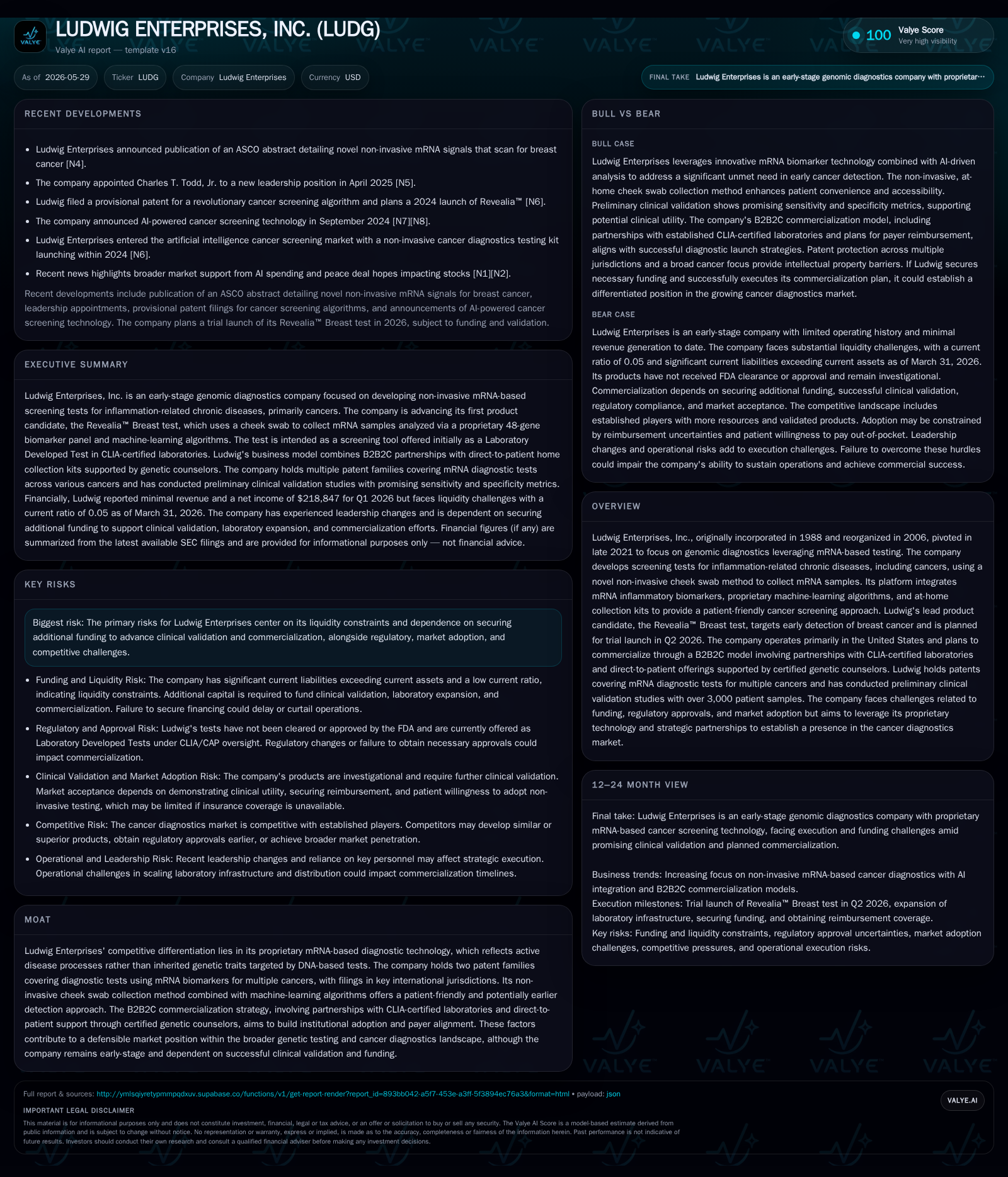
Ludwig Enterprises, an early-stage genomic diagnostics company, reported in its latest quarterly filing that it is set to launch clinical trials for its Revealia™ Breast test in Q2 2026, marking a significant milestone toward commercialization. The company's differentiated approach leverages mRNA inflammatory biomarkers analyzed via non-invasive cheek swabs, combined with machine-learning algorithms, offering earlier detection of inflammation-driven diseases such as cancer. Ludwig is pursuing a B2B2C commercialization model through CLIA-certified laboratory partnerships and direct-to-patient kit offerings supported by certified genetic counselors. However, substantial liquidity constraints and the nascent nature of product validation present ongoing risks that require monitoring as the company advances trial execution and market development.
Latest Operating Update: Pre-Commercialization Milestone Approached
In its 10-Q filed May 29, 2026 [S2], Ludwig Enterprises detailed forward progress toward a pivotal commercial event — initiating clinical trials for its Revealia™ Breast test scheduled in Q2 2026. This marks the transition from a development-focused phase into clinical validation essential for future commercialization and payer discussions. The filing underscores the company’s commitment to launching within the targeted timeframe despite typical early-stage biotech uncertainties.
This immediate catalyst crystallizes Ludwig’s strategic pivot since late 2021 toward high-potential mRNA-based genomic diagnostics focused on inflammation-driven chronic conditions like cancer [S1]. As no products are currently available commercially, this trial launch constitutes a major step in advancing Ludwig’s technology platform from theory into practice.
Business Model and Product Innovation in mRNA-Based Diagnostics
Ludwig operates an innovative B2B2C model where revenue generation stems primarily from licensing proprietary algorithms to CLIA-certified, CAP-accredited partner laboratories functioning under Laboratory Developed Test (LDT) regulations [S1]. These labs handle either local test processing or sample referrals to Ludwig's affiliated lab. Revenue streams also include sales of at-home cheek swab kits directly to patients—an unusual approach in cancer screening—that are supported by certified genetic counselors to aid interpretation and facilitate patient engagement.
This dual-channel strategy is designed both to leverage existing physician sales channels maintained by partners with reimbursement relationships and facilitate patient-friendly access aligned with evolving telehealth trends. The business model banks on mitigating customer acquisition risk through multi-channel distribution while building scalable infrastructure for broader institutional and payer adoption.
Central to Ludwig’s offering is its proprietary testing platform using mRNA inflammatory biomarkers collected via non-invasive cheek swabs [S1]. This novel sample method distinguishes Ludwig from DNA-based genetic tests that focus on inherited traits; instead, Ludwig targets dynamic gene expression reflecting active disease processes potentially detectable earlier than static DNA markers. Their machine-learning algorithms refine biomarker interpretation, promising improved sensitivity and specificity for early detection of breast cancer and other inflammation-linked diseases.
Competitive Landscape and Market Positioning in Genomic Screening
Within the crowded genetic testing landscape dominated by DNA-centric diagnostics firms, Ludwig claims differentiation through its exclusive focus on mRNA biomarkers that signify active disease rather than inherited predisposition [S1]. This biological distinction may translate into clinically meaningful advantages in cancer screening efficacy if clinical data validates their hypothesis.
Patent protections underpinning this technological moat include two patent families covering diagnostic applications of mRNA markers for multiple cancers — breast, bladder, colon, ovarian among others — with filings spanning key markets including the US, Europe, Canada, Australia, Israel, India, and South Korea [S1]. This geographic breadth provides barriers against rapid competitor duplication but does not eliminate competitive threats inherent in emerging diagnostics fields.
Regulatory positioning leans on the Laboratory Developed Test pathway overseen by CLIA-certified labs rather than pursuing FDA premarket approvals upfront [S1]. While this expedites market entry allowing flexible iteration and adoption by physician channels familiar with LDTs, it also presents reimbursement hurdles requiring robust demonstrated clinical utility to payers.
Growth Drivers: Clinical Validation, Multi-Channel Commercialization, and Data Generation
Growth catalysts hinge primarily on successful execution of multiple fronts:
- Clinical Trials: Positive outcomes from the Revealia™ Breast test trial starting Q2 2026 will be critical for credibility with clinicians and payers alike.
- Laboratory Partnerships: Expanding agreements with independent CLIA-certified laboratories that possess established sales channels aims to scale pipeline reach rapidly while diffusing concentration risk.
- Direct-to-Patient Access: The home collection kit platform enhances convenience and compliance potential while generating a rich dataset of real-world usage essential for health economic analyses.
- Real-World Evidence: Accumulating patient-derived data supports reimbursement efforts by demonstrating test impact on care pathways and outcomes under coverage negotiations.
This multi-channel approach addressing various stakeholder touchpoints—physicians, patients, payers—reflects an industry-aware strategy responding to fragmented genetic screening adoption patterns. Effectively balancing these elements is necessary given complex downstream factors affecting genetic test utilization beyond mere technological efficacy.
Risks and Constraints: Funding, Regulatory Pathways, and Market Adoption
The most pressing risk evident from the latest financial data ([F1]) is Ludwig’s severely constrained liquidity profile as of Q1 2026:
- Cash and equivalents totaled approximately $18 thousand.
- Current liabilities exceed $5.3 million.
- The current ratio stands at an alarming ~0.05 indicating short-term obligations far outstrip liquid assets.
Such statistics intimate an urgent need for capital infusion to continue funding costly clinical validation studies and operational scale-up [S1]. Failure to secure additional financing could force suspension or cessation of operations—risks characteristic of early-stage biotech ventures with no commercial revenues yet realized.
Additional material risks include:
- Regulatory Uncertainty: While leveraging the LDT framework accelerates access compared to FDA clearance routes, evolving regulatory scrutiny may impose additional burdens impacting timelines or cost.
- Market Adoption: Convincing clinicians, patients, and especially payers to embrace a novel mRNA-based screening modality faces challenges amid entrenched preferences for well-known DNA tests or imaging approaches.
- Competition: Established diagnostics players adapting RNA or alternative biomarker strategies could erode Ludwig’s potential market share without clear dominance by patent exclusivity alone.
Taken together these dynamics frame Ludwig as a high-risk enterprise still navigating foundational hurdles before realizing growth avenues fully.
Key Metrics to Watch: Trial Progress, Partnership Expansion, and Payer Engagement
Monitoring execution against specific milestones is essential for assessing Ludwig’s trajectory:
- Progression status reports from Revealia™ Breast test trial phases commencing Q2 2026 will provide early signals about technical feasibility and regulatory positioning.
- Announcements regarding new or expanded contracts with CLIA-certified laboratories will reflect commercial channel momentum critical for scaling revenue opportunities.
- Initial revenue recognition either through per-test licensing fees or service billing once operations commence will indicate market traction versus developmental burn rate.
- Updates concerning certification status of supporting genetic counselors underscore investment in patient engagement infrastructure boosting adoption likelihood.
- Emerging discussions or agreements with payers influenced by real-world effectiveness data could validate reimbursement viability – a pivotal factor determining scalability beyond niche early adopters.
Successful navigation across these domains determines sustainability amidst an expensive commercial ramp-up phase characterized by negative operating margins.
Supplemental Financial Profile: Funding Outlook and Capital Structure
As of March 31, 2026 [F1], Ludwig reported cash reserves amounting to $18,323 juxtaposed against current liabilities exceeding $5.3 million — yielding a current ratio roughly equal to 0.05.
Operating losses persist into FY 2025 with annual operating income negative $1.77 million and net loss exceeding $2.23 million [F1]. These figures underscore continuing cash burn consistent with pre-commercial biotech enterprises investing heavily in product development ahead of revenue generation.
The company acknowledges reliance on securing further funding rounds or capital sources indispensable for sustaining clinical validation programs alongside expansion of laboratory infrastructure required for commercialization [S1]. Without timely access to additional resources, progressing beyond pilot stages may be imperiled despite promising technology foundations.
This analysis synthesizes available filings as of May 2026 without offering investment advice. All observations rely strictly on documented corporate disclosures supplemented by sector-specific context pertinent to early-stage genomic diagnostics businesses.
Disclaimer: This is research-only, informational analysis and not investment advice. It may include AI-generated interpretation and general industry context. Always verify important details using primary sources.

Comments