
lululemon Athletica’s Q1 Shift: Momentum Amid Competitive and Supply Pressures
lululemon’s latest quarterly results illustrate enduring brand resilience alongside emerging headwinds from supply chain complexity and intensified market competition.
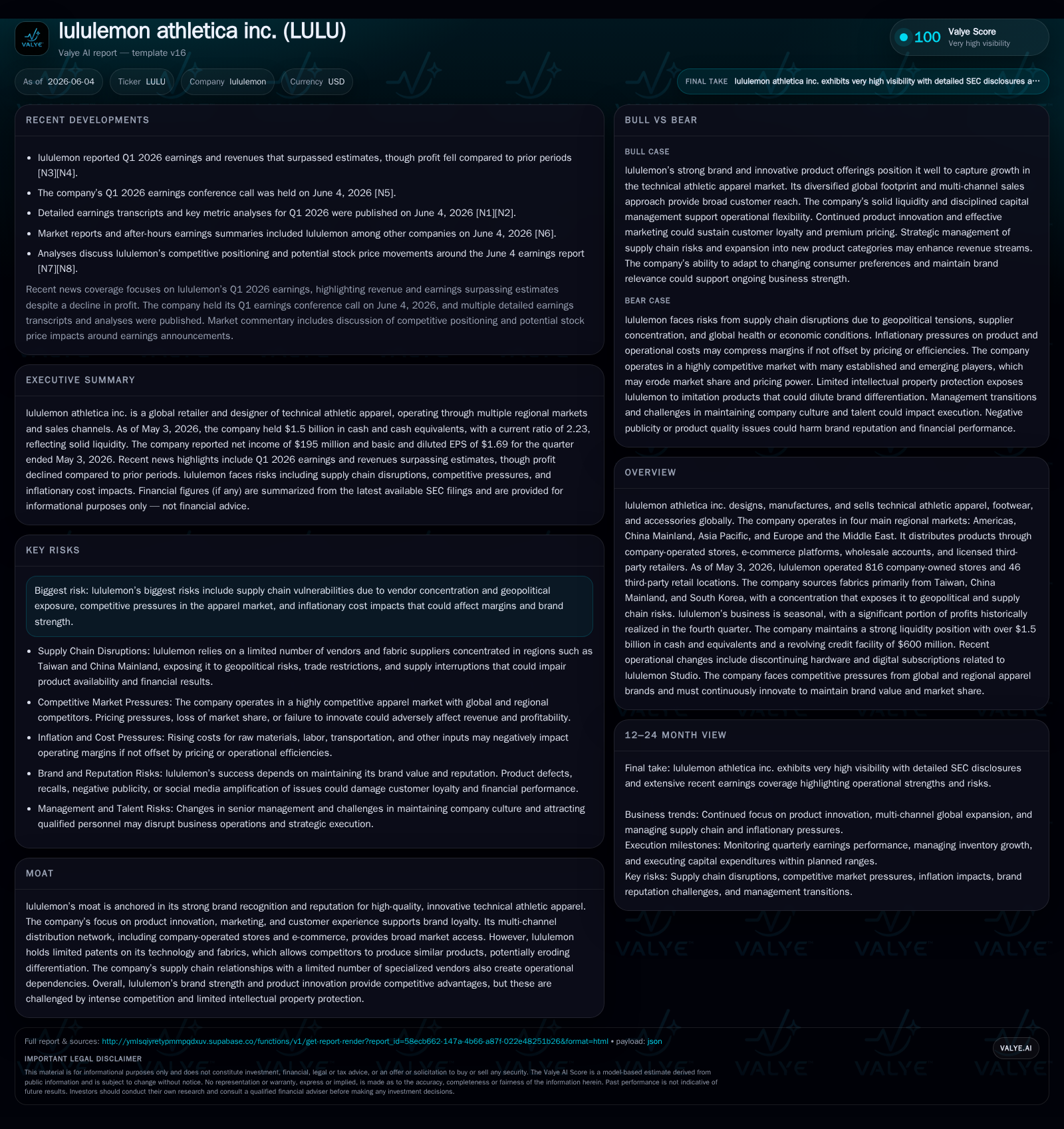
In its Q1 2026 filing, lululemon athletica presented a narrative of sustained revenue strength tempered by modest inventory growth and persistent cost pressures. The company’s multi-channel model—centered on owned stores, e-commerce, and selective wholesale—continues to fuel customer loyalty and direct engagement. However, vendor concentration in Asia exposes supply chain vulnerabilities amid global trade uncertainties. Competition from major athletic apparel players further tests lululemon’s ability to maintain pricing power absent robust patent protection. Going forward, innovation in products and geographic expansion remain key growth levers, while inflationary cost pressures and geopolitical risks pose ongoing challenges.
First Quarter Operational Highlights: Signals from the Latest Filing
lululemon athletica’s Q1 2026 results detailed in the June 4th 10-Q [S2] reveal continued top-line momentum underscored by strategic inventory management. Inventory balances rose moderately by 2% year-over-year as of May 3, 2026, signaling an incremental expansion of assortment breadth to meet anticipated demand without excess stock risk. Purchase obligations remained steady against this backdrop, indicating disciplined procurement aligned with revenue growth projections. Liquidity metrics underscore a robust financial footing with $1.5 billion cash and equivalents on hand, zero borrowings under the $600 million unsecured revolving credit facility (save for minor letters of credit), and a healthy working capital position excluding cash at roughly $685 million [S2]. Seasonal operational dynamics remain consistent; historically, lululemon recognizes a disproportionate share of profits in Q4 given holiday sales strength.
Management acknowledges supply chain exposures given reliance on Asian fabric suppliers concentrated in Taiwan, China Mainland, and South Korea. These vendor dependencies heighten operational risk during geopolitical volatility [S2]. Additionally, persistent inflationary forces affecting product input costs pose challenges to margin preservation despite price initiatives.
Brand and Business Model: The Engine of lululemon's Revenue
lululemon’s business model centers on designing technical athletic apparel alongside footwear and accessories marketed across four regional markets: Americas, China Mainland, Asia Pacific (APAC), and Europe & Middle East (EMEA) [S1]. As of early May 2026, the company operated 816 company-owned stores complemented by 46 licensed third-party retail locations strategically distributed worldwide [S1][S27]. This physical footprint is integrated with a direct-to-consumer e-commerce channel which grows in tandem to ensure brand exclusivity while maximizing consumer touchpoints.
Revenue generation intricately links to unit volume sold across its multi-channel architecture involving owned stores capturing higher margin sales versus wholesale or licensing arrangements which extend reach but at diluted returns [S1]. Customer loyalty rooted in innovative fabrics—such as moisture-wicking proprietary blends—and technical performance drives repeat purchase behavior. However, lululemon’s intellectual property predominantly relies on brand equity rather than patents; limited patented textile innovations restrict the firm’s ability to legally block competitors crafting comparable products. Thus, customer retention efforts emphasize continuous merchandizing innovation coupled with an elevated in-store experience.
Competitive Ecosystem and Industry Positioning
lululemon competes within a crowded global athletic wear market dominated by legacy giants like Nike, Under Armour, and Adidas that maintain significant scale advantages across manufacturing capacity, marketing heft, and R&D budgets. These peers also intensify fabric technology races deploying advanced mesh materials or sustainable textiles backed by stronger patent portfolios. Without deep protected IP assets for fabrics or designs, lululemon must rely heavily on brand perception and novelty cycles to sustain pricing power.
On channel strategy fronts, lululemon has distinguished itself through balanced omnichannel execution—high touchpoint density in flagship stores complemented by rapid e-commerce fulfillment—which partially insulates it from digital pricing competition prevalent in wholesale-heavy peers [S9]. However, supplier concentration notably introduces capacity constraints; production sourcing in Asia renders lululemon susceptible to trade tariffs or disruptions outpacing larger diversified competitors’ contingency measures
Growth Catalysts: Innovation, Expansion, and Market Penetration
Product innovation remains central as lululemon extends beyond apparel into footwear lines aimed at diversifying unit economics downstream [S1][S2]. These launches underpin improving margin profiles due to higher ASPs compared to basic apparel categories. Concurrently geographical expansion targets growth regions like China Mainland where store count increased to 173 reflecting nuanced local consumer demand [S27]. APAC markets also show steady network densification leveraging flagship presence in Australia, South Korea, Japan, Taiwan and Southeast Asia.
The company’s emphasis on omni-channel fulfillment investments facilitates seamless integration of online orders with brick-and-mortar pickup options enhancing guest convenience—a critical metric driving same-store sales uplift.
Capital spending guidance for 2026 is pegged between $725 million to $745 million supporting both domestic store openings plus state-of-the-art distribution center upgrades that bolster logistics efficiency [S1]. While Q1 inventory increases present timing considerations for new assortments ahead of peak demand seasons.
Risk Factors and Constraints Impacting Trajectory
Among chief headwinds are geopolitical risks tied to vendor concentration in Taiwan-China-South Korea corridors potentially disrupting raw material availability or inflating freight costs should trade tensions escalate [S9][S23]. Inflation continues to pressure gross margins through higher costs for textiles, labor, transportation which may constrain pass-through pricing capabilities in competitive contexts.
Legal risks persist with ongoing securities litigation alleging historical misinformation relating to inventory allocations posing reputational hazards [S5]. Moreover intellectual property limitations heighten vulnerability as rivals introduce analogous technical apparel absent patent enforcement barriers.
Inventory management requires delicate balance; aggressive assortment expansion risks overstock write-downs during volatile demand cycles while overly conservative purchasing could limit market responsiveness [S2]. Consumer activism linked to brand social positioning also presents reputation management complexity impacting guest loyalty [S23].
Forward-Looking Indicators: What to Monitor Next
Investors should track subsequent quarterly guidance updates elucidating demand durability amid competitive dynamics. Inventory turn ratios will signal how efficiently lululemon converts stock into sales particularly across new product categories like footwear. Management commentary on e-commerce penetration relative to physical store sales will be critical given shifting consumer shopping patterns post-pandemic.
Footwear margin trends require close examination as these newer lines become material contributors informing long-term profitability pathways. Additional geographic expansion milestones especially in underpenetrated APAC markets will indicate success translating global brand appeal into sustained volume growth.
Financial Overview: Liquidity, Margins, and Capital Allocation
As of May 3rd quarter end [S2], lululemon retains a solid liquidity profile highlighted by approximately $1.5 billion cash reserves paired with zero outstanding debt under its revolving facility maintaining nearly $600 million borrowing capacity untouched—a signal of prudent capital structure management [F1][S2][S7]. Capital expenditure plans are set between $725-$745 million primarily focused on expanding the retail footprint plus upgrading supply chain infrastructure essential for scaling omni-channel capabilities [S1][S19].
Gross margins face compression from inflationary cost inputs; nevertheless brand strength allows partial pricing strategies that protect margin integrity relative to mass-market peers [S20]. Share repurchase activities continue under an authorized program enabling flexible capital return but judiciously paced respecting cash flow constraints given reinvestment priorities [S19].
This analysis synthesizes lululemon's latest regulatory disclosures with sector-specific context to illuminate how recent operational developments relate to ongoing structural themes shaping its market trajectory. It refrains from predictive judgments focusing instead on documented business realities underpinning the company’s current performance framework.
Disclaimer: This is research-only, informational analysis and not investment advice. It may include AI-generated interpretation and general industry context. Always verify important details using primary sources.

Comments