
Southwest Airlines: Resilient Low-Cost Leader Facing Liquidity and Demand Challenges
Southwest Airlines balances its well-entrenched budget carrier strength and comprehensive cybersecurity governance against tightening liquidity and evolving passenger dynamics in 2025.
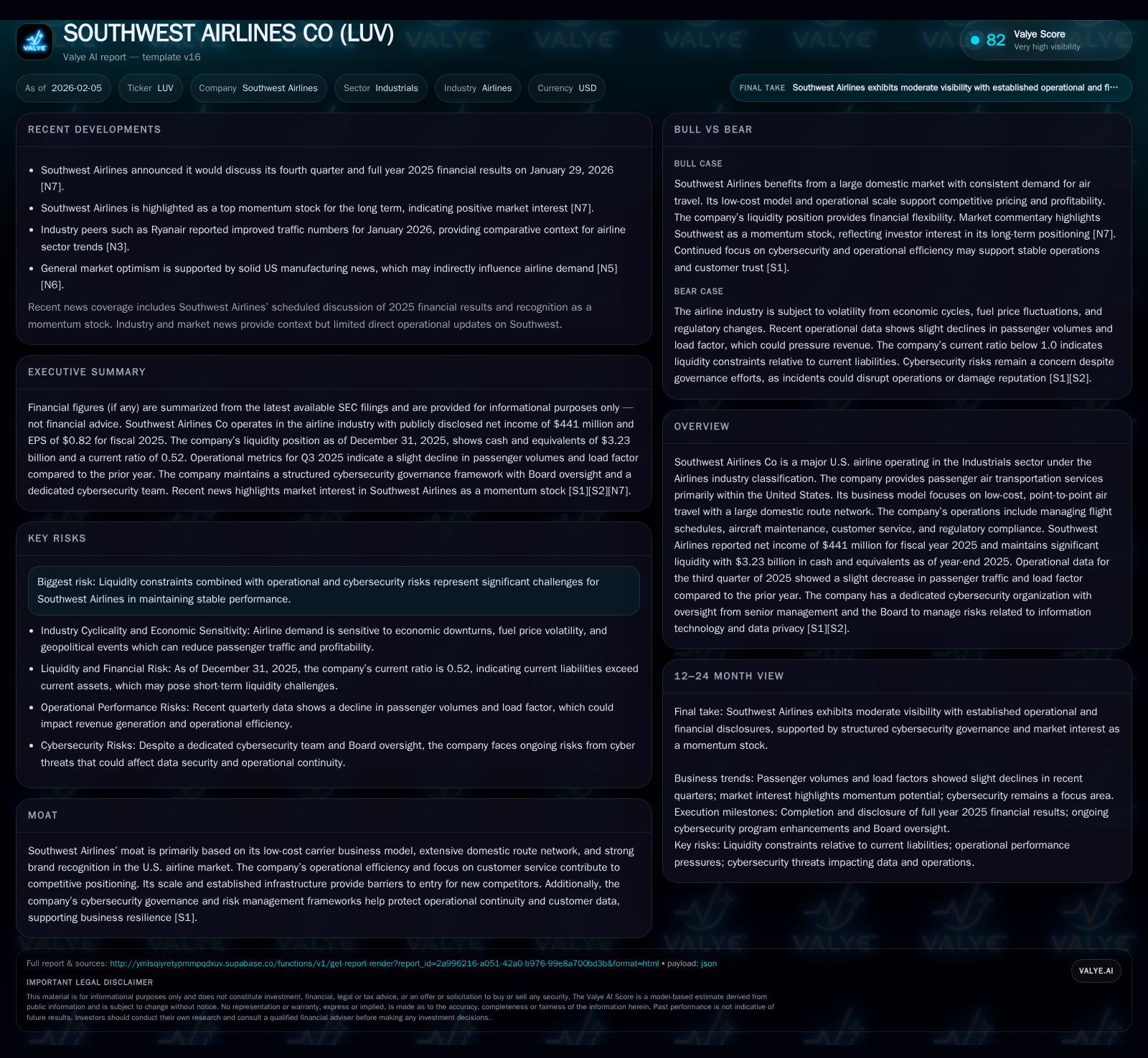
In fiscal 2025, Southwest Airlines reported positive net income of $441 million despite a softening in third-quarter passenger traffic and load factors. The company’s enduring competitive edge stems from its disciplined low-cost model, extensive domestic network, and strong brand loyalty. Southwest’s robust cybersecurity infrastructure under board oversight fortifies operational resilience amid rising digital threats. However, liquidity remains a constraining factor with a notably low current ratio, underscoring funding risks amid market pressures. Against a backdrop of global airline passenger growth variability and peer momentum, Southwest confronts strategic tradeoffs between growth initiatives and operational risk management as it navigates the near-term outlook.
Navigating 2025’s Financial Landscape: Results and Realities
Southwest Airlines closed the 2025 fiscal year with a modest net income of $441 million, reflecting continued operational profitability amid notable market headwinds [F1]. The company also held $3.23 billion in cash and equivalents at year-end, underscoring a liquidity buffer that provides some financial cushioning. Yet this surface-level comfort masks underlying pressure points; for instance, the third quarter revealed a slight decrease in passenger traffic and load factor year-over-year — subtle indicators of shifting traveler behavior possibly linked to macroeconomic factors or competitive influences [N1][F1]. These early softness signals imply that Southwest's traditionally steady demand environment is encountering new complexities.
While revenue figures for full-year 2025 were not disclosed here beyond historical context, the path to sustaining profitability remains increasingly challenged by evolving cost structures and consumer preferences within the broader U.S. airline market.
The Low-Cost Moat: Operational Excellence at Scale
At the core of Southwest Airlines’ competitive fortress lies its low-cost carrier (LCC) business model — centered on point-to-point air travel across an extensive domestic route network [S1]. This stand-out approach contrasts sharply with hub-and-spoke systems favored by legacy carriers, enabling Southwest to keep turnaround times tight, maximize aircraft utilization, and reduce operational redundancies.
Operational efficiency is not simply about cost-cutting but also about delivering consistent customer satisfaction through simplified fare structures and transparent service policies. This careful balance nurtures strong brand loyalty among U.S. consumers who associate Southwest with reliability at an accessible price point [valye_report_excerpt].
Moreover, scale effects derived from an entrenched infrastructure create formidable barriers for new entrants attempting to replicate Southwest’s network breadth or cost dynamics. The company’s ongoing profitability amid fluctuating market conditions attests to the durability of this moat.
Passenger Patterns and Market Dynamics: A Subtle Shift
Recent passenger data reveal nuanced shifts challenging Southwest’s momentum. The third quarter of 2025 recorded a marginal dip in passenger traffic volume alongside a reduction in load factor compared to the same period in the prior year [F1][N1]. While not dramatic, these changes merit close attention; they could presage demand softness impacting quarterly revenues going forward.
Contextualizing this within airline sector trends is instructive: Ryanair’s January 2026 numbers indicated year-over-year traffic improvements reflective of stronger European market buoyancy [N5]. Such comparative performance underscores regional disparities in travel recovery trajectories globally.
Southwest’s predominantly domestic focus weighs both as strength—through deep market penetration—and vulnerability—given limited exposure to faster-growing international segments or leisure travel surges.
Cybersecurity as a Strategic Imperative: Governance to Execution
In an era where digital threats can disrupt operations as severely as physical constraints, Southwest Airlines demonstrates rigorous commitment to cybersecurity governance [S1]. The Board oversees related risk management both at full sessions and through its Audit Committee; these bodies regularly review cybersecurity frameworks, incidents, program enhancements, and emerging threat landscapes.
The company has established a dedicated cybersecurity function led by an experienced Chief Information Security Officer (CISO) reporting directly to the CIO — both bringing decades-long expertise [S1]. These leaders coordinate layered teams handling threat intelligence, incident response, vulnerability management, and compliance activities.
Southwest’s incident response protocols emphasize timely escalation to senior management and Board committees when thresholds are met. This structure aims to slay cyber ‘dragons’ before they metastasize into business continuity crises. Such robust posture contributes positively to investor confidence by reducing hidden operational risks.
Liquidity Challenges and Balance Sheet Resilience
Despite holding over $3 billion in cash reserves at the close of 2025, Southwest’s liquidity picture reveals some tension points suggesting constrained short-term flexibility [F1][S1]. Specifically, the current ratio stands at approximately 0.52—a level significantly below typical comfort benchmarks indicating assets insufficient to cover imminent liabilities.
This discrepancy emanates largely from current liabilities exceeding $10.9 billion against current assets near $5.64 billion [F1]. Such tight working capital conditions heighten vulnerability to unexpected expenses or revenue shortfalls, potentially limiting maneuver room for investment or buffering economic shocks.
Liquidity risk is explicitly disclosed among key challenges in filings and underscores the imperative for disciplined cash flow management going into 2026.
Industry Context and Competitive Positioning
The backdrop for Southwest Airlines’ operating environment includes signs of robust American manufacturing strength fueling broader economic optimism — factors that generally support travel demand fundamentals [N6][N7]. Yet competition within the domestic airline space intensifies as peers seek market share through pricing strategies or network expansions.
Ryanair's recent growth momentum hints at competitive pressures that could eventually influence pricing paradigms even across disparate geographies [N5]. Meanwhile, stock market analysts have highlighted Southwest among top momentum airline stocks for long-term prospects while acknowledging associated risks [N8][N9].
These external forces necessitate continuous refinement of Southwest’s strategic playbook balancing aggressive defense of its cost leadership against selective growth initiatives.
Strategic Growth Levers Amidst Operational Risks
Southwest faces critical strategic crossroads: maintaining its low-cost ethos while embracing necessary fleet modernizations or route optimizations recognized industry-wide as catalysts for efficiency gains [valye_report_excerpt][S1]. Although no recent major fleet deals are reported here, general industry trends push towards updating aging aircraft for more fuel-efficient models—an essential step towards controlling operating costs.
Balancing these growth levers is complicated by growing operational risks — including fluctuations in travel demand patterns outlined earlier — plus persistent cybersecurity imperatives requiring resource investment.
Thus management must steer carefully between extending capacity where profitable versus shoring up defenses against both physical disruptions and cyber intrusions.
Forward Outlook: Risks, Opportunities, and Investor Sentiment
Looking ahead, Southwest Airlines projects resilience grounded in its established brand stature but faces hedged optimism due to highlighted risk factors including liquidity constraints and evolving passenger preferences [S1][N8][N9]. Investor enthusiasm reflected in recent analyst upgrades must be weighed alongside ongoing disclosures about operational vulnerabilities.
The company’s commitment to governance excellence—particularly via cybersecurity oversight—positions it well amidst heightened digital threat environments but will require sustained vigilance.
Ultimately, Southwest’s ability to navigate financial tightropes without compromising execution on its low-cost promise will shape stakeholder confidence into the mid-2020s horizon.
This analysis synthesizes publicly available financial data, regulatory filings, and recent news recounting; it does not constitute investment advice but offers an informed perspective on Southwest Airlines’ business condition and competitive landscape as of early 2026.
Disclaimer: This is research-only, informational analysis and not investment advice. It may include AI-generated interpretation and general industry context. Always verify important details using primary sources.

Comments