
Macy's First Quarter Surge Highlights Omnichannel Momentum and Brand Resilience
Robust Q1 2026 results demonstrate Macy’s successful integration of digital and physical retail channels under its Bold New Chapter strategy.
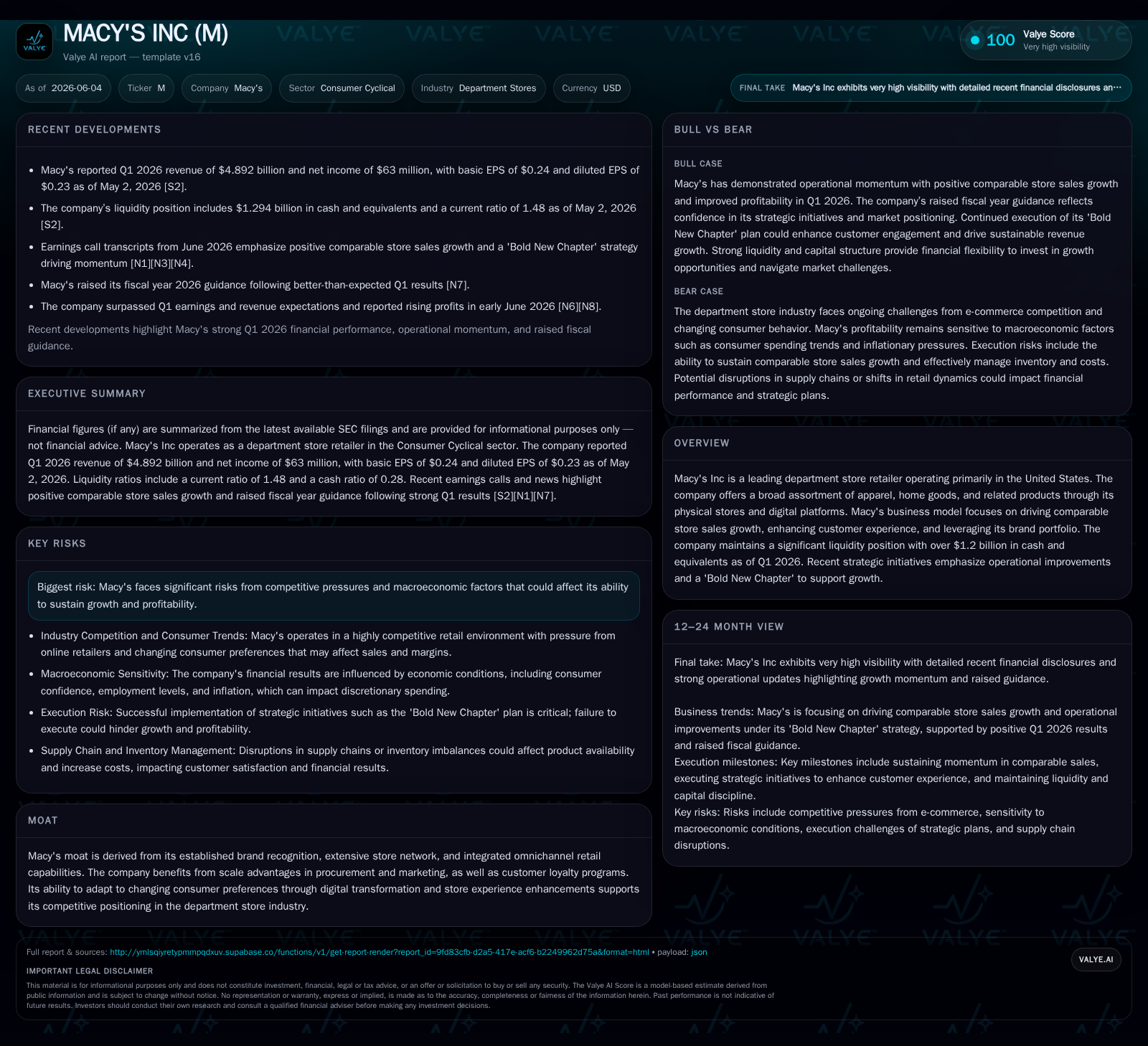
Macy’s reported a strong first quarter for 2026, driven by solid comparable store sales growth and an uptick in omnichannel engagement. The latest 10-Q filing confirms that the company is capitalizing on its extensive store network paired with enhancing digital platforms to fuel sales and customer loyalty. Management’s optimism is reflected in an elevated FY27 outlook, supported by operational improvements and disciplined inventory management. Macy’s competitive positioning rests on scale advantages and evolving assortment strategies amid ongoing promotional challenges and macroeconomic uncertainty.
Q1 Update: Operational Momentum Supports Enhanced Guidance
Macy's latest quarterly filing (10-Q dated June 4, 2026) highlights substantial operational progress in the first quarter ended May 2, 2026. Comparable store sales (comps) outpaced internal projections, underpinned by strong performance across key apparel and home categories [S2][N2]. Management emphasized robust omnichannel sales growth—reflecting a seamless integration of physical stores with e-commerce platforms—as a principal contributor. This enhanced customer experience is a core pillar of the company's 'Bold New Chapter' strategy launched earlier in fiscal year 2026. The company raised its full-year FY27 guidance based on these early gains [S3][N3].
These results mark a meaningful turnaround against the backdrop of ongoing retail industry disruption. Macy's focus on SKU-level comp improvements demonstrates an ability to attract customers with updated assortments and improved full-price selling while maintaining differentiated brand appeal.
Business Model Fundamentals: Omnichannel Retailing Powered by Customer Engagement
Macy’s operates an expansive network of department stores supplemented by a growing e-commerce business. Revenue generation stems from a diversified product mix dominated by apparel and home goods—a balance that helps smooth demand cycles. The recent filings reaffirm investments into customer experience enhancements including store remodeling, loyalty program upgrades, and data-driven merchandising.
The company’s business model leverages both volume and price levers: driving higher traffic through targeted marketing campaigns while striving for improved gross margins via promotional discipline. Loyalty programs serve not only as retention tools but also help optimize customer acquisition cost by incentivizing repeat purchases at full price [S1][S2][N1]. The 'Bold New Chapter' initiative undergirds these efforts with operational excellence projects aimed at tighter inventory management and supply-chain agility.
Competitive Environment: Department Store Dynamics and Macy’s Market Position
The department store sector remains intensely competitive, challenged by pure-play e-commerce brands and discount retailers. Macy's competitive moat lies in its scale advantages—in procurement, marketing spending efficiency, and real estate footprint—that smaller specialty retailers cannot easily replicate.
Promotional intensity across the industry pressures gross margins; however, Macy's demonstrated relative success in moderating markdowns while improving inventory turnover rates compared to peers [S1][S14]. Its multi-channel distribution capability supports elevated customer reach beyond what single-channel competitors can muster. These structural factors position Macy's better than many traditional department store rivals still adjusting to digital integration.
Driving Growth: Digital Integration, Assortment Strategy, and Loyalty Programs
Sales momentum in Q1 was buoyed notably by strengthened omnichannel penetration. Digital sales complement rather than cannibalize physical store revenue—a key metric signaling effective cross-channel synergy [N3][S2]. Enhanced assortment planning seeks to increase freshness of offerings, reduce inventory aging risks, and lift sell-through at or near full price.
Loyalty program engagement metrics suggest better customer retention as well as more efficient spend patterns—both vital to sustaining long-term profitability given the costs associated with new customer acquisition in a crowded retail landscape [F1]. Reducing reliance on deep discounting also supports margin resilience amid inflationary input cost pressures.
Risks and Constraints: Promotional Pressures and Macroeconomic Sensitivities
Despite the positive Q1 tone, Macy's acknowledges risks tied to increased competition-induced promotional pressure that could compress gross margins if not tightly controlled [S14]. Additionally, broader macroeconomic headwinds—including variability in consumer discretionary spending—introduce demand uncertainty.
Inventory management remains a watchpoint; failure to maintain assortment agility risks accumulation of aged stock requiring markdowns that erode profitability. While Macy's scale affords procurement leverage mitigating some risk, ongoing vigilance will be necessary as economic conditions evolve.
Looking Ahead: Key Milestones and Performance Indicators to Watch
Going forward, Macy’s execution cadence will be evaluated through sustained comparable sales growth rates across both physical stores and digital channels. Expansion of omnichannel capabilities—such as buy-online-pick-up-in-store (BOPIS) penetration—and enhancements in fulfillment speed represent near-term tactical priorities.
Progress on loyalty program innovations will be critical to monitor for customer lifetime value uplift. Inventory turnover improvement targets should confirm whether merchandise lifecycle optimizations are translating into operational gains.
Additionally, any further updates on capital allocation choices or brand portfolio extensions will provide insight into strategic flexibility within the evolving sector landscape [N3][S2].
Financial Overview: Liquidity and Leverage Following Q1 Results
As of quarter-end May 2, 2026, Macy's possesses $1.29 billion in cash and equivalents alongside total debt approximating $2.44 billion resulting in net debt around $1.15 billion [F1]. Current assets stand at $6.90 billion against current liabilities of about $4.67 billion yielding a current ratio of approximately 1.48—indicating reasonable short-term liquidity cushion.
This analysis integrates publicly available filings filed with the SEC along with recent earnings commentary to provide an informed industry perspective on Macy’s Inc., without investment advice or specific research views.
Disclaimer: This is research-only, informational analysis and not investment advice. It may include AI-generated interpretation and general industry context. Always verify important details using primary sources.

Comments