
Mattel Inc. Struggles with Profitability Despite Iconic Brands and Strategic Expansion
Mattel’s legacy as a toy industry leader meets recent earnings pressures as the company bets on entertainment and IP growth.
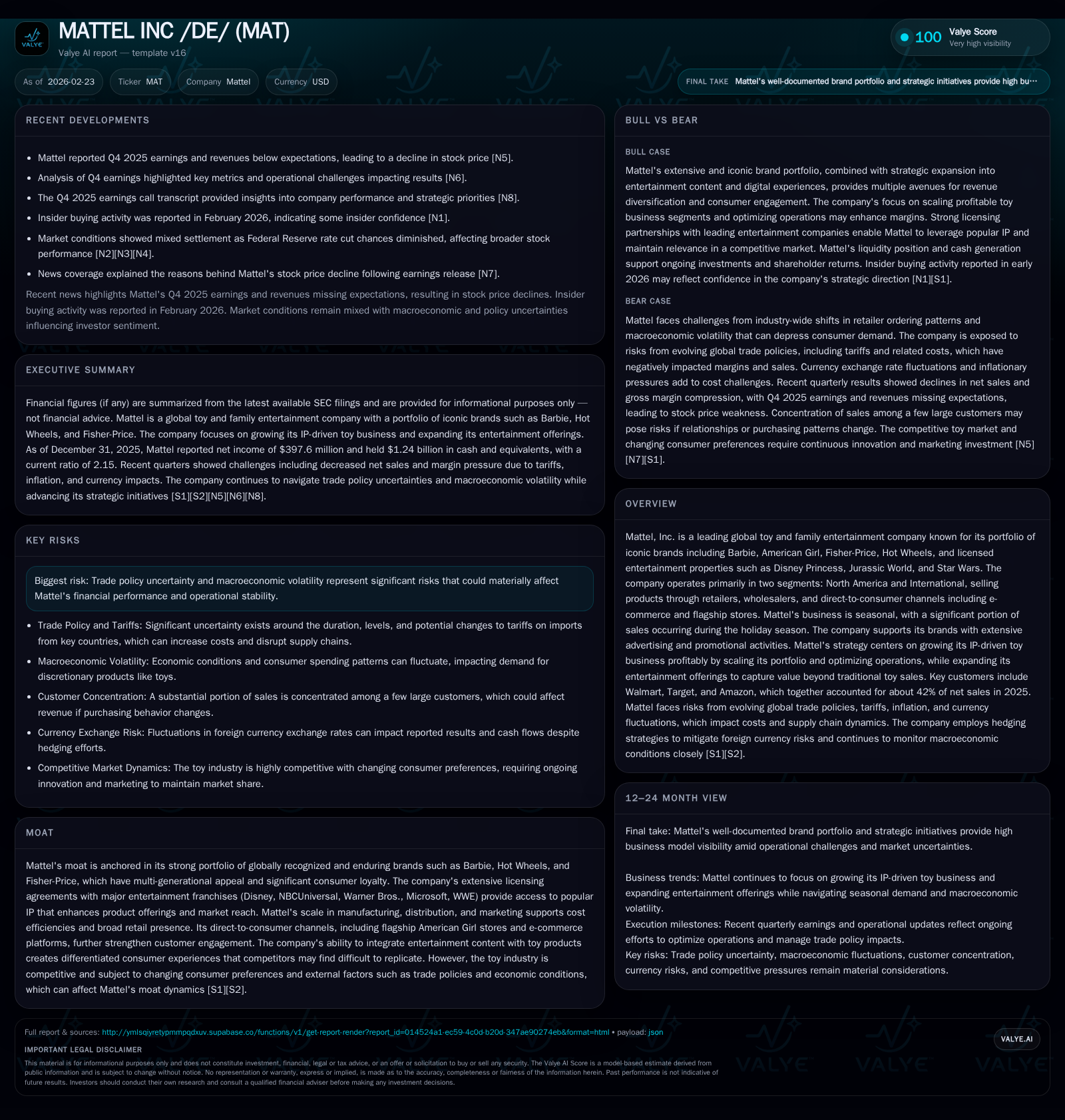
Mattel leverages globally recognized brands like Barbie and Hot Wheels supported by deep licensing ties to major franchises, sustaining multi-generational consumer loyalty. However, fiscal 2025 revealed notable operating income and net income declines driven by cost inflation, seasonality, and supply chain challenges. While the company pursues growth through expanding its entertainment footprint and content monetization, risks linked to trade policies and competitive dynamics remain material. Despite profitability headwinds, aggressive share repurchases underline capital return focus amid limited dividend payouts. Monitoring operational execution of IP-driven initiatives will be critical for 2026 performance outcomes.
Iconic Brands Powering Historical Growth Amid Shifting Consumer Tastes
Historical performance (annual)
| FY | Net ($mm) | CFO ($mm) | OpInc ($mm) | Net YoY |
|---|---|---|---|---|
| 2025 | 398 | 593 | 546 | -26.6% |
| 2024 | 542 | 801 | 694 | +152.8% |
| 2023 | 214 | 870 | 562 | -45.6% |
| 2022 | 394 | 443 | 676 |
Note: Omitted columns lack sufficient annual XBRL coverage in the provided tags (need ≥2 annual points): Rev, Capex, Div, FCF. Source: SEC companyfacts cache [F1].
Capital returns and efficiency (annual)
| FY | Buybacks ($mm) | ROE% |
|---|---|---|
| 2025 | 600 | 17.8 |
| 2024 | 400 | 23.9 |
| 2023 | 203 | 10.0 |
| 2022 | 19.2 |
Source: SEC companyfacts cache [F1].
Mattel's heritage is deeply rooted in a portfolio of iconic brands that have shaped the global toy market for decades. Leading names such as Barbie—the flagship doll line inspiring aspirations since 1959—Hot Wheels with its enduring appeal to collectors and children alike, and Fisher-Price targeting early childhood development comprise its core offerings. Supplemented by licensed properties including Disney Princess, Jurassic World, Star Wars, and partnerships with NBCUniversal, Warner Bros., Microsoft (Minecraft), WWE, among others, Mattel taps into popular culture zeitgeist to drive demand creation across age groups [S2][S22][F1].
The company's distribution model is multichannel: it sells through wholesale channels (retailers like Walmart and Target), direct-to-consumer platforms (e-commerce sites and American Girl flagship stores), alongside international wholesalers and distributors covering Europe, Latin America, Asia-Pacific regions [S4][S5]. This omnipresence supports brand scale while enabling localized marketing strategies adapting to shifting consumer tastes.
Seasonality plays a significant role; most sales occur during the holiday period requiring advance inventory builds early in the year coupled with strategic advertising campaigns peaking around Q4. Mattel allocates nearly 10% of net sales to advertising promotion including digital media, TV commercials, tie-in events—a critical element of sustained franchise brand scaling [S17].
Analyzing 2025 Financial Results: Operating Income and Net Income Pressures
Fiscal year 2025 marked a challenging period financially. Operating income fell sharply by 21.3% year-over-year to $546 million from $694 million in 2024; net income dropped even more steeply by 26.6% to approximately $398 million from $542 million previously [F1][N1][N4]. These declines exceeded consensus expectations and were partly influenced by elevated cost inflation pressures—higher raw material prices and labor costs—as well as increased logistics expenses.
Additionally, Mattel faced seasonal working capital effects consistent with prior years such as build-ups in inventory preceding peak selling season and accounts receivable expansions during Q3-Q4 caused temporary liquidity drainage [S2][S4]. Gross billings—a key non-GAAP indicator reflecting amounts invoiced before trade discounts—suggested softness in certain categories despite overall brand strength.
Cost management initiatives could not fully offset margin contraction given persistent macroeconomic headwinds affecting discretionary consumer spending trends globally [N3]. The interplay between price increases attempted to mitigate inflation impacts versus competitive pricing pressures further squeezed profitability metrics.
Segment Performance and Customer Concentration Risks
Mattel's revenue streams stem primarily from its North America segment which includes both traditional retail channels plus the American Girl direct-to-consumer business with dedicated flagship outlets in major U.S. cities—the latter offering an experiential retail format combining products with lifestyle content [S4][S5]. International operations encompass multiple countries through a mix of direct retail agreements as well as third-party distributor partnerships allowing scale without heavy footprint investments abroad.
Notable is the concentration risk tied to top customers: Walmart ($1.08B), Target ($630M), Amazon ($520M) collectively constituted approximately 42% of worldwide consolidated net sales in 2025 compared to around 44% the prior year [S4][S10]. Such dependency implies that shifts in purchasing patterns or retailer financial health could disproportionately impact Mattel’s topline stability.
Furthermore, license renewals for key franchises remain pivotal; failure to maintain or expand these agreements would materially affect offerings especially within competitive albeit lucrative branded categories like Disney properties or anticipated Nickelodeon franchise launches in later years [S6][S7].
Strategic Growth Drivers: IP Expansion and Entertainment-Oriented Initiatives
Recognizing the evolving landscape where physical toy sales face challenges from digital alternatives and changing consumer preferences, Mattel is actively pivoting toward exploiting its rich intellectual property beyond traditional product manufacturing—a dual-pronged strategy focusing on enlarging franchise brands while accelerating integrated entertainment offerings including digital content creation, live experiences, gaming collaborations, and consumer products extensions [N5][N6][S2][S22].
This transition towards content monetization aims to unlock new revenue verticals where IP serves as currency generating scalable top-line growth less tethered to seasonality than physical toys alone. For example, leveraging Barbie’s storytelling capabilities through streaming series or immersive events fosters higher engagement levels driving ancillary merchandise sales.
However, this strategy carries execution risk notably given the high investments required upfront coupled with uncertainties around consumer adoption rates amid fierce competition spanning traditional toy makers embracing similar moves plus dominant video game publishers who command significant market share [S6]. The company acknowledges that digital gaming/IP synergy remains nascent with potential volatility impacting near-term earnings trajectories.
Key Risks: Supply Chain, Trade Policies, and Competitive Pressures
Mattel confronts multifaceted risks tied closely to supply chain complexity including concentration of manufacturing facilities primarily located across Asia (China, Vietnam, Malaysia) mixed between company-owned plants and third-party contractors. Recent closures of Chinese factories underscore efforts towards cost reduction but amplify risk exposure amid geopolitical tensions or pandemic disruptions raising concerns for production continuity [S9].
Trade policy uncertainty particularly tariffs or new trade restrictions implemented by governments can elevate product input costs unpredictably impairing margins if not offset by pricing or efficiency gains [S6][S8]. Currency fluctuations add further complication on consolidated financial results given Mattel’s broad international sales footprint hedged only partially via forward contracts.
Competition intensifies both from established peers like Hasbro, Lego which historically invest heavily in innovation cycles as well as emergent digital categories pulling discretionary time away from play traditional formats. Incorporation of AI capabilities into toys or interactive experiences raises consumer expectations heightening pressure on Mattel R&D pipelines to innovate rapidly to avoid product obsolescence or loss of market relevance [S22].
Capital Allocation Review: Robust Buybacks Counter Limited Dividend Activity
Evaluating returns on capital deployment reveals a clear preference for share repurchases over dividend distributions. In FY25 Mattel repurchased $600 million worth of common stock up markedly from $400 million in FY24 while no dividends have been paid since prior to the pandemic era bandwidth adjustments (last recorded dividends pre-2019) [F1][S11][S26]. This buyback activity may reflect management’s view on undervaluation driven by recent stock price pressures post earnings misses coupled with a desire to enhance shareholder value via EPS accretion despite profit margin compression.
Return on equity approximated 17.8% in 2025 based on net income relative to stockholders' equity levels indicating moderate efficiency in capital utilization but tempered by profitability dips requiring close monitoring for improvement [F1]. Cash flows from operations declined by roughly 25.9% year-over-year reaching $593 million while capital expenditures were trimmed substantially (-55.6%) signaling tighter investment discipline amidst uncertain demand environment but supporting positive free cash flow generation near $519 million after capex subtraction.
Financial Health Snapshot: Liquidity, Working Capital, and Leverage Metrics
On liquidity metrics Mattel maintains solid footing; the current ratio stood around 2.15 indicating healthy coverage of short-term liabilities via current assets including cash balances exceeding $1.24 billion at fiscal year-end providing a buffer against potential volatility or abrupt operational spend spikes [F1][S13][S20]. Seasonal working capital dynamics however remain salient—inventory builds early in the year combined with accounts receivable expansions toward end-of-year elevate financing requirements cyclically compelling active management.
Long-term leverage metrics are within typical industry ranges though exact debt levels are not fully captured here; ongoing focus on balancing growth investment needs against prudent debt service obligations continues amid rising interest rate backdrops [S16][S18].
What Investors Should Watch in 2026: Earnings Milestones and Strategic Execution
Absent explicit forward guidance within latest filings or news releases investors should focus attention on several key operational benchmarks throughout calendar year 2026:
- Progress metrics on entertainment content launches particularly any material revenue contributions from streaming series or live consumer events tied to flagship IPs,
- Digital gaming partnerships execution progress serving as proof points for successful transformation beyond traditional toys,
- Margin stabilization efforts focused on supply chain optimization combating inflationary pressures,
- Sales trajectory resilience across major customers especially Walmart/Target/Amazon given their outsized impact,
- Working capital turns improvement reflecting smarter inventory management balancing availability against capital intensity,
- Potential announcements regarding licensing renewals/extensions adding certainty around premium franchise access.
These elements embody the tension between pursuit of "blue ocean" growth avenues epitomized by entertainment expansion versus imperative return-to-profitability mandates critical for sustained investor confidence given recent earnings strain narratives reported through early February earnings calls and analyses [N5][N6].
Disclaimer: This analysis is provided solely for informational purposes drawn from publicly filed records and reputable news sources as of February 2026. It does not constitute investment advice or recommendations regarding buying or selling securities of Mattel Inc.; readers should conduct their own due diligence or consult professional advisors before making any financial decisions.
Disclaimer: This is research-only, informational analysis and not investment advice. It may include AI-generated interpretation and general industry context. Always verify important details using primary sources.

Comments