
Methode Electronics Exits Medical Segment and Refocuses on Automotive and Industrial Markets
Fiscal 2026 results show portfolio shifts, supply chain challenges, and sustained engineering efforts amid net losses and solid liquidity.
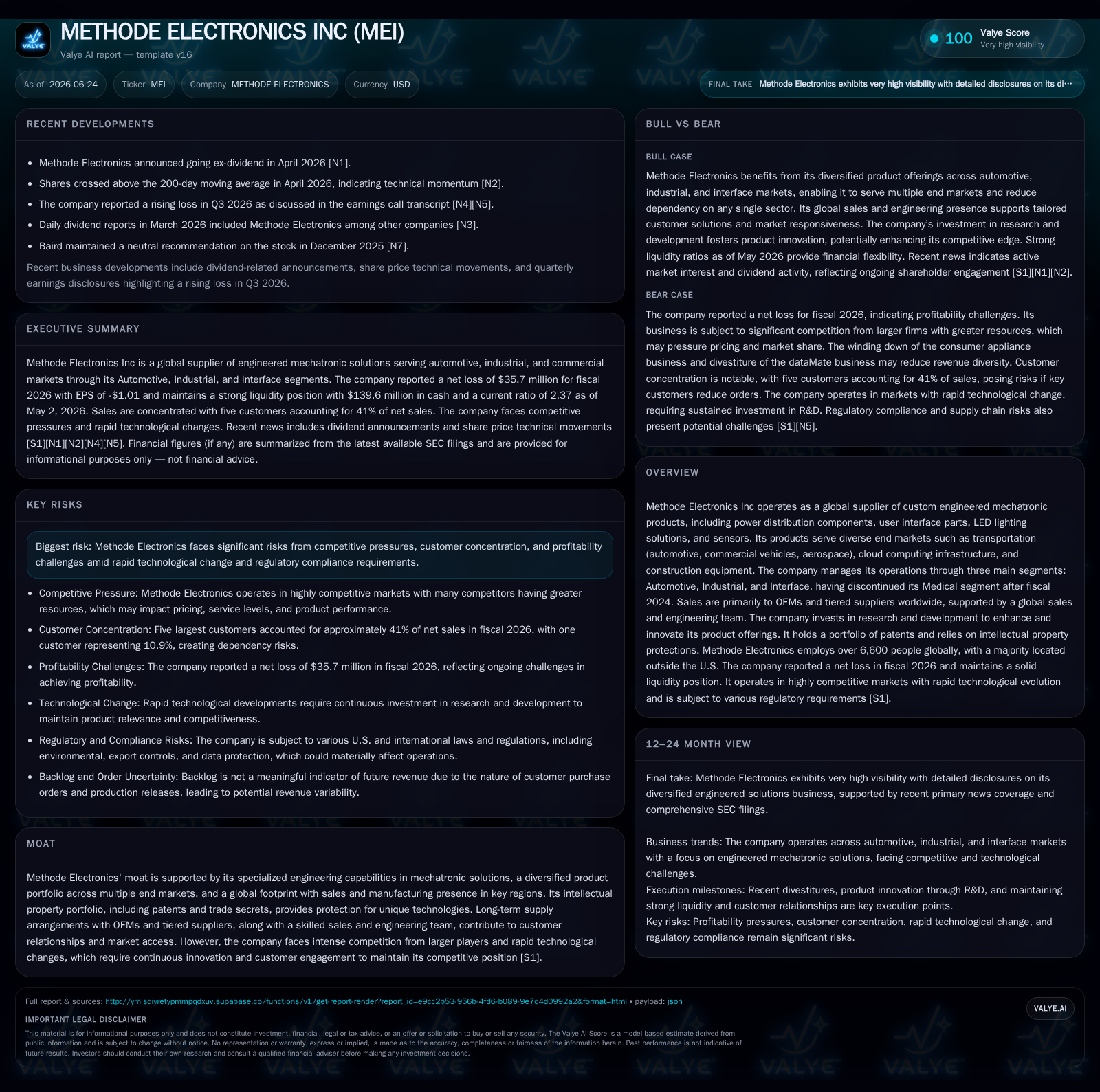
Methode Electronics recently concluded fiscal 2026 with strategic divestitures and ongoing portfolio realignment, notably exiting its Medical segment and divesting parts of its Interface business. The company continues to serve diverse end markets including automotive, industrial, and commercial sectors with custom engineered mechatronic solutions. Key operational themes include responding to evolving automotive electrification trends, managing supply chain complexities, and sustaining innovation through targeted R&D. Despite competitive pressures and customer concentration risks, Methode leverages its engineering capabilities, global footprint, and intellectual property to maintain customer relationships. Its financial position shows positive liquidity but net losses were reported in the latest fiscal year, underscoring execution challenges.
Recent Operating Update
In its latest Form 8-K dated June 24, 2026 [S3][S11], Methode Electronics announced its fourth quarter and full fiscal year 2026 results alongside an important restructuring of its business portfolio. The company completed the exit from its Medical segment following asset divestitures in fiscal 2024 and has now divested the dataMate business within the Interface segment during Q4 FY2026. The consumer appliance sector within Interface is also winding down as programs conclude. These moves have concentrated Methode's focus on two primary reporting segments: Automotive and Industrial [S1][S9].
This operational pivot highlights a strategic realignment toward core strength areas amidst challenging competitive dynamics across sectors. The latest quarter also reinforced that while long-term supply arrangements exist with OEMs—including blanket purchase orders supplemented by production releases—firm backlog remains limited as OEMs retain flexible purchasing options [S6]. This visibility constraint requires cautious operational planning given seasonal production cycles.
Business Model Analysis
Methode Electronics designs, engineers, and manufactures custom mechatronic products targeting OEMs and tiered suppliers across varied markets: transportation (automotive, commercial vehicles, aerospace), cloud computing/data centers, and construction equipment [S1][S8]. The business model hinges on delivering specialized components such as:
- Power distribution solutions encompassing busbars, battery disconnect units, smart connect systems, and integrated circuit boards
- User interface components designed for seamless operator interaction
- LED lighting solutions tailored for efficiency and diverse applications
- Sensor applications providing precise measurement capabilities
Revenues are driven primarily by long-term supply agreements structured around blanket purchase orders complemented by production releases that specify quantities and delivery timing. This arrangement fosters close integration with OEM development cycles but simultaneously subjects revenue to fluctuations based on OEM program schedules.
Engineering capabilities anchor revenue generation with dedicated product application engineers who not only support sales efforts but also identify emerging market needs—fueling innovation pipelines [S7]. The company's geographic footprint spans North America, Europe, Asia, and the Middle East supporting global sales activity.
Industry Structure & Competitive Position
Operating within the industrial mechatronics sector means contending with rapid technological evolution and intense competition from players such as TE Connectivity or Amphenol—firms often larger in scale with broader product portfolios. Methode’s competitive moat stems largely from its engineering specialization in electro-mechanical systems tailored to customer specifications across multiple verticals [S1].
Intellectual property protections guard unique innovations related to force sensing technologies, current sensing elements, lighting products, and radio-frequency devices; however, no single patent holds material sway alone [S8]. Therefore continuous R&D investment is crucial to maintaining technical differentiation amid fierce pricing pressure.
Customer concentration remains a salient risk factor: approximately 41% of consolidated sales derive from just five customers with one accounting for nearly 11% [S6]. Such dependencies necessitate proactive customer relationship management alongside diversification efforts into emerging end markets.
Growth Drivers
Methode’s growth trajectory is influenced by several structural demand vectors:
Automotive Electrification: Increasing complexity in vehicle powertrains underpins demand for power distribution modules like busbars and battery disconnect units customized for electric vehicles.
Industrial Automation & Cloud Infrastructure: Expansion in data center networks drives need for integrated sensor applications and power cabling systems compatible with high-performance environments.
Energy-Efficient Lighting: Adoption of specialty LED lighting in both industrial machinery interiors/exteriors exploits advantages in durability and lower energy consumption.
OEM Outsourcing Trends: Larger OEMs increasingly delegate subsystem development to specialized suppliers like Methode capable of integrating sensors, power electronics, software controls within compact modules.
Innovation pipeline activity supported by R&D expenditure directed toward next-generation sensor suites or advanced materials broadens addressable markets [S4]. Geographic expansion beyond established regions into emerging markets enhances customer reach.
Risks & Constraints
Challenges tempering growth potential include:
Customer Concentration: Heavy reliance on few large OEMs leaves revenue exposed to program cancellations or volume variability.
Rapid Technological Change: Sustaining innovation demands continual R&D investments; failure risks product obsolescence.
Supply Chain Disruptions: Dependence on multiple component suppliers introduces vulnerability to delays or cost escalations impacting production releases.
Regulatory Compliance: Operating globally entails adherence to diverse environmental regulations and export controls which might impose incremental costs.
Competitive Intensity: Larger competitors may exert pricing pressure given superior scale economies or broader market access.
Market Seasonality: Automotive-related volumes fluctuate seasonally affecting segment revenue stability [S6]
What to Watch Next
Key milestones include monitoring:
- Backlog developments or shifts in production release volumes that signal demand momentum particularly in automotive electrification projects.
- New product introductions reflected in R&D disclosures or patent filings highlighting innovative mechatronic integrations.
- Execution progress on Interface segment wind-down alongside any strategic reallocations into higher-growth industrial applications.
- Supply chain lead times and raw material cost trends potentially affecting margin profiles.
- Customer diversification initiatives addressing concentration risks.
- Regulatory or geopolitical developments impacting cross-border operations especially given extensive non-U.S. workforce presence (>93% employees outside U.S.) [S1][S13]
Financial Profile Snapshot (Fiscal Year Ended May 2, 2026)
The company reported operating income of $8.8 million complemented by net losses totaling $35.7 million reflecting restructuring costs or non-operational charges impacting bottom line [F1]. Cash balances stood at approximately $140 million providing short-term liquidity buffers against $325 million total debt resulting in about $185 million net debt after cash offsets. Current assets exceeded current liabilities yielding a solid current ratio near 2.37 indicating comfortable near-term financial flexibility [F1].
This analysis draws exclusively upon the latest Form 8-K updates dated June 24, 2026; accompanying annual Form 10-K disclosures issued same date; quarterly Form 10-Q filed March 5, 2026; along with verified financial snapshot data as of fiscal year-end May 2, 2026. It synthesizes operating developments within Methode Electronics’ targeted industrial mechatronics sector without speculative forecasting or unsupported claims about contract specifics or market shares.
Disclaimer: This is research-only, informational analysis and not investment advice. It may include AI-generated interpretation and general industry context. Always verify important details using primary sources.

Comments