
Meta Platforms Inc: Navigating AI Expansion Amidst Advertising Dominance and Reality Labs Investment
Meta’s strategic pivot towards AI and immersive technologies coexists with robust ad-driven revenue, shaping a complex growth and investment landscape.
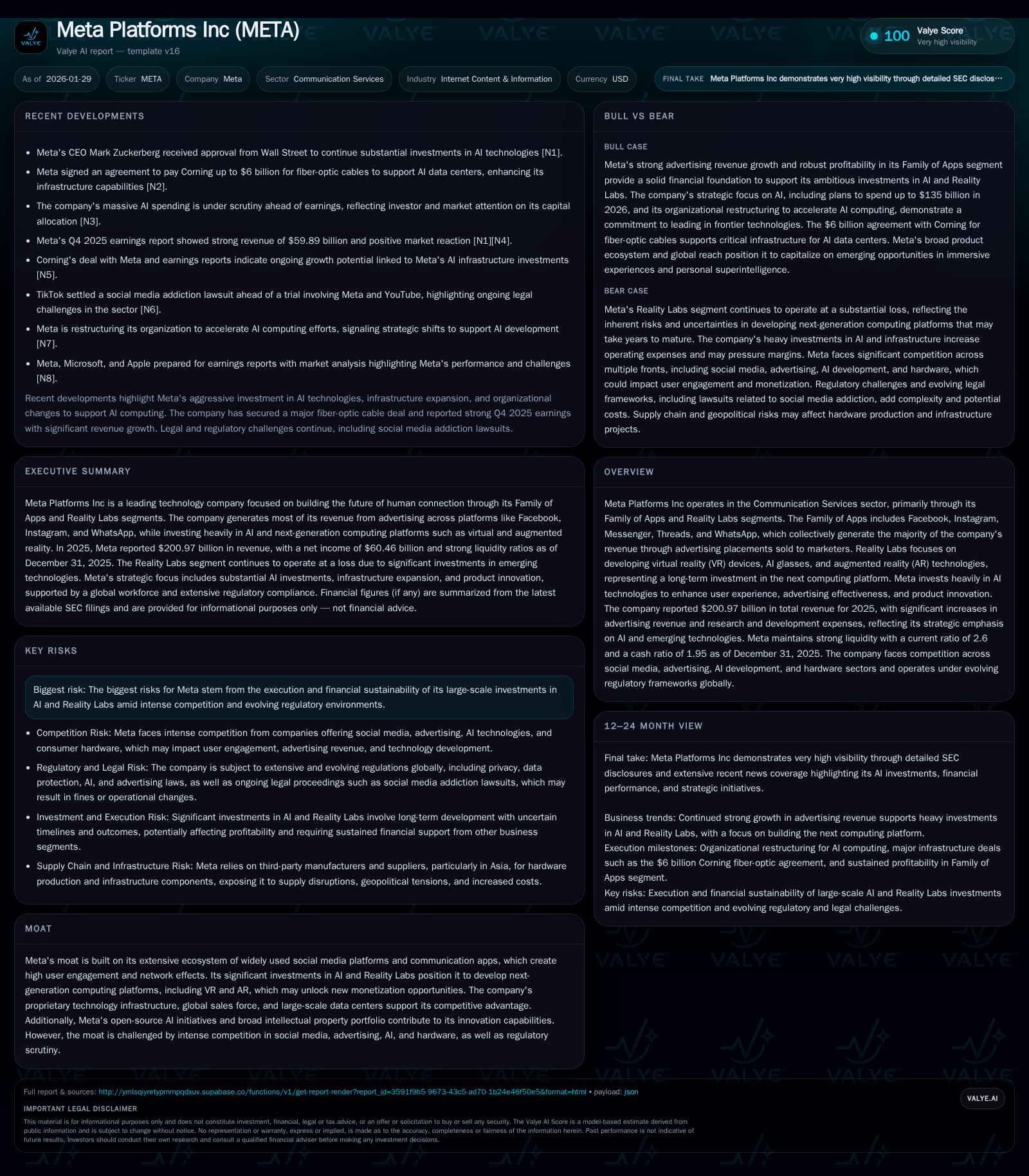
Meta Platforms continues to capitalize on its dominant Family of Apps advertising business while making unprecedented investments in AI infrastructure and Reality Labs’ VR/AR hardware. The company's latest results show revenue and profit growth driven by advertising, supporting aggressive capital expenditures of up to $135 billion in AI build-out in 2026. However, sustained losses in Reality Labs and regulatory challenges underscore significant operational and financial risks. Meta’s competitive positioning hinges on its ecosystem scale, AI innovation, and ability to monetize emerging platforms over the long term.
What changed recently
Meta Platforms reported strong Q4 2025 earnings that beat revenue and earnings expectations, driven primarily by growth in advertising revenue across its Family of Apps. The company emphasized large-scale investments in AI by announcing plans to spend as much as $135 billion on AI infrastructure and capital expenditures during 2026, an aggressive increase from prior years [N3, N13]. This includes contracts such as a $6 billion deal with Corning for fiber-optic cables to support AI data centers [N2, N11, N12]. Meta’s shares climbed following the earnings release, reflecting investor confidence in the sustainability of its core business and potential payoff from AI investments [N3, N4].
While Reality Labs continues to incur substantial losses (approximately $19 billion in 2025), Meta reiterated its commitment to this segment as a long-term initiative to build the next computing platform encompassing virtual and augmented reality devices and AI glasses [S5, S8, S14]. The company also highlighted ongoing product launches and ecosystem development efforts including Meta Quest, Meta Horizon, and AI assistants integrated across apps [S1, S4].
Business model as a system
Meta’s business operates as a tightly integrated system centered on its Family of Apps and Reality Labs segments. The Family of Apps—Facebook, Instagram, Messenger, WhatsApp, and Threads—drive user engagement and generate the majority of revenue through advertising placements. Marketers pay either based on impressions delivered or user actions (clicks, conversions), with pricing varying by ad format and platform. While most revenue is impression-based, Meta continually evolves ad load and format strategies to optimize engagement and monetization [S3].
Other revenue streams include paid messaging services (e.g., WhatsApp), Meta Verified subscriptions, payments fees, and hardware/software sales within Reality Labs. Reality Labs focuses on consumer VR and AR devices, software, and content, which currently operate at a loss but are viewed as strategic investments in the future computing platform [S3, S5].
The company’s large-scale investments in AI encompass infrastructure, data center expansion, AI model development, and integration of AI features across its apps to enhance content relevance, advertising effectiveness, and new product innovation. These AI initiatives also aim for superintelligence capabilities over the long term [S1, S4, S10, S14].
Meta invests heavily in its proprietary technology stack including data centers, networking, and large-scale machine learning infrastructure. Intellectual property protection is maintained through patents, copyrights, trade secrets, and licensing agreements, supporting the development and defense of its technology assets [S1].
Industry map & competitive battlefield
Meta operates at the intersection of social media, digital advertising, AI technology, and immersive hardware. Its primary competitors in social media and digital advertising include other dominant platforms such as Google (Alphabet), TikTok (ByteDance), Twitter (X), and Snapchat, each competing for user attention and advertising dollars. In AI, Meta faces competition from major technology companies investing heavily in frontier AI models, including Microsoft, Google, Amazon, and specialized AI startups [S19, S20].
Reality Labs competes in the nascent but rapidly evolving VR/AR hardware market against firms like Apple, Sony, and emerging startups focusing on wearables, neural interfaces, and spatial computing. Success in this segment depends on product innovation, ecosystem development, developer engagement, and user adoption [S5, S19].
Meta’s advantage lies in its massive user base and ecosystem effects across its Family of Apps, enabling data aggregation and advertising scale unmatched by smaller players. However, it faces pressure from regulatory scrutiny and innovation cycles that may erode user engagement or ad effectiveness. The company’s open-source AI initiatives create both opportunities to lead and risks of losing proprietary control [S20].
Where the economics become real
The core economic engine driving Meta is its advertising business leveraging its large, engaged user base. Key unit economics revolve around the number of ads delivered (impressions), average price per ad, and user engagement. Meta continuously calibrates ad load to optimize revenue without degrading user experience [S3].
AI investments aim to improve ad targeting precision, content recommendation relevance, and advertiser ROI, which could increase willingness to spend and expand total ad inventory monetization. However, these investments require massive capital expenditures, including data center build-out and specialized headcount, which pressure operating margins in the near term [S10, S14].
Reality Labs presents a different economic profile. It currently generates limited revenue from hardware sales (Meta Quest, AI glasses) and related digital content, operating at a substantial loss due to R&D and production costs. The objective is long-term platform creation, unlocking new revenue streams from hardware, software, advertising, and digital goods. Success depends on achieving scale, reducing costs, and establishing monetization models [S5, S8, S14].
Meta’s liquidity position, with $36 billion in cash and cash equivalents and a current ratio of 2.6, provides financial flexibility to sustain large-scale investments and cushion near-term profitability impacts [derived].
Diligence questions / disconfirming signals
- Can Meta sustain advertising revenue growth if macroeconomic headwinds or regulatory changes reduce advertiser budgets or constrain data usage? [S11, S15]
- Will AI investments translate into meaningful improvements in ad effectiveness and user engagement, or will the capital intensity and competitive pressure erode returns? [N1, N7, S10]
- How quickly can Reality Labs reduce losses and establish a self-sustaining hardware/software ecosystem amid strong competition and uncertain consumer adoption? [S5, S14]
- Are there emerging regulatory frameworks around AI and data privacy that could materially increase compliance costs or limit Meta’s business practices? [S15, S16, S17, S18]
- Does the open-source AI strategy risk enabling competitors or reduce Meta’s proprietary advantage? How is Meta balancing openness with IP protection? [S20]
- How resilient is Meta’s user engagement across its Family of Apps in the face of evolving content trends, competitor platforms, and demographic shifts? [S3, S19]
- What operational risks exist in scaling AI infrastructure, including supply chain constraints for specialized hardware and energy consumption? [N11, S20]
Conclusion
Meta Platforms stands at a pivotal juncture, leveraging its entrenched advertising business to bankroll transformative investments in AI and immersive technologies. This dual-track strategy offers significant growth potential but introduces complexity and risk. The company’s success will depend on its ability to sustain advertising momentum, execute on capital-intensive AI infrastructure build-out, and realize long-term returns from Reality Labs, all while navigating an increasingly challenging regulatory environment. Meta’s massive ecosystem, talent base, and technical infrastructure provide competitive moats, but the rapidly evolving landscape demands continued innovation and operational discipline.
This analysis is based on publicly available news and company disclosures as of January 2026 and does not constitute investment advice.
Disclaimer: This is research-only, informational analysis and not investment advice. It may include AI-generated interpretation and general industry context. Always verify important details using primary sources.

Comments