
McKinley Acquisition Corp’s Early Stage: Capital Readiness and Strategic Focus on Progressive Industries
A Cayman Islands-registered blank check company with $150 million raised, poised to acquire high-growth enterprises in innovation-driven sectors.
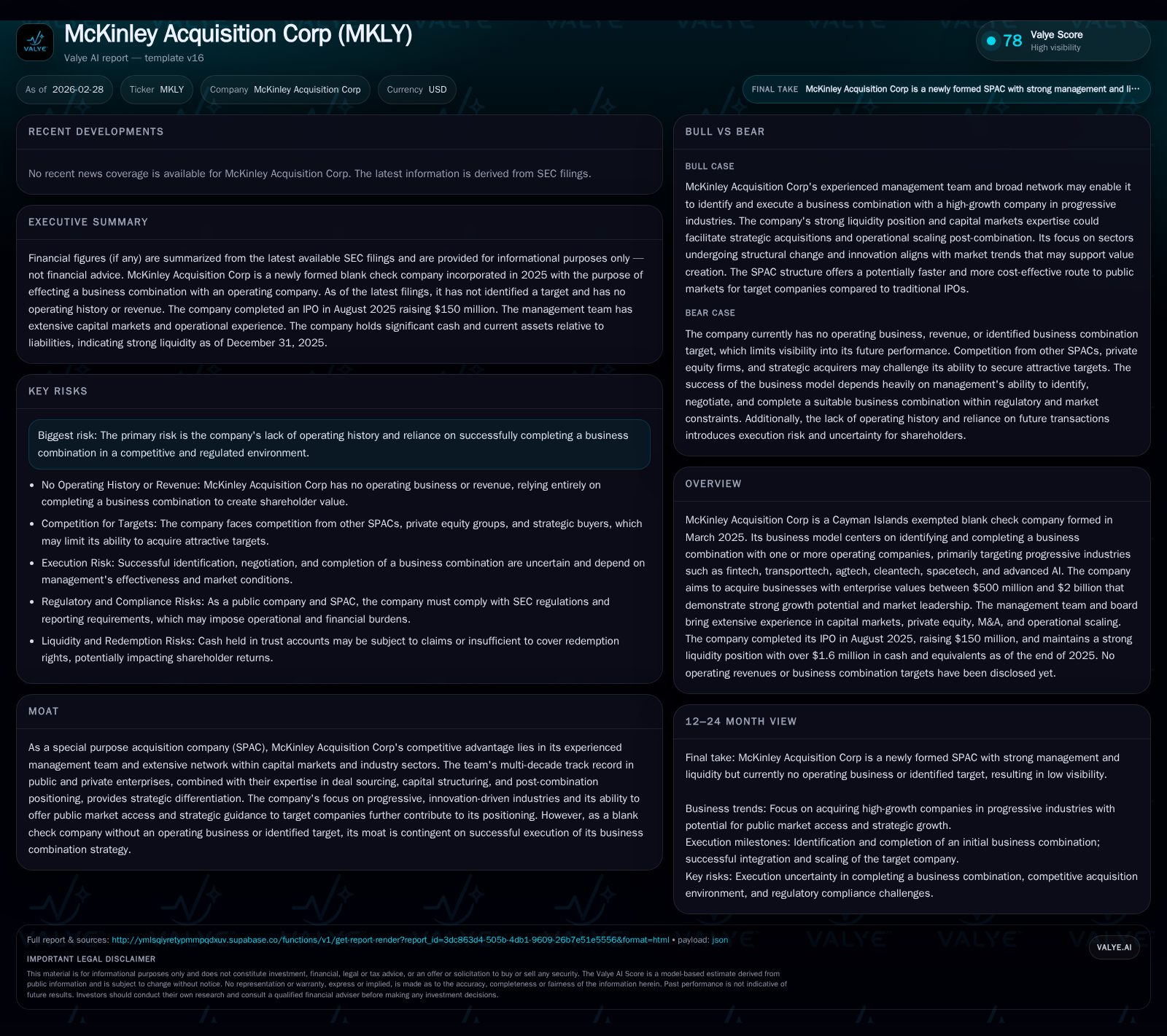
McKinley Acquisition Corp, formed in March 2025, launched its IPO in August 2025 raising $150 million. As a SPAC, it currently holds no operating revenues or business combination targets but focuses on identifying companies valued between $500 million and $2 billion in fintech, transporttech, agtech, cleantech, spacetech, and advanced AI. The management team's deep capital markets and M&A expertise underpins a strategy emphasizing high-growth potential firms ready for public market transition. Liquidity remains strong with over $1.6 million in cash as of end-2025. Execution risk centers on successful deal sourcing in a competitive environment.
Company Overview
McKinley Acquisition Corp (MKLY) was established in March 2025 as a Cayman Islands exempted blank check company formed to facilitate one or more mergers or acquisitions primarily targeting progressive industries. It conducted its initial public offering (IPO) in August 2025, successfully raising $150 million of gross proceeds. As is typical of newly formed SPACs at this stage, the company has yet to generate operating revenues or identify specific business combination targets.
The founders and management team bring senior leadership experience across investment banking, private equity, financial restructuring, and operational scaling [S1][S6]. Their strategy leverages this expertise to identify companies valued between $500 million and $2 billion that operate within sectors undergoing technological innovation and structural transformation such as financial technology (fintech), transport technology (transporttech), agricultural technology (agtech), clean energy technology (cleantech), space technology (spacetech), and advanced artificial intelligence solutions [S10].
Historical Performance
Given its formation timeline and nature as a blank check entity, McKinley’s standalone financial history is limited. It reported no revenues for the period ending December 31, 2025. Operating expenses primarily reflect administrative costs related to being a public company post-IPO. The company recorded an operating loss of approximately $615 thousand but reported positive net income close to $2 million for the same period due predominantly to non-operating items related to financing activities [F1].
By year-end 2025, cash and cash equivalents stood at roughly $1.66 million outside the trust account dedicated for potential redemptions or business combination funding—indicating solid liquidity for operational needs while awaiting deployment of the majority funds raised via IPO into an acquisition [F1][S7]. Current liabilities were minimal relative to current assets leading to a robust current ratio near 20x.
Historical performance (annual)
| FY |
|---|
| 2025 |
Source: SEC companyfacts cache [F1].
Table: McKinley Acquisition Corp selected financials for FY2025 showing early-stage balance sheet strength.
Future Growth Prospects
As a SPAC without current operations beyond general corporate management functions, McKinley's growth prospects depend entirely on successfully identifying and closing an initial business combination with one or more target companies aligned with its thematic focus. The firm actively screens approximately 150 prospective targets initially narrowing to fewer than three candidates for advanced negotiations per their outlined diligence funnel [S21].
The primary growth lever is acquiring a high-growth enterprise positioned at an inflection point featuring accelerating profitability potential, scalable platform characteristics, sound capital structures improving weighted average cost of capital by potentially 150–320 basis points post-transaction, and identifiable near-term milestones such as product launches or strategic partnerships [S10][S21]. Targets ideally command sizeable total addressable markets exceeding $1 billion with revenue streams between $75 million and $350 million annually.
Potential constraints include competition from other SPACs and private equity groups pursuing similar deals within progressive sectors alongside regulatory hurdles impacting deal structuring or shareholder approval processes [S18][S27]. Moreover, if shareholders opt extensively for redemption at combination time reducing available cash proceeds below expectations, consummating transactions may be impaired [S15][S19].
Forecasts and Milestones to Watch
McKinley has not publicly announced explicit milestones beyond its IPO completion or forecasted financial metrics subsequent to business combination closing given the absence of a finalized transaction as of early 2026. Key events investors should monitor include:
- Announcement of definitive agreements with target companies aligned with stated industrial verticals.
- Shareholder votes relating to approval of proposed initial business combinations.
- Redemption activity levels among public shareholders which may impact available cash resources.
- Securing additional financing—potentially through private placements or debt issuance—to supplement transaction funding if necessary.
- Progress towards regulatory compliance measures needed for public entity governance following merger completion.
Such developments will signal trajectory towards operational status beyond blank check status.
Returns and Capital Allocation
Operating returns data are not meaningful at this juncture since MKLY generates no operational cash flows until it completes its inaugural business combination. The reported net income primarily reflects accounting effects rather than ongoing profitability [F1].
The company does not pay dividends nor conduct share repurchases prior to closing an acquisition given absence of distributions from operations or free cash flow generation. Capital allocation decisions revolve around preserving sufficient funds for transaction execution while managing administrative expense burdens conservatively.
Its capital structure is straightforward: equity raised from IPO held predominantly in trust accounts committed solely for target acquisition funding or redemption purposes should no deal be consummated [S7][S15][S28]. Sponsor shares known as founder shares align interests but do not influence interim liquidity significantly.
Competitive Positioning and Moat Analysis
McKinley's edge within the crowded SPAC space derives principally from the depth of experience among its leadership team across public-private market dynamics and their established industry networks offering differentiated access to proprietary deal pipelines [S6][S21]. This is critical since many deals compete heavily among institutional acquirers demanding nuanced sector knowledge coupled with transactional agility.
Their focused thematic concentration on progressive sectors exposed to secular innovation trends meets popular investor interest areas enhancing funding prospects post-business combination. Furthermore, management emphasizes structured integration support including public company readiness infrastructure which can be critical in sustaining market valuation expansion after going public via SPAC merger [S6][S21].
However, like all blank check companies pre-combination, McKinley’s moat is conditional; it fully depends on executing these strategies effectively amidst rising competition from better-capitalized peers who may limit available quality targets [S18].
Risk Factors Summary
Key risks delineated stem from intrinsic blank check entity traits:
- No operating history limits visibility into sustainable profit generation capacity pre-merger.
- Reliance on completing an initial business combination within prescribed SEC timelines; failure results in liquidation with return likely near IPO price adjusted by certain costs [S4][S15][S27].
- Intense competition for attractive acquisition targets plus volatile capital market conditions affecting valuation windows.
- Potential liabilities arising from disputes over trust account funds used either in redemptions or fees exposing sponsors/shareholders.
- Regulatory compliance challenges if targeted businesses require extensive internal control enhancements prior to public listing per Sarbanes-Oxley requirements [S16].
These highlight the execution-centric nature of McKinley’s risk profile common across recent-generation SPAC vehicles.
Conclusion Analysis
While McKinley Acquisition Corp remains at an embryonic stage with no revenue-producing operations nor consummated acquisitions as of early 2026, it stands equipped with significant capital raised through its IPO alongside experienced leadership adept at navigating complex deal-making scenarios within promising technological sectors. The firm’s deliberate focus on sizable growth-stage companies in innovation-heavy verticals aligns well with prevailing investor appetites for scalable disruptive business models that can benefit greatly from U.S. public market access.
Nonetheless, much rests upon timely identification of appropriate targets amid stiff competition along with favorable shareholder response permitting adequate deployment of trust account assets into accretive combinations—a non-trivial hurdle given recent historical volatility in SPAC markets broadly. Monitoring upcoming disclosures regarding target announcements and transaction progress will be essential to appraise whether McKinley can translate latent potential into realized growth through effective execution.
Disclaimer: This analysis is provided solely for informational purposes based on SEC filings dated February 27, 2026 (Form 10-K), company-provided data as well as regulatory disclosures aligned with reporting periods ended December 31, 2025. It does not constitute investment advice or recommendations.
Disclaimer: This is research-only, informational analysis and not investment advice. It may include AI-generated interpretation and general industry context. Always verify important details using primary sources.

Comments