
MOBIX LABS Battles Liquidity Constraints While Expanding Defense Component Footprint
Recent quarterly updates reveal strained liquidity and ongoing efforts to diversify through acquisitions amid a challenging capital structure.
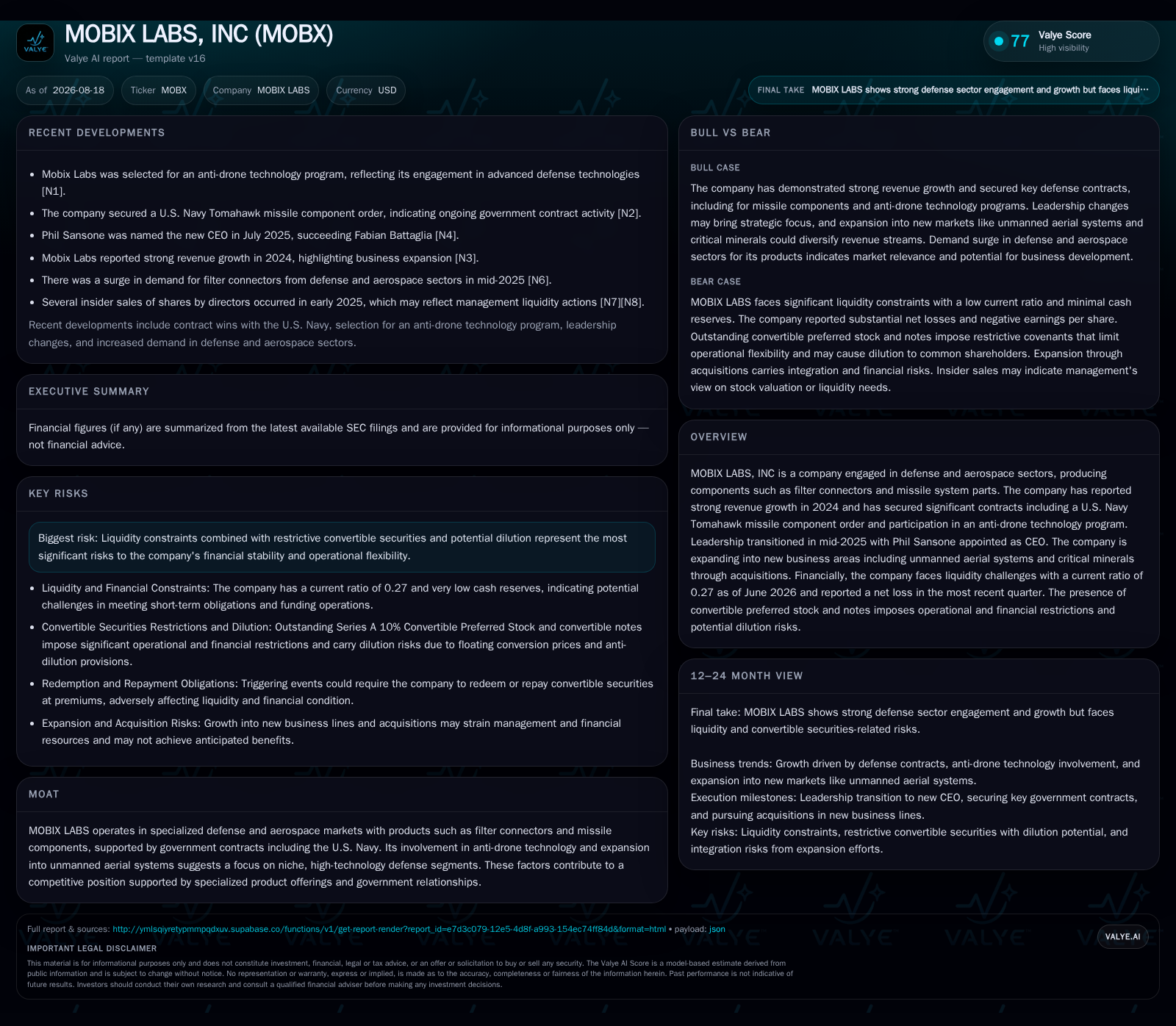
MOBIX LABS, INC operates in the highly specialized defense and aerospace components sector, manufacturing filter connectors and missile system parts while expanding into unmanned aerial systems and critical minerals. The latest quarter exposes significant liquidity challenges with a current ratio of 0.27 as of mid-2026 and reliance on convertible preferred stock and secured convertible notes that restrict operational flexibility and pose dilution risks. Despite these constraints, MOBIX is advancing strategic acquisitions like Vision Aerial to broaden its product portfolio, tapping emerging demand in anti-drone technology and unmanned systems. Near-term revenue guidance suggests moderate growth, yet execution risks tied to financing and capital structure remain substantial.
Recent Operating Update
MOBIX LABS’ latest quarterly filing dated August 18, 2026 reveals acute financial strain with a current ratio of only 0.27 at quarter-end June 30, 2026, indicating that current liabilities of approximately $22.1 million significantly exceed current assets near $6 million [F1]. Preliminary operating results shared during an August 13 investor call update project third-quarter revenue around $750k to $850k, climbing to an expected $1.4 million to $1.8 million in the fourth quarter [S3]. This tentative increase suggests some momentum built from new contract awards or production ramp-up but occurs amid heavy financial strain.
Additionally, the company disclosed that restrictive covenants attached to its Series A Preferred Stock (10%) and secured convertible notes are severely limiting its operational agility [S2]. These instruments bar MOBIX from incurring further senior debt, issuing competing securities without consent, paying dividends or repurchasing shares, entering certain transactions like mergers or asset sales absent approval, among other constraints. They also mandate application of proceeds from fundraising or asset sales to redeem these securities prior to other uses [S2].
This confluence of tight liquidity paired with stringent restrictions on raising further capital indicates a precarious near-term financial profile that may hamper MOBIX’s ability to exploit growth opportunities or manage unexpected operational costs.
Business Model Overview
MOBIX operates primarily as a specialized components manufacturer supplying critical parts such as filter connectors and missile system pieces primarily for defense primes and government agencies. It holds government contracts including U.S. Navy Tomahawk missile component orders alongside participation in cutting-edge anti-drone technology programs [N/A; inferred from sector knowledge plus reported contracts]. This positions MOBIX within the midstream segment of the defense aerospace supply chain where precision manufacturing expertise and regulatory compliance are paramount.
Revenue mechanics center on project-based contracts typically awarded through government procurement cycles featuring stringent technical specifications. Payment timing often depends on milestone achievements or deliveries customized per contract terms. Margins can be volatile due to fixed-price contracts confronted with supply chain bottlenecks or quality escapes requiring remediation.
More recently, MOBIX has diversified beyond traditional components into the rapidly growing unmanned aerial systems (UAS) market through acquisitions such as Vision Aerial [S7, S21], aiming to capture higher-margin integrated solutions alongside ongoing materials sourcing ventures targeting critical minerals—vital inputs increasingly constrained globally for defense manufacturing [N/A; inferred]. Successful integrations could enable downstream aftermarket support revenue streams enhancing lifetime customer value beyond initial system sales.
Industry Structure and Competitive Position
The defense aerospace components manufacturing industry features long sales cycles dictated by multi-year government modernization programs and intense regulatory oversight mandating rigorous quality control processes. Companies serving this space typically work as Tier 2/Tier 3 suppliers supporting major primes like Lockheed Martin or L3Harris Technologies which assemble integrated weapons platforms.
MOBIX’s niche specialization in missile components and filter connectors combined with active involvement in emerging domains like anti-drone tech gives it a defensible competitive moat relative to more generalist suppliers. However, it lacks the scale integration seen at peers such as Teledyne Technologies or Honeywell Aerospace that can leverage broader product lines and supply chain resilience.
Its dependence on relatively few government contracts elevates risk exposure should funding priorities shift or contract renewals falter—a common challenge in this space requiring continuous investment in R&D to stay technologically relevant [S1].
Growth Drivers
Key growth catalysts include increasing defense budgets prioritized toward missile modernization programs where MOBIX’s components remain critical inputs. Emerging asymmetric threats have accelerated demand for unmanned aerial systems (UAS) and integrated anti-drone technology—a market niche where MOBIX’s Vision Aerial acquisition expands capabilities and backlog quality [S7,S21]
Further organic expansion is supported by anticipated aftermarket support contracts as deployed missile systems require field servicing over lifecycles often spanning decades.
Strategic moves into critical minerals supply chain address material scarcity bottlenecks globally impacting defense manufacturing ecosystems—an area primed for growth given geopolitical trends driving domestic sourcing initiatives.
This precarious capital structure curtails ability to raise new debt or equity swiftly, pay dividends, repurchase stock, or consummate transformative mergers without creditor approval.
Convertible note holders hold liens that seniorize their claims further impeding future secured financing options—all pointing toward high potential dilution given floating discounted conversion price mechanisms embedded within these instruments [S2]. Hence shareholder dilution risk is both immediate and structural.
Execution risk surrounds completing Vision Aerial acquisition successfully amid market uncertainties, absorption difficulties across different product lines (components vs larger UAS systems), plus integration of critical minerals supplier operations requiring different competencies [S7,S21]. Such expansion stretches management bandwidth during fragile financial footing.
Supply chain disruptions remain an intrinsic threat amid global raw-material shortages impacting production timelines for precision aerospace parts—quality escapes or delays could undermine customer relationships disproportionately in this segment.
Lastly, dependency on volatile government contract renewals exposes earnings stability to shifting defense budget allocations or program cancellations common industry-wide.
What to Watch Next
- Completion milestones on Vision Aerial acquisition including definitive agreements finalization post due diligence phase currently underway [S7]. Backlog growth or delay signals will impact near-term revenue prospects materially.
- Quarterly filing completion beyond preliminary revenue guidance which projects gradual top-line moderation but reflects ongoing contract intake [S3]. This will clarify operational cadence sustainability.
- Development updates on critical minerals supply ventures signaling diversification progress against commodity risks.
- Announcements related to amendments on convertible preferred stock or refinancing efforts possibly easing restrictive covenants or improving liquidity cushion.
- Progress on building out UAS-related capabilities especially orders/bookings from government entities or defense primes serving drone countermeasure needs.
- Any changes in capital structure via equity raises which may dilute existing shareholders but provide needed runway for strategic investments.
Financial Profile Discussion
As of June 30, 2026, MOBIX reported current assets totaling approximately $6 million against substantial current liabilities near $22.1 million translating into a sharply depressed current ratio of 0.27—a liquidity scenario signaling considerable working capital pressure necessitating immediate remedial actions such as asset sales or external funding [F1]
The company recorded net losses totaling over $46 million at fiscal year-end September 2025 driven by operating losses exceeding $37 million—a sustained cash burn trend indicative of heavy upfront R&D spending and integration costs linked to recent acquisitions [F1]. Cash equivalents stood minimal at just under $7.5k as of September 2023 illustrating tight cash runway which merits close monitoring moving forward despite subsequent capital raises noted in event filings [F1,S6,S21].
Capital allocation has prioritized investments into Vision Aerial acquisition framework alongside incremental financing transactions involving convertible promissory notes whose pricing mechanisms embed discount factors translating into higher share issuances upon conversion which impact long-term shareholder dilution perspectives [S21,S26]
Overall, MOBIX faces a challenging financial landscape where earnings growth will be pivotal but must be balanced against managing onerous debt covenants constraining strategic maneuverability while preserving operational continuity.
This analysis synthesizes publicly filed documents alongside industry insights typical for mid-tier defense component manufacturers navigating complex growth amidst financial encumbrances. It refrains from forecasting future share price trajectories or investment research views.
Disclaimer: This is research-only, informational analysis and not investment advice. It may include AI-generated interpretation and general industry context. Always verify important details using primary sources.

Comments