
MP Materials Corp. Grows U.S. Rare Earth Vertical Integration While Operating at a Loss
MP Materials expands domestic rare earth magnet manufacturing amid ongoing capital intensity and operating losses.
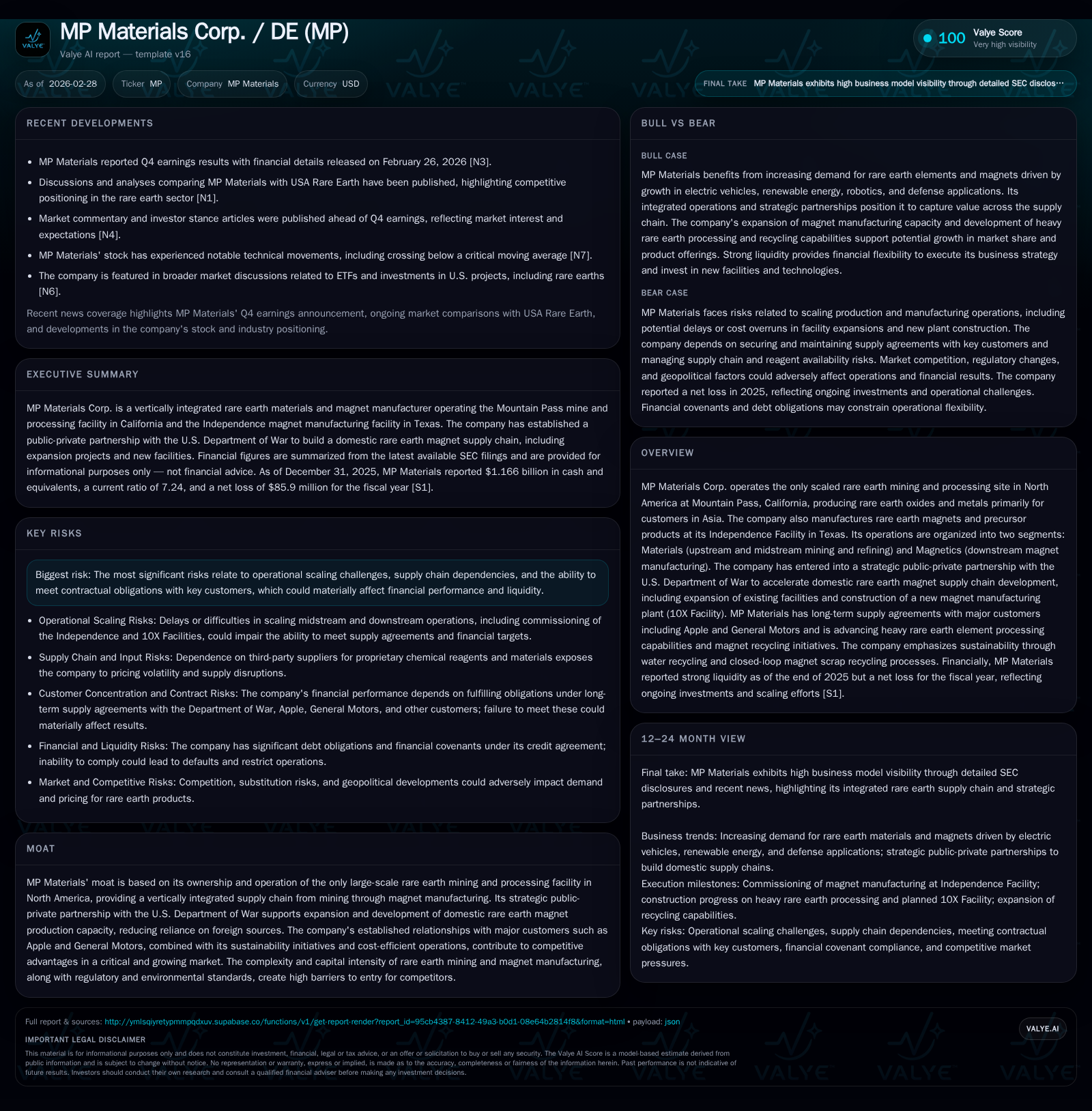
MP Materials Corp. is the sole scaled North American rare earth mining and processing operator, integrating upstream mining at Mountain Pass with downstream magnet manufacturing in Texas. The company has moved aggressively into magnet production since late 2025, supported by a strategic partnership with the U.S. Department of War that includes facility expansions and a $140 million EBITDA-guaranteed new plant—the 10X Facility. Despite these advancements and longstanding supply agreements with major customers such as Apple and General Motors, MP Materials has incurred operating losses and negative free cash flow as it invests heavily in capacity and vertical integration. Key risks include operational scaling challenges and reliance on government contracts, but the company’s strategic positioning and sustainability initiatives present strong competitive barriers in a market dominated globally by Chinese producers.
Company Overview
MP Materials Corp., headquartered in Las Vegas, Nevada, commands a unique position as the largest producer of rare earth materials in the Western Hemisphere. Its flagship asset is the Mountain Pass Rare Earth Mine and Processing Facility situated near Mountain Pass, California—the only rare earth operation of scale on the continent. Complementing this is the Independence Facility in Fort Worth, Texas, producing magnetic precursor products and commencing neodymium-iron-boron (NdFeB) permanent magnet manufacturing in late 2025 [S1][S12].
The company's operations are segmented into two reportable parts: Materials (upstream mining and refining) and Magnetics (downstream alloying and magnet manufacturing). The Materials segment focuses on producing refined rare earth oxides (notably neodymium-praseodymium oxide or NdPr) which historically were largely sold into Asian markets through intermediary distributors but recently shifted focus due to strategic realignment [S12][S5].
Historical Performance & Growth Drivers
Between 2022 and 2025 MP experienced significant volatility in its financial performance amidst its rapid expansion phase:
Historical performance (annual)
| FY | Net ($mm) | CFO ($mm) | OpInc ($mm) | Capex ($mm) | Net YoY |
|---|---|---|---|---|---|
| 2025 | -86 | -156 | -149 | 172 | -31.3% |
| 2024 | -65 | 13 | -169 | 186 | -369.2% |
| 2023 | 24 | 63 | -18 | 262 | -91.6% |
| 2022 | 289 | 344 | 327 | 327 |
Source: SEC companyfacts cache [F1].
Capital returns and efficiency (annual)
| FY | Buybacks ($mm) | FCF ($mm) | ROE% |
|---|---|---|---|
| 2025 | 0 | -328 | -4.3 |
| 2024 | 225 | -173 | -6.2 |
| 2023 | -199 | 1.8 | |
| 2022 | 17 | 22.0 |
Source: SEC companyfacts cache [F1].
Note: Revenue data available only for FY2021 ($331.95 million), post which detailed figures are less explicit [F1]
The decline from operating profitability in 2022 to growing operating losses through 2024-25 aligns with tremendous capital deployment toward building out midstream separation capacity at Mountain Pass and initiating domestic magnet production at Independence [S11][S12]. Notably:
- Operating loss deepened to $149M in 2025 reflecting increasing costs from scaling operations.
- Free cash flow turned sharply negative (-$328M), driven by capex near $172M amidst expansion initiatives.
- The company ceased buybacks post-2024 repurchases as liquidity prioritized growth investment.
- Cash balances remain robust over $1.16 billion supporting funding needs.
Future Prospects & Growth Catalysts
The company’s future growth trajectory hinges on several critical factors:
- Continued ramp-up of midstream processing capability at Mountain Pass aiming for higher throughput with improved cost efficiencies.
- Expansion of magnetics production underway following December 2025 commencement of NdFeB permanent magnet manufacturing at Independence Facility.
- Construction start on the new "10X Facility," announced under a transformative public-private partnership with the U.S. Department of War (DoW), designed to produce at least $140 million EBITDA annually with guaranteed offtake rights [S1][S26].
- Extension of heavy rare earth element refining capabilities targeting samarium oxide crucial for diverse defense and industrial applications.
- Development of rare earth recycling capabilities for post-industrial/end-of-life magnets to create circular supply chains enhancing sustainability profiles [S26][S9].
- Ongoing long-term supply agreements with strategic customers like Apple for magnets and General Motors for precursor products provide revenue visibility [S11].
Yet several constraints warrant attention:
- Operational scale-up risks remain substantial given novel manufacturing processes requiring precise metallurgical control.
- Dependence on proprietary chemical reagents exposed to price volatility threatens cost control unless alternative sourcing or onsite chlor-alkali facility recommissioning proceeds successfully [S14].
- Regulatory scrutiny on environmental remediation is acute owing to legacy contamination at Mountain Pass necessitating ongoing groundwater treatment obligations [S25].
- Supply chain logistics risks persist particularly around container shipping congestion in Southern California ports impacting export cycles [S21].
- Geopolitical trade tensions reinforce need for diversified markets but could disrupt global demand dynamics [S28].
Capital Allocation & Financial Health
As of December 31, 2025 MP reported strong liquidity with roughly $1.16 billion in cash and equivalents against current liabilities near $299 million yielding a solid current ratio (~7.24), underpinning its ability to fund capital-intensive expansion [F1]. However:
- Operating losses persisted at about $149 million reducing near-term profitability prospects.
- Negative operating cash flow of approximately $156 million reflects ongoing startup costs across segments.
- Capital expenditures remain high ($172 million), though down from prior years indicating gradual moderation but still heavy investment phases.
- No share repurchases were executed during recent fiscal year contrasting with previous buyback programs [F1].
- Return on equity is negative (~ -4.3%) consistent with reinvestment during growth cycle.
Debt structure includes revolving credit facilities with covenant thresholds tied to leverage ratios and cash interest coverage that management must carefully navigate to avoid default risk [S4][S27]. The behavioral complexities of convertible notes with capped call options introduce additional financial contingencies [S27].
Strategic Moat & Competitive Positioning
MP Materials enjoys a pronounced moat anchored by being North America's sole large-scale vertically integrated rare earth producer spanning mining through finished magnets—a capability not replicated domestically since decades ago. This vertical integration reduces dependence on foreign sources traditionally dominated by Chinese incumbents who hold oligopolistic control over global rare earth supply chains via integrated quotas and extensive refining infrastructure [S18][S23].
Additional competitive strengths include:
- Close proximity of Mountain Pass's integrated processing footprint enhances logistics efficiency relative to disaggregated competitors.
- The dry tailings approach minimizes environmental exposure versus wet tailings ponds standard elsewhere supporting regulatory compliance while reducing water consumption dramatically (~95% water recycling) [S9][S19].
- Strategic partnerships enabled by DoW support facility expansions plus guaranteed minimum earnings broaden de-risking versus purely commercial ventures [S26][S15], though impose operational performance covenants.
- Long-term high-profile customers such as Apple and GM underpin demand visibility and foster adoption of domestically sourced magnets aligned with U.S. industrial policy [S11].
Nonetheless competitors remain formidable globally given state-sponsored capacities in China bolstered by lower labor/environmental costs—requiring MP's continued technological advancement and efficiency improvements to compete effectively on cost basis [S18][S23]. Industry consolidation pressures also bear watching.
Risks & Challenges Summary
A measured appreciation of key risk vectors includes:
- Scaling new magnet manufacturing plants entails technology execution risks; delays or underperformance could affect contractual deliverables risking penalties or revenue loss [S20].
- Supply chain complexity especially reliance on specialized reagents exposes margin pressure potential from possible shortages or cost jumps [S14].
- Regulatory compliance burden especially environmental remediation liability from legacy contamination remains material long-term cost considerations impacting operational flexibility [S25].
- Geopolitical developments like tariffs or export controls introducing uncertainties affecting cost structures or market access dynamics [S28][S16].
- Intellectual property defense costs relating to patent protection or trade secrets risks may impose legal expenses or competitor encroachments dampening innovation rents [S22][S20].
- Dependence on government partnerships implicates risks associated with policy reversals or contract performance expectations that may be difficult to meet amid changing political landscapes or operational setbacks [S15].
What To Watch Going Forward (Analysis)
Absent explicit forward guidance or financial milestones beyond existing contractual disclosures [N1][N3], investor focus should track:
- Production ramp metrics from both upstream separation facilities at Mountain Pass and downstream magnet fabrication output rates at Independence plus progress on construction milestones for the forthcoming 10X plant.
- Cost per unit trends for NdPr oxide production signaling margin improvement potential alongside reagent procurement strategies including chlor-alkali facility recommissioning results.
- Contract fulfillment updates particularly regarding DoW public-private partnership commitments plus any extension or renewal terms with major industrial customers like Apple or GM.
- Environmental audit results or new regulatory developments impacting operational permits or liability provisions.
- Industry competitive shifts including any moves by China-backed groups leveraging quota adjustments potentially impacting global pricing dynamics.
Closing Observations
MP Materials stands at the nexus of redefining U.S.-based rare earth critical materials independence through its singular domestic mining asset coupled with expanding downstream technology-enabled manufacturing capabilities. While still traversing an investment-heavy phase exemplified by persistent losses and negative free cash flow as recently reported for fiscal year ending December 2025 [F1], its strategic alliances with key U.S. defense entities ensure an enhanced role within national security-driven supply chains.
The company's scalable growth depends crucially on technological execution success across multiple high-capital projects carrying inherent uncertainties reflective of complex metallurgy combined with emerging process innovation demands typical within this sector. Keeping close watch on incremental operational outputs tied back into contractual earnings benchmarks will be critical alongside monitoring evolving environmental/regulatory frameworks that weigh heavily given historic site conditions at Mountain Pass.
Although challenged by entrenched global incumbents with scale advantages supported by differing regulatory regimes abroad—especially China’s consolidated rare earth oligopoly—MP’s integrated western hemisphere positioning supported by sustainability-focused process design differentiates it significantly within this vital industrial ecosystem poised for electrification-driven demand growth worldwide.
This analysis is based solely on publicly available SEC filings up to February 28th 2026 ([F1],[S1–29]) and related news coverage ([N1–14]). It does not constitute investment advice.
Disclaimer: This is research-only, informational analysis and not investment advice. It may include AI-generated interpretation and general industry context. Always verify important details using primary sources.

Comments