
Sensus Healthcare’s Revenue Contraction and Innovation Push Shape 2025 Performance
Sensus Healthcare confronts regulatory rigor and competitive pressures while enhancing its proprietary SRT technology and service model.
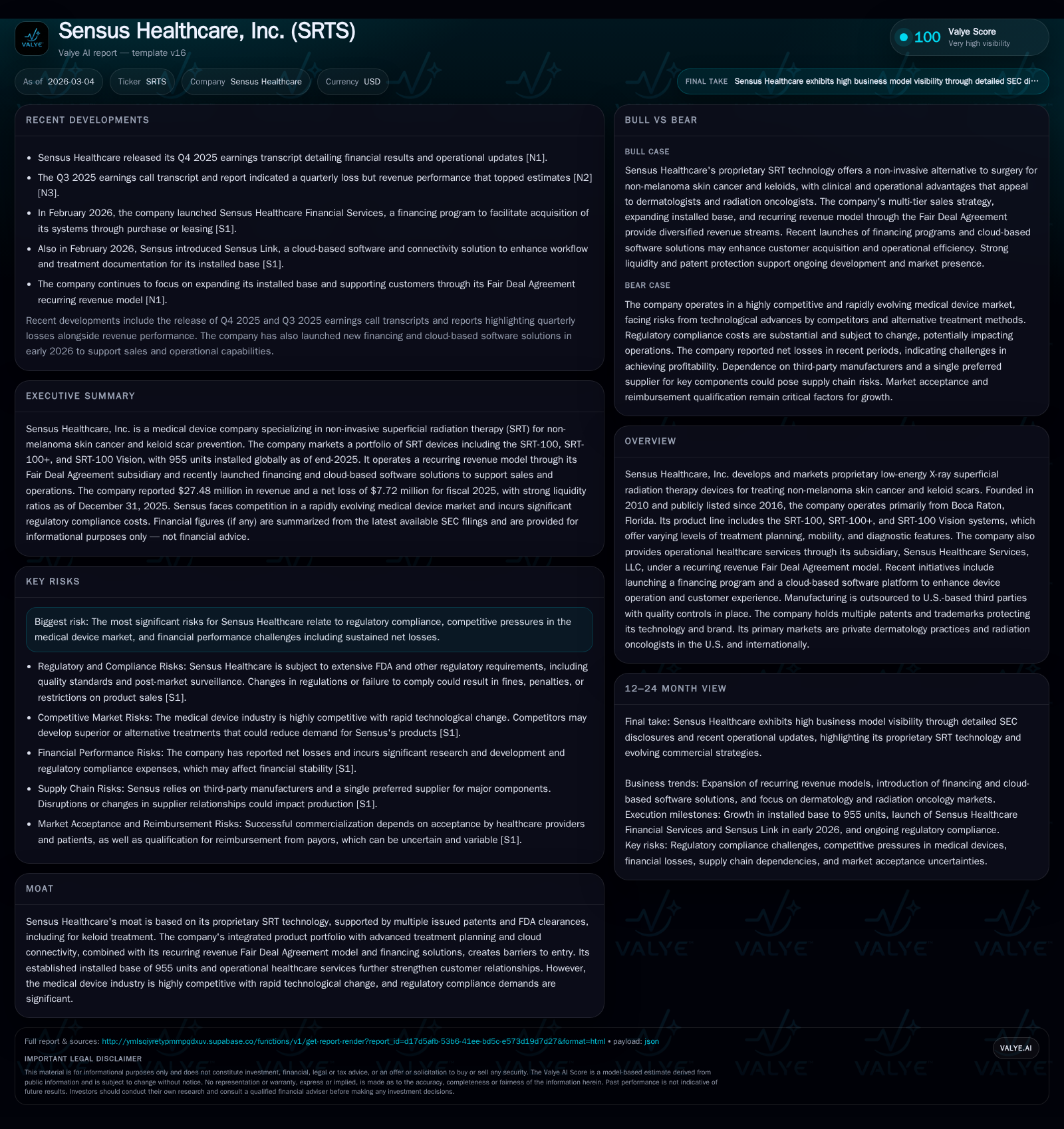
In 2025, Sensus Healthcare, Inc. experienced a significant revenue decline of over 34%, reversing the prior year’s growth, with operating losses widening substantially. The company’s core superficial radiation therapy (SRT) devices serve niche dermatological and oncology markets by offering non-invasive alternatives for non-melanoma skin cancer and keloid treatment. Amid this contraction, Sensus pushed innovation through a new financing program and cloud-based software platform to improve device accessibility and customer workflow. Regulatory compliance costs rose notably, reflecting intensified FDA scrutiny and complex healthcare fraud and privacy laws. Despite financial pressures, the company maintains strong liquidity and modest positive operating cash flow, with ongoing R&D investment aiming to sustain competitive advantage.
Company Overview and Core Technology
Sensus Healthcare, Inc., headquartered in Boca Raton, Florida, specializes in developing proprietary low-energy X-ray superficial radiation therapy (SRT) devices dedicated primarily to treating non-melanoma skin cancers (NMSC) and keloid scars [S1][S17]. The company's flagship products—the SRT-100, SRT-100+, and SRT-100 Vision systems—offer clinicians varying degrees of treatment planning sophistication, mobility enhancements, and integrated diagnostic capabilities including embedded high-frequency ultrasound imaging for volumetric tumor analysis [S6][S21]. Since inception in 2010 with an IPO listing in 2016, the firm has deployed approximately 955 units globally as of December 31, 2025 across 21 countries [S1][F1]. These devices enable dermatologists to retain patients by providing non-surgical alternatives that avoid invasive procedures such as grafting and anesthesia usage [S1]. Radiation oncologists benefit by off-loading simpler lesions traditionally treated on linear accelerators.
Historical Financial Performance
The company experienced volatile revenue and income trends over the past four fiscal years (FY), influenced by shifts in reimbursement policies notably around CPT code revisions that directly impact billing practices for SRT treatments [S20].
Historical performance (annual)
| FY | Rev ($mm) | Net ($mm) | CFO ($mm) | OpInc ($mm) | Rev YoY | Net YoY |
|---|---|---|---|---|---|---|
| 2025 | 27 | -8 | 1 | -10 | -34.3% | -216.1% |
| 2024 | 42 | 7 | -1 | 8 | +71.3% | +1270.5% |
| 2023 | 24 | 0 | -2 | 0 | -45.2% | -98.0% |
| 2022 | 45 | 24 | -1 | 15 |
Source: SEC companyfacts cache [F1].
Capital returns and efficiency (annual)
| FY | Buybacks ($mm) | FCF ($mm) | ROE% |
|---|---|---|---|
| 2025 | 0 | 0 | -16.0 |
| 2024 | 0 | -1 | 11.9 |
| 2023 | 0 | -2 | 1.0 |
| 2022 | 3 | -2 | 50.4 |
Source: SEC companyfacts cache [F1].
Revenue soared in FY2024 due partly to customers delaying purchases awaiting new CPT codes effective January 2026 but fell sharply back in FY2025 as this anticipation normalized [S20][N1]. Operating income swung dramatically from profitability in FY2024 (+$8m) to sizable losses (-$10m) in FY2025.
Despite operating losses in FY2025, the company generated positive operating cash flow of $528k driven partly by improved working capital management amid reduced revenue [F1]. Capital expenditures remained modest at $196k.
Business Model: Products and Recurring Revenues
Sensus' competitive moat is firmly anchored on its patented proprietary SRT technology with multiple FDA clearances as Class II devices requiring premarket notification per regulatory mandates [S6][S25]. This technology underpins its medical devices that address sensitive oncologic skin lesions with better patient outcomes relative to surgery or conventional radiation.
Alongside outright device sales managed directly or through international distributors lies the Fair Deal Agreement model launched via its wholly owned subsidiary since early 2024 [S1]. Under this recurring revenue arrangement, the Company supplies equipment plus radiation oncology oversight and technologist services onsite in exchange for a percentage of collected reimbursements—effectively shifting some capital outlay burdens from the customer while ensuring ongoing income for Sensus [S1][S9].
Early February 2026 marked further expansion of commercial toolkit with the launch of Sensus Healthcare Financial Services—a financing partnership enabling flexible leasing or purchase options through third-party banks—which aims to boost system acquisition conversion rates especially among independent dermatology clinics wary of upfront costs [S9][N1]. Concurrently, the rollout of Sensus Link software integrates cloud-enabled advanced workflows, documentation automation, remote diagnostics monitoring, and operational intelligence features historically exclusive to high-end oncology workstations [S19]. This cloud platform should amplify recurring service revenues while enhancing installed base utilization.
Market Focus and Growth Opportunities
Primary end markets remain private dermatology practices treating NMSC patients who can be managed entirely within these settings without referral to surgical centers or radiation oncology clinics [S10][S17]. Radiation oncologists also represent a channel seeking efficient lesion management techniques that maximize linear accelerator availability.
Emerging plastic surgery and aesthetic laser sectors represent secondary avenues leveraging FDA clearance for keloid treatment through SRT technology—these growing segments could diversify revenue streams beyond oncology use cases [S12][S17]. However, intensity of competition from alternate therapies such as Mohs surgery, topical agents, or emerging biologics may constrain rapid market share gains.
Regulatory Environment & Compliance Costs
Operating within stringent biomedical device regulations exposes Sensus to complex federal laws encompassing FDA device clearance/monitoring requirements including post-market surveillance; CMS reimbursement policy by CPT/LCD rules affecting procedure coverage; HIPAA patient data privacy standards; False Claims Act implications; anti-kickback statutes; and international product compliance regimes under EU MDR or Medical Device Single Audit Program certifications [S4][S6][S11][S18][S20].
The company acknowledged sharp increase in regulatory compliance expenditures totaling $3.4 million for FY2025 reflecting intensified inspection cycles alongside investments in cybersecurity risk governance led by an experienced CTO supported by a forming governance committee overseeing risk mitigation controls [S1][S4]. These compliance outlays are material headwinds particularly given relatively narrow scale of operations.
Intellectual Property Protection
A robust patent portfolio secures the technology foundation vital for differentiation against incumbent or emerging competitors [S16][S26]. Key recent patents cover hybrid ultrasound guidance integration improving precise tumor visualization during treatment—a significant clinical advantage extending protection into late-2030s horizon [S16]. Trademark registrations fortify brand integrity essential for B2B customer retention.
Protection extends beyond patents relying on secrecy protocols including employee invention assignment agreements ensuring continuity of innovation stewardship amidst competitive pressure.
Capital Allocation & Balance Sheet Positioning
Financial discipline amid loss-making results is evidenced by limited but consistent share repurchase activity ($300k total buybacks FY2025 versus $27k-$3m prior years) indicating some confidence in stock valuation despite broader fiscal challenges [F1].
Liquidity remains robust with $22 million cash reserves supporting operational needs plus strong current ratio near 9.7x alleviating short-term solvency concerns even amid cyclical revenue pressure [F1]. Capital expenditures have been modest aligning with outsourced manufacturing strategy relying on U.S.-based partners such as RbM Services who provide scalable supply without heavy fixed asset investment commitments [S12].
Given the persistent trajectory of net losses (-$7.7 million FY2025), return on equity presently runs negative around -16%, confirming earnings stress though mitigated partially by positive operating cash flows signaling underlying operational cash generation capability absent investing or financing activities [F1].
Outlook Considerations & Monitoring Signals (Analysis)
No explicit forward guidance is provided beyond official filings; however key indicators warrant close observation:
- Growth trajectory post-implementation of financing program indicating whether upfront acquisition barriers diminish leading to more robust system placements,
- Uptake rates of Sensus Link cloud platform impacting stickiness and breadth of recurring Fair Deal Agreement revenues,
- Regulatory environment developments potentially affecting cost structure or product market access especially regarding evolving CMS coding adjustments or international regulation enforcement,
- Competitive dynamics including potential new entrants deploying alternative technologies or more aggressive pricing strategies,
- Research & Development expenditure direction given expectations that spend will decline substantially from near $7.8 million peak levels recorded in FY2025 which might affect future innovation cadence [S18],
- Legal/compliance issues especially relating to healthcare fraud investigations given pervasive industry enforcement trends.
In aggregate these factors combine technological promise with financial volatility typical of early-stage medical device innovators.
Disclaimer: This is research-only, informational analysis and not investment advice. It may include AI-generated interpretation and general industry context. Always verify important details using primary sources.

Comments