
Marathon Petroleum’s Refining and Midstream Scale Offsets Supply Constraints and Regulatory Risks
MPC’s large integrated asset base supports resilient earnings and significant shareholder returns despite industry volatility.
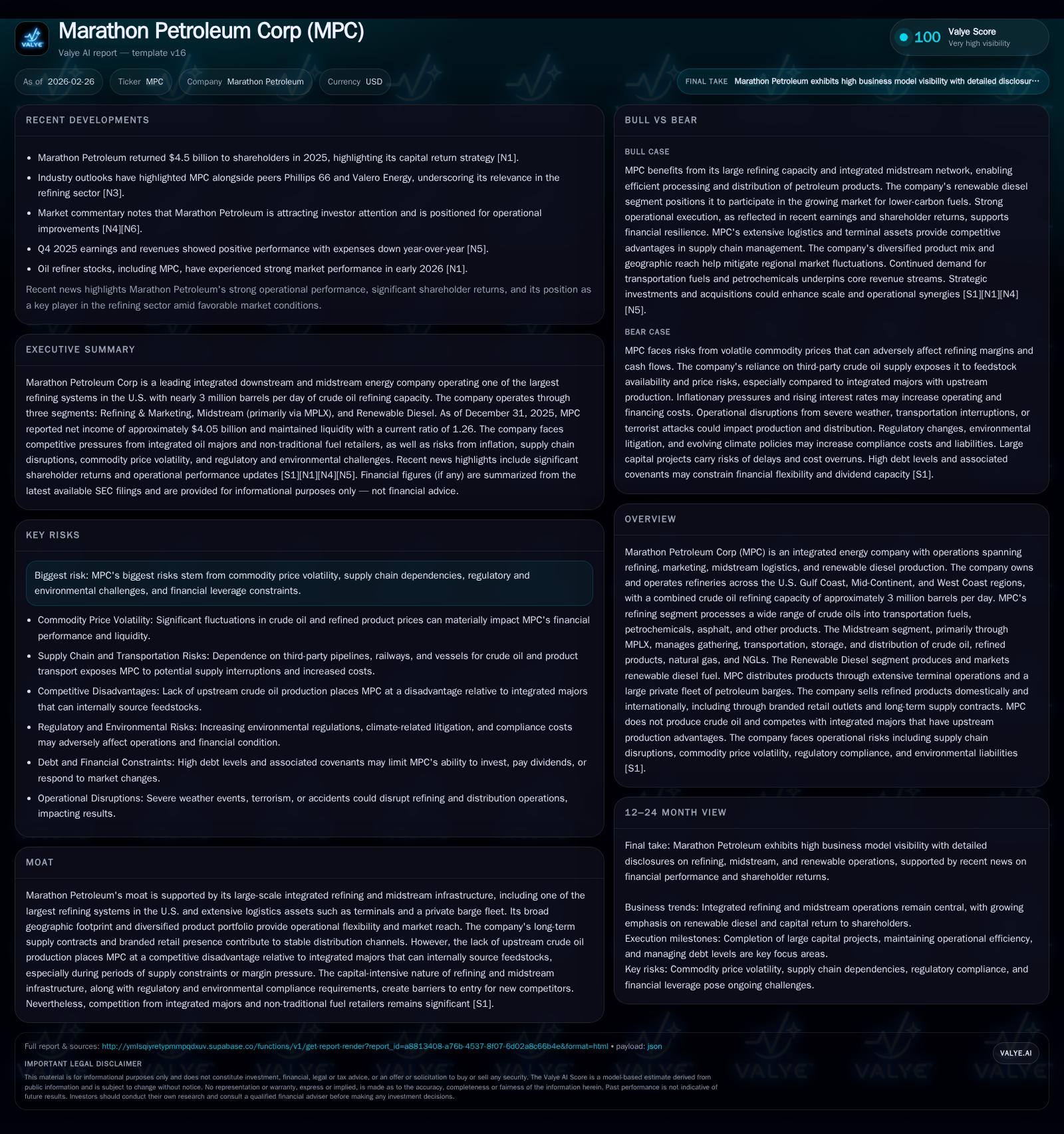
Marathon Petroleum Corporation operates a vast refining network with nearly 3 million barrels per day capacity, complemented by midstream logistics through MPLX and renewable diesel production. Its 2025 financials show a rebound in operating income and net income after multi-year fluctuations, driven by operational efficiency gains and downstream product mix optimization. The company faces headwinds from feedstock sourcing vulnerabilities, regulatory pressures including California's refining mandates, and environmental litigation risks. Capital allocation remains shareholder-friendly with robust cash flow fueling dividends and buybacks.
Company Overview
Marathon Petroleum Corporation (MPC) is one of the largest integrated downstream energy companies in the United States with a rich history dating back nearly 140 years [S7]. Its operations span three core segments: Refining & Marketing, Midstream (primarily through MPLX), and Renewable Diesel production [S1].
The company operates a substantial refinery system spread across three main geographic regions — the Gulf Coast, Mid-Continent, and West Coast — with an aggregate crude oil refining capacity approaching 3 million barrels per day (mbpd) [S13]. These refineries convert a broad range of crude oils into gasoline, distillates (diesel/jet fuel), petrochemicals, asphalt, heavy fuel oil, propane, and other products used domestically and exported internationally [S15].
MPC’s midstream assets are controlled mainly through MPLX LP (64% owned by MPC), formed as an MLP in 2012 to manage gathering, transportation, storage, fractionation of hydrocarbons including natural gas liquids (NGLs), refined product distribution logistics including terminals and its private barge fleet [S12][S16].
The Renewable Diesel segment reflects MPC's strategic position in low-carbon fuels, producing renewable diesel from sustainable feedstocks supplied to both domestic customers under long-term contracts and spot market buyers [S1]. Distribution leverage is enhanced by MPC’s terminal operations and extensive shipping assets.
Historical Financial Performance
Over the last several years ending 2025, MPC exhibited revenue growth from $17.2 billion in 2016 to a peak over $31 billion by 2019 but saw some volatility thereafter reflecting market cycles and operational changes [F1]. Revenue slightly declined by approximately 3.8% year-over-year from 2024 to 2025; however, operating income improved robustly by about 22%, increasing to $8.29 billion in FY2025 from $6.80 billion in FY2024. Net income followed suit ascending roughly 17.5% to $4.05 billion [F1].
Operating cash flow showed some compression (-4.8% YoY) to $8.25 billion while capital expenditures rose significantly (+37%) in FY2025 to $3.49 billion as MPC advanced maintenance turnarounds and capacity upgrade projects especially in renewables [F1]. Equity declined year-over-year reflecting share repurchases alongside net income retention.
This pattern highlights earnings resilience bolstered by improved margin management despite modest topline pressure — consistent with industry exposure to volatile commodity prices affecting sales volume values but offset by optimized product mix and cost controls.
Historical performance (annual)
| FY | Net ($bn) | CFO ($bn) | OpInc ($bn) | Capex ($bn) | Net YoY |
|---|---|---|---|---|---|
| 2025 | 4.0 | 8.3 | 8.3 | 3.5 | +17.5% |
| 2024 | 3.4 | 8.7 | 6.8 | 2.5 | -64.4% |
| 2023 | 9.7 | 14.1 | 14.5 | 1.9 | -33.3% |
| 2022 | 14.5 | 16.4 | 21.5 | 2.4 |
Source: SEC companyfacts cache [F1].
Capital returns and efficiency (annual)
| FY | Div ($mm) | Buybacks ($bn) | FCF ($bn) |
|---|---|---|---|
| 2025 | 1140 | 3.5 | 4.8 |
| 2024 | 1154 | 9.2 | 6.1 |
| 2023 | 1261 | 11.6 | 12.2 |
| 2022 | 1279 | 11.9 | 13.9 |
Source: SEC companyfacts cache [F1].
Note: Revenue values for recent years are only fully available through FY2019 [F1], operating results reflect continuing operations post-Spinoff/Sale adjustments.
Past Growth Drivers
MPC’s past growth has been catalyzed largely by:
- Scale Expansion: Strategic acquisitions such as Andeavor in 2018 expanded geographic reach particularly on the West Coast and midcontinent markets adding refining throughput capacity and integrating supply chains for improved margins [S1][S13].
- Operational Integration: Leveraging pipeline connectivity between refineries to shuffle intermediate streams for optimal yield maximization; conducting planned maintenance turnarounds to assure reliability while capturing margin opportunities via blending strategies.
- Midstream Synergies: MPLX acquisition strategy enhancing control over feedstock logistics reduced dependency on third parties while introducing fee-based revenue streams from gathering/treating natural gas/NGLs [S12].
- Renewables Pivot: Early investments into renewable diesel processing positioned MPC ahead of peers responding to increasing government mandates for cleaner transportation fuels.
Future Growth Prospects
Growth Catalysts
- Expansion of Renewable Diesel Production: Increasing renewable diesel refinery capacity through both organic expansions and potential acquisitions could enable MPC to capitalize on tightening low-carbon fuel standards across multiple states including California where CARB-compliant fuels dominate [N2][S1][S16].
- Midstream Infrastructure Development: MPLX continues organic growth projects linking more shale plays with demand regions via pipelines and fractionation plants critical for sustaining volumes; increased NGL market participation also offers upside [S16].
- Refinery Yield Optimization: Continuous improvements in process technology adoption (e.g., hydrocracking upgrades), crude slate diversification pursuing heavier/sour feeds could enhance overall margins.
- Export Market Growth: Leveraging deepwater terminals to boost refined product exports especially distillates into overseas markets could supplement U.S.-based demand moderation effects.
Growth Constraints/Risks
- Feedstock Supply Dependency: Unlike fully integrated majors with upstream production arms, MPC relies entirely on market-sourced crude oil that exposes it to supply tightness or price spikes undermining refining margins during volatile periods [S5][S8].
- Regulatory Headwinds: State-level regulations such as California's SB X1-2 impose operational constraints including turnaround scheduling limits, mandatory inventory requirements, gross margin caps which could increase operating costs or reduce flexibility [S11][S14].
- Environmental Litigation Exposure: Growing litigation risk centered around climate-related claims including alleged false disclosure practices alongside emerging pollutant concerns (PFAS) may compel costly remediation or operational adjustments affecting profitability [S23][S26].
- Labor Relations Uncertainty: Collective bargaining agreements covering roughly half the workforce are due for renewal within the next couple of years; any protracted disputes or wage inflation could disrupt refinery throughput or increase cost structures significantly [S9].
- Financial Leverage Concerns: Total consolidated debt stands at $33+ billion inclusive of MPLX obligations; elevated leverage poses refinancing risks amid interest rate uncertainty potentially constricting capital raising or dividend policies [S10][F1].
Forecasts / Milestones / Expectations
Recent disclosures indicate improved earnings performance exceeding analyst estimates for Q4/25 due primarily to margin expansion coupled with disciplined expense management [N2][N3]. No formal forward guidance was issued explicitly in latest filings but ongoing investments into renewable diesel capacity expansions are expected milestones within the next two years given public statements confirming capex increases targeting low-carbon businesses [N6][S21].
Market watchers should track:
- Progress on renewable diesel capacity additions especially new biorefinery commissioning timelines.
- Regulatory developments impacting California refinery operations including implementation details of SB X1-2 enforcement.
- MPLX project announcements expanding pipeline/fractionation throughput.
- Crude oil price trends influencing refinery throughput economics.
Returns / Capital Allocation
MPC has demonstrated a strong commitment to returning capital despite cyclical headwinds:
- In FY2025 the company returned approximately $4.6 billion through dividends ($1.14 billion) plus share repurchases ($3.49 billion), representing a sizable portion of free cash flow (~$4.77 billion after capex) [F1][N6].
- Dividend payments have remained steady with slight variability reflecting cash flow dynamics.
- Significant buyback volumes reflect management focus on prudent capital deployment amidst evolving energy market conditions.
- Return on equity implied near ~23% driven by resilient net income relative to equity base despite contraction since prior peaks due partly to buybacks lowering equity balances [F1].
These actions suggest balanced capital stewardship enabling continued investment alongside shareholder returns.
Industry Context Analysis (Not Company-Specific)
The downstream/refining sector in North America contends with structural shifts including electrification trends reducing gasoline demand medium term; however refined product exports remain a bright spot recently bolstered by international supply gaps due to geopolitical tensions abroad pushing U.S.-origin fuel shipments higher considerably. Also impacting refiners are increasingly stringent emissions rules forcing upgrades toward ultra-low sulfur fuels complemented by incentives favoring renewables like biodiesel/renewable diesel thus encouraging strategic pivot moves such as MPC’s segment emphasis. Integrated majors enjoy feedstock procurement advantages missing at pure downstream operators yet refiners have utilized logistical scale economies plus asset interconnections creatively mitigating some disadvantages.
Risks Summary
Key risks faced by Marathon Petroleum include commodity price cyclicality affecting refining margins; regulatory complexity heightening compliance costs especially with rapid climate-policy changes; ongoing legal liabilities tied to environmental claims; labor union negotiations introducing operational risk; supply chain disruptions especially dependency on third-party producers for crude inputs which can create bottlenecks during tight markets; exposure to interest rate fluctuations raising debt servicing costs given substantial leverage; geopolitical uncertainties impacting export dynamics.[S4][S6][S17][S20]
Conclusion
Marathon Petroleum commands an influential downstream presence bolstered by integrated midstream logistics and early stakes in renewable diesel production positioning it advantageously amid an evolving energy landscape characterized by decarbonization pressures and shifting demand profiles. While exposures tied to feedstock sourcing absence of upstream reserves persist along with regulatory constraints notably inducive at the California level plus rising ESG-related litigation threats, resilient operating results underpin strong shareholder returns evidenced by sizeable dividends and buybacks funded from healthy cash flows. Growth prospects hinge on successfully executing renewables expansion plans, sustaining throughput via integration synergies across refining hubs, prudent financial management amidst leveraged balance sheet concerns plus navigating emerging regulatory regimes shaping future compliance costs. Stakeholders should weigh these fundamentals alongside macroeconomic influences shaping commodity production and consumption outlooks when monitoring MPC's trajectory going forward.
This analysis is based solely on publicly available information as of February 26, 2026 from regulatory filings ([F1],[S#]) and news sources ([N#]). It does not constitute investment advice or recommendations but aims to provide a detailed understanding of Marathon Petroleum Corporation’s business profile, historical performance trends, strategic context, growth outlooks, risk factors and financial stewardship practices within the broader energy sector framework.
Disclaimer: This is research-only, informational analysis and not investment advice. It may include AI-generated interpretation and general industry context. Always verify important details using primary sources.

Comments