
Marker Therapeutics Advances MAR-T Cell Trials While Facing Funding Horizon into Early 2027
Latest quarterly results highlight clinical progress in T-cell immunotherapies alongside ongoing cash burn and capital raise considerations.
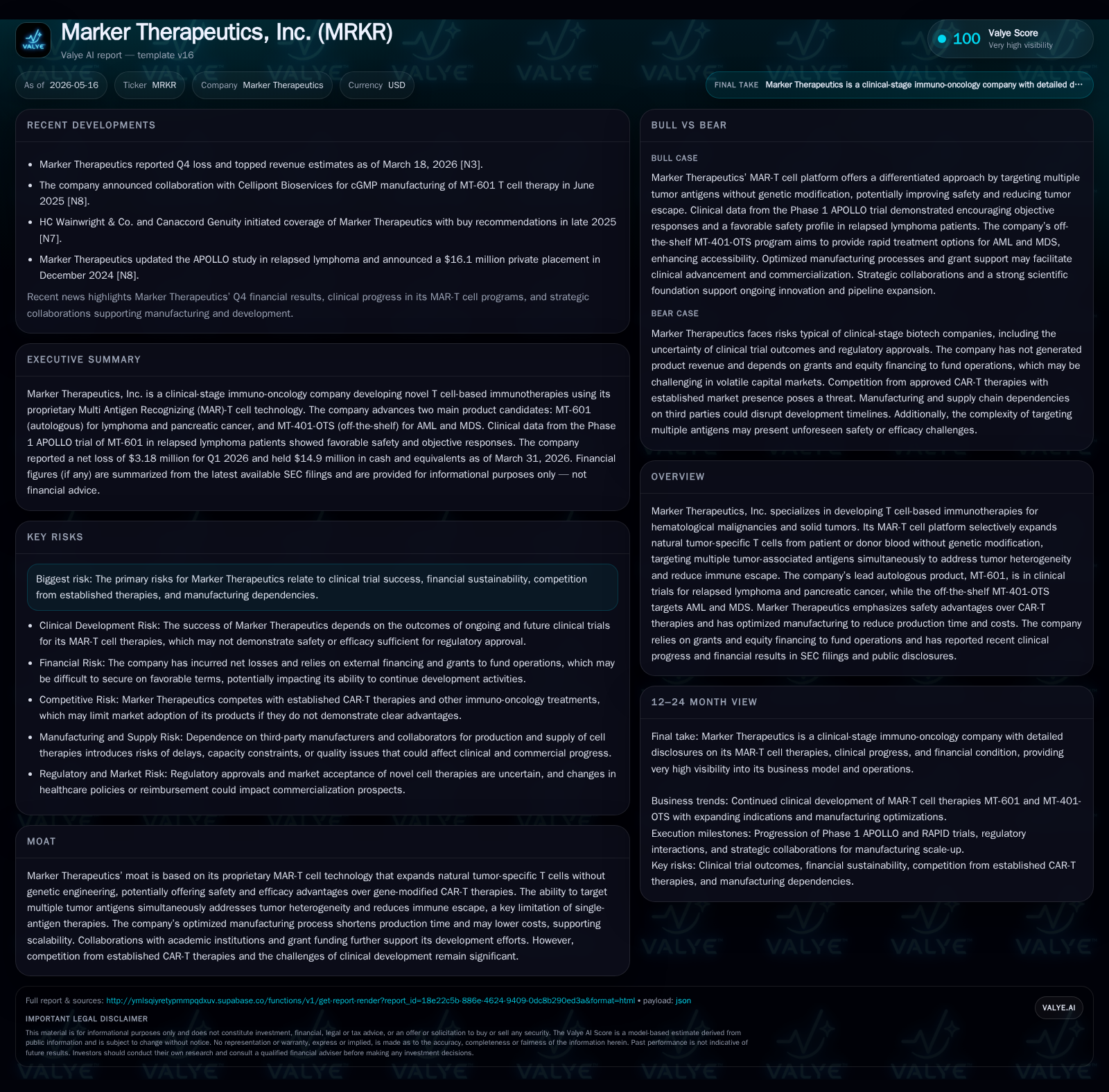
Marker Therapeutics, a clinical-stage immuno-oncology company, reported in its Q1 2026 filing continued advancement of its MAR-T cell therapy candidates for cancer treatment. The company remains pre-revenue and expects to incur losses over the coming years, projecting sufficient cash runway into the first quarter of 2027 assuming no additional grant income. Its proprietary technology aims to selectively amplify natural tumor-targeting T cells without genetic modification, targeting tumor heterogeneity in both hematologic and solid cancers. Funding constraints and regulatory hurdles remain key risks amid intensifying competition from established CAR-T therapies.
Recent Operating Update
Marker Therapeutics’ Q1 2026 reporting on May 15 details ongoing development progress while underscoring the company’s extended loss-incurring trajectory typical of clinical-stage biotech firms [S2]. Cash and equivalents stood at approximately $15.6 million as of March 31, 2026, supporting operations into the first quarter of 2027 under current spending assumptions absent new grant awards [S2][F1].
This projection extends prior guidance but highlights an unavoidable funding cliff characteristic of deep R&D-stage companies lacking commercial products. Management signals intent to pursue equity or preferred share issuances and actively seeks grant funding to extend runway beyond early 2027 [S2]. Notably, the company’s working capital position remains healthy at nearly five times current liabilities, providing short-term financial stability [F1].
The recent May 4, 2026 event filing documents significant shareholder approvals for amendments increasing authorized common shares from 30 million to 130 million shares—a move likely designed to bolster future capital raising flexibility [S3]. These corporate governance changes align with anticipated equity financing over the coming periods.
Business Model and Product Overview
Marker Therapeutics operates as a clinical-stage developer of T cell immunotherapy leveraging proprietary Multi Antigen Recognizing T cell (MAR-T) technology [S1]. At its core, this platform selectively expands endogenous tumor-specific T cells harvested from patient or donor blood without employing genetic engineering techniques such as viral vector-mediated gene transfer used by CAR-T competitors.
By targeting multiple tumor-associated antigens (TAAs) simultaneously (up to six antigens encompassing hundreds of epitopes), the approach aims to overcome tumor heterogeneity—a major driver of immune escape which undermines single antigen-targeted therapies [S1]. This broad target recognition through native T cell receptors (TCRs) theoretically enhances anti-tumor efficacy while reducing relapse risk.
Product candidates include:
- MT-601, an autologous therapy currently in clinical trials addressing relapsed lymphoma and pancreatic cancer.
- MT-401-OTS, an allogeneic off-the-shelf therapy targeting acute myeloid leukemia (AML) and myelodysplastic syndromes (MDS).
Unlike gene-engineered CAR-T products, MAR-T’s non-genetically modified status enables a less complex manufacturing process with potentially lower costs because it bypasses transduction steps and associated vector production logistics [S1]. Clinically, the absence of severe toxicities typically seen with CAR-Ts—such as immune effector cell-associated neurotoxicity syndrome (ICANS)—represents a significant safety differentiator [S1].
Revenue is currently nonexistent as all candidates remain in development phases; funding comes primarily via equity issuances and research grants. The operating model necessitates sustained investment until regulatory approval and commercial launch can be established.
Industry Structure and Competitive Positioning
The immuno-oncology sector focused on adoptive T cell therapies is highly competitive with rapid technological innovation. CAR-T therapies pioneered by well-capitalized firms have secured multiple FDA approvals in hematologic malignancies, shaping a challenging landscape for emerging entrants like Marker Therapeutics.
MRKR's differentiation lies chiefly in its multi-antigen targeting without genetic engineering—a contrast to single-antigen CAR constructs that face limitations due to antigen loss variants in tumors. This multiplexed approach could offer durability benefits in heterogeneous solid tumors where CAR-T penetration has been less successful historically.
However, MRKR faces notable commercialization hurdles given limited human trial data relative to CAR-T incumbents, alongside scale-up manufacturing challenges common across cell therapy producers. Its collaborative licensing origins with Baylor College of Medicine provide academic validation but have yet to translate into broad proof-of-concept commercial success [S1].
Regulatory pathways are evolving for novel non-engineered adoptive T cell modalities; absent precedent complicates timelines and approval probabilities [S20]. Additionally, reimbursement negotiations may become complex due to price sensitivity surrounding high-cost cell therapies.
Growth Drivers
Growth catalysts for Marker Therapeutics hinge on several factors:
- Clinical Trial Results: Positive efficacy/safety data from ongoing MT-601 lymphoma/pancreatic cancer trials could validate platform utility beyond hematologic malignancies.
- Expansion into Off-the-Shelf Products: Scaling MT-401-OTS could enable broader patient access due to ready availability versus individualized autologous therapies.
- Regulatory Milestones: Accelerated approvals or breakthrough designations would significantly de-risk timelines.
- Manufacturing Optimization: Reducing production cycle duration and costs supports scalability necessary for commercial viability.
- Grant Awards & Partnerships: Continued public/private funding reduces capital dependency; strategic pharma collaborations could enhance development resources.
Each driver is linked closely to KPIs such as trial enrollment rates, interim phase readouts, regulatory submissions acceptance, manufacturing yields/capacity utilization metrics, grant acquisition announcements, and potential licensing deals.
Risks and Constraints
Key risks articulate around:
What To Watch Next
Monitor upcoming milestones such as:
- Interim clinical trial updates on MT-601 lymphoma and pancreatic cancer cohorts providing early efficacy/safety signals.
- Enrollment progress or expansion announcements for MT-401 off-the-shelf AML/MDS studies.
- Regulatory submission filings or breakthrough designation requests responding directly to trial data maturity.
- Capital raising activity or announcements regarding new grant awards impacting financial runway scenarios beyond early 2027.
- Manufacturing scale improvements or partnerships enhancing supply stability.
These metrics will clarify whether the MAR-T platform advances toward viable market entry or faces setbacks prolonging development uncertainty.
Financial Profile Summary
Latest financial snapshot
| Metric | Value | Period |
|---|---|---|
| Cash & equivalents | $15mm | |
| 2026-03-31 | ||
| Current assets | $17mm | |
| 2026-03-31 | ||
| Current liabilities | $4mm | |
| 2026-03-31 | ||
| Current ratio | 4.79x | |
| 2026-03-31 |
Source: SEC companyfacts cache [F1].
Marker Therapeutics remains pre-revenue with consistent net losses reflecting intensive R&D investment: operating loss totaled approximately $12.9 million for the fiscal year ended December 31, 2025 [F1]. Cash reserves of around $15.6 million at March-end support more than a year’s planned expenditures under current assumptions but require replenishment soon given ongoing burn rates and absence of recurring revenues [S2][F1]. Total debt is minimal at roughly $68 thousand indicating low leverage burden but emphasizing pure equity financing reliance [F1].
The substantial increase in authorized shares recently approved reflects management’s anticipation of imminent equity issuance necessity [S3]. Financial health depends on effectively balancing dilution concerns with maintaining operational continuity through critical clinical milestones before possible commercialization revenue onset.
This analysis synthesizes Marker Therapeutics' latest quarterly disclosures alongside annual context to assess strategic positioning within cell therapy immuno-oncology. While innovative in concept, MRKR faces typical early-stage biotech operational challenges centered on clinical validation, regulatory navigation, competitive differentiation, and financing continuity. Investors should track near-term trial data releases alongside capital markets developments for updated business outlook clarity.
Disclaimer: This is research-only, informational analysis and not investment advice. It may include AI-generated interpretation and general industry context. Always verify important details using primary sources.

Comments