
Marvell Technology Strengthens AI Infrastructure with Strategic Acquisitions and Innovation
Marvell’s recent quarterly filing highlights key acquisitions and product advances that position it as a critical supplier for next-generation AI and data center connectivity solutions.
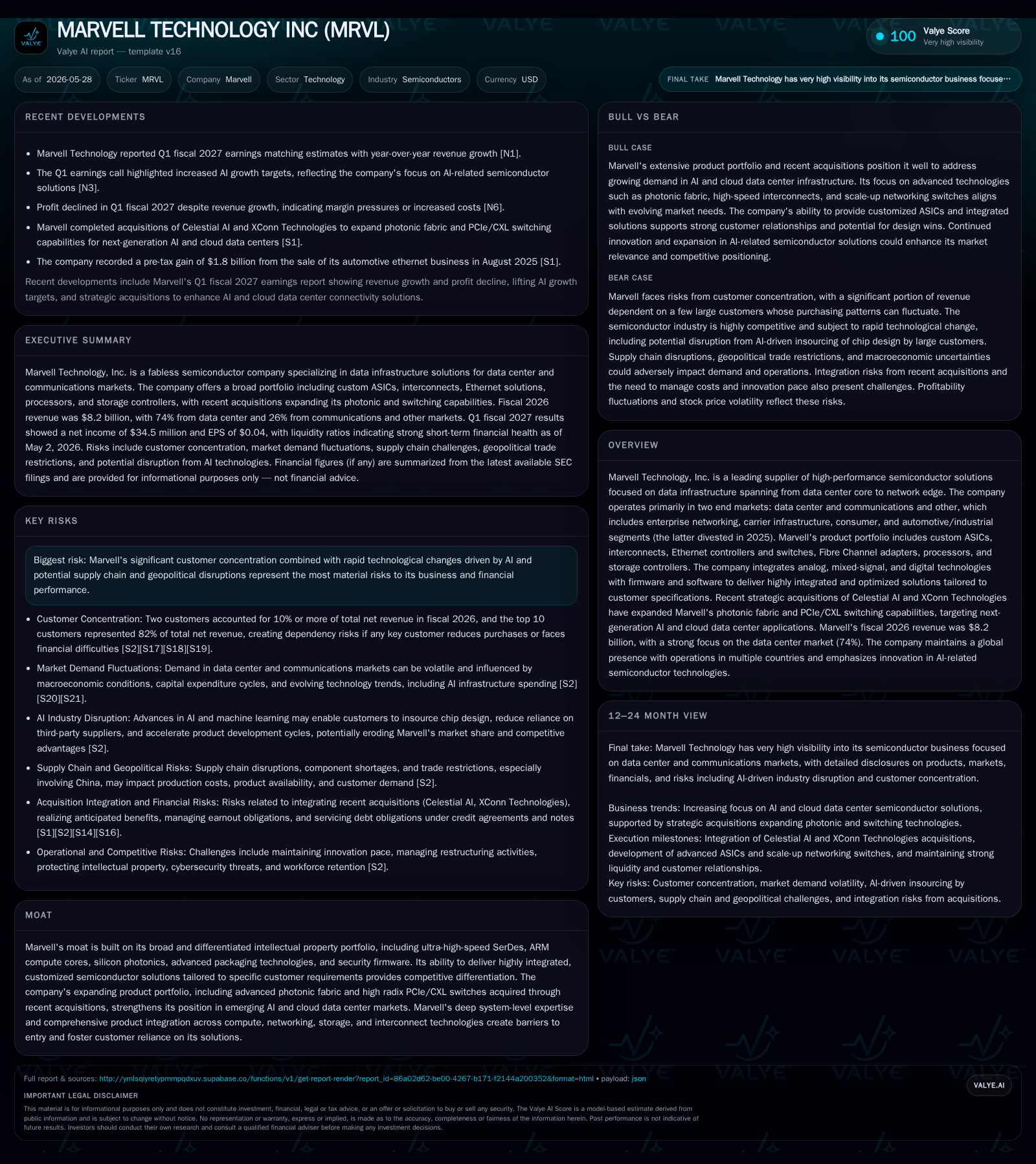
Marvell Technology’s Q1 2027 results reveal solid operational momentum driven by expanding demand for AI-focused semiconductor solutions. The company’s acquisitions of Celestial AI and XConn Technologies have strategically broadened its portfolio into silicon photonics and high-performance PCIe/CXL switching, enhancing its competitive positioning in scale-up interconnects crucial to modern data centers. Strong customer concentration and geopolitical risks remain significant considerations, but Marvell’s differentiated IP and system-level integration capabilities underpin a durable moat in rapidly evolving infrastructure markets.
Latest Quarterly Operating Update Highlights Strategic Momentum
Marvell Technology’s latest 10-Q filing dated May 28, 2026 ([S2]) reveals continued progress capitalizing on AI-driven demand surges across data center end markets. Revenue growth during Q1 FY 2027 is supported by initial commercial adoption of solutions based on its recently acquired technologies — notably the Photonic Fabric platform from Celestial AI and high-performance PCIe/CXL switching silicon from XConn Technologies ([S3], [N1]). Management emphasized in earnings discussions ([N1], [N5]) an upward revision to AI-related growth targets fueled by these strategic expansions.
The Celestial acquisition closed in February 2026 with approximately $1.3 billion paid in cash plus issuance of common stock shares; contingent payments through fiscal 2029 are tied to milestone achievement ([S1]). Similarly, the XConn deal augmented Marvell's proprietary Ultra Accelerator Link suite with re-timers and switches essential for composable infrastructure architectures — a critical element responding to modern multi-host compute demands ([S1]). These advancements reflect Marvell’s pivot from traditional semiconductor components into integrated system-level interconnect fabrics optimized for emerging AI workloads.
Business Model & Differentiated Product Portfolio
Marvell operates as a fabless semiconductor supplier focused on delivering high-performance System-on-a-Chip (SoC) solutions tailored primarily for the data center and communications markets ([S1], [S20], [S21]). The company integrates analog circuits, mixed-signal processing, digital cores including ARM compute elements, security firmware stacks, and proprietary IP like ultra-high-speed SerDes links. This deep integration enables customized ASICs that differentiate via power efficiency, latency optimization, and functionality specific to customers’ architectures.
Its core product lines encompass Ethernet controllers and switches for cloud-scale networking; Fibre Channel adapters supporting storage area networks; processors embedded in servers; storage controllers crucial to network-attached storage (NAS); as well as emerging switches targeting scale-out AI fabrics (UALink™) ([S21]). Recent portfolio expansions—the Photonic Fabric™ family from Celestial—add silicon photonics-based optical interconnects elevating bandwidth-density-efficiency ratios beyond electrical limits. Meanwhile, XConn extends the line into purpose-built PCIe and CXL switches that serve critical memory pooling and device disaggregation needs arising from large AI model consumption ([S1]).
The blend of software-firmware integration with proprietary hardware IP substantially raises switching costs for customers. Once deep design wins are secured, customers derive systemic performance benefits difficult to replicate elsewhere without significant engineering investment. This approach underpins Marvell’s premium pricing power in complex semiconductor niches.
Industry Structure and Competitive Positioning
The semiconductor industry segment where Marvell plays is defined by high barriers to entry owing to lengthy development cycles for cutting-edge optics (photonic fabrics), ultra-fast SerDes interfaces capable of hundreds of gigabits per second speeds, advanced packaging technologies including chiplet modularization, alongside stringent security certification requirements (, [S1]).
Major competitors vary by subdomain: traditional networking vendors are challenged by pure-play semiconductor suppliers like Broadcom or Intel investing heavily in PCIe/CXL switch design—the latter crucial for composable infrastructure architectures sought after by hyperscale cloud providers. Silicon photonics remains nascent with limited players globally; Marvell’s acquisition of Celestial marks a strategic leap forward relative to peers still reliant on electrical interconnect scaling alone.
The company faces concentrated customer demand primarily from hyperscalers who exert strong pricing pressure but also impose rapid innovation cycles. Regulatory constraints particularly affect sales into China due to export controls impacting advanced semiconductor technologies ([S10], [S14]). Supply-chain fragility remains a consideration given global shortages affecting fabless suppliers indirectly through foundry capacity allocation.
Catalysts for Growth: AI, Data Centers, and Advanced Connectivity
Marvell’s growth levers center on accelerating demand within cloud-scale data centers aggressively expanding infrastructure capacity to support next-generation AI models requiring massive parallelism with low latency connectivity ([N1], ).
Celestial’s Photonic Fabric products enable optical interconnects that overcome copper-based bandwidth-distance-power limitations crucial when scaling rack-to-rack or even within rack level connections in data centers hosting GPUs/accelerators. This tech supports weighty workloads exemplified by large language models where latency bottlenecks translate directly into performance degradation.
Meanwhile, XConn’s PCIe/CXL switch technology fits neatly into evolving composable infrastructure paradigms where compute resources dynamically pool shared memory across multiple hosts. This modular flexibility is essential to meet variable workload demands while optimizing asset utilization — a vital efficiency driver for cost-conscious cloud operators.
Management has underscored early traction of these specialized product sets through design wins converting into initial revenues—an encouraging leading indicator aligning with raised quantitative guidance around AI-driven growth pathways ([N1], [S2]).
Risks and Growth Constraints: Customer Concentration, Tech Shifts, Geopolitics
Notwithstanding strategic momentum, several material risks could moderate business outcomes. Marvell depends heavily on a limited number of key customers accounting cumulatively for over 80% of sales; this concentration introduces revenue volatility tied to design win timing or order deferrals ([S10], [S14]). The highly cyclical nature coupled with incremental AI-driven architectural shifts require constant product innovation—failure of which can cause erosion of competitive positioning ([S2]).
Geopolitical tensions impacting US-China trade policy represent a persistent headwind: export restrictions may curtail access or reduce demand from Chinese entities due to licensing constraints or increased self-sufficiency moves by local manufacturers ([S6]). Supply chain uncertainties including component shortages or manufacturing delays could also constrain shipment volumes or elevate costs.
Litigation risk related to intellectual property infringement claims remains elevated industry-wide due to aggressive patent assertion trends; any adverse legal outcomes impose financial penalties or operational restrictions impacting product availability ([S12]). Finally, increased leverage warrants monitoring from a capital structure standpoint amid interest rate fluctuations potentially increasing debt servicing costs ([F1], [S15], [S16]).
Key Upcoming Milestones and What to Monitor
Important execution checkpoints include license milestone payments linked to the Celestial acquisition extending through FY 2029 contingent on revenue targets achieved ([S1]). Additionally, market penetration metrics of the Photonic Fabric line alongside scaled deployment of XConn PCIe/CXL switches across major cloud providers will signal sustained product-market fit.
Future quarters’ revenue mix shifts towards higher contribution from these novel segments will provide tangible evidence confirming strategic pivot yields value-added expansion beyond legacy ASIC offerings. Investors should also track updates from upcoming earnings releases or management commentary signaling revisions in guidance informed by macroeconomic conditions or competitive dynamics ([N1], [S3]).
Concise Financial Snapshot Supporting Strategic Narrative
Marvell maintains robust liquidity as reflected in recent filings: nearly $3.84 billion in cash & equivalents against a total debt burden approximating $5.0 billion results in net debt near $1.15 billion ([F1]), indicating manageable leverage levels relative to operational cash flow generation. Operating income stood around $1.32 billion most recently ([F1]), providing sufficient cash conversion headroom supporting reinvestment initiatives including R&D expenditures targeting new interconnect technologies.
The company benefits from a strong current ratio above 3x ([F1]), flagging comfortable short-term asset coverage versus liabilities amid ongoing capital commitments related to integration expenses or milestone payments inherent in executed acquisitions.
This analysis synthesizes publicly filed SEC disclosures alongside verified news sources to provide an independent evaluation of Marvell Technology Inc.’s strategic trajectory within the semiconductor sector without offering investment research views.
Disclaimer: This is research-only, informational analysis and not investment advice. It may include AI-generated interpretation and general industry context. Always verify important details using primary sources.

Comments