
Microsoft's Strategic AI Expansion Amid Cloud Growth and Competitive Pressures
Microsoft accelerates AI integration and cloud infrastructure investments while navigating margin pressures and intensifying competition.
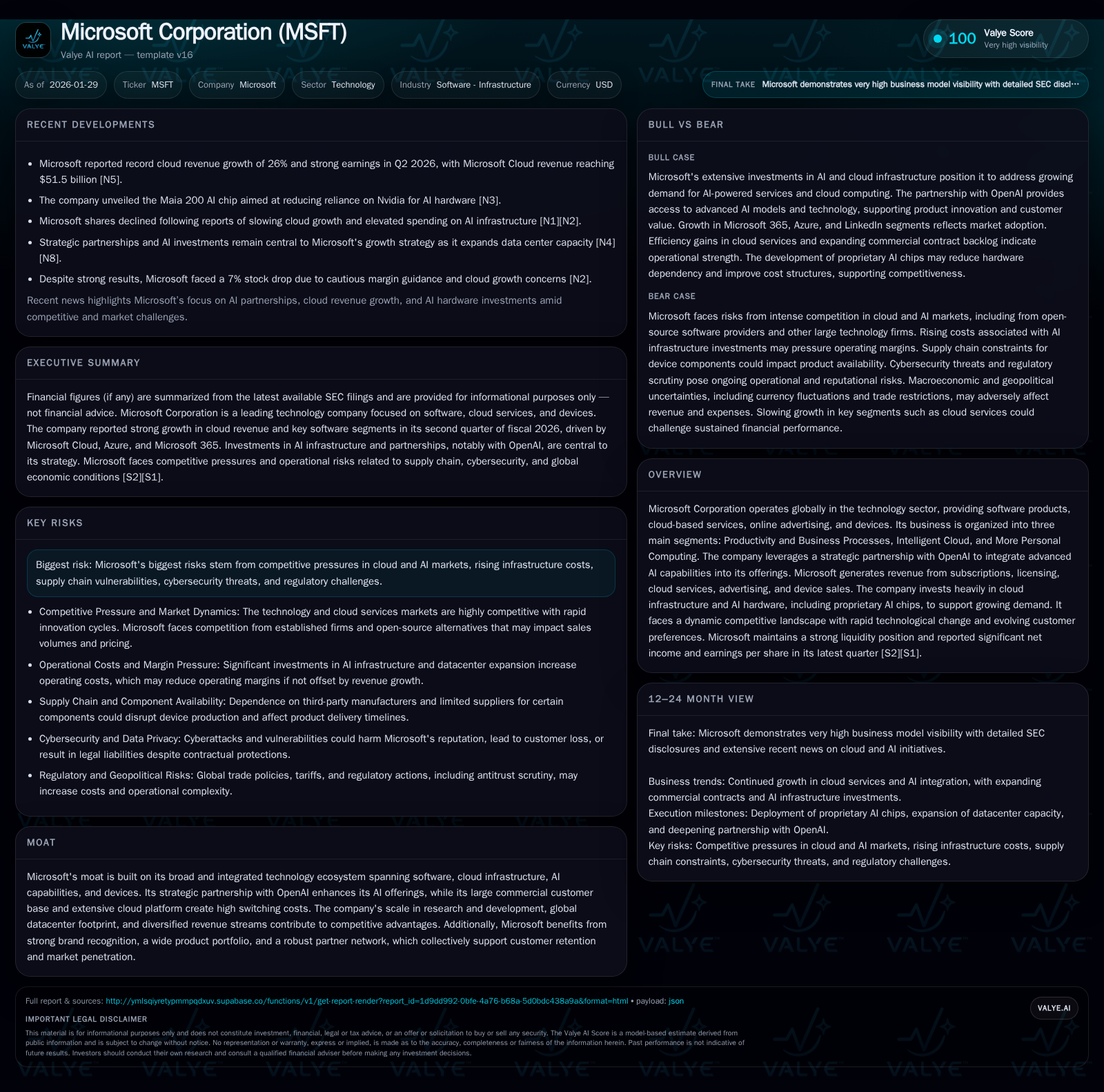
Microsoft Corporation continues to solidify its position as a technology leader by deepening its strategic partnership with OpenAI and expanding cloud infrastructure, notably with its Maia 200 AI chip. Recent quarterly results showed record cloud revenue growth driven by Azure and AI services, although slowing momentum and margin pressures tempered investor sentiment. The company's extensive ecosystem, diversified revenue streams, and R&D scale underpin its competitive moat, yet rising costs, cybersecurity risks, and a shifting industry landscape present ongoing challenges. Monitoring execution on AI commercialization and infrastructure efficiency remains critical as Microsoft balances growth ambitions with cost discipline.
What Changed Recently
Microsoft’s latest fiscal Q2 2026 earnings revealed record server products and cloud services revenue growth of 30%, driven by 40% growth in Azure and other cloud services, underscoring strong demand for its AI-enhanced portfolio [N2][S2]. However, this growth was accompanied by increased spending on AI infrastructure, including the launch of the Maia 200 AI chip, designed to optimize AI workloads on Microsoft’s cloud platform [N4]. Despite top-line strength, investor reaction was muted, with shares dropping more than 7% due to concerns over slowing cloud growth rates and lighter-than-expected margin guidance, reflecting the cost impact of expanding AI investments [N6][N12].
Microsoft continues to highlight its strategic partnership with OpenAI as a core growth driver, maintaining exclusive rights to integrate OpenAI’s intellectual property into its products and sharing revenue, which remains a fundamental pillar in its AI strategy [S1]. The company also emphasized ongoing capital expenditures to boost data center capacity, aiming to meet anticipated surges in AI and cloud demand [N4]. Despite widespread optimism about AI’s potential, some market observers caution that the AI market requires "trillions in revenue" to justify current valuations, adding pressure on Microsoft to convert AI investments into sustainable revenue streams [N3].
Business Model as a System
Microsoft’s business model is orchestrated across three principal segments: Productivity and Business Processes, Intelligent Cloud, and More Personal Computing [S4].
Productivity and Business Processes includes Office 365 subscriptions, LinkedIn, and Dynamics, generating recurring revenue through software-as-a-service (SaaS) offerings. These products benefit from high switching costs due to enterprise integration and user familiarity.
Intelligent Cloud encompasses Azure cloud services, server products, and enterprise support. The segment’s growth is propelled by scaling cloud workloads, AI services, and transactional licensing of Windows Server 2025, which contributes modestly but strategically to revenues [S2].
More Personal Computing covers Windows licensing, devices (Surface), gaming (Xbox content, Game Pass subscriptions), and search advertising, providing diversification and consumer market exposure [S6].
Microsoft’s integration of AI functionalities throughout these segments leverages its OpenAI partnership, embedding advanced models into productivity tools, cloud services, and developer platforms. The model balances subscription-based recurring revenues with transactional sales and growing cloud consumption fees, all supported by a vast global infrastructure footprint and extensive R&D [S1][S2].
Importantly, Microsoft’s scale enables it to invest in proprietary AI hardware like the Maia 200 chip, reducing dependency on third-party suppliers and improving efficiency for AI workloads on Azure, exemplifying vertical integration in support of its AI ambitions [N4].
Revenue visibility is strengthened by multi-year enterprise contracts and a broad partner ecosystem, driving high customer retention and cross-selling opportunities. However, the model also requires continuous innovation to stay ahead of competitive pressures and meet evolving customer demands in a fast-moving technology landscape [S4][S10].
Industry Map & Competitive Battlefield
Microsoft competes at the intersection of cloud infrastructure, productivity software, AI, gaming, and device markets, facing multiple competitive fronts:
Cloud Services: Azure competes with AWS, Google Cloud, and emerging regional providers. The cloud market is characterized by rapid innovation, aggressive pricing, and demand for specialized AI capabilities. Microsoft’s advantage lies in enterprise integration, hybrid cloud solutions, and AI-enhanced services, but competitors challenge on scale and open-source AI model adoption [S10].
AI Platforms: The partnership with OpenAI gives Microsoft early access to leading AI models, but open-source alternatives and proprietary models from competitors threaten to erode exclusivity. The AI industry is still nascent, with substantial R&D investment needed to commercialize capabilities profitably [N1][S1][S10].
Productivity & Collaboration: Products like Microsoft 365 dominate enterprise productivity, competing with Google Workspace and niche SaaS players. AI integration is increasingly a differentiator here.
Gaming and Consumer Devices: Xbox gaming content and Surface devices face competition from Sony, Nintendo, and various PC manufacturers. Gaming subscriptions drive recurring revenue but depend on content quality and user engagement [S6].
Advertising & Search: Microsoft’s Bing search and online advertising contend against Google’s dominant position; scale and integration with Windows and Edge drive incremental gains.
Microsoft’s moat is built on a tightly woven ecosystem spanning software, cloud, AI, and devices. Network effects from its partner ecosystem and enterprise customer base create high switching costs, while proprietary AI investments and global data centers reinforce infrastructure strength. However, the competitive battlefield is dynamic, with open-source AI models and cloud providers leveraging lower-cost or more flexible alternatives, pressuring Microsoft to sustain innovation and competitive pricing [S10].
Where the Economics Become Real
Microsoft’s economics hinge on the interplay between scale, innovation, and cost structure:
Revenue Growth Drivers: Azure and cloud services growth (40% year-over-year) underpin top-line expansion, amplified by the increasing adoption of AI workloads that command higher usage fees. Licensing transactional sales, such as Windows Server 2025, provide incremental revenue but are less material [S2].
Margins and Costs: Gross margin growth is driven by Microsoft 365 Commercial cloud efficiency gains, but expanding AI infrastructure investments, including proprietary AI chips and data center capacity, increase operating expenses, compressing margins in the near term [S3][S8]. Microsoft faces a balancing act between scaling AI services (which are capital and energy intensive) and maintaining operating leverage.
Capital Expenditures: Significant capex is allocated to data centers and AI hardware to sustain cloud services and differentiate AI capabilities. This investment cycle is crucial but creates near-term cash flow pressure [N4][S8].
Customer Retention & Contracting: Multi-year enterprise contracts enhance revenue visibility, reduce churn, and improve cash flow predictability, supporting sustained investment and innovation cycles [S4].
Unit Economics of AI: AI workloads are computationally demanding, and Microsoft’s investment in AI-specific chips like Maia 200 aims to improve cost efficiency and performance. Success in this area may reduce marginal costs per AI query and improve profitability as volume scales [N4][S8].
Risks to Economics: Cybersecurity threats, supply chain disruptions, and regulatory oversight could increase costs and delay projects. Competitive pricing pressures may compress margins if Microsoft must aggressively discount to maintain cloud market share [S9][S10].
Diligence Questions / Disconfirming Signals
How materially will AI infrastructure investments impact Microsoft’s operating margins over the next several quarters, and can efficiency gains offset these costs?
What is the durability of Microsoft’s exclusivity or preferential access to OpenAI’s IP, given rapid proliferation of open-source AI models and competing AI platforms?
How effective is Microsoft’s vertical integration strategy (e.g., Maia 200 chip) in improving unit economics for AI workloads compared to alternatives?
To what extent can Microsoft sustain or accelerate Azure growth amid signs of cloud growth deceleration and intensifying competition?
How vulnerable is Microsoft to potential supply chain constraints or geopolitical risks impacting data center expansion and device manufacturing?
What are the implications of heightened cybersecurity threats on customer trust and potential remediation costs?
How might regulatory developments in privacy, AI governance, or antitrust impact Microsoft’s business model or market access?
Can Microsoft continue to innovate across its productivity and business processes segment to fend off competition from Google and emerging SaaS providers?
Is the current market valuation pricing in a realistic growth trajectory for AI revenue, or is there risk of a correction if AI monetization takes longer?
How will consumer-facing segments like Xbox content and devices evolve in a market shifting toward cloud gaming and subscription models?
This analysis is based on publicly available information and does not constitute investment advice. It aims to provide a comprehensive understanding of Microsoft’s current business dynamics, competitive environment, and key risks to inform further diligence.
Disclaimer: This is research-only, informational analysis and not investment advice. It may include AI-generated interpretation and general industry context. Always verify important details using primary sources.

Comments