
Microsoft's Strategic Evolution Amid AI Investment and Cloud Growth Challenges
Microsoft navigates a transformative technology landscape with AI-driven innovation and cloud expansion tempered by margin pressures and supply chain risks.
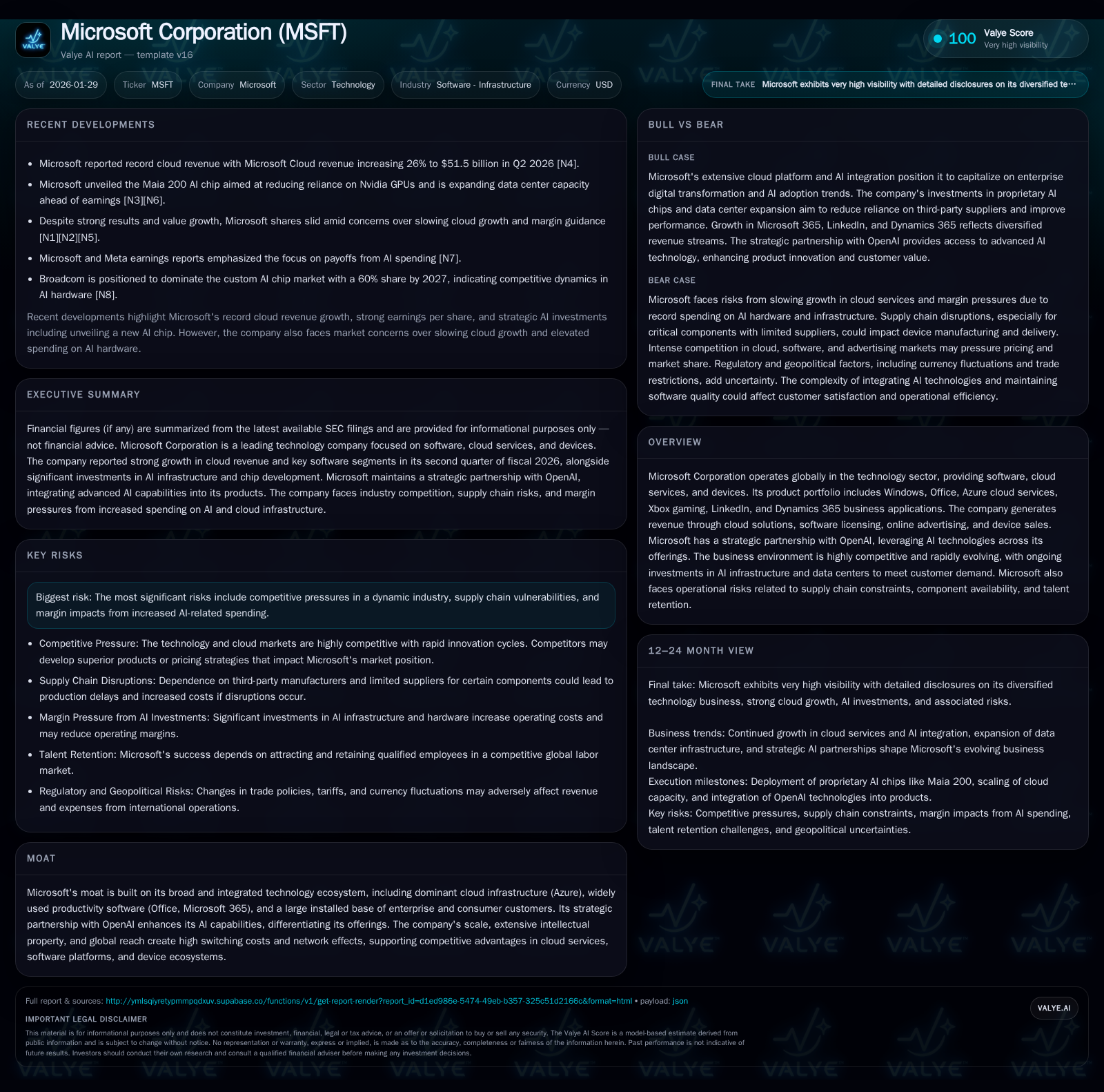
Microsoft Corporation continues to leverage its broad software ecosystem and cloud infrastructure to integrate AI capabilities, highlighted by a strategic partnership with OpenAI and recent introduction of proprietary AI chips. Despite record cloud revenue, growth rates have moderated, and increased AI-related expenses have pressured margins, reflecting the industry's intense capital requirements and competitive dynamics. Supply chain uncertainties and evolving regulatory risks add operational complexity, underscoring the challenges inherent in sustaining Microsoft's integrated business model amid rapid technological change.
What Changed Recently
Microsoft reported its Q2 fiscal 2026 earnings with record cloud revenue, signaling continued demand for Azure and associated cloud services. However, the company faced investor disappointment due to slowing cloud growth rates and softer-than-expected margin guidance, leading to a roughly 7% drop in stock price shortly after the results [N1, N5, N9]. This reflects market sensitivity to the pace of AI-driven growth and the capital intensity required to support scaling AI infrastructure.
A notable strategic development is the launch of the Maia 200 AI chip designed to decrease Microsoft’s reliance on Nvidia for AI hardware accelerators. This vertical integration move aims to optimize cost and performance for AI workloads on Azure, underscoring the critical importance Microsoft places on custom AI infrastructure as a competitive differentiator [N4, N14].
Complementing hardware innovation, Microsoft continues to deepen its partnership with OpenAI, securing rights to leverage OpenAI’s models and IP for embedding AI capabilities across productivity, cloud, and business applications [S1].
Business Model as a System
Microsoft operates a highly integrated technology ecosystem encompassing cloud infrastructure (Azure), productivity software (Windows, Office 365), business applications (Dynamics 365), gaming (Xbox and related content/services), LinkedIn, and advertising platforms. Revenue generation is diversified across subscription licenses, usage-based cloud services, software sales, device sales, and advertising revenues [S1, S3, S4].
Its cloud segment anchors the transformation from traditional software licensing to recurring and scalable revenue streams. Azure’s platform-agnostic approach enables deployment across diverse devices and ecosystems, including competitors', increasing customer stickiness [S6]. Meanwhile, Dynamics 365 integrates ERP, CRM, Power Apps, and automation tools, targeting enterprise digital transformation budgets [S3]. Xbox content and service revenues leverage first- and third-party games, subscriptions (Game Pass), and in-game content for consumer engagement [S4].
The company’s operational model balances innovation investments in AI and cloud with broad global distribution and support. Supply chain management is complex, with hardware assembly concentrated in Asia and potential for disruptions affecting datacenter capacity and device availability [S5]. Software reliability and security are critical due to product interdependencies and increasing reliance by customers on Microsoft’s platforms for mission-critical operations [S5, S12].
Industry Map & Competitive Battlefield
Microsoft competes in a dynamic and rapidly evolving technology landscape characterized by accelerating AI adoption and cloud infrastructure expansion. Primary competitors include other hyperscale cloud providers (Amazon AWS, Google Cloud), enterprise software vendors (SAP, Oracle), and emergent AI-focused firms. In gaming, competitors like Sony and emerging cloud gaming platforms challenge Xbox’s content ecosystem.
Microsoft’s moat derives from its scale, IP portfolio, and ecosystem integration, creating network effects and high switching costs. The OpenAI partnership and proprietary AI chip development reinforce its position in the AI arms race. However, competitors aggressively invest in AI, cloud, and developer platforms, making ongoing innovation essential.
Regulatory pressures around data privacy, security, and content moderation also shape the competitive environment, requiring substantial compliance investments globally [S12]. Cybersecurity threats, including sophisticated nation-state attacks, further raise the stakes for operational resilience [S13].
Where the Economics Become Real
Unit economics are complex and hinge on balancing high-margin software and cloud subscription revenues against capital-intensive infrastructure buildout. Data center expansion and AI hardware investments, including new AI chips, drive significant capital expenditures that weigh on near-term margins [N4, N9]. However, the recurring revenue model from cloud and productivity software offers stable cash flow and scalability.
Cost of revenue has been influenced by hardware sales fluctuations and investments in search and advertising platforms, with gross margin improvement supported by higher Windows OEM volumes and advertising growth [S8]. Seasonality affects revenue recognition, with Q4 historically stronger due to multi-year contract signings [S10].
Supply chain bottlenecks and component shortages present risks to hardware availability and operational agility, potentially increasing costs or limiting service expansion [S5]. Software reliability issues and cross-product dependencies may exacerbate operational challenges, especially as AI services become more critical for customers [S5].
Diligence Questions / Disconfirming Signals
How sustainable is the current pace of AI-related spending given margin pressures and slowing cloud growth? Are efficiency gains from proprietary AI chips sufficient to offset escalating costs?
To what extent can Microsoft continue to differentiate through its OpenAI partnership and AI IP rights as competitors also invest heavily in AI?
How resilient is Microsoft’s supply chain infrastructure amid geopolitical risks and component shortages, particularly for datacenter hardware and Xbox devices?
What is the risk profile related to cybersecurity incidents, especially considering recent nation-state attacks and the complexity of securing integrated cloud and AI services?
How effectively can Microsoft manage regulatory and compliance risks globally, especially with evolving content moderation and data privacy laws?
Are current market reactions to slowing cloud growth and lighter margin guidance indicative of deeper challenges in converting AI investment into profitable growth?
How dependent is Microsoft on multi-year contract renewals for revenue stability, and what trends exist in customer acquisition and retention across business segments?
Conclusion
Microsoft stands at a crossroads characterized by strong foundational assets in cloud, software, and AI, but faces real challenges from competitive intensity, capital requirements, operational risks, and market expectations. Its strategic moves toward proprietary AI infrastructure and deep AI partnerships reflect a commitment to lead in the next phase of technology evolution. Yet, navigating macroeconomic, supply chain, and regulatory complexities while maintaining growth and margins will demand continued execution excellence and innovation.
This analysis is based solely on publicly available information as of January 29, 2026, including recent news and SEC filings. It is intended for informational purposes and does not constitute investment advice.
Disclaimer: This is research-only, informational analysis and not investment advice. It may include AI-generated interpretation and general industry context. Always verify important details using primary sources.

Comments