
Meritage Homes Corp: Navigating Residential Construction Amid Market Headwinds and Operational Complexity
Meritage Homes Corp leverages scale and integrated operations in residential construction while facing cyclical demand and evolving market dynamics.
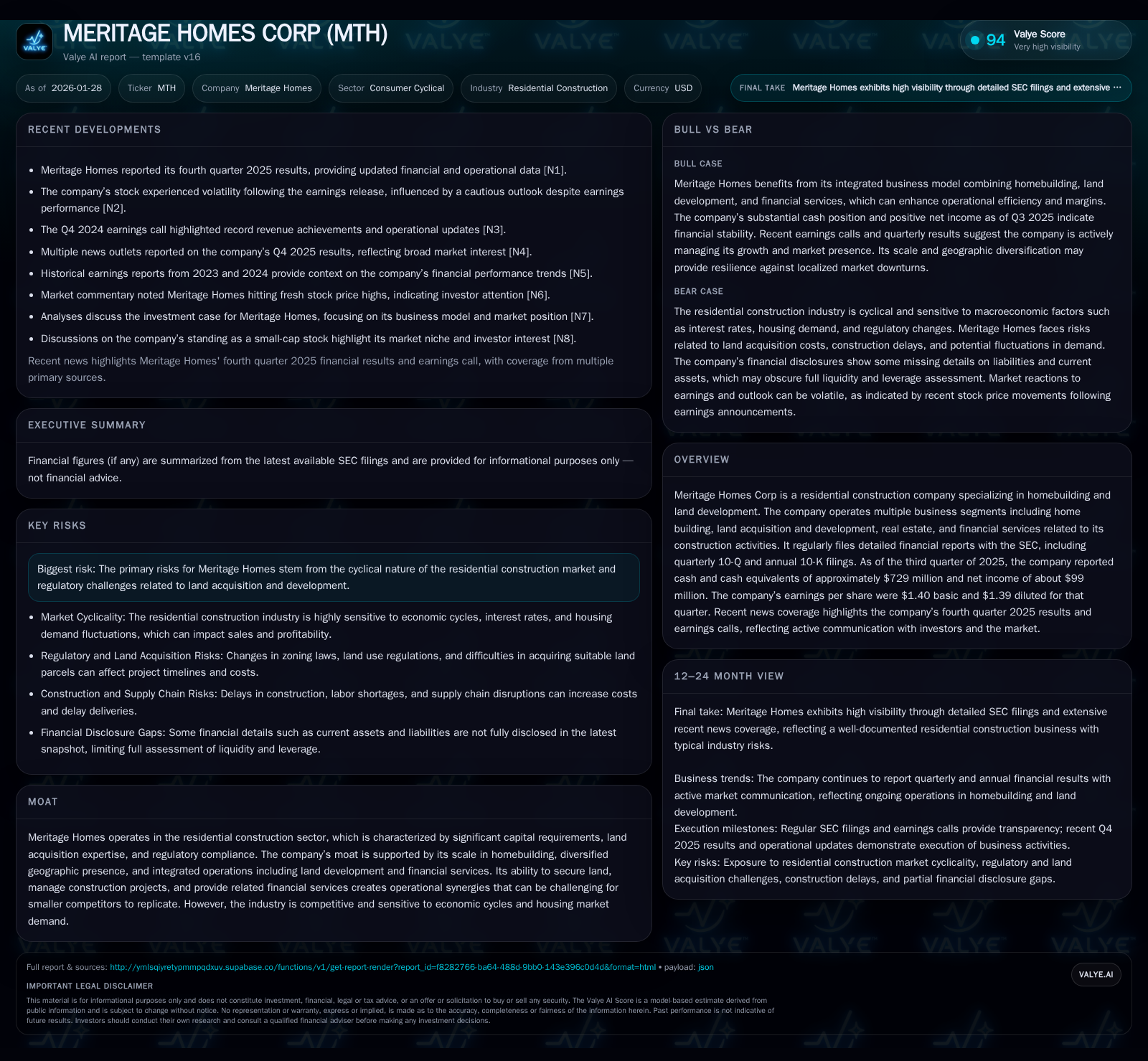
Meritage Homes reported solid financial results in Q4 2025, beating earnings estimates despite a cautious outlook for the near term. The company’s integrated business model combines homebuilding, land development, and financial services, supporting operational synergies and scale advantages. However, the residential construction sector’s cyclical nature and regulatory complexities continue to impose risks and margin pressures. Competitive dynamics and land acquisition challenges remain key factors shaping Meritage’s growth prospects and profitability.
What Changed Recently
Meritage Homes Corp reported its fourth quarter 2025 financial results on January 28, 2026, revealing a mixed picture. The company beat earnings expectations for the quarter, driven by strong execution in home sales and operational efficiencies. Net income for Q3 2025 stood at approximately $99 million, with cash and cash equivalents near $729 million, signaling solid liquidity [N1][S1]. Despite the positive earnings surprise, the company issued a weaker outlook tied to cautious assumptions about housing demand and rising interest rates, which pressured the stock price on the earnings release day [N2].
Investor calls and market commentary highlighted record revenue achievements but also underscored margin pressures due to inflationary cost inputs and labor shortages [N3][N4]. The mixed signals reflect broader industry challenges amid a shifting macroeconomic environment, particularly the sensitivity of residential construction to mortgage rates and consumer confidence [N5].
Business Model as a System
Meritage operates an integrated residential construction system combining multiple interconnected segments: homebuilding, land acquisition and development, and financial services related to new home sales. This multi-segment approach allows the company to internalize key supply chain elements and reduce dependency on external parties for critical inputs such as raw land and financing solutions.
The homebuilding segment is the core revenue driver, focusing on single-family homes across diversified U.S. markets. This requires managing a complex, capital-intensive construction process encompassing design, permitting, procurement of materials, subcontractor coordination, and quality control. Given the long lead times inherent in homebuilding, efficient project management and cost control are crucial to margin stability.
Land acquisition and development is a strategic pillar, as access to buildable land underpins the company’s capacity growth. Meritage’s ability to secure land at favorable terms, navigate zoning and regulatory processes, and prepare sites for construction provides a competitive moat difficult for smaller builders to replicate. However, this segment entails significant regulatory risk and capital tie-up.
Financial services offered by Meritage include mortgage financing and insurance products that facilitate homebuyer conversions and reduce sales cycle friction. By bundling these services, the company can enhance customer experience and capture incremental margins, while also managing credit risk exposure associated with buyer financing.
Together, these segments form a vertically integrated value chain that supports scale economies, operational synergy, and risk mitigation. However, capital intensity, regulatory compliance, and operational complexity remain ongoing challenges.
Industry Map & Competitive Battlefield
The residential construction industry is inherently cyclical, with demand closely linked to macroeconomic factors such as interest rates, employment levels, and demographic trends. Rising mortgage rates typically dampen buyer affordability, slowing home sales and pressuring margins.
Key players in this space include national builders like D.R. Horton and Lennar, regional homebuilders with strong local market knowledge, and emerging entrants leveraging modular or prefabricated construction technologies. Meritage’s competitive positioning stems from its scale, geographic diversification, and integrated land development capabilities, which allow it to better manage cost volatility and supply constraints.
However, the competitive landscape is intensifying as labor shortages, raw material price inflation, and land scarcity drive up costs industry-wide. Builders with efficient procurement processes, strong supplier relationships, and access to capital are better positioned to withstand these headwinds.
Additionally, regulatory complexity around land use, environmental compliance, and zoning increasingly impacts timelines and costs. Companies that can navigate these hurdles effectively gain a structural advantage.
Where the Economics Become Real
Unit economics in residential construction revolve around land costs, construction costs (materials and labor), and sales prices. Land acquisition is often the largest upfront expense and a critical determinant of project profitability. Meritage’s ability to secure land at scale and control development costs directly impacts its gross margins.
Construction cost inflation, driven by commodity price volatility and labor market tightness, compresses margins unless offset by price increases. Meritage’s scale and purchasing power help negotiate better input costs, but pass-through is not guaranteed given competitive pressures on home pricing.
Financial services embedded in the home sale process provide incremental contribution margins and help stabilize revenue recognition by reducing buyer financing uncertainty. However, exposure to credit risk must be actively managed.
Cash flow timing is another crucial factor, as homebuilding projects have long cycle times from land acquisition through completion and sale. Efficient working capital management and liquidity buffers, such as the reported $729 million cash balance, are essential to funding ongoing construction and absorbing market fluctuations.
Diligence Questions / Disconfirming Signals
- How sustainable is Meritage’s land acquisition pipeline amid rising regulatory scrutiny and land scarcity?
- What strategies does the company employ to manage inflationary pressures in labor and materials?
- How sensitive are home sales volumes and pricing to recent mortgage rate increases and macroeconomic uncertainties?
- What is the credit quality of buyers using Meritage’s financial services, and how is risk mitigated?
- Are there any emerging regulatory or environmental compliance risks that could delay project approvals?
- How does Meritage’s geographic diversification mitigate localized market downturns?
- What operational improvements or technology investments are in place to offset labor shortages?
- Have any recent market signals suggested a material deterioration in housing demand beyond company forecasts?
Conclusion
Meritage Homes Corp embodies the complexities of a vertically integrated homebuilder navigating a challenging residential construction landscape. Its scale, diversified operations, and financial services offerings create operational synergies and competitive barriers, yet cyclicality, cost inflation, and regulatory pressures persist as headwinds. Recent financial results demonstrate execution strength but also highlight cautious forward guidance amid macroeconomic uncertainties. Continuous diligence on land pipeline sustainability, cost management, and demand resilience will be critical to understanding the company’s trajectory.
This analysis is based on publicly available information as of January 2026 and does not constitute investment advice.
Disclaimer: This is research-only, informational analysis and not investment advice. It may include AI-generated interpretation and general industry context. Always verify important details using primary sources.

Comments