
GHST World Inc.: Navigating the Precipice of Innovation and Financial Fragility
GHST World Inc.'s ambitious entry into sports technology and clean energy is overshadowed by critical liquidity challenges and developmental uncertainties.
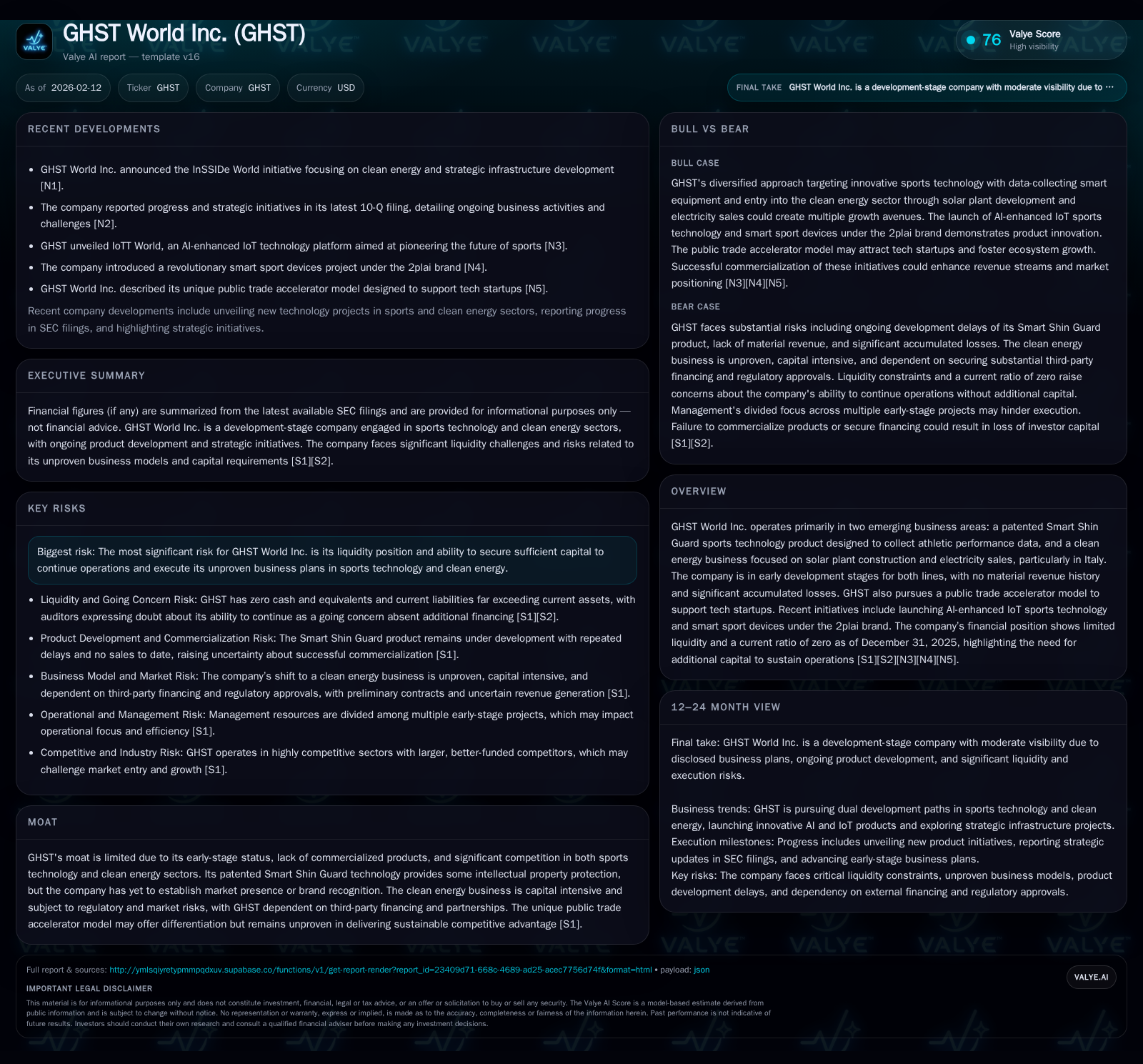
GHST World Inc. pursues a high-risk dual business strategy involving its patented Smart Shin Guard IoT sports device and a burgeoning solar energy venture focused in Italy. Despite intellectual property assets and innovative aspirations, the company remains in early stages with no meaningful revenue generation and confronts severe liquidity constraints, including a zero current ratio as of year-end 2025. Its unique public trade accelerator model further diversifies its profile but lacks operational track record, intensifying concerns about GHST's ability to sustain operations without major capital infusions.
GHST’s Ambitious Dual-Front: Smart Shin Guards Meet Solar Energy
GHST World Inc. stands at the intersection of two cutting-edge yet embryonic arenas: advanced sports technology through its patented Smart Shin Guard and a pivot towards renewable energy via solar plant construction primarily targeted at the Italian market [S1][S2]. This bifurcated approach reflects an entrepreneurial zeal to carve out niches in rapidly evolving but distinct sectors. The Smart Shin Guard serves as a wearable Internet-of-Things (IoT) device aimed at providing detailed athletic performance analytics, while the clean energy division focuses on building infrastructure to generate and sell electricity from solar sources.
However, both branches remain rudimentary; neither has yielded material revenue. Instead, GHST is managing early-stage product development cycles alongside navigating the complex regulatory terrain intrinsic to energy projects. Their parallel pursuits showcase strategic ambition but simultaneously amplify operational complexity given limited resources.
Behind the Patents: Examining the Smart Shin Guard Promise
Central to GHST’s innovation narrative is its Smart Shin Guard technology—an IoT-enabled wearable designed to capture granular athletic data for performance enhancement [S1][S2]. While patent protection grants a legal moat of sorts, it does not immunize the company from significant hurdles. Development progress has lagged expectations, missing several internal milestones which casts doubt on timely commercialization [S1].
The sports tech landscape is fiercely competitive, populated by larger firms with established customer bases and deeper pockets funding continuous R&D cycles. For GHST, converting its patented design into a commercially viable product involves surmounting technological refinement, manufacturing scalability, brand awareness building, and channel establishment—all formidable for an entity lacking proven track records.
Moreover, patent enforcement and intellectual property protection demand resources that may further strain operational capabilities amid tight liquidity.
Clean Energy Aspirations Amidst Capital Constraints
In tandem with sports tech, GHST is pursuing solar plant construction projects coupled with electricity sales concentrating on Italy’s market [S1][S2]. This sector promises long-term revenue streams aligned with global decarbonization trends but comes at a high cost upfront.
The required capital expenditure for developing renewable infrastructure is substantial. GHST's financial disclosures suggest dependency on third-party capital infusions and partnerships to realize these ambitions [S1]. Additionally, fluctuating regulations governing energy markets present layered risks—approval delays, subsidy policy changes, or grid integration challenges can all disrupt timelines and increase costs.
This transition towards an asset-heavy business model diverges from their legacy smart device focus but magnifies funding needs during an already cash-strapped period.
The High-Stakes Risk Profile: Liquidity and Going Concern Warnings
Perhaps most striking is GHST’s precarious financial footing. As of December 31, 2025, current assets were approximately $1,058 against current liabilities surpassing $542,000 — translating into a distressingly low current ratio effectively at zero [F1]. In addition, cash equivalents had vanished earlier as of year-end 2022 [F1].
This imbalance prompted independent auditors to include explicit going concern qualifications within recent filings [S1]. The company’s ongoing operations hinge almost entirely on securing fresh capital quickly enough to meet payrolls, supplier obligations, and developmental outlays. Historical revenue contributions have been negligible ($10k reported for the fiscal year ending 2025) while cumulative losses since inception exceed $14 million [F1][S1], underscoring sustained negative cash flow trends.
Without decisive financial reinforcement or operational pivots generating new cash inflows soon, continuity beyond the near-term remains deeply uncertain.
Competitive Landscape and GHST’s Narrow Moat
Underneath GHST’s dual initiative lies the stark reality of entrenched competition. In sports technology wearables, industry incumbents benefit from decades-long research investments coupled with expansive marketing budgets [S1]. GHST's single patent portfolio does little against this backdrop where brand loyalty matters intensely.
Similarly in clean energy—especially solar—infrastructure giants command scale advantages alongside political influence critical in securing approvals and subsidies. New entrants like GHST encounter steep barriers to entry including price competition from established operators deploying mature technologies.
Hence, while their patented technology offers nominal protection legally speaking, marketplace defensibility remains frail absent proven sales traction or differentiated offerings beyond early-stage prototypes.
Unpacking the Public Trade Accelerator Model’s Potential
Distinctively among startups with ambitious growth agendas, GHST pilots what it calls a "public trade accelerator" designed to support other technology startups [S1]. This approach ostensibly aims to leverage public market access mechanisms creatively as an incubator platform—potentially unlocking synergies not typically accessible privately.
Yet this model remains largely theoretical without demonstrated success cases cited. With limited operating history overall plus active financial pressures constricting resource allocation internally, the accelerator concept currently appears more aspirational than actionable. Moreover, such initiatives pose distraction risks especially if stretched beyond core competencies during critical survival phases.
Financial Snapshot: A Company on the Edge
Quantitatively summarizing underscores GHST’s fragility:
- Revenue stood near $10,367 in 2025—insignificant relative to normal startup ramp benchmarks [F1]
- Net loss approximated $15,935 for same period reflecting persistent negative profitability [F1]
- Zero reported cash balances magnify solvency concerns dating back multiple years [F1]
- Current ratio calculated at zero highlighting severe short-term liquidity mismatch [F1]
- Over $14 million in cumulative losses evidencing continued burn without offsetting income generation since inception [S1] These data points collectively paint a portrait of an enterprise teetering along a razor’s edge where any delay or setback materially escalates existential threats.
Navigating Uncertainty: Forward-Looking Risks and Strategic Pressures
Prospective commentary embedded within SEC filings flags multiple intersecting hazards clouding outlooks:
- Acute reliance on obtaining additional equity or debt financing amid unsettled geopolitical tensions (Ukraine-Israel conflicts) plus inflationary pressures restricting capital markets accessibility [S1]
- Operational execution risks given shifting business model—from delayed smart shin guard commercial launches towards capital-intensive renewable energy deployments—which compound managerial bandwidth demands [S1]
- Market environment volatility potentially curtailing consumer demand for emerging sports technology devices plus heightened regulatory scrutiny affecting clean energy project timelines or economics [S1]
- Potential undisclosed weaknesses emerging in internal controls or litigation related to intellectual property enforceability adding further cost burdens [S1] Together these forces create a multi-front battle necessitating nimble financial stewardship alongside pragmatic realism about achievable milestones under prevailing constraints.
Assessing Potential Catalysts and Pitfalls Ahead
Looking forward over the next twelve months presents mixed signals requiring close observation:
- Positive inflection might derive from finally completing Smart Shin Guard R&D enabling initial commercial launches that validate market acceptance
- Successful strategic partnerships or capital raises supporting scaled solar project implementation could provide durable revenue base diversification
- Conversely failure to secure essential liquidity imminently could precipitate insolvency events
- Regulatory setbacks in Italy around subsidy removal or grid interconnection delays might stall clean energy ambitions indefinitely
- Underperformance of the public trade accelerator platform risks dissipating scarce managerial focus needed elsewhere Overall GHST inhabits a volatile juncture where specific operational successes combined with judicious financial management represent prerequisites for enduring viability whereas setbacks could terminate prospects abruptly.
Disclaimer: This analysis reflects information available as of February 2026 without offering investment advice or recommendations. It incorporates publicly disclosed facts from SEC filings supplemented by general industry context without speculative assertions beyond source data.
Disclaimer: This is research-only, informational analysis and not investment advice. It may include AI-generated interpretation and general industry context. Always verify important details using primary sources.

Comments