GCI Liberty’s Bold Emergence as an Alaskan Telecom Standalone Amid Regulatory and Financial Flux
GCI Liberty, Inc. has transitioned from a Liberty Broadband subsidiary to an independent Alaskan telecom operator navigating unique geographic and regulatory challenges.
Formed in late 2024 and spun off in mid-2025, GCI Liberty now serves as the standalone holding company for GCI’s telecommunications assets across Alaska. The company leverages a multifaceted communications infrastructure integrating fiber, microwave, satellite, and wireless technologies to serve a dispersed population in a difficult terrain. Having exited the video business by end-2025 to sharpen focus on wireless and data solutions, GCI Liberty’s operations are significantly supported by federal subsidies targeting rural connectivity. Despite solid liquidity from a recent rights offering, the company faces ongoing regulatory uncertainty related to subsidies and competitive pressures from emerging satellite technologies. Its financial profile reflects post-separation overhead costs and negative profitability, underscoring the complex balancing act between sustaining network growth and navigating Alaska’s unique market dynamics.
From Subsidiary to Standalone: The Birth of GCI Liberty
The creation of GCI Liberty marks a defining structural transformation within the Liberty family of companies. Established in December 2024 specifically to hold the GCI Business — encompassing GCI LLC, GCI Holdings LLC, and their subsidiaries — the company emerged from an internal reshuffling by Liberty Broadband culminating on July 14, 2025. This reorganization transferred full ownership of GCI’s operational assets from Liberty Broadband into the newly formed entity through an exchange of stock and liability assumption [S1].
Critically, this separation was accompanied by a nuanced stock reclassification into three series classes (GLIBA, GLIBB, GLIBK), effectuating shareholder alignment post-distribution while also issuing non-voting preferred shares that were sold to third parties. These preferred shares carry a significant fixed dividend rate of 12%, underscoring a commitment to meet investor income expectations despite nascent standalone status [S1].
Intercompany agreements enacted at the time—covering tax sharing arrangements and service contracts with Liberty Media—reflect an intent to ease transitional frictions inherent in newly autonomous operations. For example, recurring services from Liberty Media including legal and investor relations support come at a manageable annual cost near $5 million [S1]. Together, these elements establish GCI Liberty not just as an isolated spinoff but as a carefully calibrated operator prepared to address Alaska's telecom demands distinctively.
Leveraging Infrastructure: A Moat Built on Alaska’s Challenging Terrain
Alaska presents one of North America’s toughest telecommunications environments: expansive geographies with low population density interspersed across mountain ranges, tundra, and remote settlements. GCI Liberty’s competitive strength is anchored by an integrated network infrastructure combining fiber optic lines for backbone connectivity; microwave transmissions bridging difficult spans; satellite technology covering isolated areas; alongside comprehensive deployment of advanced wireless services including 5G and legacy 4G LTE networks [valye_report_excerpt].
This multi-modal approach yields exceptional coverage capabilities unmatched by much larger national competitors constrained by mainland-centric footprints. Moreover, regulatory licenses granting spectrum usage create entry barriers that protect incumbent advantages. The steady infusion of public funds via federal universal service programs (USF) and local grants compensates for high operating expenses endemic to rural Alaska markets [valye_report_excerpt]. This funding is instrumental in reaching underserved customers who would otherwise remain disconnected due to prohibitive costs.
Customer loyalty is further nurtured through bundled offerings spanning voice, data, managed services for residential users as well as government, medical, education sectors—sectors often prioritized for subsidized connectivity. The result is a deeply entrenched market position requiring substantial capital expenditure commitment but yielding reliable revenue streams buttressed by durable governmental support [valye_report_excerpt].
The Exit from Video: Strategic Focus on Wireless and Data Services
By fully withdrawing from the video business by late 2025—a legacy segment that historically demanded heavy content licensing fees and infrastructure investments—GCI Liberty effectively realigned its core focus towards data-centric services more aligned with contemporary demand patterns [S1][valye_report_excerpt].
This pivot reflects both market realities where over-the-top streaming platforms disrupt traditional pay-TV models and strategic pragmatism about capital allocation amid competitive pressures in broadband provisioning.
Redirecting capital freed from video operations bolsters investment capacity into expanding wireless footprints and enhancing broadband reliability—a critical differentiator in Alaska's patchwork communities. It also simplifies operational complexity allowing resources—from technical staff to network management—to concentrate on the most promising growth vectors within Alaska's unique telecom ecosystem.
Financial Recalibration: Understanding the Impact of the Separation and Rights Offering
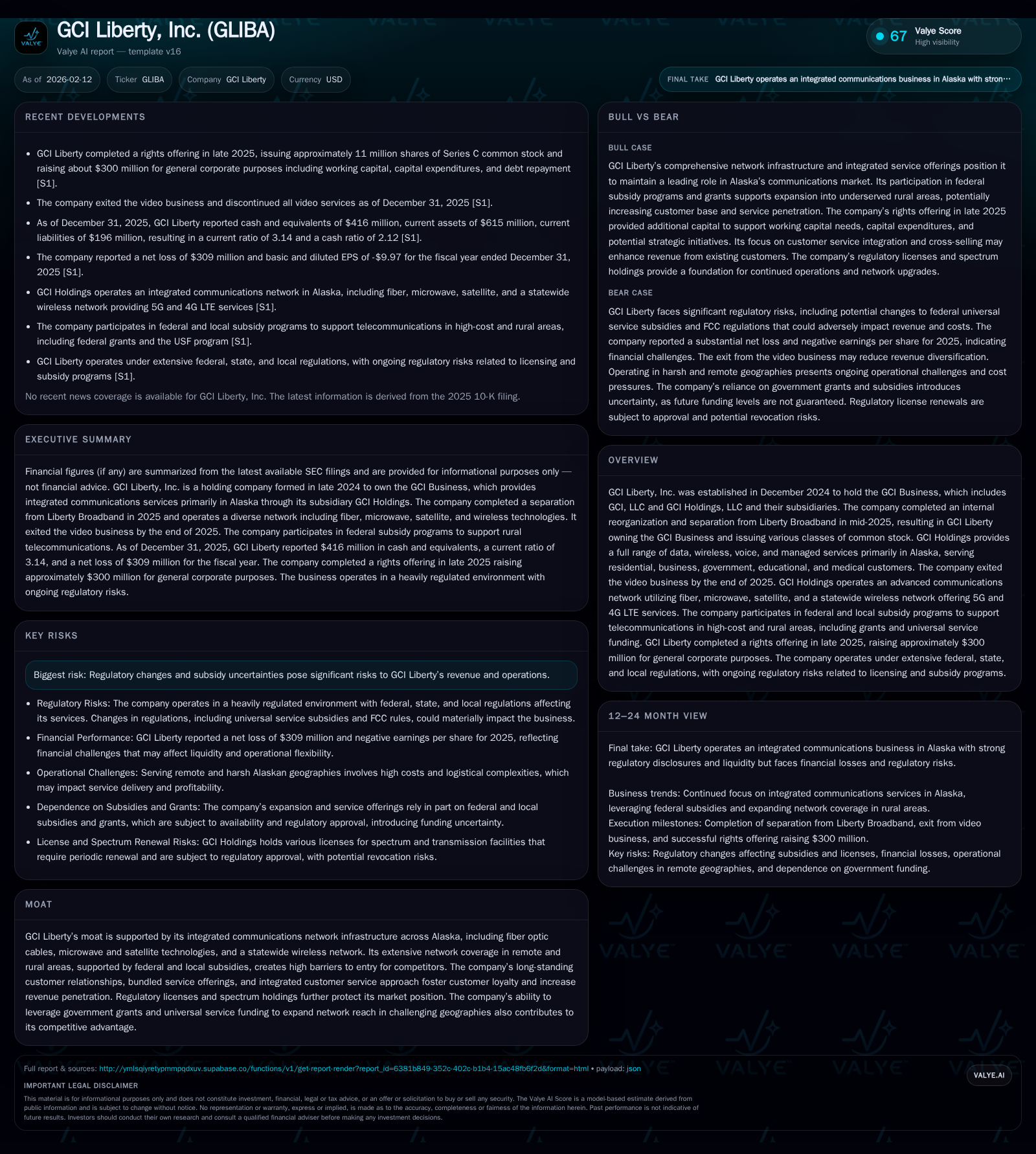
With independence came extensive financial recalibration. As of year-end 2025, GCI Liberty demonstrated solid immediate liquidity figures: cash and equivalents stood at $416 million against current liabilities of $196 million yielding a well above par current ratio near 3.14 [F1]. This liquidity reflects prudent working capital stance necessary for sustained capital-intensive operations across harsh terrains.
However, profitability remains challenged with reported net losses reaching -$309 million in 2025—a reflection partly attributable to separation-associated costs including standalone corporate overhead (~$5 million annually) plus fees payable under service agreements with Liberty Media [F1][S1]. These expenses underscore the incremental financial burdens imposed post-separation compared to prior consolidated structures.
The November–December 2025 rights offering further fortified finances by raising roughly $300 million via issuance of Series C common stock at a discounted price relative to trading levels [S1]. The proceeds furnish flexibility for general corporate purposes ranging from capital expenditures needed for infrastructural upgrades to potential repayment or refinancing of existing debt instruments.
Crucially, this fundraising episode signals strategic intent not only to stabilize balance sheet fundamentals but also preserve optionality for investments or acquisitions aligned with long-term growth objectives.
Navigating Regulatory and Subsidy Uncertainties in Rural Telecom
Subsidies provided through frameworks like the Federal Communications Commission's Universal Service Fund represent lifelines enabling financially viable operations across Alaska’s high-cost rural zones. Yet these same subsidies introduce exposure to evolving political deliberations around telecom funding mechanisms [valye_report_excerpt][S1].
Regulatory risks include potential reinterpretation or challenge of USF statutes that could directly curtail allocated support payments jeopardizing core revenue bases [S1]. Beyond subsidy volatility lies broader regulatory scrutiny impacting licensing conditions or new mandates on service standards—any material shift could impose significant compliance expenditures or alter competitive dynamics.
GCI Liberty must maintain proactive engagement with regulators while demonstrating efficient use of public funds amidst increasing demand for enhanced connectivity nationwide. Balancing these factors will be pivotal as policies adapt under changing administrations or technological landscapes.
Competition and Innovation: Responding to Satellite and AI Challenges
The telecommunications space servicing remote geographies like Alaska faces intensifying competition notably from emerging non-geostationary satellites constellation providers aiming to deliver broadband globally at competitive speeds [S1]. This represents a disruptive threat capable of eroding traditional subscriber bases particularly among consumers valuing mobility or lacking ground infrastructure.
Concurrently, incorporation of artificial intelligence tools within network management or customer service presents both opportunity and risk fronts. Effective AI deployment can enhance operational efficiency but raises new considerations around legal compliance, privacy concerns, reputational impacts if mishandled [S1].
For GCI Liberty, staying abreast of these disruptive trends requires agile innovation pipelines coupled with careful risk mitigation frameworks ensuring regulatory adherence without stifling technological advancement.
Risks Embedded in Geography and Market Concentration
Operating predominantly within Alaska subjects GCI Liberty to specific localized vulnerabilities absent broad geographic diversification benefits. Economic downturns linked to regional industries (oil & gas fluctuations), demographic shifts such as population migration trends out of rural communities could suppress long-term demand growth [S1][valye_report_excerpt].
Geophysical hazards capable of physical network disruption include extreme weather events or seismic activity compounded by logistical challenges inherent in rapid restoration efforts [S1]. Additionally, cybersecurity threats represent systemic risks given increasing interconnectedness of critical infrastructure requiring constant vigilance.
Dependency on select communications equipment vendors introduces supply chain risks that could hamper timely deployment or maintenance cycles with downstream customer impact if disrupted [S1]. Climate change implications add further uncertainty around operational continuity especially considering increasing environmental regulations relevant to infrastructure installation or modification.
Capital Structure and Liquidity in a Post-Separation World
GCI Liberty’s capital structure features prominently its issuance of non-voting preferred stock carrying a fixed dividend yield of 12% payable until mandatory redemption slated for July 2032 [S1]. This imposes steady cash outflows irrespective of operating performance placing pressure on free cash flow availability.
Variable rate indebtedness compounds interest expense exposure susceptible to shifts in macroeconomic interest rates potentially inflating financing costs requiring attentive treasury management strategies [S1][F1]. Meanwhile elevated corporate overhead consistent with standalone public company requirements adds steady fixed cost layers absent economies previously achievable within larger conglomerate frameworks.
Nevertheless, strong liquidity evidenced post-rights offering enhances debt servicing capability reducing refinancing strain near term though ongoing discipline will be necessary especially if revenue growth proves inconsistent or capex requirements escalate substantially.
Looking Forward: Growth Drivers and Potential Strategic Moves
Future prospects hinge upon leveraging integrated multi-technology networks capable of meeting heightened demand for robust wireless data connectivity critical across residential, commercial, institutional sectors in Alaska [valye_report_excerpt][S1]. Scaling advanced 5G services alongside maintaining extensive legacy systems ensures breadth of reach required given diverse customer needs.
Capital raised allows pursuit not only of organic investment supporting network extension into unserved locales but also selective strategic acquisitions or partnerships aimed at bolstering footprint or technology capabilities without overleveraging balance sheets [S1]. Navigation through changing subsidy landscapes necessitates adaptability measured deployment ensuring cost recovery aligns with anticipated returns.
In sum, GCI Liberty stands at an inflection point characterized by newfound autonomy tempered by intricate operational demands unique to Alaskan topology combined with evolving regulatory environments shaping future sustainability paradigms.
This report is prepared solely for informational purposes based on publicly available data as of early 2026. It does not constitute investment advice or recommendations regarding securities transactions. Readers should conduct their own due diligence before making any financial decisions related to GCI Liberty or its industry peers.
Disclaimer: This is research-only, informational analysis and not investment advice. It may include AI-generated interpretation and general industry context. Always verify important details using primary sources.

Comments