
NBT Bancorp’s Regional Strength Drives Profitability and Shareholder Returns
NBT Bancorp leverages regional market depth and diversified lending to sustain strong earnings and disciplined capital returns.
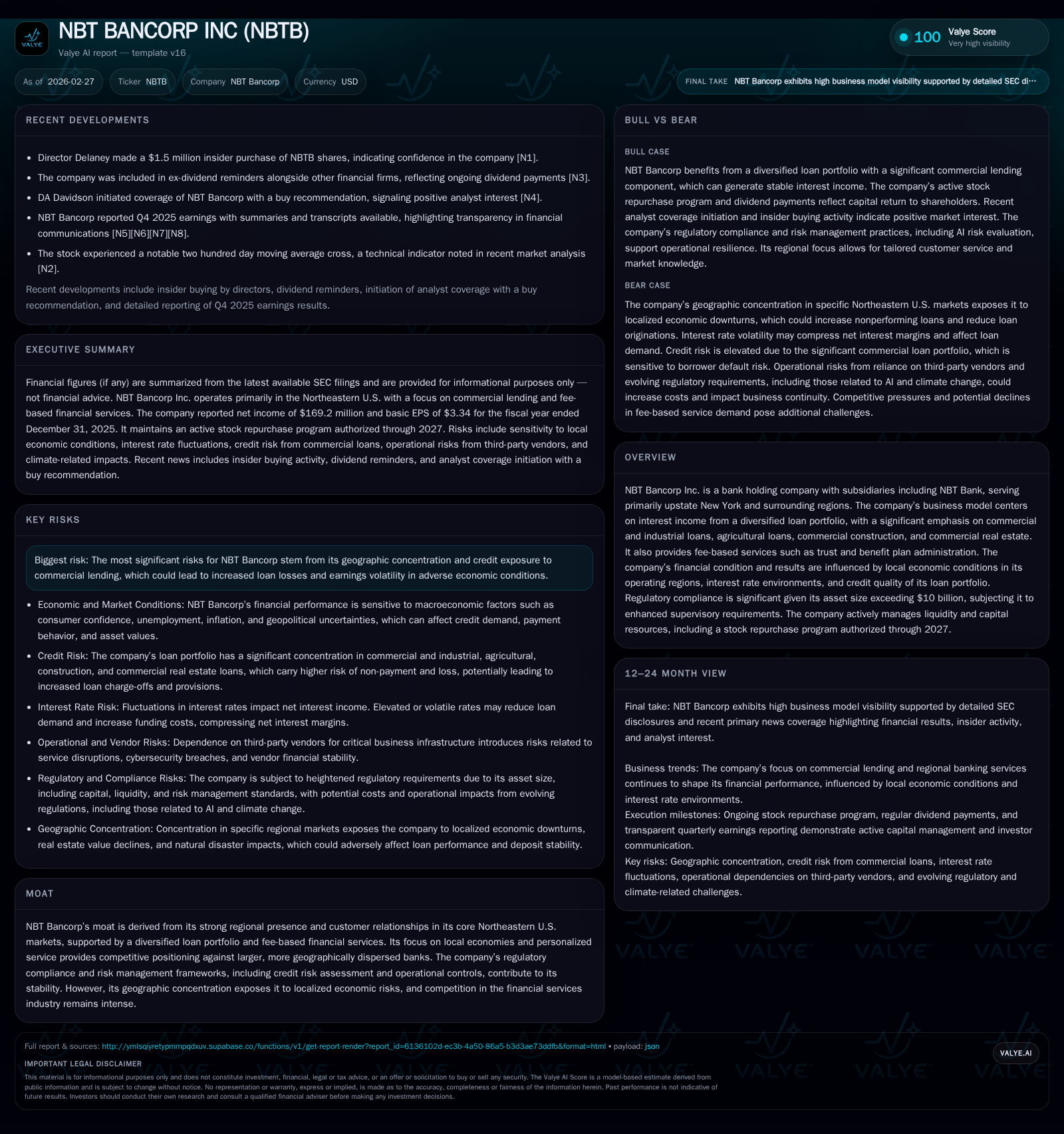
In 2025, NBT Bancorp exhibited a robust 20.3% increase in net income, reflecting strategic management of its diversified loan portfolio focused on commercial, agricultural, and real estate segments within the Northeastern U.S. This growth was supported by effective capital allocation policies, including steady dividend increases and a renewed stock repurchase authorization extending through 2027. Despite geographic concentration risks tied to local economic conditions, NBT's capital and liquidity position remains solid under enhanced regulatory oversight for institutions exceeding $10 billion in assets.
Historical Growth Performance and Loan Portfolio Drivers
NBT Bancorp's financial journey from FY2022 through FY2025 illustrates a noteworthy rebound and acceleration in profitability that underscores the strength of its core business model centered on diversified lending. Net income figures according to [F1] show a dip from $152 million in FY2022 down to $119 million in FY2023 before climbing markedly to $140.6 million in FY2024 and ultimately reaching $169.2 million by the end of FY2025 — representing a year-over-year growth of 20.3%. This recovery reflects improved credit quality management while growing commercial loan segments that include industrial, agricultural, commercial construction, and commercial real estate loans as highlighted in [S1].
The loan composition leans heavily on higher-yielding commercial categories which naturally introduce elevated risk profiles but also offer stronger interest income generation potential compared to residential loans. NBT’s footprint in upstate New York and adjoining Northeastern markets means the company’s credit performance is sensitive to localized economic cycles affecting these sectors ([S7],[S19]). The combination of fee-based trust services supplements interest-driven revenues providing some balance against cyclical loan demand.
Historical performance (annual)
| FY | Net ($mm) | CFO ($mm) | Capex ($mm) | Net YoY |
|---|---|---|---|---|
| 2025 | 169 | 235 | 16 | +20.3% |
| 2024 | 141 | 189 | 12 | +18.4% |
| 2023 | 119 | 157 | 9 | -21.9% |
| 2022 | 152 | 183 | 7 |
Source: SEC companyfacts cache [F1].
Capital returns and efficiency (annual)
| FY | Div ($mm) | Buybacks ($mm) | FCF ($mm) |
|---|---|---|---|
| 2025 | 73 | 10 | 219 |
| 2024 | 62 | 0 | 177 |
| 2023 | 56 | 5 | 148 |
| 2022 | 50 | 15 | 176 |
Source: SEC companyfacts cache [F1].
Geographic Concentration: Opportunity Meets Local Market Risk
NBT's operational focus squarely targets upstate New York along with adjacent areas of Pennsylvania and New England states such as Vermont and New Hampshire ([S7],[S13]). This concentrated regional presence fosters deep customer relationships underscored by local knowledge that larger national banks often lack — constituting an important moat powered by personalized service and tailored lending expertise.
However local economic dependence introduces distinct vulnerabilities; downturns in regional industry sectors or declines in residential/commercial real estate values could impair collateral quality leading to increased nonperforming loan ratios and credit losses ([S10],[S11]). Regulatory disclosures emphasize that severe weather events and climate-related risks may further affect physical assets securing loans ([S7],[S22]). While geographic homogeneity facilitates underwriting vigilance focused on specific market conditions it inherently constrains diversification benefits making credit volatility a persistent challenge.
2025 Financial Highlights: Earnings, Cash Flow and Capital Efficiency
The financial trajectory across key metrics underscores improving efficiency at scale characterized by an approximate return on equity of roughly 8.9% calculated using the FY2025 net income of $169 million over equity totaling close to $1.9 billion [F1]. Operating cash flow grew markedly by nearly one quarter to $235 million even as capital expenditures increased by nearly two-fifths reflecting investments in technology platforms and branch modernization crucial for competitive positioning [F1]. Free cash flow remained robust at approximately $219 million after accounting for capex expenditures.
Dividend distributions increased steadily over this timeframe supporting shareholder income needs while modest share repurchases resumed more actively during late-2025 with around 250 thousand shares bought back at an average price of $40.74 per share under the amended program expiring end-2027 ([S5]). These shareholder return elements evidence balanced capital stewardship aligned with organic growth funding needs.
Capital Allocation Strategy: Dividends and Buybacks
Capital deployment demonstrates consistent prioritization of dividends alongside opportunistic share repurchases underpinned by ample retained earnings ([S5],[F1]). The current dividend yield stands near a notable 3.41% ([N14]), appealing within the regional banking peer spectrum especially given steady dividend growth trajectories from approximately $50 million paid out in FY2022 to over $72 million by FY2025 [F1].
The October 2025 board authorization raised the share repurchase ceiling to two million shares through year-end 2027 signifying ongoing confidence amid fluctuating depositor behavior following sector-wide shocks seen more broadly in banking ([S5]). Management frames buybacks mainly as measures to offset dilution from incentive plans but also reflect underlying optimism about valuation levels ([N14]).
Balance sheet prudence is evident with equity growth complemented by disciplined leverage maintaining comfortable regulatory capital buffers within new supervisory regimes earmarked for banks over $10 billion in assets ([S4],[S23]).
Liquidity Position and Regulatory Compliance Post-2023 Banking Sector Shocks
Liquidity management became an acute focus following sector perturbations seen in early-2023 with NBT highlighting "basic surplus" as its critical liquidity metric capturing both reliable cash sources versus funded liabilities ([S4],[S6],[S9],[S19]). NBT maintains diverse funding channels including core deposits supplemented by access to federal funds borrowings and brokered time deposits allowing rapid scaling or contraction.
Competitive pressures that might force deposit pricing increases or trigger attrition could pose net interest margin compression risks affecting earnings visibility ([S6],[S21]). Enhanced regulatory requirements apply since crossing regulatory asset thresholds well above $10 billion adding layers of compliance cost but also oversight safeguards aimed at stability ([S10],[S23]).
Forward-Looking Considerations: Economic Trends and Credit Quality Risks
Recent commentary reiterates that demand for loans closely tracks economic dynamics across core operating markets where consumer/business confidence shifts modulate credit uptake routines ([N1],[N2],[N7],[S1],[S27]). Rising or volatile interest rate environments pose dual effects impacting asset yields versus borrowing costs necessitating nimble asset-liability management ([S21]).
Credit loss provisioning remains an area subject to material judgment given economic uncertainties coupled with exposure concentrations within commercial portfolios ([S19],[S20]). Competitive environment intensifies amid consolidation waves thereby requiring careful product innovation balanced with risk appetite controls ([N7],[S8]).
Key Metrics to Watch: ROE; Loan Growth; Deposit Stability; Fee Income Dynamics
In addition to formal earnings forecasts not publicly issued at this time , close monitoring will be warranted around return on equity sustainability near current mid-to-high single-digit levels amid evolving credit conditions ([N11]). Loan growth relative to deposit inflows will be critical indicators of liquidity stress or margin pressures. Fee income trends from trust services also merit attention as recurring revenue sources that partially offset cyclical interest income swings intrinsic to regional banking models ([N11]). Insider acquisitions reported alongside increased analyst interest underscore prevailing management confidence anchored in execution fundamentals ([N8],[N12],[N14]).
This analysis incorporates publicly available SEC filings and recent news materials up through February 27th of fiscal year ending December 31st, 2025. All numeric data cited derives directly from company filings or company-approved releases without extrapolation beyond stated values. It is intended solely for informational purposes without any recommendation regarding securities transactions.
Disclaimer: This is research-only, informational analysis and not investment advice. It may include AI-generated interpretation and general industry context. Always verify important details using primary sources.

Comments