
Nevada Canyon Gold’s Exploration and Royalty Model Faces Development and Financing Hurdles
A junior exploration company reliant on third-party operators, Nevada Canyon Gold's recent quarterly highlights ongoing drilling at key projects amid sustained operational risks and funding challenges.
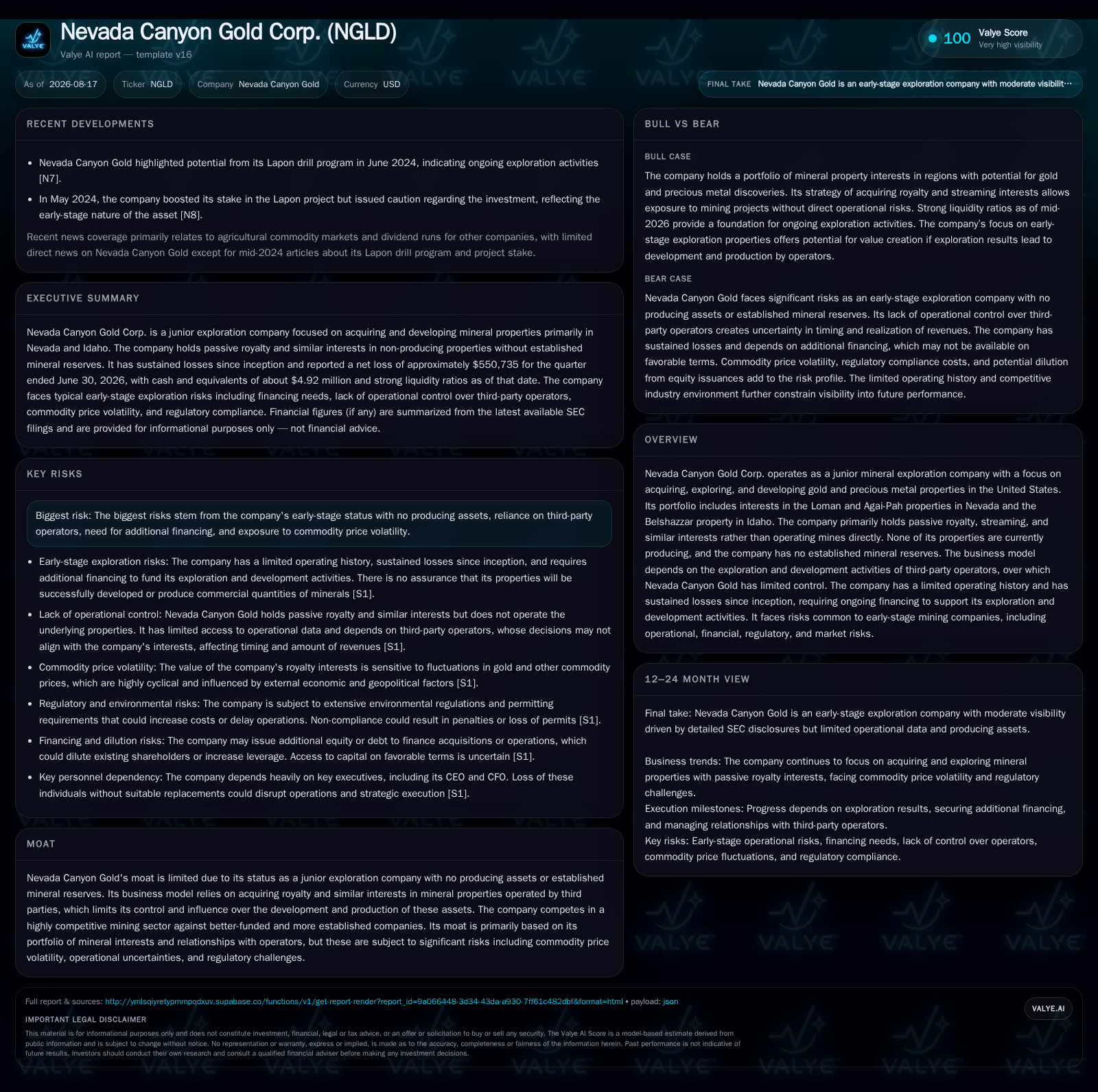
Nevada Canyon Gold Corp. operates as a junior mineral exploration company with a portfolio of royalty and streaming interests in U.S. precious metals properties. Its latest quarterly report confirms advancing exploration activities, notably drilling programs under third-party operator Walker River Resources, but without direct control or producing assets. The company remains dependent on external financing to sustain operations, facing typical industry risks including commodity price fluctuations, regulatory uncertainties, and operational execution by partners. Its business model contrasts with mid-tier producers by monetizing passive interests rather than mine operations, making revenue contingent on operators’ development progress. Key growth drivers include successful exploration results and rising gold prices, while watchpoints center on capital access, operator alignment, and regulatory compliance.
Recent Operating Update
Nevada Canyon Gold Corp.’s latest quarterly filing dated August 14, 2026 underscores continuation of active exploration efforts centered around the Lapon Canyon Project in Nevada. This property is operated by Walker River Resources Corp., owner of the project where Nevada Canyon holds an Exploration Stream Earn-in Agreement alongside royalty interests [S2][S3]. Walker River initiated a reverse circulation (RC) drilling program in mid-2026 to advance the project’s geological understanding. Though the company does not operate the mine directly, news flow from operator updates informs investors about progress relevant to potential future revenue streams via its royalties and streaming arrangements.
Apart from Lapon Canyon, Nevada Canyon’s asset base includes the Loman and Agai-Pah properties in Nevada and the Belshazzar property in Idaho — all non-producing mineral prospects without established reserves yet in early-stage exploration or pre-development phases [S1]. The company’s financial statements reflect no ongoing mining revenues; for example, annual reported revenue is negligible with operating loss continuing into recent periods [F1]. Accordingly, operational progress remains anchored to successful third-party advancement on partnered projects.
Business Model Analysis
Nevada Canyon’s business model typifies junior mineral exploration companies that selectively acquire rights such as royalty interests or streaming agreements rather than owning or operating producing mines directly [S1]. These interests entitle the company to a share of production proceeds or revenues generated by third-party operators without incurring direct mining operational costs.
Revenue mechanics hinge entirely on these operators’ development milestones including final feasibility studies, permitting approvals, capital investment decisions and ultimately production output. Therefore, exploration expenditure budgets are typically passed through to partners who assume operational risk while Nevada Canyon retains exposure mostly as a non-operating investor.
This passive royalty/streaming approach inherently restricts the company’s control over timing and pace of value realization but also limits operating expenses relative to full-scale miners. However, despite lower fixed costs, this structure amplifies reliance on successful operator execution and commodity price favorability to translate asset potential into cash flows.
Industry Structure and Competitive Position
In the precious metals mining landscape, Nevada Canyon stands among junior explorers whose primary value inflection arises from proving resource upside through drilling programs supported by capital markets financing. Unlike mid-tier producers such as Barrick Gold or Newmont Corporation which generate steady cash flow from diversified production operations, juniors often lack recurring revenues until assets enter commercial development stages.
Nevada Canyon's peer set includes other royalty and streaming companies like Franco-Nevada Corporation or Wheaton Precious Metals which also hold interests across various producing mines but generally benefit from broader portfolio scale and stable cash flow profiles derived from multiple producing assets. By contrast, Nevada Canyon's portfolio remains concentrated in early-stage properties requiring substantial advancement before production-related revenues commence.
Therefore, the company competes not only in acquiring promising mineral rights but also against better-capitalized entities with track records of executing mine development or securing long-term streaming contracts with major producers.
Growth Drivers
Fundamental drivers shaping Nevada Canyon’s growth trajectory center around:
- Exploration Success: Positive drill results extending mineralization can materially enhance resource estimates underpinning valuation uplift for royalty/stream positions.
- Strategic Acquisitions: Expanding its royalty/stream portfolio at attractive terms can diversify risk exposure while positioning for multiple optionality paths toward production.
- Rising Commodity Prices: Increasing gold prices raise projected future cash flows from royalties as operator economics improve and project economics become more viable.
- Partnership Execution: Collaboration with reputable operating partners advancing projects through feasibility studies, permitting cycles, and mine construction boosts prospects for converting assets into producing streams.
- Permitting Outcomes: Obtaining required environmental licenses timely mitigates development delays which can erode partnership successes.
Each driver is measurable via KPIs like number of drill holes completed by operators (noted recently at Lapon Canyon), incremental changes in resource estimations announced via technical reports from operators, permit approvals granted at state/federal levels for individual projects under management oversight by partners [S3][S22].
Risks and Watchpoints
The nature of Nevada Canyon's upstream position entails significant risk factors:
- Operator Dependence: Limited influence over mine development milestones exposes the company to delays or adverse decisions by partners including those deprioritizing areas generating royalties.
- Financing Requirements: Ongoing capital needs for exploration activities necessitate fresh equity/debt raises; failure could curtail operations or hamper ability to acquire new royalties [S1][S14].
- Commodity Price Volatility: Fluctuating gold prices impact asset values profoundly since lower prices might stall operator investment or lead to suspended developments reducing expected royalty income [S28].
- Permitting/Regulatory Delays: Environmental regulations stricter compliance requirements raise costs/timelines for advancing projects; failure to secure permits blocks progress altogether [S5][S6][S11].
- Portfolio Concentration: Current holdings focus primarily within Nevada/Idaho regions; adverse geological findings or operational setbacks in one large asset could disproportionately harm overall outlook [S14].
- Market Sentiment & Liquidity: Junior explorers face high share price volatility influenced by investor appetite for mining risk amid macroeconomic shifts impacting capital markets access [S12][S29].
Operationally material watchpoints include: monitoring results announcements from Walker River as operator at Lapon Canyon for evidence of expanding zones or moving forward with feasibility work; verification of updated geological models; assessment of financing rounds addressing working capital sustainability; alerts on permit applications status or community engagement outcomes related to property development plans.
What To Watch Next
Upcoming catalysts likely include:
- Progression reports from Walker River’s drilling programs through Q3-Q4 2026 highlighting assay results or updated geophysical surveys could influence market perceptions of underlying asset potential [S3][S22].
- Company announcements regarding securing additional financing facilities or partnerships enabling further acquisitions or accelerating initiation of new joint ventures would be critical indicators of growth capacity [F1][S14].
- Regulatory filings disclosing permit application approvals or setbacks especially concerning Loman/Agai-Pah properties will signal regulatory risk trajectory affecting near-term development plans.
- Strategic moves towards augmenting royalty streams possibly via deals funneling production rights from advancing mines represent leverage points transforming valuation from pure exploration risk towards revenue-generating stages.
Financial Profile Discussion
Nevada Canyon Gold exhibits a typical junior explorer financial profile characterized by limited cash flow generation given absence of producing assets combined with recurring net losses linked to ongoing administrative costs and investment in early-stage project facilitation. Latest data shows cash & equivalents poised at approximately $4.9 million as of June 30, 2026 supporting current operations albeit within constrained runway parameters requiring vigilant capital management [F1]. The reported total debt levels remain trivial (~$515) indicating a largely unleveraged balance sheet offering financial flexibility but underscoring reliance on equity funding sources rather than debt instruments which would be challenging without predictable revenue streams [F1]. The company's current ratio approximates a healthy 4.45 ratio signaling adequate short-term liquidity coverage although this metric rarely captures the episodic timing demands typical to exploration cycles [F1].
Revenue remains negligible reflecting that no royalties or streams have yet matured into substantive cash inflows. Net losses persist driven mainly by general corporate expenses plus periodic carrying costs associated with maintaining property interests prior to commercial viability realization.
Disclaimer: This analysis reflects publicly available information up to August 17, 2026. It provides an informed perspective based on documented filings without speculative forecasting or investment research views.
Disclaimer: This is research-only, informational analysis and not investment advice. It may include AI-generated interpretation and general industry context. Always verify important details using primary sources.

Comments