
NanoViricides' Growth Hinges on NV-387 Phase II Trials and Broad-Spectrum Antiviral Promise
Clinical advancement of NV-387 and strategic partnerships remain critical for commercialization prospects.
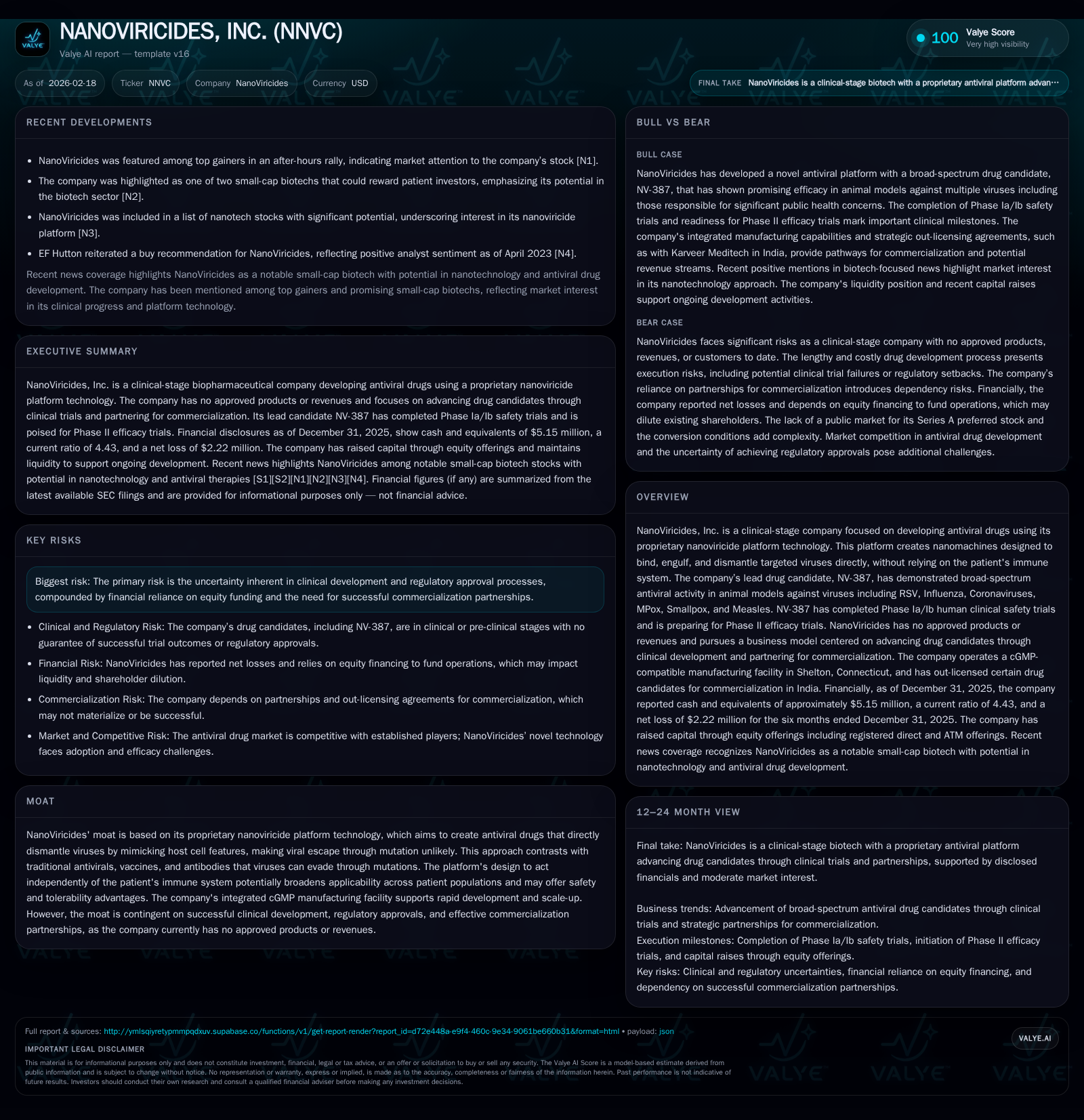
NanoViricides, Inc. is a clinical-stage biopharmaceutical company leveraging proprietary nanoviricide platform technology to develop broad-spectrum antiviral drugs, most notably the lead candidate NV-387. Historically, the company has expanded its pipeline through preclinical studies and completed Phase Ia/Ib safety trials for NV-387, with Phase II efficacy trials underway. Although NanoViricides currently lacks revenue streams and approved products, its focus on a novel mechanism that limits viral resistance positions it uniquely in the antiviral space. Key future growth drivers include successful Phase II data and potential strategic collaborations, while capital structure relies heavily on equity financing without dividends or buybacks.
Company Overview
NanoViricides, Inc. is a clinical-stage pharmaceutical entity pioneering antiviral drug development using its nanoviricide platform technology. This innovative platform engineers polymeric micelles functionalized with ligands mimicking host cell surface receptors to directly bind, engulf, and dismantle targeted viruses. Unlike conventional antivirals or vaccines that elicit immune responses or inhibit specific viral enzymes—often susceptible to viral mutations—the nanoviricide design anticipates and mitigates viral escape through mutation by mimicking cellular mechanisms [S1][S3][S22].
The company’s flagship drug candidate is NV-387, positioned as a broad-spectrum antiviral agent effective against several high-impact viruses including Respiratory Syncytial Virus (RSV), Influenza strains (including Asian bird flu), various Coronaviruses (including SARS-CoV-2), orthopoxviruses (MPox/Smallpox), and Measles virus [S3][S6]. The technology’s breadth aims not only at pandemic-relevant pathogens but also targets endemic infections lacking safe antiviral options.
Historical Performance
NanoViricides remains pre-revenue with no approved products yet. Progress has been primarily funded through equity raises alongside strategic licensing agreements with TheraCour Pharma (a related party) holding key intellectual property rights [S5]. The company completed Phase Ia/Ib human safety trials for NV-387 and has demonstrated robust proof-of-concept in multiple animal models indicating potential superiority or equivalency relative to existing therapies such as Oseltamivir or Ribavirin in lethal infection challenges [S3][S6][S27].
From a financial perspective, operating income has reflected continued investment in R&D activities:
Historical performance (annual)
| FY | Net ($mm) | CFO ($mm) | OpInc ($mm) | Capex ($) | Net YoY |
|---|---|---|---|---|---|
| 2025 | -9 | -8 | -10 | 56964 | -14.1% |
| 2024 | -8 | -6 | -9 | 156560 | +3.4% |
| 2023 | -9 | -6 | -9 | 151712 | -5.9% |
| 2022 | -8 | -6 | -8 | 324348 |
Note: Omitted columns lack sufficient annual XBRL coverage in the provided tags (need ≥2 annual points): Rev, Div, Buybacks. Source: SEC companyfacts cache [F1].
Capital returns and efficiency (annual)
| FY | FCF ($mm) | ROE% |
|---|---|---|
| 2025 | -9 | -125.9 |
| 2024 | -6 | -72.3 |
| 2023 | -6 | -57.8 |
| 2022 | -6 | -35.1 |
Source: SEC companyfacts cache [F1].
Source: SEC filings [F1]
Operating losses expanded by approximately 12.6% year-over-year into FY2025 reflecting intensified clinical trial preparations and manufacturing activities for NV-387. Correspondingly, net income deterioration outpaced operating loss growth slightly due to other expenses.
Operating cash flow deficit increased sharply (-34%) indicating higher burn associated with trial conduct and scaling up of manufacturing capabilities albeit under tight capital expenditure constraints (down ~64% YoY). The company is managing cash prudently given the absence of immediate revenue inflows.
Equity reduced significantly (~35%) due to accumulated losses with no offsetting capital injections within the fiscal year prior to the November 2025 financing event [F1][S18]. This results in an approximate negative return on equity near 126%, common among early-stage clinical developers without revenues.
Growth Drivers & Future Prospects
NV-387 Clinical Development as Growth Catalyst
The core driver of NanoViricides' future growth hinges critically on the success of NV-387’s ongoing and planned clinical trials:
Phase II Adaptive Basket Trial: Designed as an "emperic therapy" test targeting Viral Acute Respiratory Infections regardless of viral etiology—including RSV, Influenza, Coronaviruses—and potentially adenoviruses or rhinoviruses [S15][S17]. Achieving statistically significant efficacy could validate NV-387 as a go-to broad-spectrum antiviral enabling more cost-efficient drug development pathways.
Orthopoxvirus Indications: Including MPox infection trials in Democratic Republic of Congo aiming at initial proof of concept that could facilitate Smallpox therapeutic approval under FDA's Animal Rule regulatory pathway [S6][S15][S22]. Given current unmet needs—most existing treatments like Tecovirimat have demonstrated inadequate efficacy or tolerability—the potential biodefense applications offer significant addressable markets supported by government funding interest.
Measles Treatment: Rising measles incidence observed globally including North America points toward additional opportunities if clinical efficacy is shown [S27].
Platform Versatility
The platform's modularity allows rapid adaptation across diverse viral families beyond current indications: efforts are underway exploring HIV/AIDS candidates supported by animal model activity data warranting further development [S3]. The scalable cGMP manufacturing infrastructure also enables quick transition from lab-scale production toward commercial supply if approvals are attained.
Partnerships & Funding Outlook
The company actively pursues non-dilutive government grants focused on biodefense / pandemic preparedness along with industry collaborations primarily targeting Asian markets initially but planning Western pharma engagements as clinical data matures [S3]. Licensing arrangements with TheraCour ensure access to patented technology though milestone payment structures lack full alignment with standard pharma industry norms [S5].
Recent capital raises including the November 2025 registered direct offering plus attached warrants generated gross proceeds approximating $6 million ($5.4 million net), providing runway into late-stage trials [S18]. Additionally, the ATM program continues to supplement working capital needs albeit at variable volumes each quarter.
Expectations & Risk Factors
Due to the early-stage nature:
- Clinical trial outcomes remain uncertain; failure or delays would severely impact valuation and viability.
- Regulatory approval pathways for nanomedicines can pose unique challenges.
- Dependence on equity markets creates dilution risk amid volatile biotech sentiment.
- Commercialization depends largely on partnering success since NanoViricides lacks sales infrastructure.
Upcoming milestones worth monitoring:
- Initiation and interim readouts from Phase II basket trial targeting respiratory viral infections.
- Completion/results from MPox phase II trials advancing toward Smallpox approval under the Animal Rule.
- Regulatory feedback on planned formulations including oral gummies facilitating patient adherence contrasted with injectable/nebulized options better suited for severe cases [S15].
Capital Allocation & Returns Analysis
NanoViricides operates without revenue generation; thus, cash inflows derive almost exclusively from equity offerings:
- No dividends declared or share repurchase activities reported.
- Operating cash flow consistently negative; FCF estimated near negative $8.54 million in latest fiscal year when accounting for modest capex spending.
- Equity base shrinking due to operating losses emphasizes need for continuous capital raises risking shareholder dilution without product commercialization near term.
Industry Context (Analysis)
Broad-spectrum antivirals remain an elusive but highly sought pharmaceutical category given the high mutational rate of viruses limiting vaccine/monoclonal antibody effectiveness over time—underscored recently by COVID's evolution dynamics. Conventional small molecules often face resistance quickly due to narrow target scope.
NanoViricides innovative nanoviricide approach seeks to circumvent classical resistance pathways via physical binding and dismantling mechanisms independent of antigen variability—a concept potentially revolutionizing frontline antivirals akin to broad-spectrum antibiotics in bacterial infections, if clinical hurdles are cleared successfully.
Manufacturing polymeric micelle-based nanomedicines at scale involves sophisticated process control requiring stable polymer synthesis plus ligand conjugation reproducibility; NanoViricides’ cGMP-capable facility offers strategic advantages by internalizing these capabilities rather than outsourcing early production [S1].
Summary & Outlook
NanoViricides stands at an inflection point where advancing Phase II proof-of-concept efficacy data could unlock both validation of its technology and substantial licensing/commercial opportunities globally across unmet viral diseases spanning common colds to biodefense threats. However, this is balanced against inherent clinical stage risks amplified by financial reliance on equity markets in absence of revenues or partnerships currently providing material cash inflows beyond capital raises. Investors tracking NNVC should focus tightly on upcoming clinical trial pipelines, regulatory interactions particularly concerning novel nanomedicine frameworks, partnership announcements signaling commercial traction as well as ability to maintain sufficient liquidity amid increasing burn rates during late-stage development phases.
Disclaimer: This report is intended solely for informational purposes based on publicly available data as of February 2026; it does not constitute investment advice nor an endorsement of any security.
Disclaimer: This is research-only, informational analysis and not investment advice. It may include AI-generated interpretation and general industry context. Always verify important details using primary sources.

Comments