
Lennox International's Turnaround: Examining the Steep Earnings Decline and Recovery Path
Lennox International experienced a severe earnings collapse in 2025, driven by volatile market dynamics and acquisition integration challenges, setting the stage for its strategic recovery efforts.
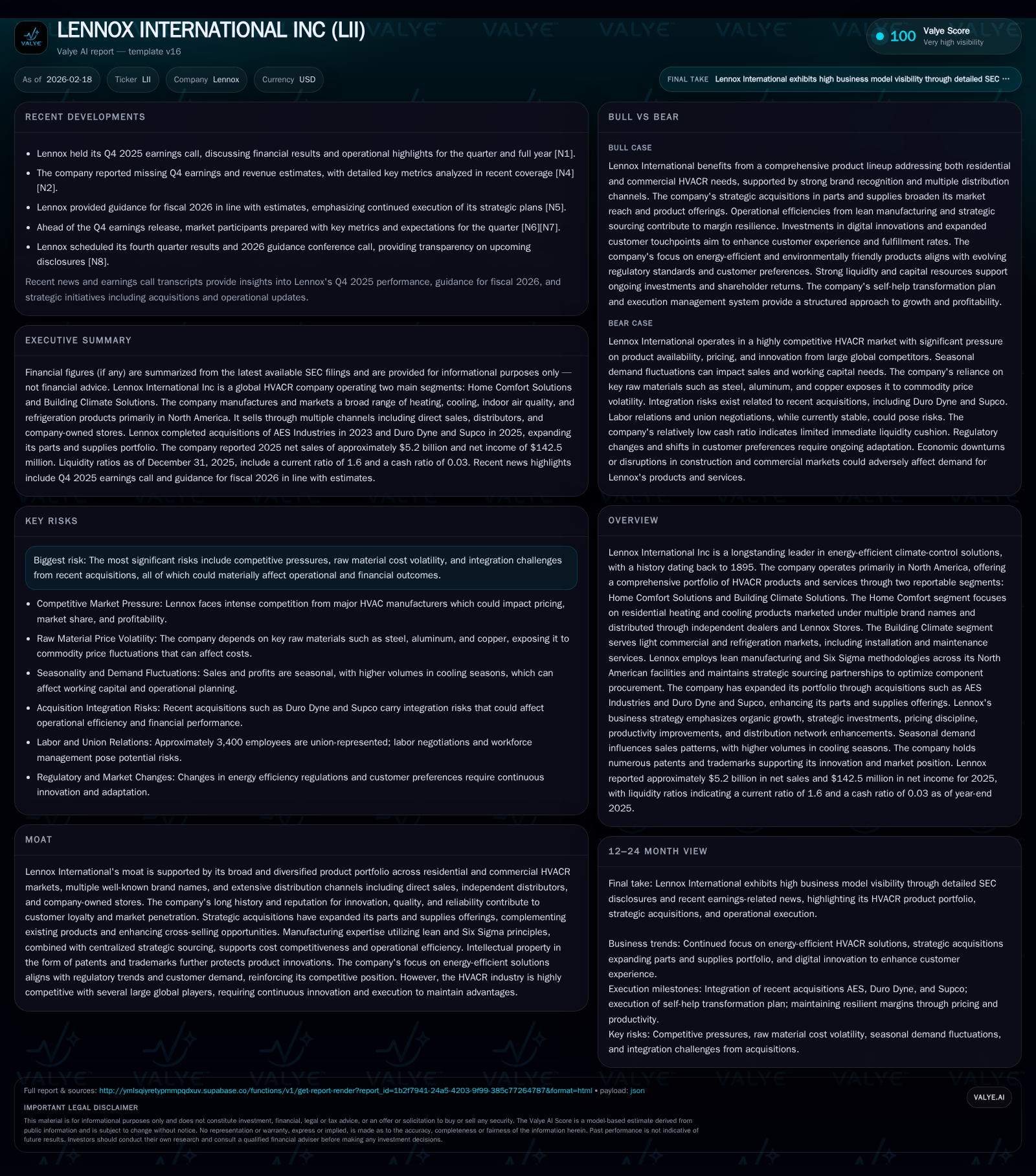
Lennox International, a longstanding leader in energy-efficient HVACR solutions, faced a drastic contraction in revenue and profitability in 2025. This decline stemmed from weaker demand affected by weather deviations, inflationary pressures, and complexities arising from sizable acquisitions like Duro Dyne and Supco. Despite an 82% drop in net income year-over-year, the company maintained strong operating cash flow and pursued aggressive share repurchases alongside dividend increases. Going forward, Lennox aims to leverage innovation in energy-efficient technologies and operational efficiencies to restore growth while navigating risks linked to integration and raw material cost volatility.
Historical Growth Trajectory and Operational Drivers
Lennox International has been a leader in residential and commercial HVACR systems since its founding in 1895. The company operates primarily through two segments — Home Comfort Solutions (residential heating/cooling) and Building Climate Solutions (light commercial HVACR including refrigeration). Historically, Lennox demonstrated steady top-line growth driven by product diversification and expansive distribution channels [S1,S14,S18].
From FY2022 through FY2024, Lennox exhibited revenue growth from approximately $4.72 billion to $5.34 billion with operating income rising notably from $656 million to over $1 billion [F1]. These gains were supported by robust demand within replacement cycles amplified by cyclical weather patterns prompting increased heating or cooling needs.
However, FY2025 marked a sharp inflection where revenue collapsed by roughly 77.6% to about $1.2 billion [F1]. Operating income plunged by over 81% to around $196 million while net income diminished by about 82% to approximately $143 million [F1]. This contraction reflects several factors including adverse seasonal weather impacting replacement elasticity, raw materials inflation squeezing margins, and transitional impacts from recent acquisitions [S1,N4].
Historical performance (annual)
| FY | Rev ($bn) | Net ($mm) | CFO ($mm) | OpInc ($mm) | Rev YoY | Net YoY |
|---|---|---|---|---|---|---|
| 2025 | 1.2 | 143 | 758 | 196 | -77.6% | -82.3% |
| 2024 | 5.3 | 807 | 946 | 1035 | +7.2% | +36.7% |
| 2023 | 5.0 | 590 | 736 | 790 | +5.6% | +18.7% |
| 2022 | 4.7 | 497 | 302 | 656 |
Note: Omitted columns lack sufficient annual XBRL coverage in the provided tags (need ≥2 annual points): Capex. Source: SEC companyfacts cache [F1].
Capital returns and efficiency (annual)
| FY | Div ($mm) | Buybacks ($mm) | FCF ($mm) |
|---|---|---|---|
| 2025 | 173 | 482 | 639 |
| 2024 | 160 | 54 | 782 |
| 2023 | 153 | 0 | 486 |
| 2022 | 142 | 300 | 201 |
Source: SEC companyfacts cache [F1].
Note: Equity was negative prior to FY2023 reflecting prior losses; capex spike in FY2023 related to expansion projects [F1].
Impact of Market Dynamics and Weather on Revenue Volatility
The steep revenue decline during FY2025 was materially influenced by macroeconomic conditions coupled with abnormal seasonal weather trends that reduced replacement demand elasticity significantly [S1,N4]. Replacement cycles—highly sensitive to weather extremes—were compressed due to an unusually mild summer reducing air conditioning equipment turnover.
New construction activity softened amid higher interest rates dampening residential housing starts and commercial real estate investments [N4]. Geographic concentration in North America (~75%-80% of revenue) accentuated exposure risk [S14,S21]. This highlights Lennox's sensitivity to climate-driven demand fluctuations along with raw material cost inflation impacting margins [S1].
Strategic Acquisitions and Segment Performance Shifts
Recent acquisitions have strategically bolstered Lennox’s Building Climate Solutions portfolio: AES Industrials was acquired in October 2023 focusing on multi-family HVAC replacements; Duro Dyne and Supco were acquired in October 2025 expanding parts & supplies offerings complementary across residential and commercial markets [S1,S18].
Duro Dyne is reported under Building Climate Solutions; Supco enhances Home Comfort Solutions' parts segment [S18]. However, these acquisitions introduced integration risks contributing to restructuring charges totaling $6.8 million in FY25 versus minimal prior years [S12]. These factors affected near-term profitability amid system unification challenges compounded by volatile raw materials pricing [S26].
Financial Results for FY2025: Profit Contraction Amid Cash Flow Resilience
Key financial metrics for fiscal year ended December 31, 2025 show:
- Revenue fell sharply from $5.34 billion in FY24 down to roughly $1.2 billion (-77.6%) [F1]
- Operating income dropped over four-fifths (-81%) compressing operating margin significantly below historical levels [F1]
- Net income contracted dramatically posting about $143 million (-82%) underscoring fixed cost leverage amid volume declines [F1]
- Operating cash flow remained comparatively robust at approximately $758 million though down nearly one-fifth year-over-year reflecting working capital management efforts [F1]
- Capital expenditures were reduced substantially (-27%) reflecting paused capacity expansion alongside maintenance investments at ~$119 million level [F1]
Margins compression was driven partly by raw materials cost inflation outpacing price realization coupled with weakened product mix quality during replenishment cycle softness [N4,S1]. While Q4 showed signs of stabilization post-acquisition adjustments quarterly revenues remain depressed relative to peaks [N1].
Capital Structure, Liquidity & Credit Covenants
Lennox maintains investment-grade credit ratings (Baa1 Moody’s / BBB S&P stable outlooks) supported by strong liquidity:
- Cash & equivalents of approximately $34 million as of Dec 31, 2025 supplemented by revolving credit facility availability of ~$772 million under a $1 billion unsecured revolver expiring May 2030 [S4,S6]
- Debt profile includes senior unsecured notes totaling approximately $800 million maturing through September 2028 plus a term loan of $300 million entered Oct 2025 maturing Oct 2027 refinancing prior borrowings; finance lease obligations add ~$69 million outstanding principal balance
- Credit covenants restrict leverage ratios requiring Total Net Leverage ≤3.50x EBITDA (extendable up to ≤4x post-acquisition); company confirms compliance as of latest filings [S4,S10]
- Weighted average borrowing rates increased consistent with floating rate regimes plus credit spreads reflecting stable credit ratings providing disciplined financing access continuity for operations [S9,S10]
Capital Allocation: Dividends & Buybacks Amid Earnings Downturn
Despite earnings pressures, Lennox sustained shareholder returns aggressively:
- Dividend payments increased ~13% effective mid-2025 raising quarterly per share payout from $1.15 to $1.30 resulting in total dividends paid of ~$173 million for FY25 compared with lower payouts previously; Delaware law constraints require distributions be made from surplus or earned profits only recently available given equity rebuilding since early decade troughs [S6,S12,F1]
- Share repurchases surged significantly executing ~$482 million worth of shares repurchased held as treasury stock during FY25 versus ~$54 million in FY24; no buybacks occurred in FY23 highlighting confidence amidst valuation support during down-cycle volumes phase [F1][S12]
- Capital expenditures reductions align with recalibrated investment focus balancing maintenance capex with enterprise system upgrades and manufacturing footprint optimizations supporting long-term supply chain resiliency while conserving cash short-term [S15]
- Free cash flow estimated at approximately $639 million (operating cash flow less capex), providing substantial internal funds coverage supporting shareholder returns while funding acquisition integration internally without incremental external financing dependency [F1]
This disciplined capital allocation supports liquidity preservation while maintaining investor confidence through dividends and buybacks despite transitory earnings weakness.
Outlook & Key Risks
Management's FY26 guidance aligns closely with consensus projecting measured recovery amid cautious optimism on demand improvement tempered by ongoing input cost pressures [N10]. Key drivers include:
- Continued ramp-up of variable refrigerant flow (VRF) commercial HVAC products addressing energy efficiency regulations yielding higher-margin installed systems solutions [S16]
- Realization of acquisition synergies from Duro Dyne/Supco enhancing parts attachment rates across segments fostering cross-selling opportunities within extensive dealer networks [S18]
- Investments into digital tools improving dealer customer experience coupled with pricing excellence initiatives targeting margin enhancement; lean manufacturing remains core ongoing enabler [S16]
- Weather volatility remains a critical factor affecting replacement volumes; warmer or milder seasons could again reduce unit turnover placing greater emphasis on new construction recoveries post-pandemic resumption trends [N6]
- Integration risks persist related to workforce harmonization or IT system consolidation potentially causing short-term disruptions underscoring execution discipline importance cited among principal risk factors; raw material price fluctuations continue introducing margin uncertainty requiring tight cost controls [S20]
Investors should monitor acquisition integration milestones, macroeconomic indicators affecting construction activity and discretionary spending, inflation trends impacting raw material costs, as well as technical indicators such as recent bullish moving average crossovers which may signal positive sentiment shifts though not fundamental metrics per se [N9,N12,S26].
Disclaimer: This report is based solely on publicly available information extracted from the company's SEC filings and reputable news sources as cited; it does not constitute investment advice or a recommendation.
Disclaimer: This is research-only, informational analysis and not investment advice. It may include AI-generated interpretation and general industry context. Always verify important details using primary sources.

Comments