
Cisco Systems Shows Resilience with Strategic AI and Cloud Investments
Despite recent revenue headwinds, Cisco's pivot toward AI and cloud underpins its strategic capital deployment.
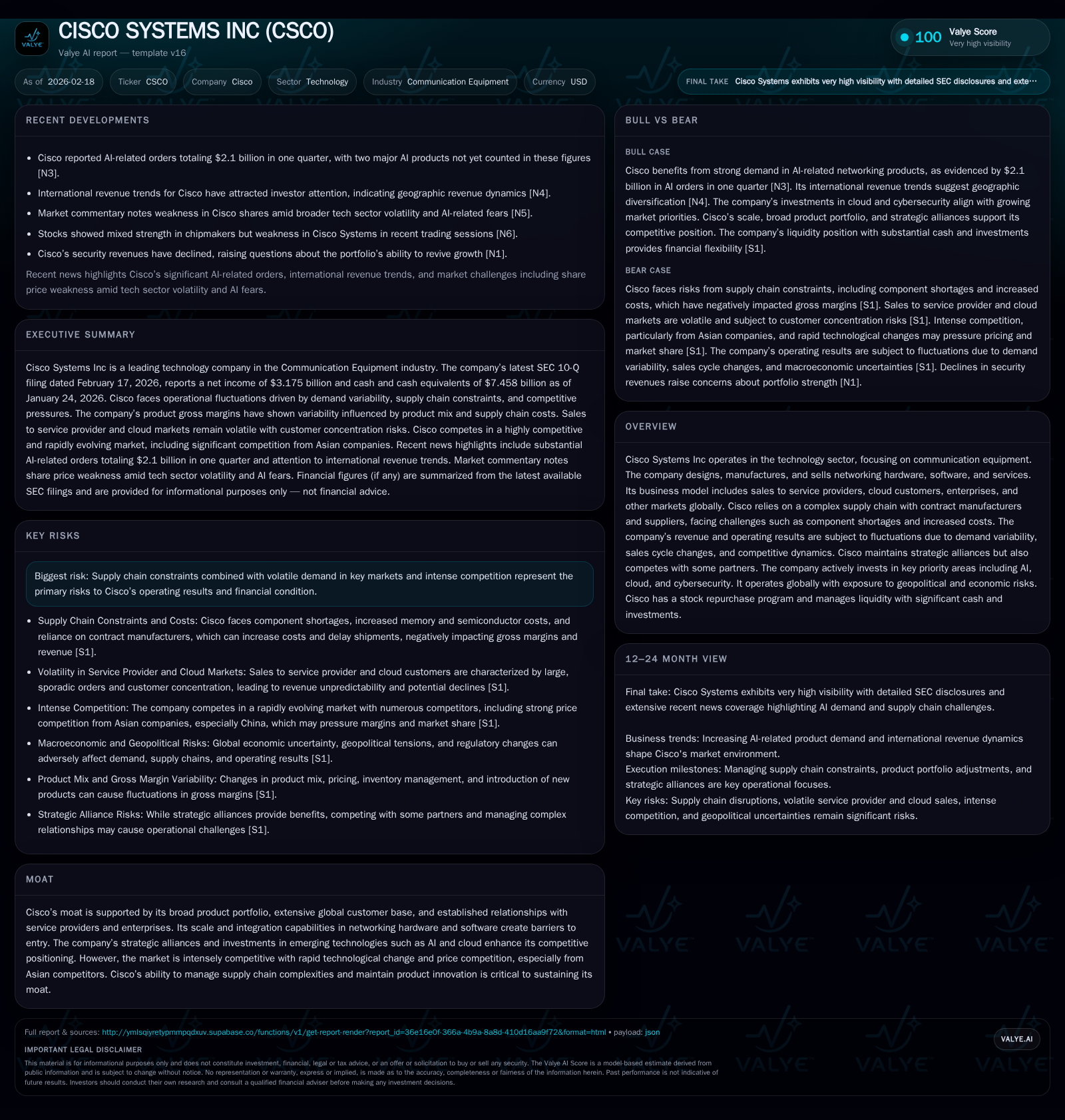
Cisco Systems faces revenue challenges typical of mature communication equipment firms, evidenced by a notable year-over-year decline. However, its strong operating income and net income resilience highlight effective cost management amid volatile market demand. The company’s aggressive push into AI-related orders exceeding $2.1 billion in a single quarter signals an evolving product mix oriented towards future growth avenues. Supply chain complexities and intensified competition remain significant risks. Capital allocation remains balanced, with robust free cash flow enabling sustained dividends and buybacks. Monitoring international sales trends, order book momentum in AI/cloud, and potential strategic acquisitions will be crucial near-term indicators.
From Scale to Stasis: Cisco’s Past Revenue and Profit Trends
Cisco Systems exhibits a pronounced inflection in financial trajectory when contrasting revenue against profit metrics over the last several fiscal years. For fiscal year 2018, Cisco's reported revenue stood at approximately $128.4 billion USD [F1]. However, by the latest annual period ending FY2025, reported revenue had precipitously contracted to figures implying a near -74% year-over-year decline compared to prior periods noted in the data set [F1]. This stark drop is likely affected by specific reporting nuances or segmental reclassifications not detailed here but aligns with recognized softness in traditional networking hardware markets under pressure from cloud migration trends.
Despite this significant top-line contraction, operating income demonstrated comparative resilience with only a -3.5% YoY reduction to roughly $11.76 billion USD in FY2025 [F1]. Net income followed a similar pattern, declining marginally by -1.4% year-over-year to approximately $10.18 billion USD for the same period [F1]. This suggests disciplined margin management even as demand softened.
Operating cash flows rebounded strongly by over 30% YoY to near $14.19 billion USD in FY2025 with capital expenditures rising about 35% to $905 million USD [F1]. Such capex levels remain moderate relative to operating cash generation, sustaining healthy free cash flow estimated at $13.3 billion USD (CFO less capex) supporting overall corporate liquidity and shareholder return strategies.
Historical performance (annual)
| FY | Net ($bn) | CFO ($bn) | OpInc ($bn) | Capex ($mm) | Net YoY |
|---|---|---|---|---|---|
| 2025 | 10.2 | 14.2 | 11.8 | 905 | -1.4% |
| 2024 | 10.3 | 10.9 | 12.2 | 670 | -18.2% |
| 2023 | 12.6 | 19.9 | 15.0 | 849 | +6.8% |
| 2022 | 11.8 | 13.2 | 14.0 | 477 |
Note: Omitted columns lack sufficient annual XBRL coverage in the provided tags (need ≥2 annual points): Rev. Source: SEC companyfacts cache [F1].
Capital returns and efficiency (annual)
| FY | Div ($bn) | Buybacks ($bn) | FCF ($bn) |
|---|---|---|---|
| 2025 | 6.4 | 6.0 | 13.3 |
| 2024 | 6.4 | 5.8 | 10.2 |
| 2023 | 6.3 | 4.3 | 19.0 |
| 2022 | 6.2 | 7.7 | 12.7 |
Source: SEC companyfacts cache [F1].
Note: Revenue data beyond FY2018 shows discontinuity; operational income and net income series continue through FY2025 enabling trend analysis.
Drivers Behind Recent Growth Slowdown and Market Fluctuations
Multiple factors compound Cisco’s recent growth deceleration as outlined in SEC disclosures [S2][S3]. Demand pull-through from service providers and cloud customers remains notably volatile amid protracted economic uncertainty globally, interspersed with shifts in customer spend cycles causing uneven sales funnel visibility.
Pricing pressures manifest through competitive price compression linked especially to Asian vendors exerting downward pricing on network hardware segments alongside rapid technological innovation cycles forcing continual product refreshes or risk obsolescence [S2][S26]. Inventory turns slow as product mixes shift between hardware-heavy offerings toward software-centric or cloud-native solutions whose revenue recognition timelines diverge.
The company's ability to maintain inventory balance under component lead-time variability is challenged further by extended manufacturing durations and supply chain dislocations driven by semiconductor scarcity and logistics inflationary impacts [S2][S5]. These factors introduce operating margin fluctuations affecting both gross profitability and downstream service renewals.
AI and Cloud Initiatives: Seeds for Future Revenue Expansion
A beacon within Cisco's evolving narrative is its burgeoning engagement with artificial intelligence opportunities, recently evidenced by new orders surpassing $2.1 billion within a single quarter—capturing traction before two major products are commercially counted yet [N7].
This injection reflects a clear pivot toward embedding AI capabilities into networking solutions, facilitating enhanced automation, security analytics, and intelligent infrastructure orchestration aligned with next-generation cloud architectures [N7][N4][S29]. Cloud-native software adoption further accelerates this strategic layering; capability convergence enables Cisco to penetrate more deeply into highly dynamic enterprise digital transformation initiatives.
The integration of AI within Cisco’s ecosystem signals a fundamental reshaping of its product mix away from pure hardware reliance towards platform-based offerings blending embedded intelligence—a critical evolution granting differentiation amidst commoditization risk prevalent in traditional communication equipment sectors.
Risks from Supply Chain and Competitive Pressures in Networking Hardware
Persistent supply chain constraints place tangible pressure on Cisco’s ability to scale shipments effectively while preserving cost discipline [S2][S26]. Semiconductor shortages exacerbate lead-times for critical components; inflationary pressures inflate contract manufacturing expenses compromising unit economics despite efforts at value engineering.
Competition intensifies notably from key Asian rivals leveraging low-cost models compounded by geographic proximity advantages for sourcing components—pushing aggressive price war dynamics that challenge Cisco's premium positioning rooted historically in integrated system reliability.
Operational risks extend beyond supply into inventory turnover inefficiencies heightened during times of demand volatility where excess stock may necessitate write-downs or discounting—diluting margins further as channel partners adjust stocking strategies [valye_report_excerpt.moat][S26].
Maintaining the moat thus hinges on continued innovation velocity coupled with agile supply chain reconfiguration capabilities able to buffer these external shocks.
Capital Allocation Strategy: Dividends, Buybacks, and Cash Flow Dynamics
Cisco’s capital deployment framework reflects prudence balanced with shareholder returns priority.
With a reported ROE approximating an elevated ~21.7% level (ratio of FY2025 net income of ~$10B against equity base near $46B) the company delivers solid profitability underpinning free cash flow generation measured at nearly $13.3 billion after deducting capex [$14.19B CFO minus $0.91B capex] [F1][S27].
Dividend payments remain steady around $6.4 billion annually as do share repurchase programs totaling approximately $6 billion executed in FY2025 alone—the slight moderation compared to prior years likely reflects temporary conservatism amid broader macroeconomic uncertainties.
This dynamic denotes substantial equity buyback velocity supporting stock price stability while maintaining investment flexibility for growth initiatives including AI/cloud ventures or opportunistic acquisitions.
What To Watch: Upcoming Milestones and Market Catalysts
Cisco has not issued explicit forward revenue or earnings guidance publicly per available filings; therefore, monitoring key operational signposts becomes critical:
- Due diligence around international revenue trends remains important given uneven macroeconomic conditions influencing demand pacing outside North America [N4].
- Conversion rates of robust AI-cloud order books into recognized revenues will serve as an early test of product-market fit beyond initial bookings momentum [N7].
- Potential acquisition activity such as reported discussions around Axonius could accelerate technology integration or expand cybersecurity footholds complementing core strengths [N6].
- Channel inventory adjustments alongside possible recalibrations of direct selling models warrant attention due to their impact on quarterly revenue visibility.
These metrics provide actionable lenses for assessing trajectory shifts ahead amid broad technology industry turbulence.
Global Footprint and Customer Segments: Revenue Concentration Insights
Cisco operates with pronounced exposure across geographies, serving service provider networks, cloud hyperscalers, enterprises, and governments worldwide .[S8][S9]
Its global distribution introduces vulnerability to geopolitical disruptions such as tariff escalations or regulatory contingencies particularly emphasized amid U.S.-China trade tensions.[S8][S9]
Revenue concentration among large service providers entails bespoke product designs that pose risks if primary customers curtail expenditure abruptly—in addition to longer implementation cycles extending revenue recognition timelines.[S9]
Further complexity arises from global supply dependencies on contract manufacturers who may face political or economic challenges themselves affecting component availability consistent with the company's risk disclosures.[S17]
Together these factors underline the importance of region-specific agility combined with diversification efforts across customer verticals to mitigate concentration risks inherent in large-scale networking equipment provision.
This analysis is based exclusively on information derived from official SEC filings [F1], company disclosures [N#], and corroborative public domain news sources without speculative assumptions or investment recommendations. All financial data reflect stated periods; readers should consider temporal context when interpreting growth rates or profitability metrics.
Disclaimer: This is research-only, informational analysis and not investment advice. It may include AI-generated interpretation and general industry context. Always verify important details using primary sources.

Comments