
Western Midstream Partners Seeks Stability Through Fee-Based Contracts and Basin Diversity
Western Midstream leverages contractual protections and a diverse asset footprint in premier U.S. basins to navigate profitability pressures.
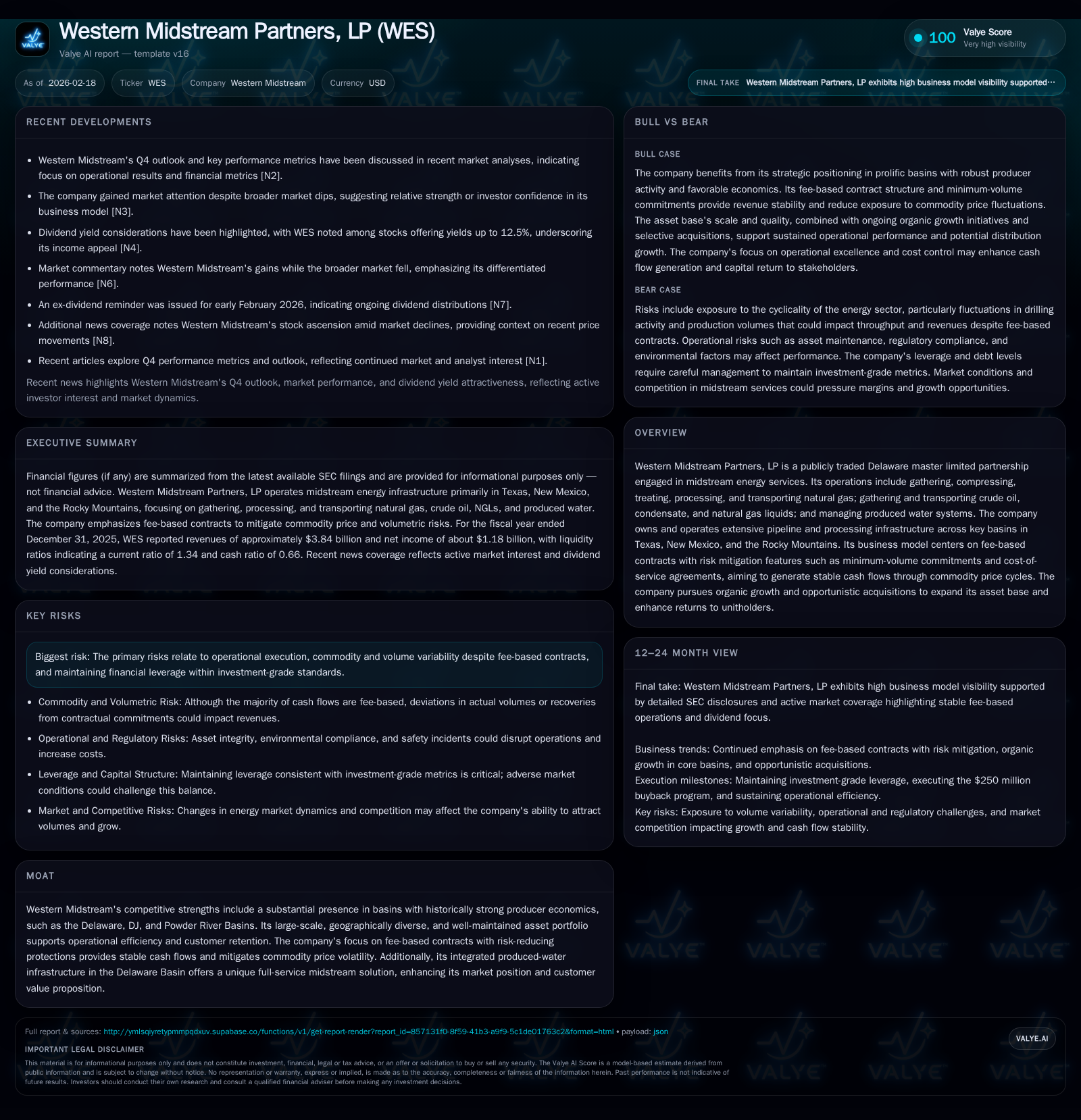
Western Midstream Partners, LP (WES) operates an extensive midstream network across top-tier U.S. basins including the Delaware, DJ, and Powder River Basins, providing fee-based gathering, processing, and produced-water management services. Despite delivering steady revenue growth of 6.6% year-over-year in 2025, WES experienced significant margin compression leading to an 18.7% decline in operating income and a 24.9% drop in net income, reflecting operational and volume variability amid broader market pressures. The company’s reliance on minimum-volume commitments, cost-of-service contracts transitioning to fixed fees, and geographic diversification helps cushion earnings volatility. Strong liquidity with a $2 billion revolver and a strategic affiliation with Occidental Petroleum supports capital efficiency. Western Midstream maintains an attractive dividend yield near 8.8%, underpinned by solid operating cash flow coverage even as buybacks remain idled. Investors should monitor volume trends within core basins, contract renewals, and leverage metrics aligned with investment-grade targets.
Foundation of Growth: Fee-Based Contract Model and Asset Positioning
Western Midstream Partners' (WES) operating foundation rests firmly on its fee-based contract portfolio that mitigates commodity exposure through minimum-volume commitments (min-vol commits) and cost-of-service contracts evolving toward fixed-fee arrangements [S4][S5]. This structure ensures more predictable cash flows amid the inherent cyclicality of oil & gas markets. The company provides natural gas gathering/compression/treating/processing; crude oil and NGL gathering and transportation; as well as produced water gathering, recycling, treatment, supply, and disposal – particularly distinctive in the Delaware Basin where integrated water infrastructure reduces producer capital intensity [S1][S4].
Geographically diversified assets are concentrated in the Delaware Basin of West Texas/New Mexico, Denver-Julesburg (DJ) Basin of Colorado, and Powder River Basin spanning Wyoming-Colorado [S4][S20]. These locations historically deliver robust producer economics characterized by high liquids content and efficient drilling returns that bolster midstream volume stability [S4]. The breadth across basins also provides volume diversification benefits reducing dependency on any single reservoir or operator.
Examining Historical Performance: Revenue Growth Versus Profitability Pressure
Financially, WES demonstrated consistent revenue growth coupled with margin headwinds over recent years [F1]. Revenue increased from $3.11 billion in FY2023 to $3.60 billion in FY2024 (+15.9%), then further grew by a more moderate 6.6% in FY2025 to $3.84 billion [F1]. This expansion primarily reflects increased throughput volumes across core basins combined with rate escalations embedded in fee contracts.
Operating income rose sharply from $1.38 billion in FY2023 to $1.97 billion in FY2024 (+42.9%) but contracted by -18.7% YoY to $1.60 billion in FY2025 [F1]. Net income followed a similar pattern: $1.02 billion (FY23), $1.57 billion (FY24), down -24.9% YoY to $1.18 billion in FY25 [F1]. Declining earnings reflect cost inflation pressures amid flat-to-moderate pricing leverage given fee structures transitioning away from cost-of-service agreements plus some volume variability impacts realized especially late in the year [N2][N3][S3]. Operating cash flow has grown steadily though more moderately: increasing +29% from FY23 ($1.66B) to FY24 ($2.14B), then up +4% YoY in FY25 to $2.22B [F1], demonstrating sound cash generation capability essential for sustaining distributions.
Historical performance (annual)
| FY | Rev ($bn) | Net ($mm) | CFO ($bn) | OpInc ($mm) | Rev YoY | Net YoY |
|---|---|---|---|---|---|---|
| 2025 | 3.8 | 1181 | 2.2 | 1601 | +6.6% | -24.9% |
| 2024 | 3.6 | 1574 | 2.1 | 1971 | +16.1% | +53.9% |
| 2023 | 3.1 | 1022 | 1.7 | 1380 | -4.5% | -16.0% |
| 2022 | 3.3 | 1217 | 1.7 | 1588 |
Note: Omitted columns lack sufficient annual XBRL coverage in the provided tags (need ≥2 annual points): Capex, FCF, ROE%. Source: SEC companyfacts cache [F1].
Capital returns and efficiency (annual)
| FY | Div ($mm) | Buybacks ($mm) |
|---|---|---|
| 2025 | 1431 | 0 |
| 2024 | 1246 | 0 |
| 2023 | 978 | 135 |
| 2022 | 736 | 488 |
Source: SEC companyfacts cache [F1].
Capital expenditure data not available from provided tags.
Contractual Protections and Geographic Reach as Stability Drivers
WES’s medium- to long-term contractual framework is a critical bulwark against commodity price swings [S4][S5]. Minimum-volume commitments protect against sharp volume declines that could destabilize fixed-cost recoveries inherent in midstream infrastructure investments—a common feature of fee-based contracts designed for stable throughput revenue corridors.
Recent contract restructuring includes the transition of an Anadarko E&P Onshore LLC agreement from a pure cost-of-service model to a fixed-fee structure supplemented by heightened min-vol commitments [S5]. Such shifts reduce exposure to variable downstream processing margins while locking in baseline throughput economics.
The geographic diversity spanning three prolific basins provides operational resilience; if production falters or pauses due to localized factors such as weather or regulatory changes in one basin, volumes from others can partially offset impact [S4][F1]. This flexibility is pivotal given basin-level regulatory dynamics affecting drilling activity levels or water disposal constraints.
Q4 and Full-Year 2025 Profit Retreat Explained
Despite continued revenue ascent in Q4 2025, earnings retreated due to several factors: operational fluctuations caused volume variances below initial expectations—partially owing to seasonal maintenance downtime impacting processing availability.
Contractual renegotiations shifting legacy cost-of-service contracts into fixed-fee terms temporarily lowered operating margins though enhance future cash-flow predictability [N2][S3]. Inflationary input costs—labor and materials—increased operating expenses limiting margin expansion despite stable utilization.
These factors collectively eroded Q4 profitability but do not indicate long-term deterioration given underlying business model protections.
Liquidity Profile, Capital Structure, and Occidental Affiliation
WES maintains solid liquidity supporting capital projects and distributions with an effective borrowing capacity of approximately $2 billion under its senior unsecured revolving credit facility as of December 31, 2025 [S4][S5][S6]. Outstanding commercial paper borrowings reduce availability but do not impair financial flexibility.
Long-term debt maturities are well staggered through the decade with senior notes due between 2026 up to the early-2050s period bearing coupon rates generally around midstream sector benchmarks near ~4–5% for recent issuances [S6][S10][S15]. This maturity profile allows manageable refinancing risk relative to asset longevity.
Occidental Petroleum Corporation holds about a combined 44% stake including limited partner equity interest (42%) plus general partner control (~2%) [S9][N7], facilitating coordinated upstream-midstream planning enabling capital-efficient project execution tailored to Occidental’s development schedules enhancing asset utilization visibility.
Dividend Strategy: Sustaining an Attractive Yield Through Cash Flow Management
Investor returns via dividends remain a cornerstone of WES shareholder value supported by strong operating cash flow coverage even amid earnings pressure [F1][N1][S9]. In fiscal year 2025, dividends paid totaled approximately $1.43 billion compared with operating cash flow of ~$2.22 billion generating payout coverage within typical midstream norms [F1].
No distributions were allocated toward share repurchases during this interval reflecting prudence focused on maintaining liquidity buffers rather than aggressive buybacks given external uncertainties around volume trajectories [S11][N13]. The dividend yield at roughly 8.8% aligns with market expectations for MLPs prioritizing stable distributions backed by fee-based revenues insulated partially from commodity price cycles.[N1]
Outlook and Risks: Focus Areas for Investors
Looking ahead, WES intends to pursue organic growth primarily through acreage expansions supporting incremental gas gathering/processing volumes alongside targeted acquisitions complementing core basin footprints without compromising leverage or return metrics [N4][S9].
Volume throughput trends within the Delaware Basin will be closely monitored given its sizable contribution including produced-water handling—which uniquely positions WES but also exposes it somewhat to commodity-driven drilling cadence shifts despite contract hedges [N3][S4].
Maintaining investment-grade leverage metrics remains paramount amid macroeconomic uncertainty affecting capital access/cost potentially influencing discretionary capex pacing [S4][N4]. Operational risks include execution efficacy amid scale-up projects plus managing cost inflation pressures which could pressure margins absent offsetting rate adjustments.
Commodity price risk is reduced but not eliminated given evolving contract mix transitioning away from pure cost-of-service frameworks toward fixed-fee plus min-vol commitment blends requiring ongoing scrutiny.
Capital Allocation: Balancing Dividends, Buybacks, and Investment Opportunities
Capital allocation strategy emphasizes sustained dividend payments supplemented by opportunistic growth investments either organic or via acquisitions targeting synergistic assets enhancing throughput volume potential corridors [S9][F1].
Following share repurchases totaling approximately $135 million executed in FY2023, no buybacks occurred during FY2024–FY2025 reflecting Board preference for preserving financial flexibility amidst market cyclicality [F1][S25].
Specific capex details are not available from provided tags but management focuses on disciplined project screening informed by upstream operator development plans leveraging Occidental affiliation for pipeline projects aligned with upstream growth dynamics.
Disclaimer: This report is based solely on publicly available information as of February 18, 2026 ([N#],[S#],[F1]). It does not constitute investment advice or recommendations.
Disclaimer: This is research-only, informational analysis and not investment advice. It may include AI-generated interpretation and general industry context. Always verify important details using primary sources.

Comments