
Travere Therapeutics Advances Rare Kidney Disease Treatment with FILSPARI Approval and Commercial Initiatives
The company's transition from developmental losses to commercial execution is anchored by its FDA-approved orphan drug FILSPARI for IgA nephropathy.
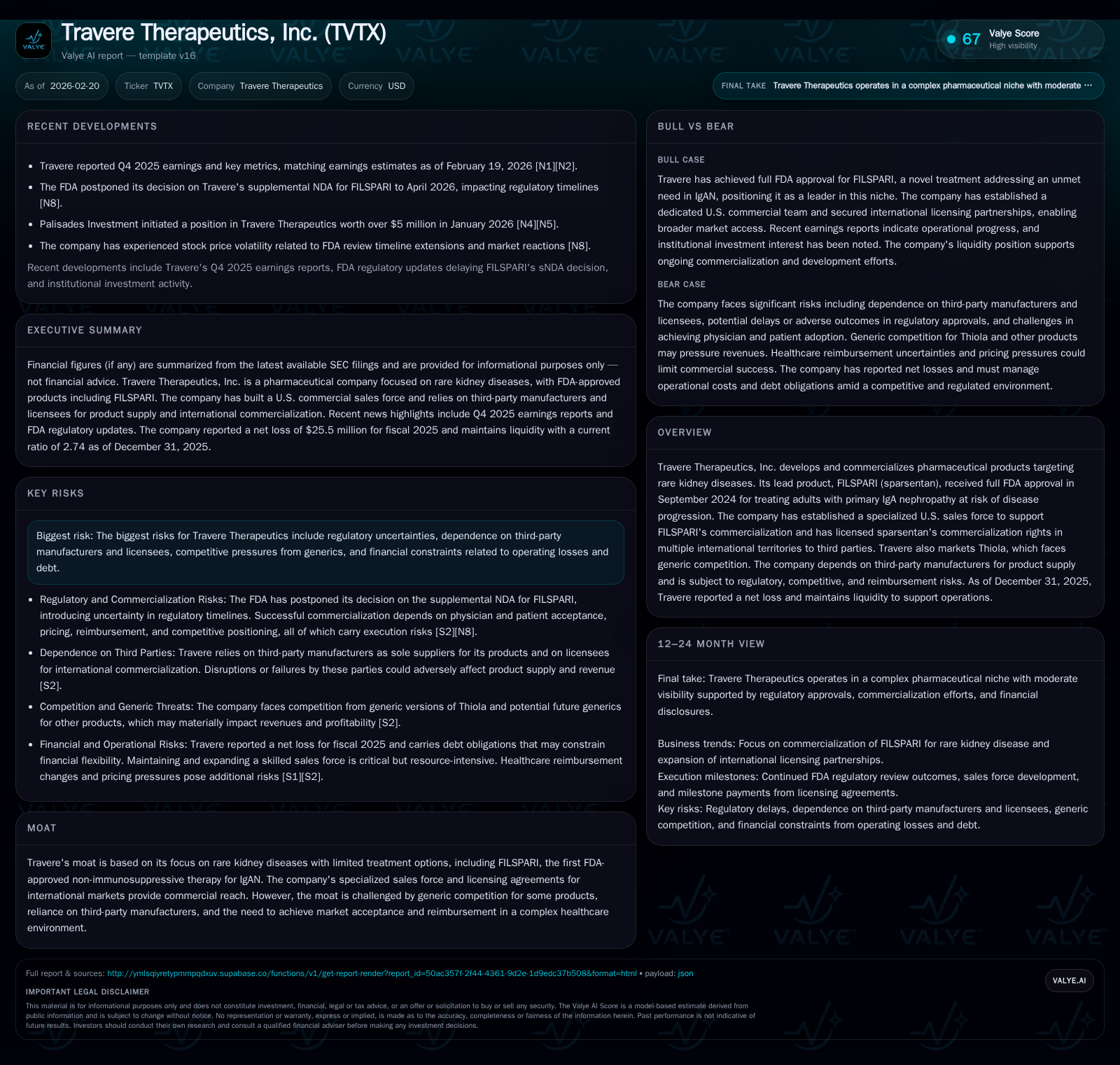
Travere Therapeutics secured full FDA approval of FILSPARI in September 2024, positioning itself at the forefront of non-immunosuppressive therapies for primary IgA nephropathy (IgAN). The firm has since invested in building a specialized U.S. sales force to drive market penetration, while leveraging international licensing arrangements. Despite progress, challenges remain from regulatory uncertainties, generic competition on legacy products, and complexities in physician and payer adoption. Financial trends through FY2025 indicate substantial improvement in operating losses and cash flow but continued net losses persist amid measured capital expenditures.
Building Momentum: Historical Financial Performance and Operating Dynamics through 2025
Travere Therapeutics' financial narrative through recent years underscores an intense transformation effort coinciding with pivotal regulatory events. While revenues were historically minimal or not regularly reported due to the company's developmental stage and orphan product focus, key income statement and cash flow metrics reveal marked improvements aligned with the full FDA approval of FILSPARI (sparsentan) in September 2024.
Operating income losses narrowed dramatically from -$323.8 million in fiscal year 2024 to -$62.8 million in fiscal year 2025, an improvement exceeding 80% year-over-year [F1]. Similarly, net losses contracted sharply from -$321.5 million to -$25.5 million within the same timeframe, reflecting operational efficiencies and early commercialization gains. This timeline highlights how the company's significant expenditures in late-stage R&D and launch readiness transitioned toward controlled commercial spend.
Cash flows from operations turned positive for the first time during this period with $37.8 million generated in FY2025 compared to sizable negative cash flows exceeding $237 million in the prior year [F1]. This CFO swing represents an over 115% improvement YoY to positive territory, affirming improving collection cycles alongside nascent revenue recognition from FILSPARI sales.
Capital expenditures have remained relatively modest compared with prior years but increased notably (roughly +250% YoY) as investments focused on establishing critical commercial infrastructure such as sales force deployment and marketing capabilities [F1]. This careful capex scaling signals pragmatic balancing of growth facilitation while controlling fixed overheads.
Historical performance (annual)
| FY | Net ($mm) | CFO ($mm) | OpInc ($mm) | Capex ($) | Net YoY |
|---|---|---|---|---|---|
| 2025 | -26 | 38 | -63 | +92.1% | |
| 2024 | -322 | -237 | -324 | -256.6% | |
| 2023 | -90 | -280 | -94 | 668000 | +67.6% |
| 2022 | -278 | -186 | -267 | 191000 |
Note: Omitted columns lack sufficient annual XBRL coverage in the provided tags (need ≥2 annual points): Rev, Div, Buybacks. Source: SEC companyfacts cache [F1].
Capital returns and efficiency (annual)
| FY | FCF ($mm) | ROE% |
|---|---|---|
| 2025 | -22.2 | |
| 2024 | -544.3 | |
| 2023 | -281 | -44.9 |
| 2022 | -186 | -649.9 |
Source: SEC companyfacts cache [F1].
Note: Revenue data post-FY2011 are unavailable in company filings.
Executing Innovation: FILSPARI’s Market Launch and Commercialization Strategy
Since the full FDA approval granted in September 2024 for FILSPARI treating adults with primary IgA nephropathy at risk of disease progression—a patient population underserved by existing therapies—Travere has embraced a specialist launch approach unique within nephrology's orphan drug landscape [N1][N4][S2].
FILSPARI is notable as the first non-immunosuppressive FDA-approved therapy for IgAN. This novelty mandates education-intensive efforts targeting nephrologists accustomed to immunomodulatory regimens or conservative standard-of-care approaches focused mainly on symptom management rather than disease modification.
To this end, Travere deployed a focused U.S. sales force specifically trained to engage specialist communities where treatment paradigms may pivot toward adoption of an innovative mechanism addressing underlying kidney function decline without immunosuppression-related toxicity risk profiles [N4][S2].
Internationally, the company has strategically licensed sparsentan commercialization rights across multiple territories to third parties—leveraging partners’ regional expertise while retaining U.S. direct control over what remains the core market opportunity [N1][S2]. This dual model balances near-term commercial execution with de-risked expansion internationally.
Nonetheless, initial launch costs remain meaningful contributors to ongoing operating losses experienced in early commercialization phases despite improved operating income trends seen post-approval [N1][S2]. This reflects investments into physician education programs and patient support infrastructure such as adherence services for a rare chronic condition typically requiring long-term management—and market access efforts to secure payer formulary inclusion under orphan drug coverage frameworks.
Navigating Regulatory and Competitive Challenges in Rare Kidney Disease Therapy
Travere faces a complex regulatory environment. Although FILSPARI obtained full FDA approval after initially receiving accelerated approval based on surrogate endpoints like proteinuria reduction—which shortens traditional clinical development timelines—submissions for supplemental new drug applications (sNDAs) aiming at label expansions or additional indications have encountered review delays extending through early 2026 [N12][N13].
These extended timelines underscore inherent uncertainties navigating evolving FDA expectations on safety and efficacy data accumulation post-accelerated approvals within orphan indications where patient populations are small yet unmet needs considerable.
Moreover, strict federal regulations restrict off-label promotional activities; while companies may communicate truthful scientific data consistent with labeling information sharing guidance must avoid unapproved use promotion liable to civil or criminal sanctions [S4][S5][S7]. Compliance demands substantial attention given heightened government enforcement focus across biopharmaceuticals targeting rare diseases amid increasing scrutiny on marketing practices potentially influencing prescribing habits improperly.
On the competitive front, Thiola—a product marketed by Travere primarily addressing cystinuria—faces generic competition pressures eroding its once steady revenue contributions [S2][N1]. Such commodity-like dynamics limit portfolio diversification benefits during ramp-up of novel products like FILSPARI.
Dependence on third-party manufacturers remains another operational risk dimension; manufacturing partner compliance failures could disrupt supply continuity affecting launch momentum or lead to costly remediation measures under applicable FDA quality regulations [S9][S13][S14]. Supply chain robustness thus remains a focal point given thin margins common among specialty pharmaceuticals targeting rare kidney conditions.
Assessing Market Adoption: Physician, Patient, and Payer Engagement in FILSPARI Uptake
Adoption dynamics for FILSPARI reflect typical orphan drug challenges compounded by a novel therapeutic class entry into established specialty domains such as nephrology. The addressable patient population size itself carries uncertainty due to heterogeneous disease presentation and underdiagnosis patterns common with IgAN globally [S2][S22].
Physicians require robust clinical evidence and confidence-building educational initiatives addressing differentiation versus existing immunosuppressive treatments which carry significant side effect burdens; initial real-world evidence outcomes will be integral to expanding routine prescription behavior beyond early adopters.
Payer reimbursement negotiations represent another critical inflection point particularly given orphan drug pricing scrutiny amid healthcare cost containment initiatives prevalent across U.S. insurers and Medicare programs [S2][S22]. Attaining broad formulary access without excessive prior authorization restrictions will materially influence penetration velocity.
Additional adoption indicators worth monitoring include patient enrollment rates in ongoing registries capturing efficacy/safety post-market data supportive of both clinical practice guideline integration and payer coverage optimization.
In summary, broader uptake depends on successful education campaigns targeting specialist prescribers combined with payer willingness to recognize FILSPARI's value proposition as a first-in-class non-immunosuppressive agent modifying disease trajectory rather than symptom palliation alone.
Capital Efficiency: Evaluating Operating Cash Flows, Capital Expenditures, and Balance Sheet Health
Financial stewardship at Travere shows encouraging signs of stabilization amidst commercialization expenses ramping up post-FILSPARI approval. Operating cash flow turned positive reaching approximately $37.7 million in FY2025 contrasting starkly against negative $237 million recorded FY2024 [F1].
This positive CFO absorption despite ongoing net losses (-$25.5 million FY2025) suggests efficient working capital management including receivables collections tied to product revenue receipts starting to materialize alongside disciplined expense control measures.
Capex remains relatively low by biopharma standards but increasing circa $668k FY2023 vs prior years indicates incremental investment focused primarily on intangible assets supporting commercial functions rather than heavy fixed asset additions like manufacturing plants—consistent with reliance on third-party suppliers highlighted earlier [F1].
Liquidity ratios are healthy; current assets approximated $438 million exceed current liabilities near $160 million yielding a current ratio of approximately 2.74 offering solid short-term solvency cushions given funding needs across upfront sales ramp costs plus R&D pipelines advancement commitments [F1][S18].
ROE remains negative at roughly -22%, characteristic of companies transitioning from research-heavy models toward sustainable profitability phases over multi-year horizons where capital allocation priorities weigh heavily on preserving cash runway versus shareholder returns including dividends or share repurchases—none evident recently reflecting prioritization of reinvestment into growth phases currently underway [F1].
Key Financial Ratios Table
| Metric | FY2025 Value |
|---|---|
| Current Ratio | 2.74 |
| Approx ROE % | -22.2% |
Note: Dividends paid are not available from provided tags; no recent share repurchase activity observed indicating capital conservation strategy focused on growth investment rather than shareholder distributions [F1].
Future Catalysts and Potential Risks: What Investors Should Monitor Ahead
Anticipated milestones that may materially affect Travere’s trajectory encompass several dimensions:
- Comprehensive commercialization progress updates post-FY25 providing clarity on revenue ramp rates for FILSPARI within U.S. nephrology markets;
- Regulatory decisions regarding pending supplemental filings that could broaden approved indication scope or enable pediatric usage enhancing market size substantially;
- Outcomes of ongoing global partnerships leveraging licensee capabilities outside North America potentially contributing royalty streams or co-development prospects;
- Legal/regulatory compliance developments stemming from intensified government focus on pharmaceutical marketing practices targeting healthcare fraud risks including off-label promotion enforcement which may impose fines or additional oversight impacting operational flexibility;
- Competitive marketplace evolution including biosimilar entrants potentially challenging incumbent Thiola revenues further necessitating pipeline diversification;
- Data privacy/security risks linked to clinical trial participant information handling subjecting company to potential penalties or reputational damage should breaches occur given sensitive health data environment.
These forward-looking factors underscore both upside opportunities via sustained successful launch execution complemented by pipeline expansion efforts alongside downside contingencies embedded within regulatory vigilance and competitive headwinds prevalent in specialty pharma environments focusing on rare kidney diseases.
Disclaimer: This analysis is intended solely for informational purposes summarizing Travere Therapeutics’ business developments available as of February 20, 2026. It does not constitute investment advice nor prospectus promoting security purchase decisions.
Disclaimer: This is research-only, informational analysis and not investment advice. It may include AI-generated interpretation and general industry context. Always verify important details using primary sources.

Comments