
Industrial Logistics Properties Trust Faces Debt and Tenant Concentration Constraints Amid Portfolio Scale
ILPT’s large single-tenant industrial portfolio drives steady rental income but brings refinancing risks and limited operational flexibility.
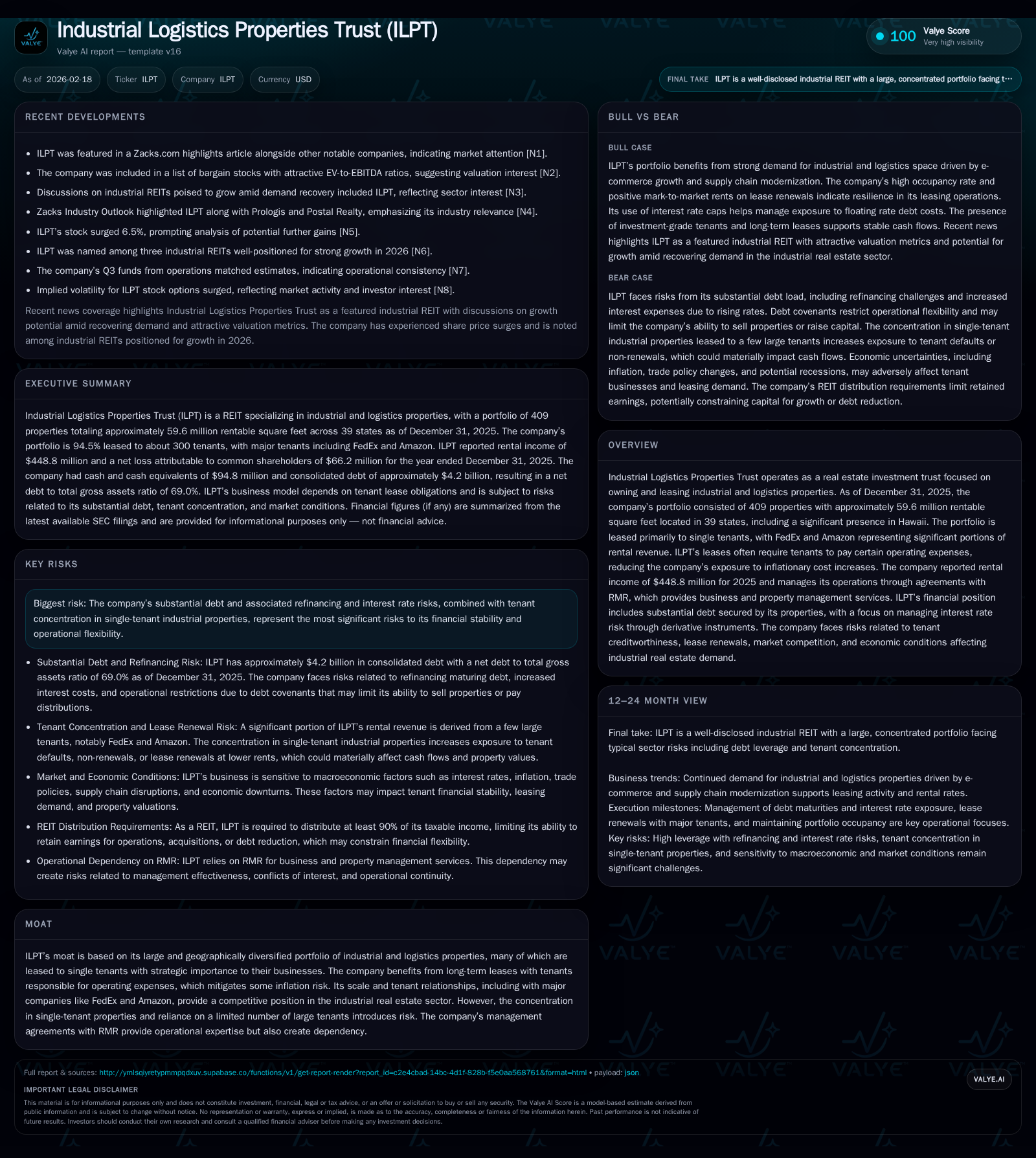
Industrial Logistics Properties Trust (ILPT) holds a sizable portfolio of industrial and logistics real estate concentrated in single-tenant leases with major firms like FedEx and Amazon. The company reported $448.8 million in rental income for 2025 supported by long-term leases that shift operating expenses to tenants, mitigating inflation exposure. However, ILPT's substantial debt load—about $4.2 billion—and high leverage ratio restrict financial flexibility and introduce refinancing risks amid rising interest rates. While operating cash flow improved sharply in 2025, net losses persist due to high interest costs and impairments. Investors should watch upcoming lease renewals, debt maturities especially the Mountain Floating Rate Loan due shortly, and ILPT's ability to sustain distributions given its constrained capital allocation capacity.
Overview
Industrial Logistics Properties Trust (ILPT) specializes in owning and leasing industrial and logistics properties with a strategic focus on warehouses primarily leased on long-term agreements to large single tenants like FedEx Corporation and Amazon.com Services Inc. The portfolio encompasses 409 properties totaling close to 59.6 million rentable square feet spread across 39 U.S. states, including a material footprint in Hawaii which constitutes roughly 28% of rental revenues [S26].
ILPT operates through management agreements with RMR, Inc., which provides property management and business services—a partnership that offers operational scale but entails dependency risk [S1]. The company's lease structure typically shifts many property operating expenses onto tenants, moderating ILPT’s inflation exposure.
Historical Performance and Growth Drivers
Rental income for the year ended December 31, 2025 was approximately $448.8 million [S1], supported by high occupancy rates anchored by creditworthy tenants such as FedEx (27.9%) and Amazon (7.3%) as of late 2025 [S26]. This tenant mix reflects both strength in securing prime logistics players yet introduces concentration risks.
From a financial perspective, ILPT reported a net loss of approximately $66.2 million for fiscal year 2025 compared to larger losses in prior years (-$95.7 million in FY24) indicating incremental improvement though profitability remains elusive [F1]. Operating cash flow rebounded significantly to about $60.7 million in FY25 from just under $2 million the prior year—a nearly 30-fold increase—partially driven by lower interest expense following refinancing activity [F1][S4]. Capital expenditures declined sharply from about $6.5 million to $1.7 million year-over-year as ILPT moderated reinvestment spending [F1].
The following table summarizes key annual financial metrics:
Historical performance (annual)
| FY | Net ($mm) | CFO ($mm) | Capex ($mm) | Net YoY |
|---|---|---|---|---|
| 2025 | -66 | 61 | 2 | +30.8% |
| 2024 | -96 | 2 | 6 | +11.4% |
| 2023 | -108 | 6 | 1 | +52.4% |
| 2022 | -227 | 83 | 3 |
Note: Omitted columns lack sufficient annual XBRL coverage in the provided tags (need ≥2 annual points): Rev, OpInc. Source: SEC companyfacts cache [F1].
Capital returns and efficiency (annual)
| FY | Div ($mm) | Buybacks ($) | FCF ($mm) |
|---|---|---|---|
| 2025 | 8 | 451000 | 59 |
| 2024 | 3 | 312000 | -5 |
| 2023 | 3 | 163000 | 5 |
| 2022 | 44 | 242000 | 81 |
Source: SEC companyfacts cache [F1].
Note: Revenue data not available from provided tags; capex refers to capital expenditures incurred but not yet paid; dividends represent payments on common shares.
Capital Structure and Refinancing Risk
As of December 31, 2025, ILPT carried approximately $4.21 billion of consolidated principal amount debt secured primarily by its properties, composed predominantly of mortgage loans with fixed interest rates averaging around 5.43%, alongside substantial floating rate exposure mostly through its Mountain joint venture loan (around $1.4 billion floating rate at SOFR plus premium) [S6][S10][S11]. The company's consolidated net debt-to-total gross assets ratio stood at roughly 69%, illustrating significant leverage that constrains financial flexibility [S6].
One notable transaction during the period was ILPT’s issuance of a new fixed-rate $1.16 billion mortgage loan at a coupon of 6.40% maturing July 2030, which was used alongside cash on hand to repay the prior $1.235 billion floating rate loan maturing October 2025—thereby reducing immediate floating rate interest expense volatility risk [S10][S11].
However, the Mountain joint venture’s floating rate loan matures imminently in March 2026 with one remaining one-year extension option; failure to extend or refinance on favorable terms poses material refinancing risk exacerbated by elevated market interest rates [S11][S12][S20]. As required under this loan agreement, the joint venture purchased an interest rate cap restricting SOFR-related costs currently capped at about 3.10%, providing some protection but at a material upfront cost ($15 million paid) [S12][S18].
Debt covenants limit property sales without lender approval and impose restrictions on operations including distributions, thus further restricting ILPT’s ability to deleverage swiftly or adjust portfolio holdings without incurring additional costs or default risks [S6][S9][S16]. The company reported compliance with all covenants as of late-2025 reporting [S6].
Tenant Concentration and Lease Profile Risks
With nearly all properties leased on a single-tenant basis—FedEx alone accounting for nearly 28% of annualized rents—the company is exposed to concentration risk disproportionate to more diversified REIT portfolios [S26]. Although these contracts usually carry long remaining terms with contractual base rents plus tenant-paid operating expense reimbursements protecting against inflationary pressures, significant tenant default or non-renewal could materially impact occupancy and revenue.
Industry-wide macroeconomic uncertainties—including global supply chain disruptions linked partially to trade policy shifts, tariff changes, geopolitical tensions—and sector-specific shifts such as e-commerce demand trends could affect tenant leasing behavior or operational viability [S21][N2]. Additionally, any downturn within the industrial sector could have outsized effects given ILPT’s concentrated property use.
Capital Allocation and Returns
ILPT pays quarterly distributions that totaled approximately $8 million in full-year 2025 (equivalent to ~$0.20 per share annually), funded largely from operating cash flows but constrained by debt obligations and REIT distribution requirements [S8][F1]. Despite improving cash flows, net losses persist due primarily to impairments related to real estate valuations and high interest expenses.
Share repurchases have been minimal historically; around $451 thousand spent in share buybacks during FY25 largely served tax withholding obligations tied to share-based compensation awards granted under their equity plan managed alongside RMR affiliates [S13][S14]. Given ongoing leverage pressures and covenant limitations, large-scale capital returns remain unlikely.
Return on equity (ROE), approximated by trailing net income over equity, is negative at about -13%, evidencing ongoing challenges converting asset scale into positive investor returns [F1]. Monitoring future improvements will hinge on stabilizing earnings through refinancing success and lease renewals.
Industry Context Analysis
The industrial REIT sector generally benefits from continued growth driven by e-commerce expansion and supply chain diversification strategies among retailers requiring more warehouse space near population centers or ports [N2]. However, rising interest rates present valuation headwinds across real estate sectors including industrial logistics assets due to higher capitalization rates compressing property values.
Single-tenant industrial REITs must balance tenant credit reliance against attractive lease economics; ILPT exemplifies this dynamic where specialized tenant usage limits reletting opportunities but commands premium yields.
The company's geographic diversification into markets including Hawaii helps mitigate metropolitan market saturation risks but does not entirely offset economic cyclicality.
What To Watch Going Forward
- Successful refinancing or extension of the Mountain Floating Rate Loan during early-mid calendar Q1/26 will be pivotal for liquidity stability.
- Lease renewal outcomes for major tenants FedEx/Amazon given macroeconomic volatility.
- Movement on capital allocation towards deleveraging versus increased distributions or buybacks.
- Operational efficiency improvements via RMR’s management platform impact on expense control.
- Potential impacts of regulations or sustainability requirements increasing operational costs or impacting asset valuations.
Closing Summary
Industrial Logistics Properties Trust stands as a sizeable player within the single-tenant industrial/logistics real estate niche with strategic relationships anchoring substantial recurring revenues buffered by tenant-paid expense structures that temper inflation effects.
Yet ambition meets constraints: significant leverage hovering near typical sector upper bounds combined with upcoming refinancing challenges—especially concerning floating-rate loans—and persistent net losses highlight that prudent balance sheet management remains critical amidst heightened external uncertainties.
While improving operating cash flow offers encouraging momentum post refinancings completed mid-2025, returns on equity remain negative underscoring ongoing profitability hurdles inherent to leveraged property investment sectors reliant on major tenant dependences.
Investors would do well examining how effectively ILPT navigates the interplay between its concentrated tenant profile, evolving capital market conditions dictating cost of funds availability, lease maturity profile execution, and reliance upon their external operator RMR managing day-to-day operations within those parameters.
This report is prepared solely for informational purposes regarding Industrial Logistics Properties Trust based on publicly available data as of February 18, 2026 ([N#],[S#],[F1]). It does not constitute investment advice nor an offer or solicitation for securities transactions.
Disclaimer: This is research-only, informational analysis and not investment advice. It may include AI-generated interpretation and general industry context. Always verify important details using primary sources.

Comments