
Chimera Investment Corp’s Strategic Expansion Faces Leverage and Integration Challenges
Chimera Investment Corp expanded into Non-QM mortgage origination through HomeXpress but faces capital structure risks amid volatile credit markets.
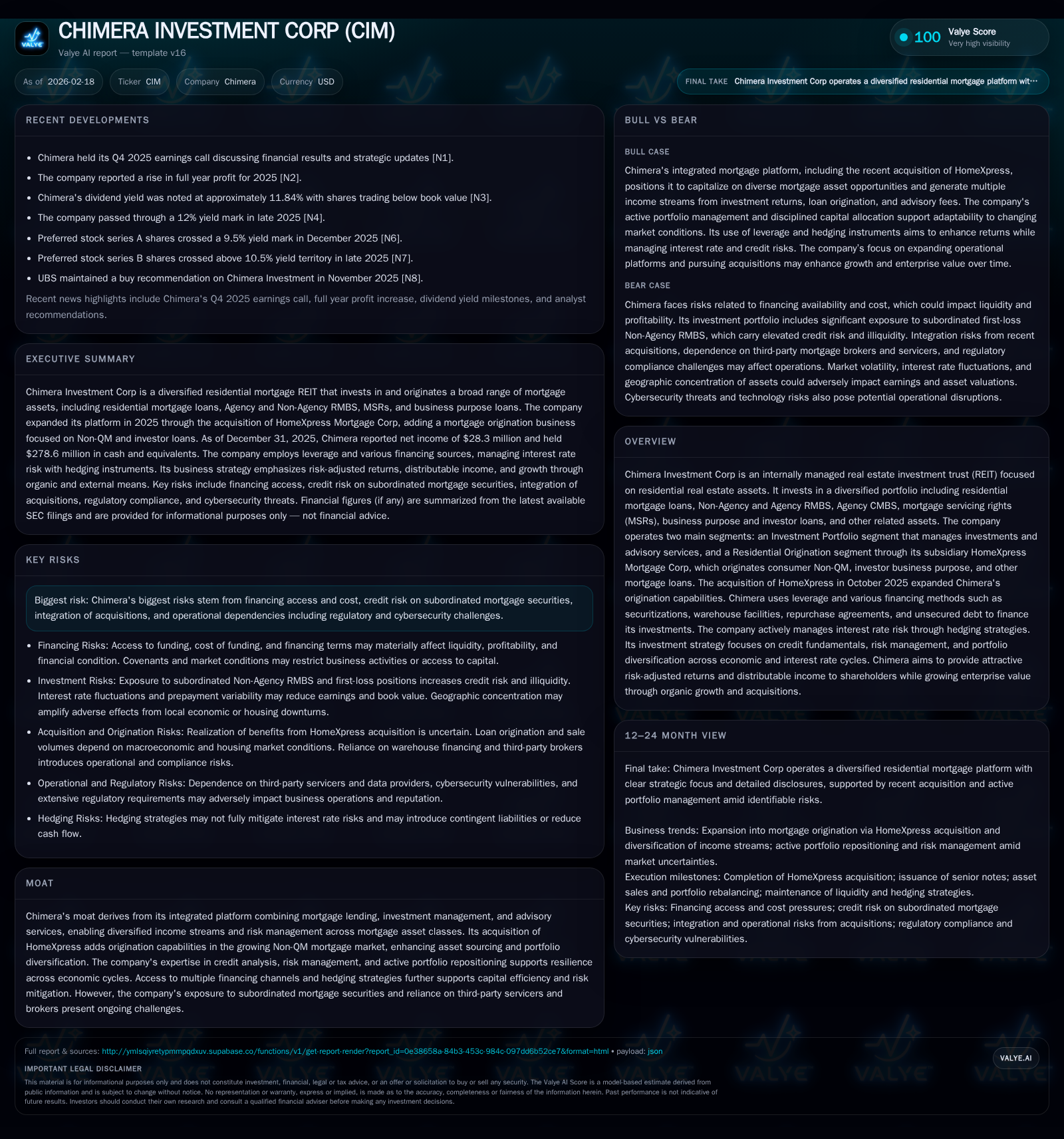
Chimera Investment Corp (CIM) operates as an internally managed REIT with a diversified residential real estate portfolio, spanning mortgage loans, RMBS, MSRs, and now origination via HomeXpress acquired in late 2025. While net income rebounded strongly in 2025 following a 2024 loss, operating cash flow turned negative on substantial investment outlays. The newly bifurcated business segments — Investment Portfolio and Residential Origination — position Chimera to capture growth in the expanding Non-QM market but also increase leverage and operational complexity. Capital structure has shifted markedly with recourse leverage doubling year-over-year, funded by secured financing facilities at declining costs yet higher absolute borrowing. The company’s returns remain constrained with around 1% ROE amid elevated dividend payouts, while liquidity management and integration risks of HomeXpress underpin financial and operational uncertainties going forward.
Company Overview and Business Model
Chimera Investment Corp (CIM) is an internally managed real estate investment trust primarily investing in residential real estate assets. Its diversified portfolio includes residential mortgage loans, Agency and Non-Agency Residential Mortgage-Backed Securities (RMBS), mortgage servicing rights (MSRs), business purpose loans, investor loans, and related real estate assets such as Agency CMBS and junior liens. A key development reshaping Chimera's business profile was the October 1, 2025 acquisition of HomeXpress Mortgage Corp., a specialty originator of Non-Qualified Mortgage (Non-QM) loans tailored for consumers who do not meet conventional qualified mortgage criteria.
This acquisition enabled Chimera to establish a bifurcated operating model with two reportable segments: the Investment Portfolio managing direct asset investments as well as advisory services via Palisades Advisory Services LLC (PAS), and the Residential Origination segment concentrating on originating Non-QM consumer loans and investor business purpose loans through HomeXpress. The origination business currently sells nearly all loans servicing-released to institutional investors.
By expanding beyond traditional securitized holdings into direct loan originations amid a tightening mortgage market for certain credit profiles, Chimera leverages its integrated platform combining lending infrastructure with active credit analysis and risk management expertise. However, this also increases operational complexity and exposure to different regulatory frameworks.
Historical Performance Highlights
Chimera's net income trajectory experienced significant volatility over recent years:
Historical performance (annual)
| FY | Net ($mm) | CFO ($mm) | Net YoY |
|---|---|---|---|
| 2025 | 28 | -249 | +119.3% |
| 2024 | -147 | 206 | -579.7% |
| 2023 | 31 | 213 | -68.6% |
| 2022 | 97 | 326 |
Note: Omitted columns lack sufficient annual XBRL coverage in the provided tags (need ≥2 annual points): Rev, OpInc, Capex, FCF. Source: SEC companyfacts cache [F1].
Capital returns and efficiency (annual)
| FY | Div ($mm) | Buybacks ($mm) | ROE% |
|---|---|---|---|
| 2025 | 123 | 0 | 1.1 |
| 2024 | 119 | 0 | -5.8 |
| 2023 | 195 | 33 | 1.2 |
| 2022 | 288 | 49 | 3.6 |
Source: SEC companyfacts cache [F1].
Note: Revenue and operating income are not available in provided disclosures.
The sharp net income turn from a large loss in FY24 back into modest profitability in FY25 illustrates substantial portfolio repositioning amidst challenging credit environments that impacted mark-to-market valuations of subordinated mortgage securities. Operating cash flow reversed from positive prior years to a large outflow in FY25 driven by significant purchases of Agency RMBS (~$3.3B) and loans held for investment combined with the HomeXpress acquisition cash consideration totaling $272 million [S1][F1][N1]. Despite profitability declines year-over-year excluding one-off impacts, equity has been stable near $2.5 billion due to capital raises offsetting operating results.
Capital returned to shareholders via dividends remains steady near $120 million annually despite earnings swings; share buybacks were halted since FY24 likely reflecting valuation considerations given stock trading below book value [S6][F1][N3].
Portfolio Composition and Segment Evolution
Post-acquisition segment delineation shows the Investment Portfolio still dominant but shrinking from historically ~88% residential mortgage loan exposure down to about 65% at fair value alongside a pronounced growth in Agency MBS exposure from ~4% to ~23%. Non-Agency RMBS holdings also dropped proportionally suggesting strategic rotation toward more liquid Agency securities [S1].
HomeXpress's loan holdings accounted for approximately 6% of total interest earning assets by year-end, marking a material new origination footprint focused on niche credit segments underserved by traditional QM lenders [S1]. This consumer Non-QM lending targets borrowers often excluded due to rigid underwriting guidelines but reflects higher yields commensurate with incremental credit risk.
Capital Structure & Funding Strategy
Chimera funds its investments primarily through secured financing agreements including securitizations backed by mortgage loans/MBS collateral, warehouse facilities supporting originations at HomeXpress, repurchase agreements (repo), and unsecured debt issuance [S4][S8]. As of December 31, 2025:
- Total interest-bearing debt was approximately $13.1 billion,
- Recourse leverage ratio increased markedly to ~5.1x (total debt/equity), up from 4x in prior year,
- Financing terms improved modestly with weighted average borrowing costs declining roughly from ~6.5% to ~5%, aided by refinancing activity,
- Secured financing outstanding reached over $6 billion with average maturities concentrated mostly within one-to-two years,
- Haircuts on collateral range widely: low single digits for Agency MBS (4–5%) up to >25% for more volatile Non-Agency RMBS reflecting lender risk mitigation [S19][S20].
The firm employs hedging instruments such as interest rate swaps, swap futures, swaptions, and interest rate caps designed to limit sensitivity of financing costs to rising short-term rates which could otherwise compress net interest spread earned on assets [S8]. These measures reflect prudent risk management critical given ongoing inflationary pressures and central bank policy uncertainty.
Integration of HomeXpress Acquisition & Growth Outlook
HomeXpress' addition strategically broadens Chimera's revenue sources into the expanding but underpenetrated segment of Non-QM mortgages—a market gaining traction as demand shifts toward more flexible loan products for self-employed or otherwise non-standard borrowers [S1][N1]. Loan origination volume growth here is influenced heavily by macroeconomic factors like housing prices, employment stability, and especially interest rate environment trends impacting borrower affordability.
Management views this shift as complementary given these loans typically carry higher yields balancing credit risks inherent in subordinate positions within securitization capital structures [S1]. The existing wholesale distribution model depends primarily on independent brokers demonstrating scalability potential but introduces dependency risks as well [S15].
While explicit guidance is not provided for forthcoming milestones or financial targets post-acquisition beyond qualitative commentary [N1], investors should monitor:
- Originations volume growth pace at HomeXpress,
- Credit performance trends across originated portfolios especially during evolving economic cycle dynamics,
- Funding cost trajectory amid capital markets volatility,
- Integration efficiency including operational synergies,
- Liquidity positioning given sizeable leverage expansion post-acquisition.
Returns & Capital Return Profile
Return on equity remains subdued; estimated ROE is roughly calculated at around 1% based on latest net income against equity base reflecting subdued earnings levels relative to capital employed [F1]. Dividend payments remain robust reflecting REIT distribution mandates yet strain payout ratios when earnings falter; no common stock repurchases occurred in FY25 unlike modest buybacks executed earlier suggesting cautious capital allocation stance amid valuation headwinds [F1][S6].
Cash flow dynamics reveal heightened investment activity exceeding current cash generation causing operational cash flow deficits; however financing activities have largely offset these outlays sustaining liquidity buffers now approaching nearly $280 million cash reserves by year-end [F1][S11][S16].
Overall capital discipline appears geared toward supporting strategic expansion balanced against maintaining financial flexibility avoiding excessive near-term dilution or overextension.
Industry Context & Challenges Analysis
The broader residential mortgage investment sector contends with elevated interest rate environments suppressing prepayment speeds but raising funding costs; increased volatility affects valuation especially within subordinate tranche holdings common at Chimera . Rising pressures on mortgage servicers through regulatory financial soundness requirements complicate MSR valuation dynamics impacting Chimera’s MSR exposures which rely on stable third-party servicer performance [S15].
The growing Non-QM loan market offers revenue diversification but heralds credit challenges amplified by looser underwriting standards potentially elevating default risk especially if economic softness emerges [S15]. Chimera’s expansion into origination segments intensifies exposure concentration risk requiring vigilant credit monitoring alongside technology-enabled underwriting quality controls.
Liquidity management remains paramount given the company's reliance on short-dated secured financing facilities which require continuous refinancing subject to changing margin/haircut terms negotiated mainly under SIFMA master repurchase agreements—any disruption may compel asset fire sales adversely affecting portfolio valuations [S17][S19]. The company mitigates some financing risks via non-mark-to-market facilities reducing margin calls potential but must balance these against increased financing costs.
Cybersecurity threats together with compliance demands add operational risk layers requiring ongoing investments limiting near-term free cash flow availability.
Conclusion & Monitoring Considerations
Chimera Investment Corp’s transition following the HomeXpress acquisition marks a pivotal strategic evolution that positions it for participation in emergent residential lending niches while leveraging established asset management capabilities across a diverse mix of mortgage securities.
The company’s financial profile improved materially versus prior year losses but faces headwinds tied principally to integration execution risk, elevated leverage levels nearing five times equity matched with lower operating cash flows, and contingent credit risks embedded within subordinate mortgage securities portfolios.
Going forward, stakeholders should track developments around the Residential Origination segment's scale-up effectiveness, sustained access to stable cost funding sources amid market turbulence, hedging strategy efficacy amidst rate volatility, credit performance trends particularly within the higher-risk Non-QM cohorts, dividend sustainability vis-à-vis cash flow generation trends, and incremental operational cost impacts driven by regulatory compliance demands.
Disclaimer: This report is for informational purposes only without any recommendation regarding buying or selling securities or providing investment advice.
Disclaimer: This is research-only, informational analysis and not investment advice. It may include AI-generated interpretation and general industry context. Always verify important details using primary sources.

Comments