
Bausch + Lomb’s Revenue Growth and Profitability Challenge Amid Heavy Capex and Debt Burden
Bausch + Lomb reports solid top-line growth but faces margin compression and net losses amid ongoing transformation and elevated investment.
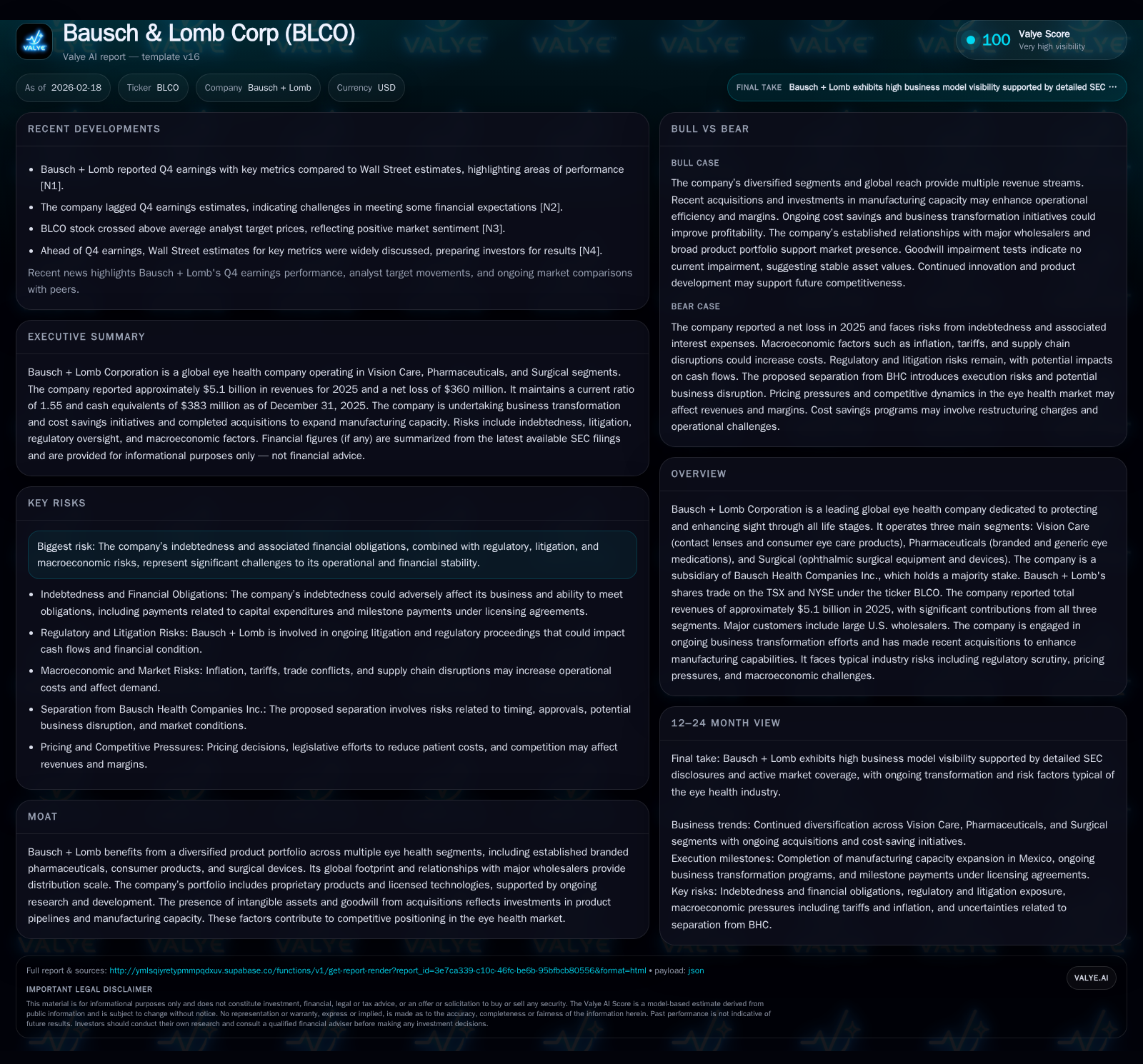
Bausch + Lomb Corp delivered steady revenue expansion driven by all three core segments—Vision Care, Pharmaceuticals, and Surgical—in 2025, supported by a broad global footprint. However, operating income declined significantly, pressured by rising costs tied to business transformation initiatives and elevated capital expenditures. High financial leverage and net losses persist despite operating cash flow growth. Key near-term milestones include full ramp of new manufacturing capacity acquired in Mexico, milestone payments for licensed products, and containment of restructuring costs. Monitoring operating margin stabilization and deleveraging will be critical to assess progress beyond current headwinds.
Company Overview
Bausch + Lomb Corporation stands as a prominent player in global eye health markets with a diversified portfolio spanning Vision Care (including contact lenses), branded and generic Pharmaceuticals targeting ocular conditions, and Surgical devices utilized in ophthalmic procedures. It operates under the wider umbrella of Bausch Health Companies Inc., which retains majority ownership. The firm services major North American wholesalers such as McKesson and Cardinal Health, reflecting robust distribution scale. Its geographic reach encompasses developed markets including the U.S., Canada, Europe (France, Germany, UK), Asia (Japan, South Korea), emerging economies like Russia and Poland, as well as other territories [S4].
Historical Performance and Growth Drivers
Bausch + Lomb’s total revenues progressed steadily upward over recent years. Revenues climbed from approximately $4.15 billion in 2023 to $4.79 billion in 2024 before reaching about $5.10 billion in 2025 [S4]—an average compound annual growth rate exceeding 10%. This was fueled primarily by:
- Expansion in Vision Care products during increasing contact lens adoption and consumer eye care awareness.
- Pharmaceutical sales growth assisted by new branded launches balanced with generic offerings.
- Enhanced contribution from Surgical through both organic volume gains and incremental device adoption.
Despite top-line strength, profitability has been pressured. Operating income softened from $207 million in 2022 down to $130 million in 2023, rose slightly to $162 million in 2024, before dropping again sharply to $113 million in 2025—a roughly 30% decline last year alone [F1]. The most salient drag was elevated SG&A related to ongoing "Business Transformation Costs," entailing executive turnover compensation packages, advisory fees for restructuring, and investments aimed at streamlining operations while cutting excess real estate and headcount [S1]/[S2]. Inflationary cost pressures across manufacturing inputs also compressed margins.
Net income reflects this margin squeeze compounded by financing expenses resulting from a sizeable debt load. Bausch + Lomb reported net losses consistently since late 2022: -$260 million (2023), -$317 million (2024), widening further to -$360 million (2025) [F1]. Despite this, the firm's operating cash flows rebounded meaningfully after a negative outflow in early periods: growing from $345 million (2022) to negative $17 million (2023), then rising strongly back to $232 million (2024) before hitting $283 million last year [F1]. This indicates improving underlying cash generation capacity offsetting some profit erosion.
Capital expenditures escalated substantially each year aligned with expansion efforts—drawing from $175 million (2022) up to $291 million (2024) then escalating sharply past $349 million (2025) as the company invested heavily in manufacturing assets including a recently announced Mexico production facility acquisition valued at around $75 million upfront payment anticipated near Q4/25 or Q1/26 subject to regulatory approvals [S2]. These investments aim to bolster capacity for higher-margin products long-term but weigh heavily on free cash flow dynamics immediately.
Selected Financials Summary
Historical performance (annual)
| FY | Net ($mm) | CFO ($mm) | OpInc ($mm) | Capex ($mm) | Net YoY |
|---|---|---|---|---|---|
| 2025 | -360 | 283 | 113 | 349 | -13.6% |
| 2024 | -317 | 232 | 162 | 291 | -21.9% |
| 2023 | -260 | -17 | 130 | 181 | -4433.3% |
| 2022 | 6 | 345 | 207 | 175 |
Note: Omitted columns lack sufficient annual XBRL coverage in the provided tags (need ≥2 annual points): Rev, Div, Buybacks. Source: SEC companyfacts cache [F1].
Capital returns and efficiency (annual)
| FY | FCF ($mm) | ROE% |
|---|---|---|
| 2025 | -66 | -5.6 |
| 2024 | -59 | -4.9 |
| 2023 | -198 | -3.8 |
| 2022 | 170 | 0.1 |
Source: SEC companyfacts cache [F1].
Notes: Revenue figures are not available from provided tags; Net income YoY percentage for FY23 is not calculated due to initial positive base.
Future Growth Prospects
Growth catalysts reflect continuation of multi-pronged strategies:
- Product Portfolio Expansion: Leveraging pipeline pharmaceutical launches addressing unmet eye disease needs with novel mechanisms coupled with sustained consumer eye care innovation drives potential for sales lift.
- Manufacturing Scale & Vertical Integration: Completion of the Mexico manufacturing facility acquisition aims to reduce supply chain disruptions and improve gross margins through localized production.
- Cost Rationalization: Headcount reductions, consolidation of underutilized real estate assets, and process efficiencies foresee improved operating leverage once transformation costs normalize [S1]/[S2].
- Geographic Penetration: Expanding presence especially in developing markets with rising healthcare expenditures offers incremental revenue opportunities beyond saturation points reached in mature economies like the U.S., where mostly volume-driven gains remain feasible.
However, growth could be capped or pressured by:
- Continued intense competition impacting pricing power across segments.
- Regulatory environment tightening on drug pricing reforms potentially limiting pharmaceutical pricing flexibility.
- Legal contingencies related to product liability or antitrust allegations requiring reserves or diversion of management attention although some litigation exposure has been reduced recently [S7]/[S10]/[S14].
- Macroeconomic volatility that may constrain discretionary spending on elective surgical procedures or premium vision care products.
Forecasts / Milestones / Expectations
The company’s official filings highlight certain upcoming items:
- A sales-based milestone payment of approximately $35 million related to the MIEBO® product licensed from Novaliq GmbH is accrued as of September 30, 2025 and anticipated payment falls within Q1/26 once triggered sales thresholds are met [S1]/[S2].
- Closing of the manufacturing facility acquisition by early quarters of fiscal year '26 remains contingent upon regulatory clearance but is slated as critical capex towards capacity expansion [S2].
- Management plans further cost savings actions but has not booked any specific restructuring charges beyond ongoing business transformation costs noted; potential exists for additional exits or restructuring if market conditions necessitate deeper action [S1]/[S2].
Primary metrics to watch include operating margin trends post-transformation expense normalization plus free cash flow trajectory given capital investments weigh heavily on liquidity currently.
Returns / Capital Allocation
Bausch + Lomb does not report positive returns measured via traditional ROE given persistent net losses; approximate trailing ROE based on latest fiscal data is near -5.6%, reflecting net losses relative to an equity base around $6.45 billion at end-2025 [F1].
Cash flow trends illustrate strengthening operating inflows despite negative net results but sustained high capital expenditure yields a negative free cash flow profile approaching -$66 million last year (operating cash flow minus capex). Dividends paid or share repurchase activities are not reported within available disclosures; thus no data on distributions or buybacks can be confirmed [F1].
Significant debt service obligations dominate capital structure considerations as the firm carries over $5 billion senior secured debt with staggered maturities mainly after calendar year '28; refinancing moves completed early '26 have lowered interest costs but maintaining covenant compliance amidst margin pressure will remain focal for treasury strategy [S5]/[S6]/[S12]/[S17].
Industry Context Analysis
The ophthalmic industry is characterized by high R&D intensity especially within pharmaceuticals addressing chronic eye diseases such as glaucoma or age-related macular degeneration where patent cliffs loom large disincentivizing complacency around innovation pipelines. The competitive landscape spans specialist device manufacturers producing complex ophthalmic surgical platforms and mass-market vision care consumables like contact lenses dominated by few global players benefiting from scale advantages but vulnerable to price wars especially through large wholesale distributors dominating US channel ecosystems.
Manufacturing trends increasingly emphasize flexible batch production enabling rapid SKU adjustments relevant for Bausch + Lomb’s strategy involving newly acquired facilities intended for better supply agility amid inflation pressures experienced broadly across pharma manufacturing sectors.
Moreover, heightened regulatory scrutiny surrounding pricing behavior amid broader healthcare cost containment imperatives globally represents systemic headwinds hidden beneath revenue growth headlines.
Conclusion
Bausch + Lomb’s recent annual performance underscores its dual narrative: steady topline progression fueled by a diversified eye health portfolio counterbalanced by margin erosion deriving largely from transformational investments and escalating operational expenses associated with restructuring efforts. The next phases hinge critically on converting these investments into tangible operating leverage improvements while judiciously managing financial obligations that court interest rate risk due to floating rate components often linked with term SOFR plus margins averaging near mid-7% range and covenant restrictions constraining aggressive capital moves.
For stakeholders tracking this company post spin-off separating it effectively from BHC parent dynamics facilitating more focused strategic execution—improvements in profitability metrics alongside meaningful deleveraging would represent key inflection points signaling sustainable value creation beyond transient cost burdens incurred during this active expansion cycle.
Disclaimer: This analysis is provided solely for informational purposes based on available public disclosures up to February 18, 2026. It does not constitute investment advice or recommendations concerning any securities.
Disclaimer: This is research-only, informational analysis and not investment advice. It may include AI-generated interpretation and general industry context. Always verify important details using primary sources.

Comments