
Republic Services Leverages Scale and Innovation to Sustain Profit Growth
Republic Services’ 2025 momentum stems from yield-driven revenue gains, strategic acquisitions, and sustainability investments amid regulatory pressures.
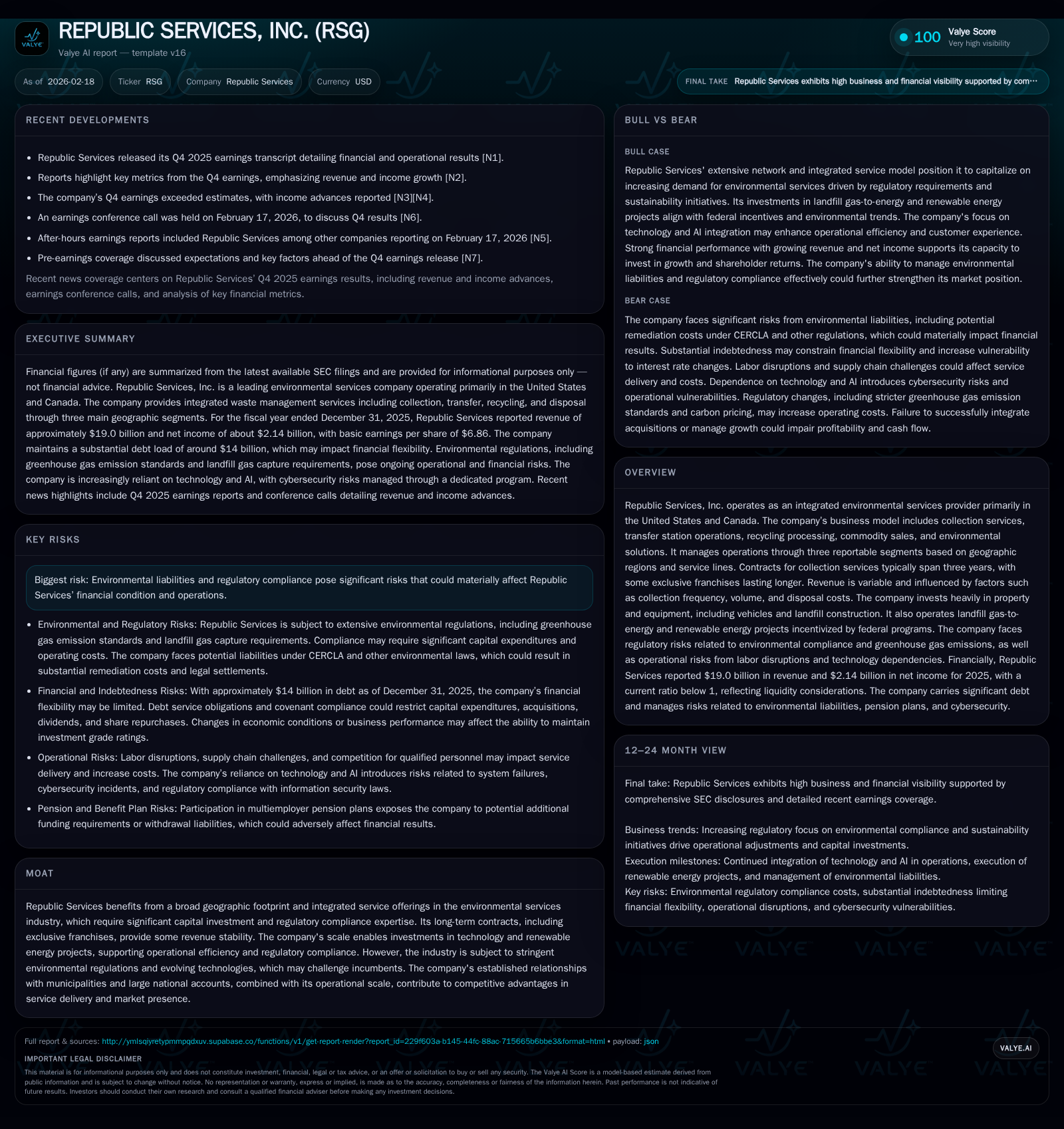
Republic Services, Inc. posted robust financial growth in 2025 fueled by a 4.1% average yield increase and acquisition contributions despite minor volume declines. The company balances rising capital expenditures for fleet and landfill investments with sustainability initiatives like landfill gas-to-energy projects and technological enhancements in route optimization. Regulatory compliance costs linked to tightened methane emissions standards and carbon pricing frameworks in the U.S. and Canada introduce operational cost pressures. Guidance for 2026 anticipates continued yield-led revenue growth offset partially by volume headwinds. Capital allocation focuses on sustaining dividends and accelerating share repurchases supported by strong cash flow generation, reflecting an approximate 18% return on equity.
Financial Trajectory: Recent Growth Drivers and Shifts
Republic Services demonstrated solid financial performance in fiscal year 2025, with total revenues reaching approximately $19.0 billion, reflecting a 3.3% increase over the prior year’s $18.4 billion [F1]. This topline gain was chiefly propelled by an average yield improvement of around +4.1%, reflecting favorable pricing dynamics including adjustments above inflation consistent with contractual provisions allowing pricing above cost inflation [S1]. Strategic acquisitions added roughly +1.3% to revenue growth, demonstrating Republic's continued focus on inorganic expansion while waste load volumes declined marginally by about -0.6%, illustrating modest headwinds in physical demand for waste services.
Operating income expanded commensurately by approximately 3.3% to $3.30 billion, preserving a consistent operating margin near 19.9%. Net income attributable to Republic reached $2.14 billion, up nearly 4.7%, aided by disciplined cost controls despite incremental pressures from rising fuel prices and labor costs [F1][S1]. Operating cash flow accelerated significantly to $4.30 billion, a nearly +9% rise over prior year levels, underpinning strong liquidity to support capital-intensive business needs.
Capital expenditures increased modestly by about +1.7% to nearly $1.89 billion as Republic invested heavily in fleet renewal — critical given the aging vehicle base typical of integrated waste management — as well as landfill construction activities essential for long-term disposal capacity [F1]. Depreciation and amortization expenses also rose due to these investments enhancing asset base longevity.
Historical performance (annual)
| FY | Rev ($bn) | Net ($bn) | CFO ($bn) | OpInc ($bn) | Rev YoY | Net YoY |
|---|---|---|---|---|---|---|
| 2025 | 19.0 | 2.1 | 4.3 | 3.3 | +3.3% | +4.7% |
| 2024 | 18.4 | 2.0 | 3.9 | 3.2 | +6.6% | +18.0% |
| 2023 | 17.3 | 1.7 | 3.6 | 2.8 | +10.4% | +16.4% |
| 2022 | 15.6 | 1.5 | 3.2 | 2.4 |
Note: Omitted columns lack sufficient annual XBRL coverage in the provided tags (need ≥2 annual points): Capex. Source: SEC companyfacts cache [F1].
Capital returns and efficiency (annual)
| FY | Div ($mm) | Buybacks ($mm) | FCF ($bn) |
|---|---|---|---|
| 2025 | 738 | 870 | 2.4 |
| 2024 | 687 | 482 | 2.1 |
| 2023 | 638 | 262 | 2.0 |
| 2022 | 593 | 204 | 1.7 |
Source: SEC companyfacts cache [F1].
Note: Percentages for some years are approximated based on available data.
The blend of higher average yields with moderate volume softness suggests pricing discipline remains the primary lever for profit growth rather than volume expansion alone, reflective of mature market dynamics where service frequency adjustments supplement load growth.
Integration of Sustainability and Technology in Growth Strategy
Republic Services continues embedding sustainability into its operating model amidst tightening environmental regulations and increasing customer expectations for greener waste solutions [N1][S1]. The company operates over eighty-four landfill gas-to-energy projects that capture methane emissions from active landfills, converting this greenhouse gas into renewable electricity under various incentive programs.
Complementing these renewable initiatives is Republic’s deployment of technology such as digital platforms for route optimization that enhance fleet productivity while reducing fuel consumption and emissions; telematics systems provide real-time operational insights reducing downtime; customer portals improve billing accuracy and retention.
While revenues from environmental solutions decreased slightly (-1%), this segment aligns with circular economy principles including recycling processing centers (79 facilities nationwide), which expose revenues to commodity price volatility given fluctuating scrap prices [S13][N1]. Regulatory drivers pushing increased diversion targets further position Republic’s scale advantage in investing in advanced recycling technologies typically unaffordable for smaller competitors.
Regulatory Landscape Impacting Operations and Cost Structure
Republic operates under intensifying federal environmental regulations particularly concerning landfill methane emissions mandated since mid-2010s under Clean Air Act amendments enforced by the EPA [S19]. Recent rules require newer landfills (post-2014 construction) to implement stricter gas capture systems; updates compel existing landfills toward tighter emissions reductions potentially requiring significant capital upgrades.
State-level mandates such as California’s greenhouse gas reporting requirements add compliance overheads though enforcement faces legal challenges [S19][S28]. In Canada, the elimination of the federal fuel charge replaced by an output-based pollution pricing system creates a complex carbon cost structure impacting landfill operations directly.
These regulatory obligations increase capital intensity related to infrastructure upgrades plus operational expenses from enhanced monitoring, reporting, and potential penalties for non-compliance [S28]. Fuel recovery fees also introduce cost forecasting variability linked to fluctuating fuel surcharge regulations.
Guidance for Fiscal Year 2026: Outlook and Expectations
Management projects consolidated revenues between $17.05 billion to $17.15 billion for fiscal year ending December 31, 2026 [S1], reflecting expected average yield increases of +3.2% to +3.7%, partially offset by volume impacts near -1%. Adjusted diluted earnings per share—a non-GAAP measure excluding restructuring charges—is forecasted between $7.20 to $7.28 versus an adjusted $7.02 achieved in fiscal year 2025 [S1]. This adjusted EPS metric isolates core operations from transient charges enhancing comparability.
Key investor considerations include execution versus yield targets within contractual frameworks—especially municipal collection agreements—and monitoring waste load volume trends amid macroeconomic uncertainties.
Capital Deployment: Balancing Growth Investments, Dividends, and Share Repurchases
In fiscal year ended December 31, 2025, Republic invested approximately $1.89 billion in property plant & equipment supporting fleet renewals vital given heavy wear inherent in refuse collection operations as well as landfill capacity expansion essential under local zoning constraints [F1].
The company returned significant capital to shareholders via dividends totaling approximately $738 million—continuing an upward payout trend—and markedly increased share repurchases amounting to $870 million during the year compared with prior years' activity [F1][S9][S20]. This reflects management confidence backed by strong free cash flow estimated at approximately $2.41 billion after capital expenditures deductions.
Return on equity approximates a robust ~17.9%, highlighting effective capital utilization despite heavy fixed-asset investments typical of integrated environmental services businesses reliant on large-scale infrastructure assets [F1].
Operational Footprint and Segment Details
Republic segments its operations into three main field groups: Group 1 covering Western U.S.; Group 2 spanning Southeastern/Midwestern U.S., Eastern Seaboard states plus Canada; Group 3 comprising Environmental Solutions across North America servicing specialized industrial treatment needs [S13][S15][S27].
These groups manage extensive asset bases including hundreds of collection operations (377), transfer stations (255), recycling centers (79), active landfills (207), treatment storage & disposal facilities (24 TSDFs), plus injection wells primarily serving oilfield wastes—a niche differentiator within Republic’s portfolio.
Competitive advantages stem from multi-year contracts averaging roughly three years or longer exclusive municipal franchises stabilizing cash flows despite cyclical economic impacts on volumes [S15]. Transfer stations serve as logistical hubs consolidating loads between collection fleets and disposal sites enhancing network efficiency across regions.
Recycling volumes expose revenue streams to commodity price fluctuations requiring strategic oversight due to scrap market volatility.
Risk Considerations: Environmental Liabilities and Compliance Exposure
Despite established regulatory compliance frameworks paired with insurance coverage where feasible, residual exposure remains regarding environmental liabilities tied to site remediation or emission control failures potentially causing material cost or margin impacts [S19].
Ongoing risk assessments incorporate probable contingencies based on litigation outcomes or changing jurisdictional policies mitigating surprises but underscore sustained monitoring given evolving legal landscapes governing waste management operations.
Management indicates no pending legal matters expected to materially impact consolidated financial condition but acknowledges environmental risk factors contribute intrinsic volatility requiring careful forecasting assumptions.
Disclaimer: This analysis synthesizes publicly available financial statements, SEC filings, earnings call transcripts, and industry context without providing investment recommendations or forecasts beyond reported guidance.
Disclaimer: This is research-only, informational analysis and not investment advice. It may include AI-generated interpretation and general industry context. Always verify important details using primary sources.

Comments