
Adapti Inc. Faces Capital and Execution Challenges Despite Sports Agency Expansion
Adapti’s early-stage pivot into sports agency services and AI technology development is constrained by liquidity pressures and unproven commercial viability.
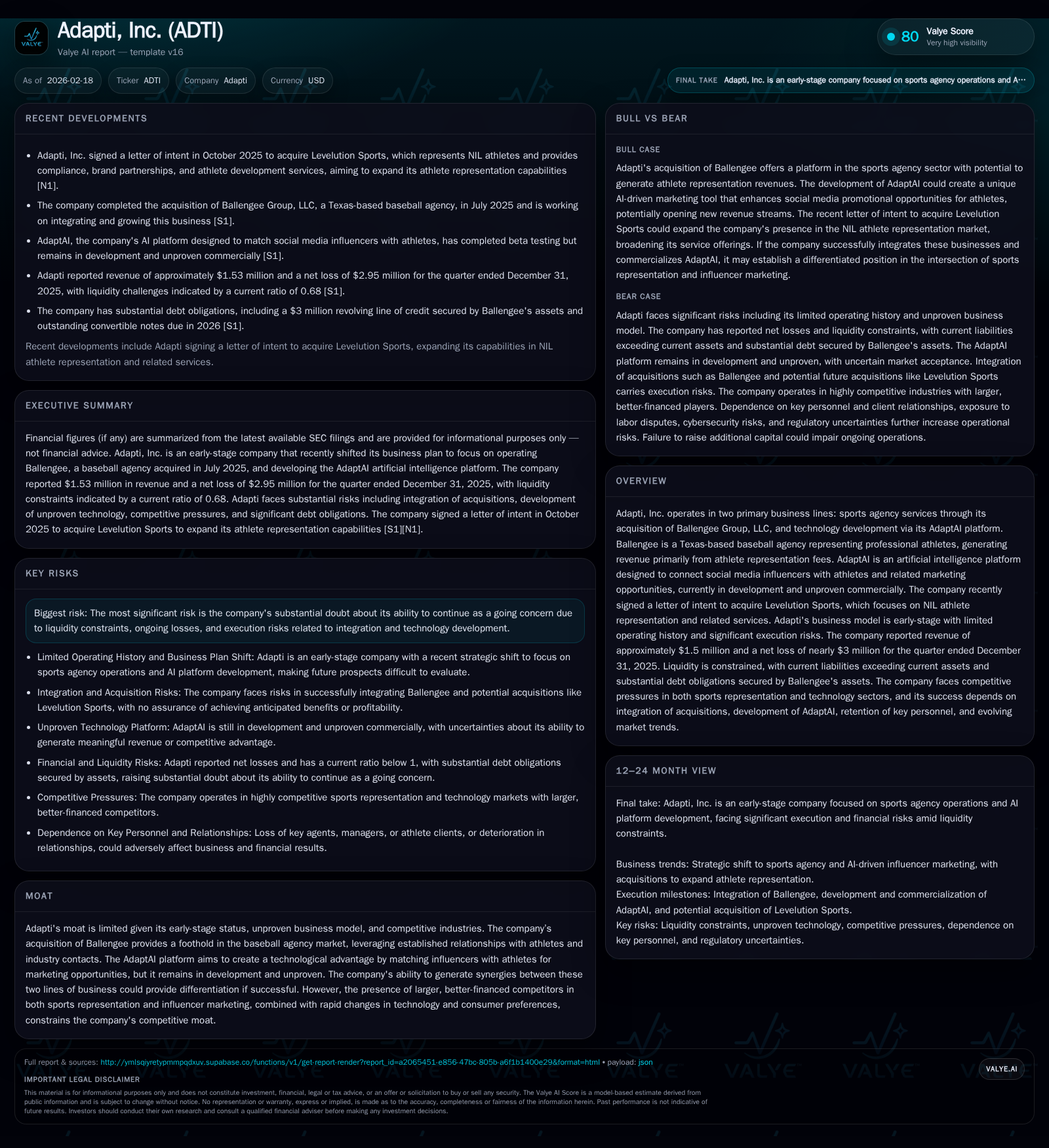
Adapti, Inc. operates primarily through its recently acquired Ballengee Group, a Texas-based baseball agency, and its developing AdaptAI artificial intelligence platform designed to connect influencers with athletes for marketing opportunities. With limited historical revenue of approximately $1.5 million for the quarter ended December 31, 2025, the company incurred a net loss approaching $3 million amid a challenging liquidity environment and substantial execution risks. Adapti’s future growth hinges on successful integration of Ballengee, commercialization of AdaptAI, and potential synergies between these lines, but material risks include significant indebtedness, ongoing losses, and regulatory compliance obligations. The company’s capital position and strategy will require close monitoring as it seeks additional financing to sustain operations beyond 2026.
Business Overview and Historical Performance
Adapti, Inc., trading under ticker ADTI, has transitioned from a consumer product focus toward a dual-line business model centered on sports agency services via its acquisition of Ballengee Group LLC—a Texas-based baseball athlete representation firm—and technology development through its AdaptAI platform [F1][S2][S19]. Ballengee generates revenue primarily from commissions on athlete representation contracts; however, the timing gap between contract signing and commission payments creates lumpy cash flows typical in professional sports representation [S19].
AdaptAI is an early-stage artificial intelligence platform designed to connect athletes with social media influencers for marketing collaborations but has not yet demonstrated commercial traction or monetization [S8].
Financial results for the quarter ended December 31, 2025 show revenues of approximately $1.53 million with an operating loss of $2.73 million and net loss of $2.95 million, reflecting initial revenue generation alongside significant costs related to acquisition integration and R&D.
Historical performance (annual)
| FY |
|---|
| 2026 |
Note: Omitted columns lack sufficient annual XBRL coverage in the provided tags (need ≥2 annual points): Rev, Net, CFO, OpInc, Capex, Div, Buybacks, FCF, ROE%. Source: SEC companyfacts cache [F1].
Note: Capital expenditures, dividends paid, and share buybacks are not available in the provided XBRL tags.
Growth Drivers and Future Outlook
Key growth drivers include leveraging Ballengee's foothold within professional baseball athlete representation to build recurring commission revenues as player contracts mature. The company also plans expansion into collegiate athlete markets through acquisitions like Levelution Sports targeting Name Image Likeness (NIL) opportunities aligned with NCAA policy changes [F1][S2].
AdaptAI aims to capitalize on emerging sports marketing trends by facilitating AI-driven matches between athletes and social media influencers to unlock new advertising opportunities. However, commercialization milestones remain forthcoming without disclosed timelines or metrics [S8].
Potential synergy between the agency business providing exclusive athlete access and AdaptAI's marketing platform could enhance revenue streams but remains speculative.
Risks and Challenges
Adapti faces substantial execution risks including integration complexities within a competitive sports agency sector subject to stringent licensing regulation—noncompliance may lead to fines or license revocations adversely affecting operations [S3][S14][S25].
The company has disclosed substantial doubt about its ability to continue as a going concern due to capital shortfalls and negative operating cash flows compounded by upcoming convertible note maturities held predominantly by insiders who may convert or demand repayment [F1][S4][S7][S16][S22].
AdaptAI faces challenges common in AI sectors such as data quality risks impacting model outputs; evolving regulatory frameworks imposing compliance costs; intellectual property exposure; and cybersecurity threats including state-sponsored attacks potentially disrupting platform operations or compromising sensitive data [S8][S9][S20].
Management’s part-time commitments across multiple entities may constrain strategic focus while insider-held debt instruments create governance complexities with potential conflicts affecting minority shareholders [S17][S18][S22].
Capital Structure and Financial Position
As of December 31, 2025, the company's current assets stood at approximately $3.88 million versus current liabilities near $5.69 million resulting in a current ratio around 0.68—indicating liquidity constraints requiring careful management [F1].
Ballengee maintains a revolving credit facility up to $3 million secured by substantially all assets with cross-collateralization provisions linked to affiliated loans increasing default risk exposure [S4][S7][S10].
The earnout arrangement from the Ballengee acquisition requires payment in common stock based on EBITDA performance thresholds over four years up to $20 million total consideration which could significantly dilute existing equity holders if targets are met [S16].
Mandatory repayments under participating promissory notes obligate the company to allocate portions of equity offering proceeds above $250K plus half of free cash flow quarterly to former Ballengee owners—cash flow generation has yet to materialize constraining reinvestment capacity [S15][S16].
Operating losses translate into an approximate trailing return on equity of -21.8% based on net losses relative to shareholders’ equity at fiscal year-end 2025; no dividends or share repurchase programs have been announced or paid [F1].
Conclusion
Adapti Inc presents a complex investment profile combining nascent sports agency operations via Ballengee Group with ambitious AI-driven marketing ambitions through AdaptAI development. Initial revenues demonstrate some traction primarily from agency commissions but remain overshadowed by substantial losses compounded by liquidity pressures.
Execution risks include regulatory compliance challenges specific to athlete representation licensing regimes alongside uncertainties inherent in early-stage AI commercialization.
Capital structure risks are heightened by significant insider-held convertible debt maturities creating potential governance conflicts while earnout-related dilution looms contingent on future EBITDA achievements.
No dividend payments or share buybacks are currently planned as the company prioritizes capital preservation amid uncertain financing prospects necessary for sustaining operations through mid-2027.
Disclaimer: This analysis relies exclusively on publicly disclosed SEC filings and company-reported financials as of February 18, 2026. It does not constitute investment advice or a securities recommendation.
Disclaimer: This is research-only, informational analysis and not investment advice. It may include AI-generated interpretation and general industry context. Always verify important details using primary sources.

Comments