
Franklin Templeton Holdings Trust: Balancing Ethical Gold Exposure with Performance Realities
FGDL’s focus on responsibly sourced gold bullion underpins its market niche while NAV dynamics remain closely tied to fluctuating gold prices and operational structures.
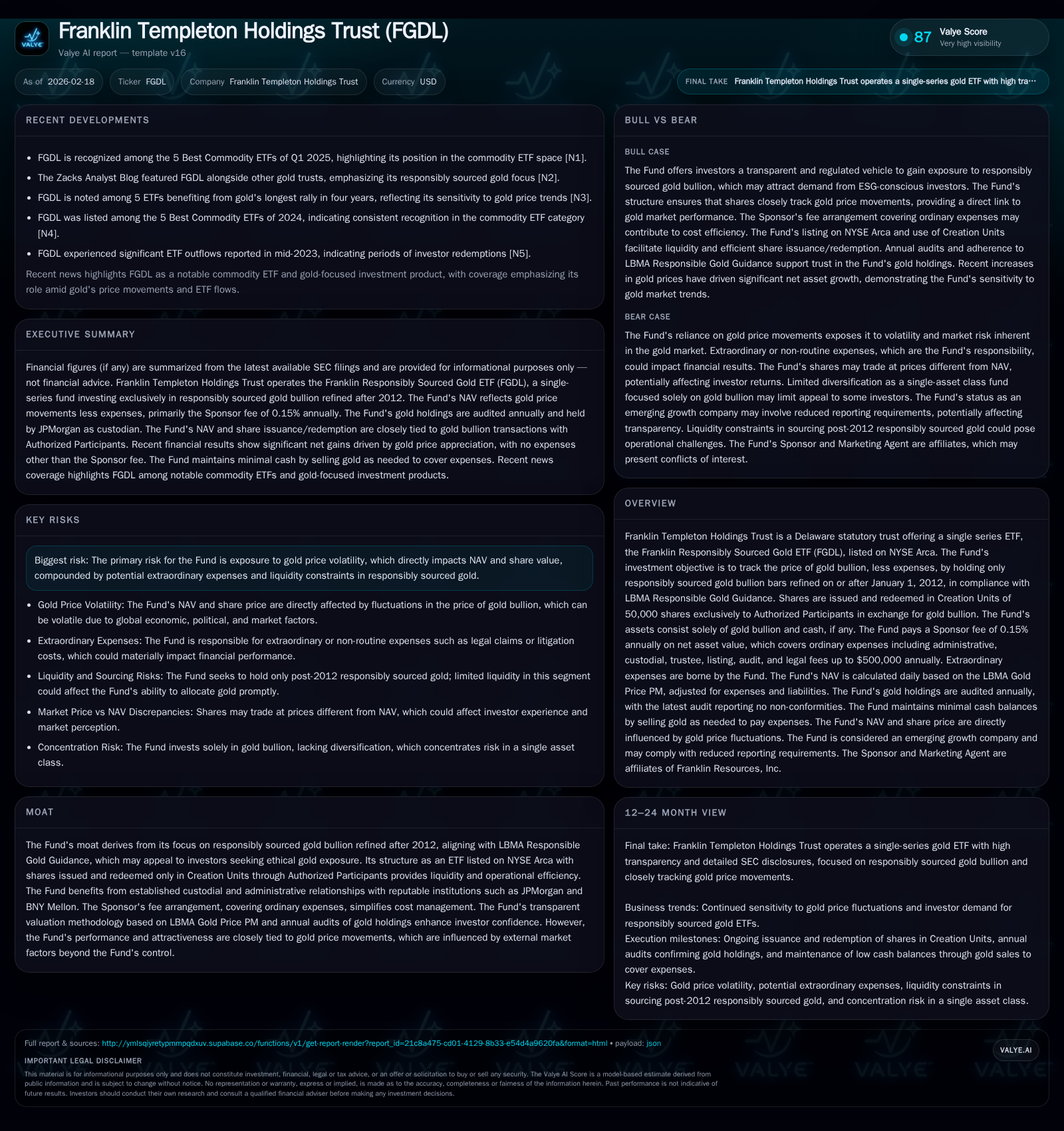
Franklin Templeton Holdings Trust operates the Franklin Responsibly Sourced Gold ETF (FGDL), a NYSE Arca-listed product that targets investors prioritizing ethical sourcing by holding only post-2012 LBMA-compliant gold. Since its 2021 inception, FGDL has shown strong net income growth driven by rising gold prices and increased share issuance. Its operational model leverages an efficient Creation Unit-based share issuance process facilitated by Authorized Participants, supported by custodial services from JPMorgan and BNY Mellon. Capital allocation remains straightforward with no dividends or buybacks; returns hinge predominantly on gold price volatility and the impact of an annual Sponsor Fee of 0.15%. Liquidity constraints occasionally arise around availability of post-2012 gold bars. Key considerations include monitoring gold market developments, creation/redemption trends, and any extraordinary expenses that may arise.
Foundation and Growth Trajectory Since Launch
Established as a Delaware statutory trust in April 2021, Franklin Templeton Holdings Trust launched the Franklin Responsibly Sourced Gold ETF (FGDL) with a distinct investment mandate: to hold only London Good Delivery gold bullion bars refined on or after January 1, 2012. This "post-2012 gold" must comply fully with the London Bullion Market Association's (LBMA) Responsible Gold Guidance, representing a niche within the broader gold ETF sector targeting ethically aligned investors [S1][S2].
FGDL began trading on NYSE Arca in June 2022 and swiftly gained traction among investors seeking ESG-conscious exposure to physical gold. The Fund's net income climbed sharply from approximately $6.1 million in FY2024 to $34.6 million in FY2025—a +464.7% year-over-year increase—reflecting both rising gold prices and substantial growth in assets under management fueled by share issuance [F1][S4]. Net assets more than doubled from $62 million at March 31, 2024, to nearly $187 million at March 31, 2025.
This rapid expansion is mirrored in share count dynamics: after beginning FY2024 with roughly 2.1 million shares outstanding, creations totaled over 3 million during FY2025 with relatively minor redemptions. The Fund positioned itself as a growing vehicle for socially responsible gold investment amid intensifying investor interest [S4].
Historical performance (annual)
| FY | Net ($mm) | CFO | Net YoY |
|---|---|---|---|
| 2025 | 35 | 0 | +464.7% |
| 2024 | 6 | 0 | -36.8% |
| 2023 | 10 | 0 |
Note: Omitted columns lack sufficient annual XBRL coverage in the provided tags (need ≥2 annual points): Rev, OpInc, Capex, Div, Buybacks, FCF, ROE%. Source: SEC companyfacts cache [F1].
Note: Operating cash flow data is zero for all periods; no dividends or buybacks reported.
Operational Framework Anchored in Responsible Gold Principles
FGDL’s moat emerges from its unwavering commitment to holding only ethically responsible gold refined under LBMA standards since January 1, 2012. Such "post-2012" designation ensures compliance with stringent environmental and social governance criteria within the precious metals supply chain — an area increasingly scrutinized by institutional investors.
Shares are created or redeemed exclusively in Creation Units of 50,000 shares each through authorized financial institutions known as Authorized Participants (APs). APs deliver physical post-2012 gold bullion to the Fund in exchange for newly minted shares or redeem shares back for allocated physical gold credits.
Custody responsibilities are split between JPMorgan Chase Bank's London branch (Gold Custodian) for secure storage of allocated physical bullion bars and BNY Mellon Asset Servicing (Administration/Cash Custodian & Transfer Agent) managing cash accounts and back-office processing [S1][S5]. This bifurcated custodian setup aligns with industry best practices for precious metals ETFs enhancing security while maintaining operational efficiency.
All ownership units represent fractional undivided interests in the allocated account of post-2012 bars — physical bars domiciled off-balance-sheet but fully audited annually giving investors embedded assurance over tangible backing [S25].
NAV Performance Drivers Amid Gold Market Dynamics
The Fund’s NAV is computed daily at noon New York time using the LBMA Gold Price PM auction data conducted electronically by ICE Benchmark Administration (IBA). If that price is unavailable or deemed inappropriate on a given day—which is rare—the Administrator employs other fair valuation methods approved by the Sponsor [S1][S2].
This methodology tightly links FGDL’s valuation directly to spot market moves of unallocated loco London gold traded under standardized contracts reflecting prevailing global demand/supply parameters.
Performance components encompass:
- Net realized gains from sales of gold primarily when shares are redeemed or expenses paid.
- Net unrealized appreciation/depreciation from mark-to-market changes due to bullion price fluctuations.
- Operating expenses represented principally by the Sponsor Fee at an annualized rate of 0.15% on NAV.
Gold price volatility dominates performance swings; during FY2025 rising benchmark prices propelled net assets upward by over 40%, partially offset marginally by accrued fees totaling approximately $142,813 annually [F1][S26].
This direct dependence exposes FGDL investors singularly to commodity risk rather than diversified equity or revenue streams typical for corporate ETFs.
Liquidity Architecture and Share Creation Insights
FGDL’s liquidity infrastructure revolves around continuous issuance/redemption mechanisms executed solely via Creation Units—blocks of exactly 50,000 shares—only accessible by Authorized Participants with requisite agreements governing operational protocols [S1][S5]. This structure maintains tight alignment between physical bullion holdings and circulating share supply.
A noteworthy operational nuance arises from the best-efforts basis applied for allocating post-2012 refined bars during transfers into/out of the Fund’s allocated account. Given these specific bars represent a smaller subset of total global gold supply—and must meet stringent provenance criteria—the custodians may face temporary delays fulfilling redemption requests until sufficient compliant inventory is secured [S1][S5].
This contrasts with standard gold ETFs holding older or mixed vintage bullion allowing more elastic liquidity but less ethical sourcing guarantees. Market makers must manage bid/ask spreads attentively around periods of heightened redemption demand limiting immediate allocation availability.
Capital Management: Fees, Expenses, and Financial Returns
The fiscal economics reflect FGDL’s single recurring expense: a Sponsor Fee fixed at an annualized rate of exactly 0.15% of daily NAV payable monthly in arrears [S6][S17]. This fee arrangement covers virtually all ordinary operating costs including custodial fees payable to JPMorgan and BNY Mellon administration/custody services, listing fees charged by NYSE Arca, auditing, legal consultancy capped at $500k annually, and routine administrative overheads.
Extraordinary expenses—rare legal claims or unexpected liabilities—are excluded from this fee cap and borne directly by fund assets instead underscoring an atypical risk profile relative to many commodity ETFs which generally internalize these costs differently [S19].
Due to FGDL’s nature as a pure physical commodity holding vehicle without underlying business operations generating cash flow:
- Operating cash flow stands effectively at zero annually.
- No dividends are distributed;
- No share repurchases occur. Return-on-equity hovers around an estimated ~25% given strong net income versus shareholder equity balances—a function primarily driven by price appreciation rather than traditional margin expansion or income diversification [F1][S4].
Risks Rooted in Gold Volatility and Extraordinary Expenses
Key risks include:
- Price Volatility: The Fund’s NAV per share is exposed fully to swings in global spot prices for LBMA-sourced unallocated loco London gold — external market forces beyond managerial influence shaping fortunes materially day-to-day.
- Extraordinary Expenses: Legal claims or other non-routine expenses fall outside ordinary cost assumptions covered by Sponsor Fee potentially creating unexpected dilution effects against NAV requiring asset sales if large enough.
- Liquidity Constraints: Occasional scarcity of responsibly sourced post-2012 bars imposes limits on immediate redemption fulfillment potentially affecting market pricing efficiency especially during periods of sharp outflows [S3][S10]. These necessitate careful investor understanding that FGDL provides targeted ethical commodity exposure accompanied inherently by systemic commodity market risks distinct from equity or fixed income funds.
What Investors Should Monitor Next
Absent explicit forward guidance typical of corporate issuers, watchers should prioritize:
- Monitoring LBMA Gold Price PM auction developments as leading indicators for NAV trajectory given valuation linkage.
- Tracking AP creation/redemption volumes signaling shifts in institutional demand elasticity within FGDL’s specialized responsible sourcing niche.
- Regulatory/legal disclosures relating to possible extraordinary expense events which could impact cost structures abruptly.
- Broader macroeconomic factors influencing global precious metal markets including inflation expectations geopolitical stress factors which historically drive safe haven demand stimuli.
Such vigilance supports nuanced positioning around FGDL’s ethically conscious yet inherently volatile thematic exposure underpinning performance outcomes moving forward.
Disclaimer: This is research-only, informational analysis and not investment advice. It may include AI-generated interpretation and general industry context. Always verify important details using primary sources.

Comments