
Zoomcar Holdings Transitions to Tech-Driven Peer-to-Peer Vehicle Sharing Amid Cash Crunch
Zoomcar's strategic shift to a peer-to-peer car sharing platform highlights growth opportunities but confronts critical liquidity and debt challenges.
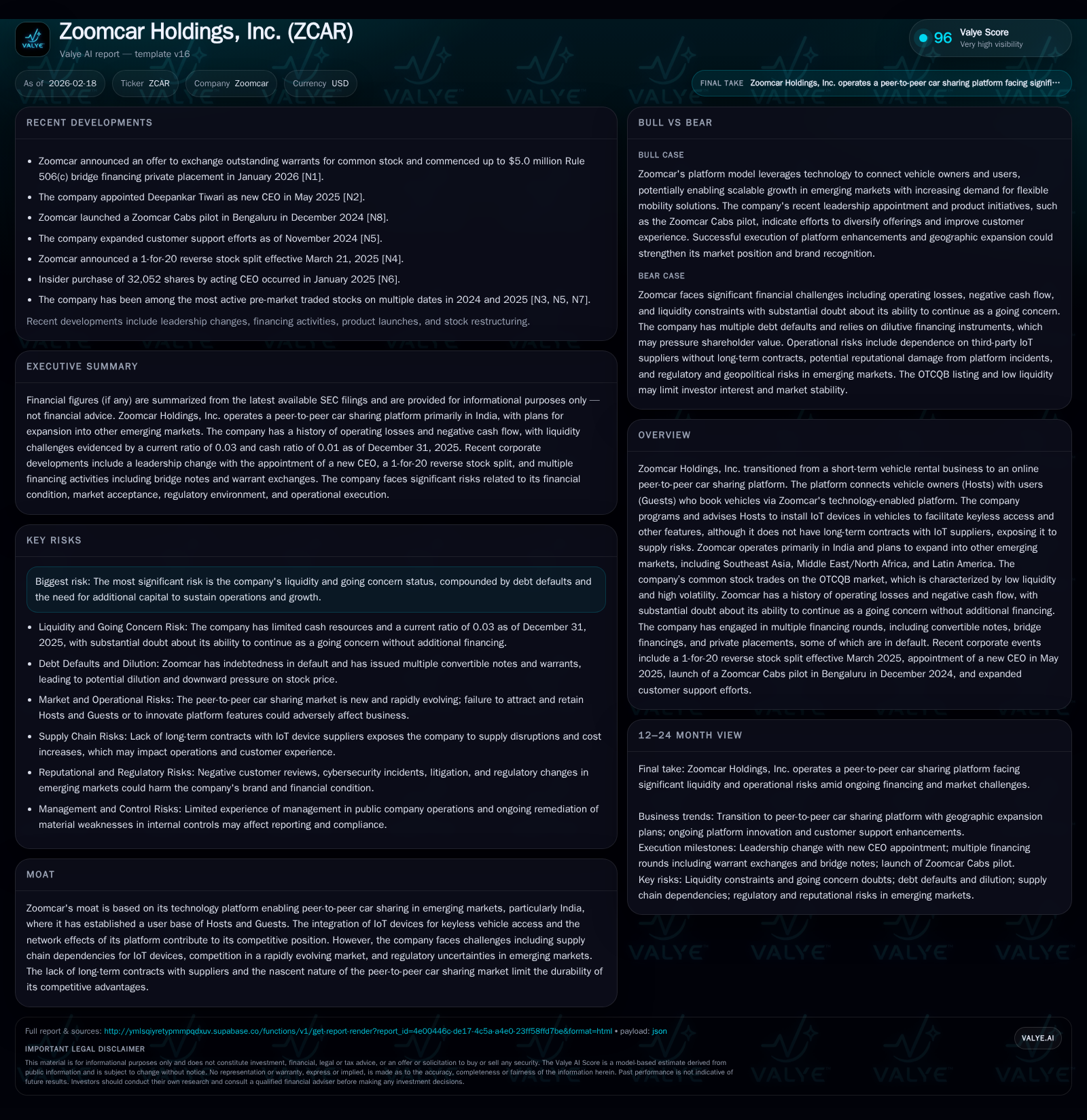
Zoomcar Holdings, Inc. has transformed its business model from traditional vehicle rentals to a technology-driven peer-to-peer car sharing platform that leverages IoT devices for enhanced fleet management and user experience, primarily in India with plans for emerging market expansions. Financially, the company continues to grapple with significant operating losses, negative cash flow, mounting convertible note debts with stringent default penalties, and imminent liquidity pressures that cast doubt on its going concern status. While Zoomcar's platform innovation and network effects bolster its competitive position, the company's capital constraints and lack of long-term supplier contracts represent substantial risks to its sustainability. Key upcoming milestones include managing debt maturities, securing new funding sources, and progressing regional expansion efforts.
From Rentals to Peer-to-Peer: Charting Zoomcar’s Business Model Transformation
Founded as a traditional short-term vehicle rental provider, Zoomcar Holdings undertook a fundamental pivot towards a peer-to-peer (P2P) car sharing platform leveraging technology to connect individual vehicle owners (“Hosts”) directly with users (“Guests”). This shift anchors Zoomcar’s strategy in enabling asset-light fleet expansion by outsourcing vehicle ownership while maintaining operational control through its proprietary digital platform.
A crucial aspect of this transformation is the deployment of Internet of Things (IoT) devices installed by Hosts under guidance from Zoomcar. These devices facilitate keyless entry and remote vehicle monitoring—features essential for scalability and user convenience in shared mobility services. However, as noted in [N1] and corporate filings [F1], Zoomcar lacks long-term contracts with these IoT device suppliers, introducing supply chain vulnerabilities that could affect fleet availability and uptime reliability critical in maintaining customer trust in a mobility-as-a-service ecosystem.
The interplay of network effects—in which increased numbers of Hosts attract more Guests, and vice versa—supports the creation of a moat within India’s nascent P2P sharing market. Yet, the competitive landscape remains evolving rapidly alongside regulatory ambiguities inherent to emerging markets [S27]. Thus, Zoomcar’s platform innovation must be paired with enhanced supply chain resilience to sustain its market foothold.
Historical Performance and Key Growth Drivers Through FY2025
Financially, Zoomcar has experienced material headwinds reflected in prolonged operating losses but has recently displayed signs of operational improvement. Table 1 below summarizes key annual financial metrics from FY2021 through FY2025 citing source [F1]:
Historical performance (annual)
| FY | Rev ($mm) | Net ($mm) | CFO ($mm) | OpInc ($mm) | Rev YoY | Net YoY |
|---|---|---|---|---|---|---|
| 2026 | ||||||
| 2025 | 9 | -26 | -9 | -10 | -8.0% | +25.2% |
| 2024 | 10 | -34 | -22 | -32 | ||
| 2023 |
Note: Omitted columns lack sufficient annual XBRL coverage in the provided tags (need ≥2 annual points): Capex, Div, Buybacks, FCF. Source: SEC companyfacts cache [F1].
Capital returns and efficiency (annual)
| FY | ROE% |
|---|---|
| 2026 | |
| 2025 | 101.1 |
| 2024 | 101.7 |
| 2023 |
Source: SEC companyfacts cache [F1].
Note: Capex data unavailable for most recent full fiscal periods; equity reported is negative reflecting accumulated losses.
Revenue contracted about 8% in FY2025 compared to FY2024, illustrating cautious demand or competitive pressures amidst transition dynamics. Yet operating losses narrowed substantially by approximately two-thirds year-over-year—a positive sign possibly attributable to tighter cost controls or increased platform efficiency as peer-to-peer operations replaced heavier asset-based rentals.
Operating cash flow remained deeply negative though improved by nearly 60%, indicating persistent cash burn characteristic of early-stage platform models but tempered somewhat by reduced investment intensity—with reported capex plunging over 95% from prior periods.
The dilapidated balance sheet status—with shareholders' equity sinking toward negative $25 million—signals capital impairment concerns common among disruptive mobility startups facing scaling hurdles.
Funding Challenges: The Mounting Debt Load and Liquidity Squeeze
Zoomcar’s capital structure reveals extensive reliance on convertible redeemable notes issued across multiple private placement tranches as documented in SEC filings [S4]-[S6], [S9]. Key details include:
- Various convertible notes aggregating principal amounts between $42k up to over $220k individually issued between mid-2025 and early 2026,
- Interest rates ranging from 6% to 12% per annum,
- Default interest penalties escalating up to an onerous 22% annually,
- Maturities concentrated mostly within a rolling 12-month timeframe,
- Substantial original issue discounts reducing immediate net proceeds,
- Rights for holders to convert outstanding dues into common stock at significant discounts potentially diluting existing shareholders.
Notably, several notes carry severe default penalty clauses increasing principal balances by up to 50%, exacerbating refinancing risks if repayments are delayed or impossible [S6], [S9]. The company itself acknowledges substantial doubt about continuing as a going concern without fresh financing injections beyond March 31, 2026 assuming no principal payments are made [S24], highlighting an acute cash runway constraint.
The transition onto the OTCQB market tier compounds fundraising difficulties due to diminished liquidity profiles typical for penny stocks, reducing institutional investor appetite and amplifying share price volatility [S25]. While recent private placements including a Rule 506(c) bridge financing offer up to $5 million indicate active attempts at bridging funding gaps [N1], these remain insufficient relative to ongoing operating deficits.
Technology Edge: IoT Integration and Supply Chain Risks
IoT hardware integration forms the backbone of Zoomcar’s P2P platform by enabling keyless access control and real-time vehicle diagnostics directly linked to software interfaces accessible via smartphones or backend systems [N1], [F1]. This hybrid SaaS-plus-hardware architecture facilitates operational scalability without requiring traditional fleet ownership.
Yet the absence of binding long-term contracts securing IoT device supply chains exposes Zoomcar to material disruption risks—any interruption could lead to unavailability or downtime of vehicles listed on the platform, undermining service reliability metrics crucial for user retention in shared mobility markets [N1]. Given emerging market infrastructure variances and vendor concentration risks typical within hardware provisioning segments, this vulnerability constitutes a strategic bottleneck requiring mitigation either through supplier diversification or contract renegotiations.
Expansion Blueprints: Emerging Markets Growth Prospects and Constraints
Having established its core user base in India's large-scale urban centers, Zoomcar plans geographic diversification into other emerging markets including Southeast Asia, Middle East/North Africa (MENA), and Latin America as disclosed in recent filings [N1], [S27]. These regions present sizable untapped demand pockets for digital mobility platforms parallel to urbanization trends combined with shifting consumer preferences toward flexible vehicle usage.
However, regional expansion faces multifaceted challenges:
- Regulatory frameworks governing shared mobility remain fragmented across jurisdictions,
- Consumer technology adoption curves vary markedly,
- Local competitor ecosystems may feature entrenched players,
- Operational logistics such as fleet onboarding processes require adaptability.
Successfully navigating these barriers will depend on proactive local partnerships, regulatory compliance agility, and fintech-enabled user engagement strategies aligning with diverse market conditions.
Financial Outlook and Market Expectations: What to Monitor Next
Explicit forward guidance from Zoomcar remains limited amidst current market volatility and financing uncertainty; therefore, close attention should be given analytically to developments in:
- Successful capital raisings or debt restructuring extending liquidity beyond Q1-Q2 2026,
- Resolution of convertible note defaults or renegotiation outcomes reducing default penalty exposure,
- Growth trajectories of Gross Merchandise Value (GMV) transacted through the platform indicating market traction sustainability,
- Formalization of supply agreements securing continuous IoT device availability enhancing operational reliability,
- Progress on regional launch execution including regulatory approvals and local host acquisitions.
These milestones collectively will illuminate path dependency between growth ambitions and solvency dynamics shaping company viability.
Capital Allocation Review: Returns, Cash Flow Patterns, and Lack of Dividends
Zoomcar’s financial disclosures reflect sustained negative returns on equity largely attributable to cumulative losses driving shareholders' deficit nearing $25 million as of latest reporting periods [F1]. An approximate calculation yields negative ROE exceeding -100%, emphasizing capital erosion rather than wealth creation.
Operating cash flow remains significantly negative (~$9 million fiscal year ending March 31, 2025), aligned with continued investments into platform development even as physical capex has contracted sharply (<$4k quarterly recently), indicating strategic emphasis on technology over heavy asset accumulation.
No dividends have been declared nor repurchases conducted post an unusually large common stock buyback event recorded during early FY2023 ($206 million), representative likely of prior capital structure maneuvers rather than steady shareholder return policy [F1]. The company appears prioritizing survival mode capital preservation over distributable profits at this stage.
Investment Risks Amid OTCQB Listing and Market Volatility
Trading on the OTCQB tier inherently limits market liquidity given reduced broker-dealer participation stemming from penny stock designation risk factors per SEC disclosures [S2], complemented by notable volatility spikes witnessed historically.
Investors face compounded liquidity risk because non-inclusion on national exchanges constrains price discovery mechanisms alongside potential delisting threats if compliance thresholds centered around minimum market capitalization ($5 million threshold breached previously) are not reattained [S25]. Furthermore, complex share structures fueled by convertible instruments at discounted conversion prices may introduce dilution volatility dampening investor confidence further.
Zoomcar openly warns on going concern material uncertainties tied to cash runway expiration looming within months without additional financing injection validating highly speculative nature intrinsic to ownership stakes currently traded under these conditions [S17].
Disclaimer: This analysis is intended solely for informational purposes derived strictly from publicly disclosed financial statements and regulatory filings without any recommendation or solicitation concerning securities of Zoomcar Holdings, Inc.
Disclaimer: This is research-only, informational analysis and not investment advice. It may include AI-generated interpretation and general industry context. Always verify important details using primary sources.

Comments