
Sunrise Communications’ 2025 Profitability Recovery Tempered by Liquidity and Competitive Pressures
Swiss telecom operator Sunrise Communications AG posted a marked net loss reduction in 2025 amid stable revenue and ongoing investment in network infrastructure.
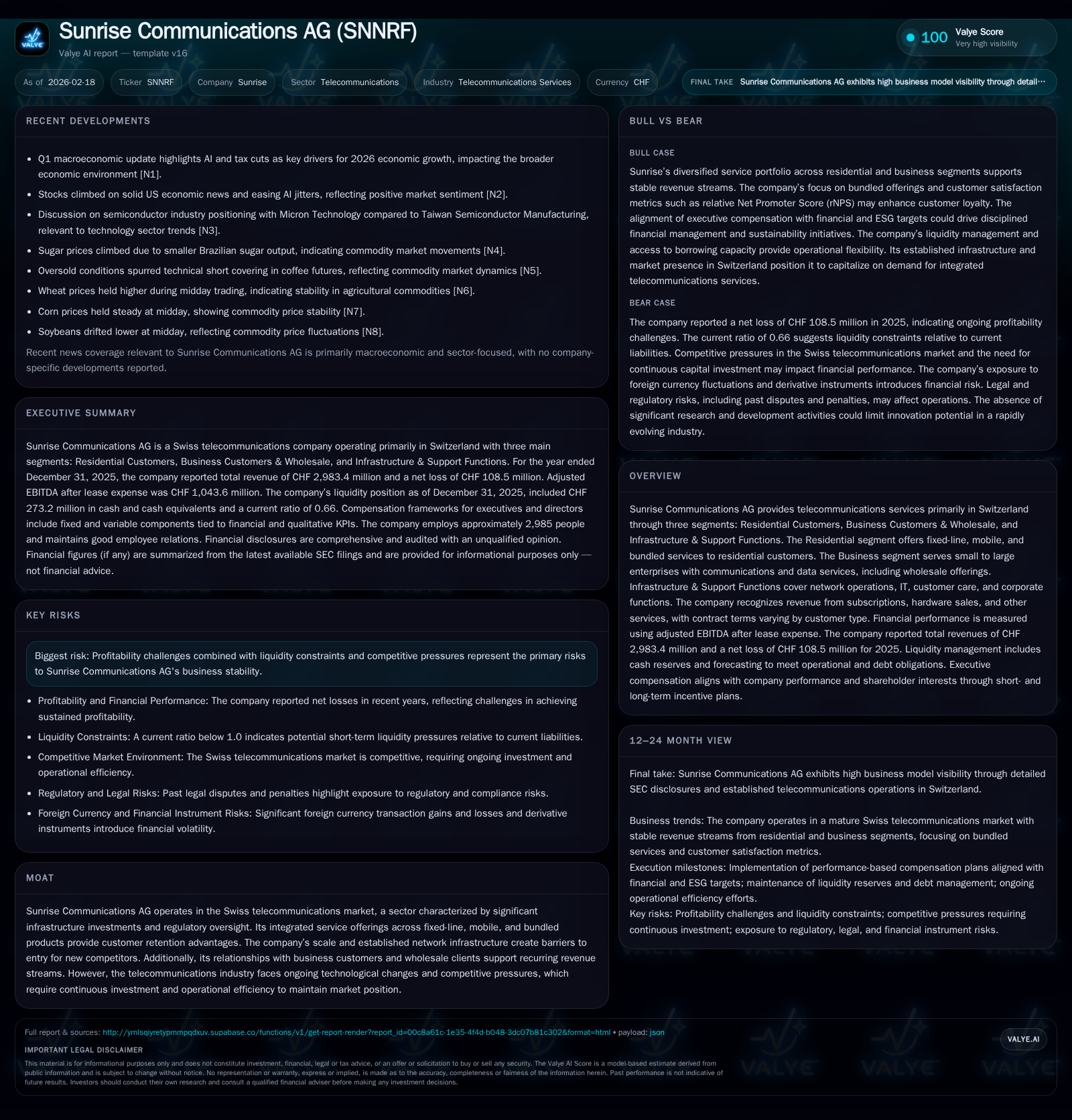
Sunrise Communications AG remains a significant player in the Swiss telecom market with integrated fixed-line, mobile, and bundled services across residential and business segments. In 2025, the company managed to reduce its net loss by 70% compared to 2024, reflecting operational improvements despite flat-to-lower revenues. Adjusted EBITDA after lease expense slightly decreased, impacted by cost pressures and restructuring offsets. The company’s liquidity profile is supported by robust cash reserves and undrawn credit facilities, but challenges remain in managing high debt levels and sustaining profitability amid competitive and macroeconomic headwinds. Investors and stakeholders should monitor operational cost control, capital expenditure efficiency, and competitive dynamics as key drivers of future performance [F1][S1][S4][S5].
Company Overview
Sunrise Communications AG stands as a key telecommunications provider domiciled in Switzerland serving residential consumers and business clients through fixed-line, mobile, IPTV, data communications, and wholesale services. The company's business model emphasizes bundled offerings aimed at boosting customer retention within the competitive Swiss market ecosystem characterized by significant infrastructure needs and regulatory oversight [S4].
The organizational structure segregates activities into three segments:
- Residential Customers: Providing fixed-line, mobile voice/data, IPTV services, handset sales.
- Business Customers & Wholesale: Serving enterprises of various sizes with integrated communication solutions plus wholesale voice/internet offerings.
- Infrastructure & Support Functions: Encompasses network operations, IT platforms, customer care, corporate governance functions.
Performance measurement focuses on adjusted EBITDA after lease expense (EBITDAaL), which serves as the core profitability metric tracked by management teams [S4].
Historical Performance
Financial data for fiscal years ending December 31, shows a period of operational challenges tempered by recent improvement:
Historical performance (annual)
| FY | Net ($mm) | Net YoY |
|---|---|---|
| 2025 | -108 | +70.0% |
| 2024 | -362 |
Note: Omitted columns lack sufficient annual XBRL coverage in the provided tags (need ≥2 annual points): Rev, CFO, OpInc, Capex, Div, Buybacks, FCF. Source: SEC companyfacts cache [F1].
Capital returns and efficiency (annual)
| FY | ROE% |
|---|---|
| 2025 | -2.7 |
| 2024 | -8.2 |
Source: SEC companyfacts cache [F1].
*Note: Revenue decline modest; net loss widened before recovery in FY25.
Despite largely stable revenue context, net losses have sharply reduced due primarily to cost containment measures and operational improvements rather than revenue growth per se [F1][S4][S24][S25].
Segment Contribution Details
- Residential Customers generated CHF 2,107 million revenue in 2025 versus CHF 2,173 million prior year primarily from bundled services combining fixed-line broadband with mobile subscriptions.
- Business Customers & Wholesale segment expanded slightly to CHF 859 million from CHF 830 million emphasizing enterprise accounts.
- Infrastructure & Support Functions maintained ancillary revenues but posted negative adjusted EBITDA reflecting heavy ongoing investments that suppress near-term profitability.
The company’s adjusted EBITDAaL margins are considerably stronger in Residential segment (~55%) than Infrastructure & Support (-33%), highlighting structural profitability imbalances driven by asset-heavy investments [S4][S24].
Cost Trends
Direct costs (28% of revenue) include hardware sales to customers plus network operating expenses while indirect costs (32%) cover administration, IT support and marketing spend excluding lease charges.
Lease expense (~CHF191 million) relates primarily to IFRS16 accounting for telecom site leases and equipment rentals across segments vulnerable to inflationary pressure on property-related costs [S14][S25].
Future Growth Prospects
Growth drivers for Sunrise hinge on:
- Bundled service penetration: Cross-selling fixed broadband + mobile + IPTV packages can enhance ARPU (average revenue per user).
- Business product expansion: Increased demand for integrated telecom/data packages among SMEs and corporates incentivizes growth.
- Wholesale relations: Carrier roaming agreements ensure steady revenues from third-party operators who rely on Sunrise network infrastructure.
Constraints include:
- Regulatory environment: Pricing caps or spectrum licensing constraints may limit pricing power or capital rollout cadence.
- Macroeconomic sensitivity: Swiss economic stability affects discretionary spending on telecom services; downturns could dampen subscriber additions/churn improvements.[N1],[N2],[N3],
- High energy costs: Network operations require substantial electricity; energy price spikes or shortages could increase OPEX materially.
- Competitive pressure: Swiss market incumbents including Swisscom present constant competition requiring consistent technology upgrades (e.g., fiber rollout; enhanced 5G coverage).
No explicit forward guidance has been published post-spin-off; accordingly monitoring quarterly trends in revenue composition, EBITDA margins, subscriber counts, churn rates will be essential for gauging trajectory .
Capital Structure & Liquidity
Largely denominated in foreign currencies (USD/EUR), Sunrise's total third-party debt including vendor financing was approximately CHF 4.34 billion at end-2025 plus accrued interest totaling about CHF 98.5 million [S8][S11]. Weighted average borrowing cost hovers near mid-single digits with principal maturities stretching out over multiple years but clustered notably between two to five years timeframes which require refinancing vigilance.
Liquidity components feature:
- Cash & equivalents of CHF ~273 million provides short-term buffer.
- Undrawn revolving credit lines amounting to nearly CHF 500 million enhance financial flexibility against covenant requirements.
- Supplier finance programs support working capital optimization without lengthening payment cycles materially beyond industry norms.
The company actively manages interest rate exposure using derivative instruments aiming to hedge variable-rate debt components as underlying benchmark rates fluctuate around SOFR/SARON/Euribor linked facilities [S16],[S18],.
Returns and Capital Allocation
Sunrise’s reported equity base stood at about CHF 4.05 billion at end-of-year with negative yet improving return-on-equity close to -2.7% mainly because net income loss shrank significantly from prior years; earnings quality remains impaired but trending positively [F1].
Dividend payments resumed post-spin-off with a distribution totalling over CHF 240 million during May 2025 paid exclusively from foreign capital contribution reserves; this indicates manageable free cash flow post-investments though comprehensive free cash flow figures are not fully disclosed [S17].
No material share buybacks were reported recently; strategic capital allocation appears focused on maintaining balance sheet strength while funding necessary network upgrades—operating leverage metrics suggest further efficiency gains are possible through scale benefits once top line stabilizes or grows slightly .
Industry Context & Strategic Considerations
Switzerland's telecommunications sector demands heavy upfront investment for fiber expansion and next-generation mobile networks amidst strong regulatory frameworks fostering competition yet limiting excessive pricing power. This environment magnifies the importance of integrated service bundles combining fixed broadband connectivity with mobile telephony to reduce churn risk via customer lock-in—a core rationale behind Sunrise’s bundled products strategy.
Energy usage remains a critical operating leverage factor due to network base stations running constantly; global energy price volatility adds uncertainty affecting operating expenses disproportionately compared to other sectors . Security risks such as cyberattacks on critical infrastructure also impose ongoing contingency planning importance especially given geopolitical instability surrounding EU neighbors which indirectly impact supply chains servicing the Swiss market .
Key Milestones & Upcoming Themes to Watch
While explicit forward guidance is sparse post-spin-off event completed late-2024 stakeholders should monitor:
- Quarterly Adjusted EBITDA trends relative to competitive peers;
- Subscriber growth or contraction trends across segmented service lines;
- Capital expenditure patterns reflecting pace of fiber rollout / mobile network densification;
- Changes in wholesale revenues tied to roaming behavior or carrier agreements;
- Management commentary on debt maturity refinancing strategies;
- Regulatory developments in spectrum licensing or consumer protection laws affecting pricing levers;
- ESG disclosures relating particularly to CO2 reduction targets connected to energy consumption given Swiss environmental policy emphasis.
Conclusion
Sunrise Communications AG demonstrated notable progress shrinking net losses sharply in calendar year 2025 through improved operational controls despite slight top-line contraction chastened partly by macroeconomic pressures endemic to Switzerland's mature telecom market landscape. The company's strong liquidity position alongside ample credit facilities provides resilience though its elevated leverage dictates cautious debt management going forward. Success hinges on balancing continued investment required for network innovation against evolving competitive dynamics while unlocking synergies across residential/business bundles that underpin sustainable margin recovery long term. Investors should weigh these factors along with external economic conditions influencing consumer demand as well as regulatory uncertainties shaping future operating conditions.
Disclaimer: This analysis is based solely on information compiled from SEC filings, company reports, investor disclosures and publicly available news sources as of February 18, 2026.
Disclaimer: This is research-only, informational analysis and not investment advice. It may include AI-generated interpretation and general industry context. Always verify important details using primary sources.

Comments