
Community Health Systems’ Margin Recovery Driven by Operational Efficiency and Outpatient Expansion
CYH’s 2025 financial turnaround underscores operational improvements and a strategic shift towards outpatient services amid regulatory pressures.
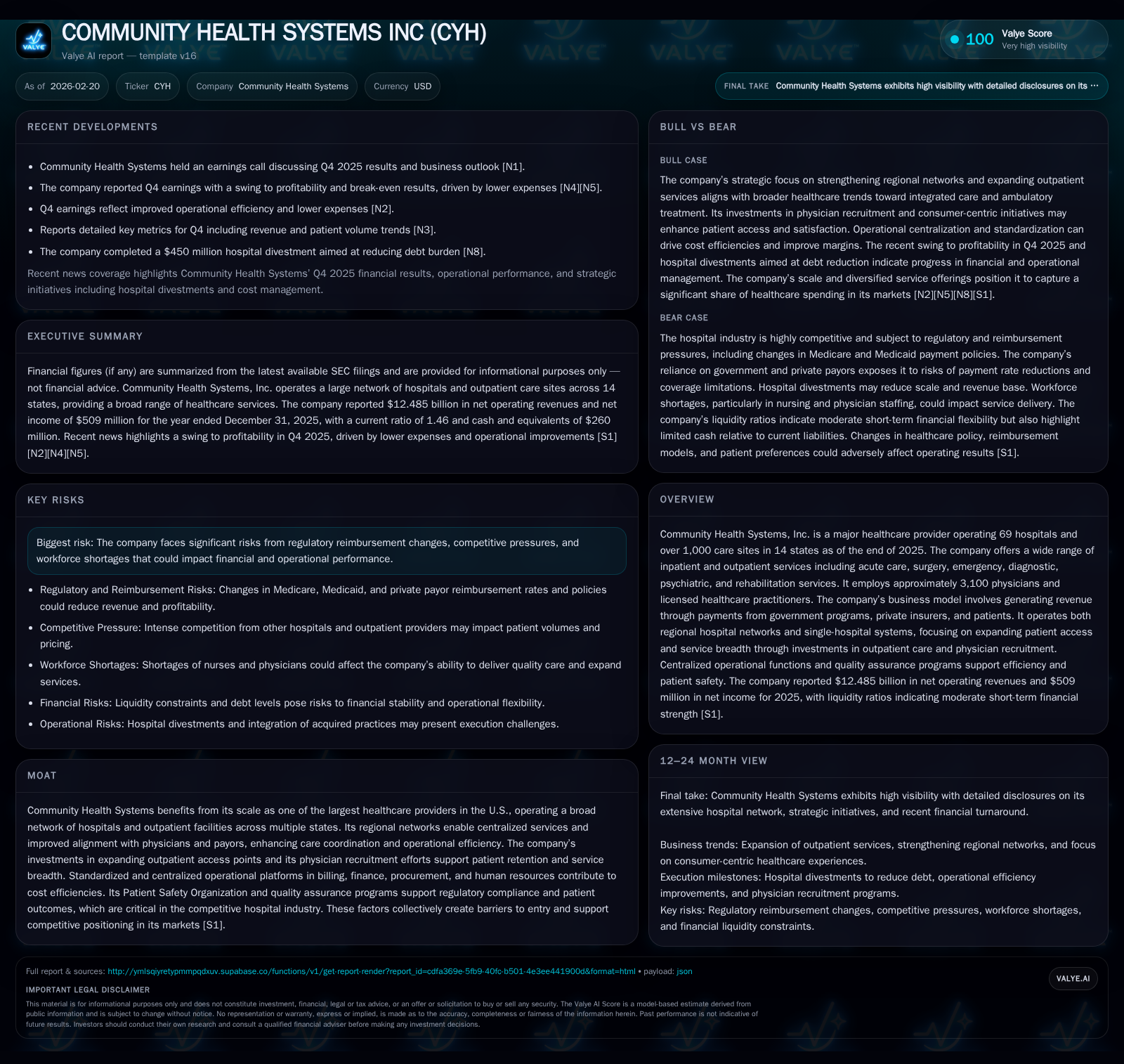
Community Health Systems, Inc. (CYH) operates a large network of 69 hospitals and over 1,000 outpatient sites across 14 states, serving as one of the largest healthcare providers in the US. After years of profitability challenges, CYH reported a meaningful net income turnaround in 2025, driven by operating income growth and expense control. The company’s focus on expanding outpatient care access and physician recruitment underpins future growth opportunities but faces risks from regulatory changes and competitive pressures. CYH’s capital allocation remains conservative with positive free cash flow but sustained negative equity reflecting legacy challenges. Near-term milestones include monitoring reimbursement policies and outpatient network expansion outcomes.
Company Overview
Community Health Systems Inc. (CYH) is one of the largest healthcare delivery networks in the United States, operating 69 hospitals with more than 10,000 beds and over 1,000 ancillary care sites including urgent care centers, ambulatory surgery centers, imaging facilities, and physician offices as of year-end 2025 [S1][F1]. The company serves diverse markets across 14 states with significant geographic concentration in Indiana (16.8% of revenues), Alabama (15.8%), Texas (11.9%), Florida (8.2%), and Tennessee (8.3%) [S17].
CYH's service offerings span inpatient acute care alongside a broad outpatient platform focused on primary care, surgical specialties such as orthopedics and cardiovascular care, behavioral health programs, diagnostic imaging, and virtual health visits [S10][S25]. It employs approximately 3,100 physicians and licensed practitioners integral to patient admissions and clinical delivery across its markets [S1]. Revenue is generated from governmental programs (Medicare/Medicaid), private insurers, and self-paying patients.
Historical Financial Performance
CYH's financial results reflect stable revenue generation with operational improvements culminating in a strong margin recovery in FY2025:
Historical performance (annual)
| FY | Rev ($bn) | Net ($mm) | CFO ($mm) | OpInc ($mm) | Rev YoY | Net YoY |
|---|---|---|---|---|---|---|
| 2025 | 12.5 | 509 | 543 | 1488 | -1.2% | +198.6% |
| 2024 | 12.6 | -516 | 480 | 542 | +1.2% | -288.0% |
| 2023 | 12.5 | -133 | 210 | 957 | +2.3% | -389.1% |
| 2022 | 12.2 | 46 | 300 | 821 |
Note: Omitted columns lack sufficient annual XBRL coverage in the provided tags (need ≥2 annual points): Capex, Div, Buybacks. Source: SEC companyfacts cache [F1].
Capital returns and efficiency (annual)
| FY | FCF ($mm) | ROE% |
|---|---|---|
| 2025 | 208 | -36.5 |
| 2024 | 120 | 27.0 |
| 2023 | -257 | 9.6 |
| 2022 | -115 | -3.4 |
Source: SEC companyfacts cache [F1].
Revenue has been essentially flat since FY2022 amid reimbursement pressures and competitive challenges impacting inpatient volumes [F1][S24]. However, operating income surged in FY2025 due to strong expense management and efficiency gains from regional network integration and outpatient service expansion [N2][N4][F1], driving net income back into positive territory after consecutive losses.
Operating cash flow increased consistently while capital expenditures were modestly reduced as CYH prioritized high-return investments aligned with strategic objectives rather than broad facility expansions [F1]. Free cash flow for FY2025 was approximately $208 million (operating cash flow minus capex), supporting manageable liquidity despite the company's continued negative shareholders’ equity of -$1.394 billion as of December 31, 2025 [F1]. This persistent negative equity results in an approximate return on equity of -36.5%, reflecting legacy balance sheet challenges despite improved profitability [F1].
Business Strategy and Growth Prospects
CYH’s strategic focus centers on strengthening market leadership through integrated inpatient-outpatient service delivery:
Regional Network Optimization: Operating hospitals within integrated regional networks allows CYH to centralize key support functions such as billing and procurement (notably via its noncontrolling stake in HealthTrust GPO), standardize clinical protocols to enhance quality metrics and cost control, while fostering alignment with physicians and payors within these markets [S10][S17].
Outpatient Expansion: Aligning with industry trends favoring ambulatory care driven by CMS incentives and patient preferences, CYH is investing in growth of urgent care centers, ambulatory surgery centers, freestanding emergency departments, plus telehealth platforms offering virtual visits for select services [S10][S24]. This diversification stabilizes volume against inpatient admission headwinds.
Physician Recruitment & Alignment: Increasing employed primary care physicians and specialists aims to improve patient retention internally by reducing leakage to competitors; the company participates in Accountable Care Organizations involving approximately 2,900 affiliated physicians supporting value-based care models [S25][S18].
Consumer-Centric Initiatives: Enhancements such as centralized scheduling call centers, transfer coordination hubs minimizing delays between facilities, patient portals and digital engagement tools aim to meet rising consumer expectations for transparency and seamless care navigation [S18].
Quality assurance programs maintain compliance with CMS accreditation standards including Joint Commission certification supporting favorable reimbursement profiles while mitigating regulatory risks [S21][S19]. CYH’s scale enables purchasing efficiencies through HealthTrust partnerships holding an estimated ~11.7% ownership interest contributing to cost containment efforts [S7][S21].
Industry Environment: Payment & Regulatory Pressures
The hospital sector faces substantial reimbursement pressures amid accelerating transitions from fee-for-service toward value-based payment models emphasizing cost control and outcomes under ACOs or bundled payment initiatives managed by CMS Innovation Center programs [S27][S19]. The gradual elimination of the Medicare "Inpatient Only List" enables procedures traditionally restricted to inpatient settings to migrate increasingly into outpatient environments—impacting hospital revenue mix sensitivity to pricing changes [S24]. Private payors are adopting narrow network designs limiting provider participation or imposing tiered cost-sharing structures that may affect patient volumes at CYH facilities versus tax-exempt nonprofit competitors enjoying capital advantages plus specialized academic medical centers attracting complex referrals [S14][S5].
State-specific certificate-of-need (CON) laws regulating facility expansions vary widely affecting CYH’s capacity for local growth initiatives alongside evolving data privacy regulations requiring costly compliance measures under HIPAA frameworks plus emerging state offshore data restrictions adding operational overheads absorbed within constrained margins [S29][S22].
Risks & Challenges
Material risk factors include:
- Reimbursement Uncertainty: Changes to Medicare/Medicaid eligibility criteria combined with potential funding reductions pose downside revenue risks; intensified utilization management including prior authorization may constrain approved volume levels negatively impacting revenues [S13][S20].
- Competitive Pressures: Many CYH hospitals compete against entrenched nonprofit or municipal rivals exempt from taxes enabling greater capital flexibility promoting higher-margin specialized service lines attracting complex case referrals limiting market share growth; consolidation among outpatient providers increases competition challenging returns on expansions here [S14][N10].
- Workforce Constraints: Ongoing shortages across nursing staff and specialized clinicians increase wage inflation risk alongside potential quality impacts undermining operational gains; clinical outcomes tied to reimbursement adjustments heighten compliance costs amid False Claims Act enforcement environments historically relevant for CYH necessitating robust compliance investments especially around physician financial arrangements subject to Anti-Kickback statutes or Stark Law interpretations complicating network expansion efforts [S4][S6][S11][S28].
- Capital Structure Limitations: Despite positive free cash flow allowing modest deleveraging potential for funding asset modernization aligned with strategy remains constrained by persistent negative shareholder equity indicating balance sheet fragility limiting financial flexibility compared with peers; this impacts resilience amid cyclical demand fluctuations typical in healthcare including episodic pandemic-related utilization variability affecting bed capacity effectiveness critical for margin expansion absent disruptive external events [F1].[N9]
Outlook & Milestones to Monitor
While explicit forward guidance was not provided publicly per latest filings dated February 19th, 2026 reporting FY2025 results ([N1],[N2],[N3]), key near-term indicators include:
- Progression of CMS reimbursement reforms related to outpatient transition payment adjustments including final phase-out timing impacts on procedure mix economics.
- Operational metrics evidencing success integrating regional hospital networks focusing on measurable operating margin improvements benefiting from economies of scale.
- Outcomes related to expanded patient access via new outpatient site openings balanced against local competitive dynamics particularly in urban areas.
- Physician recruitment pipeline throughput assessing affiliated medical staff growth relative to community demographics translating into incremental internal admissions improving revenue retention.
- Regulatory audit results concerning billing compliance under False Claims Act enforcement environments indicating legal risk mitigation progress.
- Workforce availability trends influencing cost pressures requiring targeted efficiency solutions mitigating margin erosion common across hospital operators.
CYH also integrates environmental sustainability initiatives aimed at reducing carbon footprint and resource consumption detailed in its Sustainability Report though financial impacts remain preliminary beyond regulatory disclosures analyzed here [S16].[N8]
Capital Allocation & Returns Framework
CYH’s capital allocation has emphasized operational reinvestment over shareholder distributions consistent with transitioning from loss periods into earnings recovery:
- No dividends have been paid recently aligning with prudent retention policies supporting capital restructuring needs.
- Share repurchases have been dormant since mid-decade reflecting cash conservation amid balance sheet repair preceding profitability improvement.
- Capital expenditures have trended lower from peak levels consistent with strategic prioritization focused on high-return expansions mainly within outpatient access points rather than extensive new facility builds or acquisitions given CON law constraints alongside heightened regulatory scrutiny requiring conservative investment posture mindful of increasing payor price pressures.[F1]
- Despite profitable net income performance ROE remains negative due primarily to enduring historical equity deficits signaling need for further earnings accumulation before sustainable returns are realized.[F1]
Summary Perspective
Community Health Systems emerges cautiously optimistic following a turbulent period marked by multi-year losses amid challenging reimbursement landscapes into a phase characterized by solid operational earnings recovery driven by efficiency measures effectively integrated with an expanding outpatient base combined strategically with physician alignment enhancing patient continuity pathways. Persistent risks related to regulatory reform uncertainty coupled with intense competitive forces plus significant workforce constraints temper outlook necessitating vigilant execution capabilities especially regarding compliance robustness under evolving anti-fraud frameworks critical for protecting financial integrity going forward.
Near-term assessment should focus on whether operational momentum sustains margin improvement alongside successful scaling of consumer-centric offerings increasingly vital amid rising patient cost sensitivity reshaping traditional hospital utilization nationwide.
This report is intended solely for informational purposes without any recommendation regarding transactions involving securities issued by Community Health Systems Inc. All facts herein are drawn strictly from publicly available filings or news reports dated accordingly; no proprietary projections or valuation judgments are included.
Disclaimer: This is research-only, informational analysis and not investment advice. It may include AI-generated interpretation and general industry context. Always verify important details using primary sources.

Comments