
State Street’s Strategic Evolution: Balancing Custody Strength with Digital Asset Opportunities
An examination of how State Street Corporation’s extensive custody services and technological innovations, including digital assets, are influencing its growth trajectory, capital deployment, and regulatory navigation.
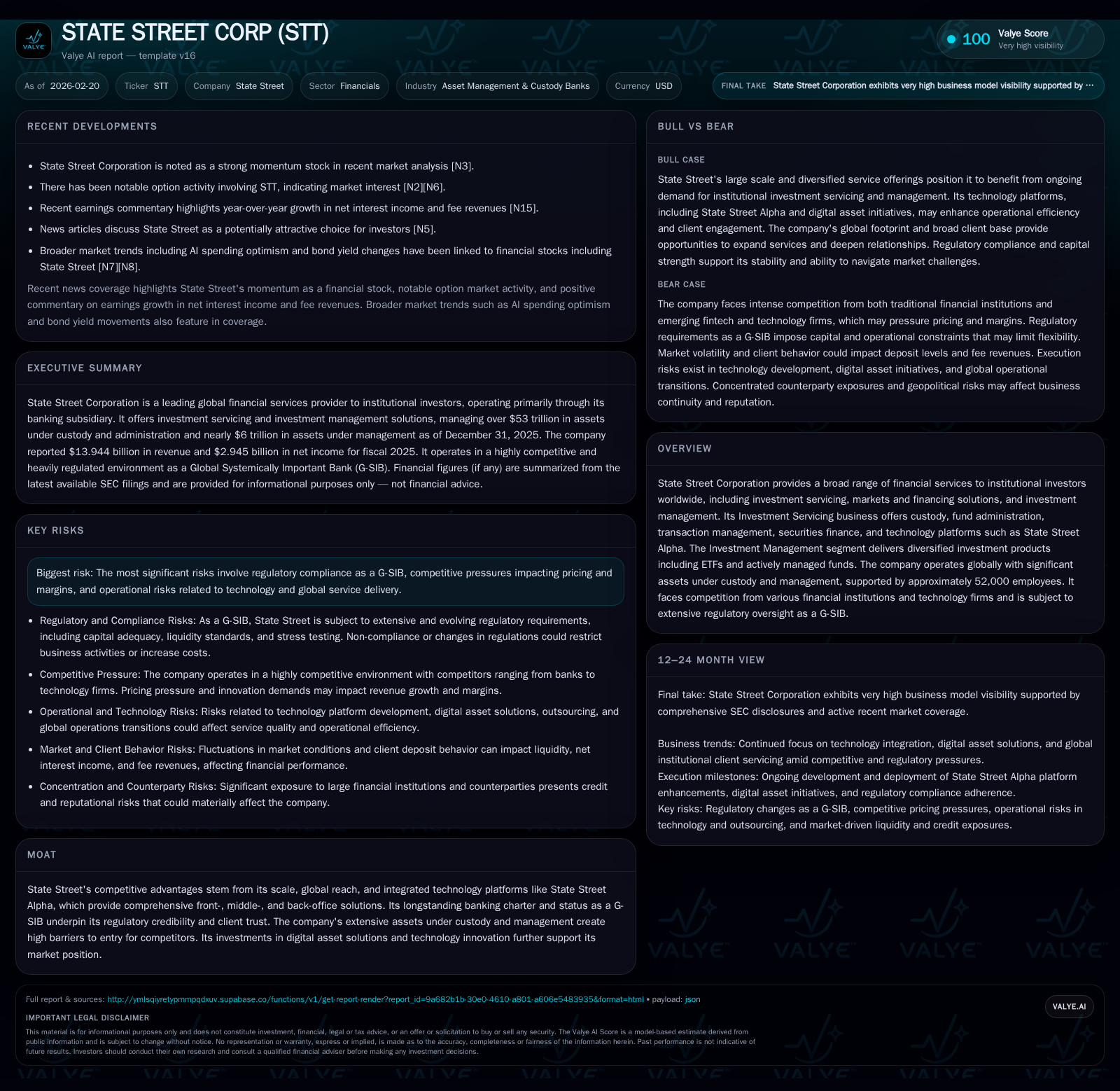
State Street Corporation leverages its commanding scale in assets under custody and administration alongside integrated technology platforms like State Street Alpha to sustain revenue and profit growth amid competitive pricing pressures. Its pivot towards digital asset initiatives and fintech innovation presents potential growth catalysts while navigating the complexities of rigorous regulatory oversight as a G-SIB. Capital allocation balances robust dividends with cautious buybacks, supported by a notable recovery in operating cash flow indicating financial resilience. Investors should monitor fee growth trends, regulatory developments, and technology adoption as key indicators of future performance.
Tracking State Street’s Revenue and Profit Expansion Over Recent Years
State Street Corporation has maintained solid top-line expansion through fiscal year 2025 driven predominantly by its massive Assets Under Custody/Administration (AUC/A) totaling approximately $53.8 trillion at year-end 2025 [S1]. With revenues climbing to $13.94 billion representing a 7.3% year-over-year increase from $13 billion in 2024, the firm demonstrates consistent growth despite persistent industry headwinds [F1]. Net income showed an even stronger pace with a 9.6% rise to $2.95 billion reflecting operational leverage within its integrated service lines and cost controls following prior volatility in cash flows.
The large-scale custody business maintains a foundational role underpinning recurring revenues centered on fund administration, transaction processing, and securities finance. The company serves more than 100 geographic markets with specialized institutional clients such as asset managers, insurers, sovereign wealth funds, official institutions, and central banks [S1]. This diversified client set provides stability amid uneven macroeconomic cycles.
Historical performance (annual)
| FY | Rev ($bn) | Net ($bn) | CFO ($bn) | Capex ($mm) | Rev YoY | Net YoY |
|---|---|---|---|---|---|---|
| 2025 | 13.9 | 2.9 | 11.9 | 1055 | +7.3% | +9.6% |
| 2024 | 13.0 | 2.7 | -13.2 | 926 | +8.8% | +38.2% |
| 2023 | 11.9 | 1.9 | 0.7 | 816 | -1.7% | -29.9% |
| 2022 | 12.1 | 2.8 | 12.0 | 734 |
Note: Omitted columns lack sufficient annual XBRL coverage in the provided tags (need ≥2 annual points): OpInc. Source: SEC companyfacts cache [F1].
Capital returns and efficiency (annual)
| FY | Div ($mm) | Buybacks ($bn) | FCF ($bn) |
|---|---|---|---|
| 2025 | 1120 | 1.2 | 10.8 |
| 2024 | 1033 | 1.3 | -14.1 |
| 2023 | 970 | 3.8 | -0.1 |
| 2022 | 972 | 1.5 | 11.2 |
Source: SEC companyfacts cache [F1].
Note: Operating income is not available from the provided tags.
Despite meaningful revenue gains and profitability improvements over recent years, operating cash flow experienced notable volatility including a steep negative outflow of approximately $13.2 billion in FY2024 before rebounding robustly to nearly $11.9 billion positive in FY2025 [F1]. This swing highlights sensitivity to market disruptions affecting settlement flows and client behavior within custodian banking.
State Street Alpha and Digital Asset Initiatives: Catalysts for Future Growth
Central to State Street’s forward strategy is the proprietary State Street Alpha platform—an integrated front-, middle-, and back-office solution combining data unification with operational efficiencies for institutional clients globally [S1]. Alpha delivers straight-through processing capabilities across custody, accounting, risk analytics, trading insights, and reconciliation workflows at scale.
This platform embodies fintech integration by merging traditional custodian services with advanced data analytics powered by AI tools—a key differentiator amidst intensifying competition from both established financial firms and emerging technology providers [N2][S22]. It supports real-time position keeping across multiple asset classes within pooled AUC/A contexts optimizing client operating models.
Complementing Alpha’s capabilities are State Street’s expanding digital asset offerings targeting institutional adoption of distributed ledger technologies (DLT), including custody for cryptocurrencies and blockchain-based securities servicing alongside collateral management solutions [S1][N2]. These efforts respond to industry shifts as regulators develop frameworks for digital assets while client demand evolves toward scalable investment-grade infrastructure.
Though still nascent relative to legacy lines, digital asset initiatives offer strategic diversification that could mitigate margin pressures inherent in commoditized custodial services through value-added fintech product suites aligned with regulatory compliance demands [S22]. Success depends on capturing market share ahead of competing fintech startups or traditional rivals reshaping institutional digital asset workflows.
Navigating Margin Pressures and Regulatory Challenges
Despite growth momentum supported by scale and technology innovation, State Street faces ongoing margin compression largely due to intense pricing competition within custody and investment management segments [S1]. Competitors include global custodians leveraging technology platforms combined with lower-cost providers who may face less stringent regulatory capital requirements due to differing business models or smaller balance sheets [S22].
As a designated Global Systemically Important Bank (G-SIB), State Street must maintain strict regulatory capital ratios imposing higher funding costs compared with many peers while accommodating supervisory stress test capital buffers—factors compressing net interest margins beyond competitive dynamics alone [S4][S5][S6][S13]. Compliance with liquidity metrics such as LCR (Liquidity Coverage Ratio) and NSFR (Net Stable Funding Ratio) requires maintaining high-quality liquid assets impacting earnings efficiency [S7][S16].
Regulatory exposures extend beyond capital into operational risks including compliance with anti-money laundering (AML), fiduciary responsibility regulations linked to invoicing transparency highlighted by prior DOJ enforcement actions, plus evolving ESG investing mandates influencing stewardship activities globally [S4][S5][S6][S19]. Legal or reputational damages arising from these risks could materially impact margins if not effectively managed.
However, regulation also creates barriers reinforcing trust among clients demanding safeguard assurances that fintech newcomers may struggle to meet without substantial investments.
Capital Deployment: Dividends, Buybacks, and Investment Priorities
Capital allocation reflects balancing sustainable shareholder returns with strategic investments into technology innovation and regulatory compliance frameworks [F1][S27]. Dividend payments have steadily increased from $972 million in FY2022 to approximately $1.12 billion in FY2025—a roughly 8% annualized rise—supporting an attractive dividend yield underpinned by consistent free cash flow after capex commitments.
Conversely, share repurchases have fluctuated significantly—declining from an outsized $3.78 billion in FY2023 down to about $1.2 billion in FY2025—indicating calibrated buyback activity influenced by evolving capital planning parameters imposed on G-SIBs during supervisory reviews or broader market conditions affecting repurchase effectiveness [F1].
Return on equity approximates a moderate but stable ~10.6%, considering an equity base exceeding $27 billion at fiscal year-end coupled with improving net income demonstrating effective use of retained earnings alongside external capital instruments when required for regulated activities [F1].
Capital expenditures rose moderately alongside revenue—from around $734 million in FY2022 reaching approximately $1.05 billion by FY2025—primarily driven by investments supporting the scalability of the Alpha platform infrastructure alongside cybersecurity enhancements critical for safeguarding multi-jurisdictional operations involving tens of trillions under administration [F1].
Earnings Drivers: Custody Scale Versus Pricing Pressure
Assets Under Custody/Administration serve as the cornerstone metric anchoring recurring revenues primarily derived from fees based on AUC/A volumes managed across equities, fixed income instruments, alternative assets, derivatives clearing services among global clients [S1][F1].
While volume expansion accelerates top-line growth—as evidenced by consistent gains—fee compression due to heightened competition among custodial banks aiming for scale economics but willing to sacrifice fees for wallet share gains or bundled product offerings remains challenging.
Managing pricing dynamics without alienating high-value relationships requires offering value-added innovations such as Alpha alongside digital asset solutions justifying premium pricing amidst commoditization risks typical of large-volume custody markets [S22]. Economies of scale support gross margin protection but cannot fully offset downward fee rate pressures given consolidation trends.
Operating Cash Flow Recovery Signals Financial Resilience
A notable feature is the recovery trajectory of net cash provided by operating activities which swung dramatically from a negative outflow close to $13.21 billion during FY2024—linked chiefly to settlement cycle disruptions or elevated working capital consumption—to substantial positive inflows nearing $11.9 billion for FY2025 illustrating operational discipline improvements coinciding with market normalization post crisis episodes [F1].
This resilience suggests enhanced liquidity management allowing better matching of client deposit inflows versus loan portfolio tenors plus collateralized financing lines while supporting ongoing capex into mission-critical IT infrastructure powering both traditional custodian mandates and fintech expansions.
Investment intensity remains balanced given modest single-digit capex increases aligning tightly with strategic priorities rather than broad corporate expansions consistent with prudent G-SIB risk profiles.
What Investors Should Monitor Next in State Street’s Outlook
Looking ahead through early-2026 lenses shaped by recent earnings commentary highlighting positive momentum around net interest income expansion combined with fee revenue upticks it is essential for market participants to track:
- Sustainability of fee income growth amid persistent pricing pressures alongside higher operational costs related to technology staffing ramp-ups [N2][N7];
- Regulatory developments impacting capital requirements or enforcement actions especially surrounding invoicing transparency or fiduciary duty legislation potentially causing episodic expenses or contract reshaping [S4];
- Scalability effectiveness of State Street Alpha integrating AI-powered workflows unlocking cross-selling potential or customer retention advantages versus fintech entrants driving disintermediation risks;
- Dynamics around digital asset adoption including regulatory clarity on crypto custody rules affecting institutional onboarding velocity;
- Client attrition risk amid industry consolidation where competing custody providers leverage scale advantages without equivalent regulatory burdens allowing more aggressive pricing tactics;
- Upcoming quarterly milestones assessing operating cash flow consistency post volatile prior years; sustaining dividend coverage ratios above policy thresholds remains critical given market variability.
These factors represent a nuanced balancing act between leveraging entrenched custody dominance selling complementary tech-enabled services while adapting responsively within an evolving financial ecosystem shaped profoundly by regulatory enforcement intensity plus rapid fintech disruption waves.
Disclaimer: This is research-only, informational analysis and not investment advice. It may include AI-generated interpretation and general industry context. Always verify important details using primary sources.

Comments