
Conduent’s Revenue Contraction and Profitability Pressures Amid Operational and Regulatory Challenges
Conduent faces headwinds from declining revenues, operational costs, and regulatory impacts despite technology investments and segment margin improvements.
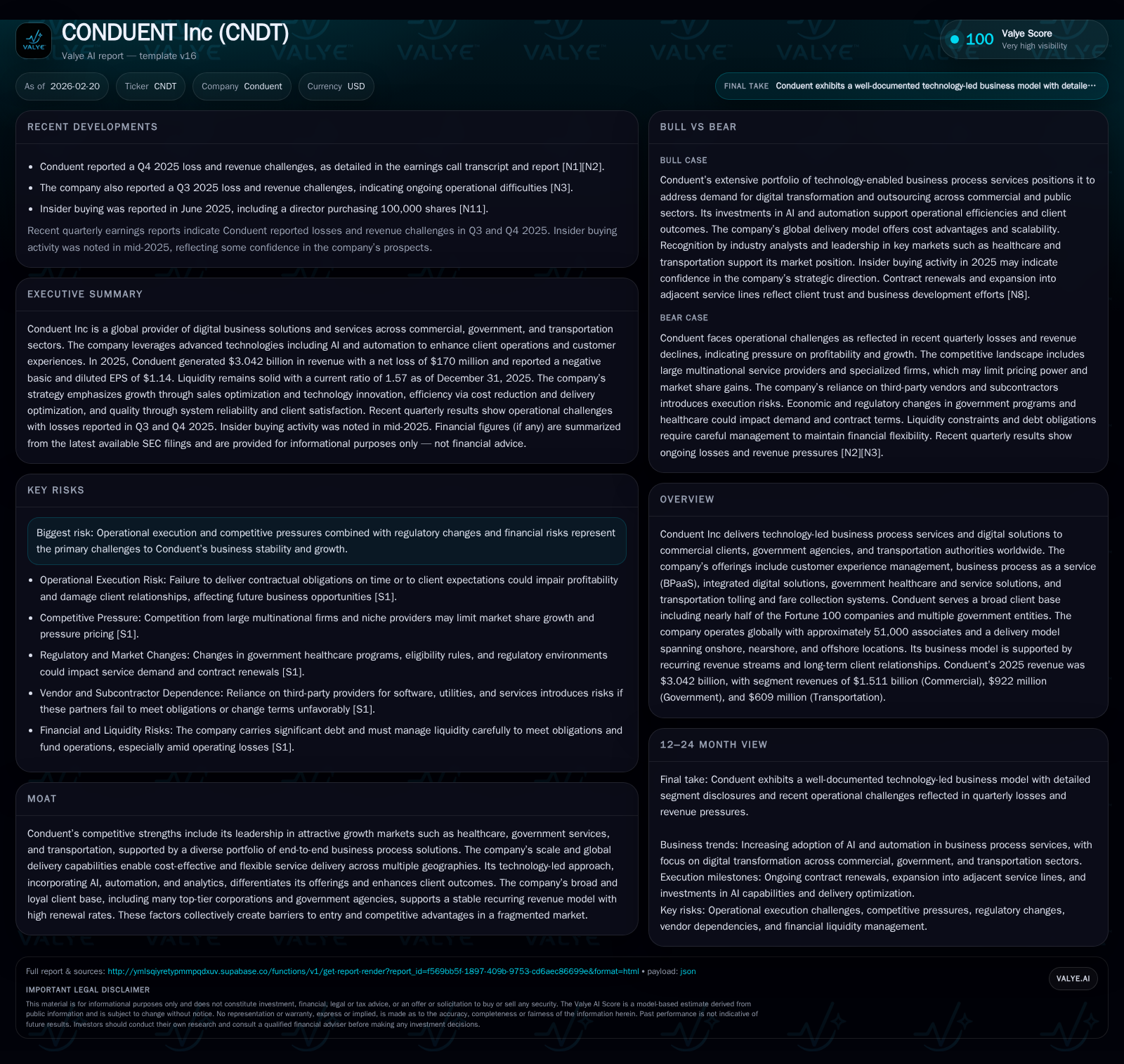
Conduent Inc’s fiscal 2025 performance reflects ongoing pressure on top-line growth with revenues declining 9.4% year-over-year to $3.04 billion, impacted by contract losses and volume reductions in both Commercial and Government segments. Profitability remains challenged by restructuring costs, a significant cyber event expense, and higher operating leverage costs despite gains in the Government and Transportation segment margins driven by automation and AI fraud prevention initiatives. The company maintains a sizable debt load with an adjusted EBITDA margin of just 5.4%, negative operating cash flow, and continues disciplined capital allocation focusing on share repurchases and debt management but does not pay dividends. Key catalysts for future growth include recovering client volumes, success in renewing multi-year contracts, scaling AI-enabled solutions, and stabilizing operational efficiency amid tightening credit covenants.
Overview
Conduent Inc is a technology-led business process services company that offers a diverse portfolio spanning commercial customer experience management (CXM), business process as a service (BPaaS), integrated digital solutions, government healthcare claims processing, transaction services, and transportation tolling systems [S1][S24]. With a global workforce of approximately 51,000 associates distributed across onshore, nearshore, and offshore delivery centers, Conduent’s operations are designed for scale and cost optimization leveraging its multi-geography footprint [S1].
The firm reported revenue for the full year ended December 31, 2025 of $3.042 billion, down nearly 9.4% relative to the prior year's $3.356 billion [F1][S1]. The revenue contraction was principally driven by lower volumes stemming from client contract losses across the Commercial segment (-6%) as well as impacts of implementation completions and federal government shutdowns affecting the Government segment [S1]. Offsetting these declines was a moderate uptick in Transportation segment revenue aided by contract amendments with tolling customers and currency benefits [S1].
Adjusted EBITDA came in at $164 million or a margin of approximately 5.4%, slightly above the prior year’s $172 million (5.1% margin), pressured mainly by elevated restructuring-related costs totaling $35 million along with a direct cyber remediation expense of $25 million arising from an incident early in the year [S1]. Segment profitability exhibited mixed trends: Government services improved margins substantially (+270 basis points) due to AI-led fraud prevention efficiency gains while Commercial margins contracted reflecting lost volumes coupled with fixed overhead costs [S1]. Transportation achieved modest profit improvement supported by revenue growth and absence of transition costs that burdened prior-year comparatives.
Historical Financial Performance
Historical performance (annual)
| FY | Rev ($bn) | Net ($mm) | CFO ($mm) | Capex ($mm) | Rev YoY | Net YoY |
|---|---|---|---|---|---|---|
| 2025 | 3.0 | -73 | 59 | -9.4% | ||
| 2024 | 3.4 | 426 | -50 | 28 | -9.8% | +243.9% |
| 2023 | 3.7 | -296 | 89 | 51 | -3.5% | -62.6% |
| 2022 | 3.9 | -182 | 144 | 92 | -550.0% |
Note: Omitted columns lack sufficient annual XBRL coverage in the provided tags (need ≥2 annual points): OpInc, Div. Source: SEC companyfacts cache [F1].
Capital returns and efficiency (annual)
| FY | Buybacks ($mm) | FCF ($mm) | ROE% |
|---|---|---|---|
| 2025 | 25 | -132 | |
| 2024 | 182 | -78 | 50.8 |
| 2023 | 27 | 38 | -47.1 |
| 2022 | 52 |
Source: SEC companyfacts cache [F1].
*Net income for FY2025 is not yet available from provided tags; dividends data not available for recent years. **Adjusted EBITDA data not consistently reported for FY2022-23.
Segment Dynamics
Commercial Segment: Representing approximately half of total revenues (~49.7%), this segment's revenue declined about six percent due to contract losses and lower volumes partially offset by new business ramps including multi-year licensing agreements [S1]. Segment profit contracted mainly due to reduced volumes alongside higher fixed technology overhead [S1].
Government Segment: Accounting for
30% of revenues ($922 million), this segment experienced revenue decreases driven by contract losses, federal government shutdown disruptions during Q4 ’25, and completion or extension delays on projects [S1]. Despite this, segment profit and adjusted EBITDA margins improved significantly (+270 basis points), attributed primarily to cost efficiencies from AI-enabled fraud prevention within Medicaid services [S1][S13].Transportation Segment: This segment grew revenue modestly (~20% of total revenue) fueled by contract amendments with Transit Solutions clients, increased volumes, and favorable foreign exchange movements [S1]. Profitability rose on these factors plus absence of costs associated with transitioning non-retained contracts seen previously.
Divestitures & Unallocated Costs: Revenues declined following divestitures including BenefitWallet Portfolio sales completed in prior periods [S1]. Unallocated corporate costs fell due to legal cost recoveries but were partly offset by increased medical expenses and direct cyber event response costs [$25 million] incurred early in the year [S1].
Capital Structure & Liquidity Analysis
As of December 31, 2025, Conduent had approximately $691 million in total outstanding debt comprising senior notes maturing mostly through FY2029 alongside finance leases; revolving credit borrowings stood at about $109 million against a facility reduced recently to $357 million (scheduled to reduce further to $187 million in October ’26) [S4][S6][F1]. Cash on hand was $233 million compared with $366 million at prior year-end amid working capital pressures partly due to cybersecurity remediation efforts [F1][S4]. Liquidity is supported by expected operating cash flows combined with credit availability; however, leverage covenant restrictions impose some constraints on financial flexibility [S12][S20].
Operating cash flow was negative at -$73 million for FY2025 worsening from -$50 million the prior year—impacted mainly by working capital swings alongside extraordinary cyber event-related expenses [F1][S21]. Capital expenditures increased sharply over twofold year-over-year to roughly $59 million reflecting investments into cloud infrastructure modernization, automation platforms employing AI/ML technologies, and digital transformation initiatives critical for competitiveness [F1][S18].
Conduent repurchased shares totaling $25 million during FY2025 under an authorized three-year buyback program capped at $50 million initiated mid-2025; no dividends were declared or paid consistent with reinvestment priorities focused on growth initiatives and debt reduction [F1][S7][S29].
Growth Outlook & Milestones
While explicit forward-looking guidance or milestones are not provided within the available disclosures or transcripts [N1][N2], management commentary emphasizes strategic focus areas including:
- Stabilization or reversal of top-line declines via retention of existing client contracts amid competitive pressures.
- Expansion of multi-year licensing agreements particularly within Commercial segments.
- Deployment scale-up of proprietary AI-driven automation capabilities enhancing Government fraud detection efficiency.
- Leveraging Transportation solutions aligned with urban mobility initiatives targeting congestion reduction. These areas collectively represent key catalysts for potential growth as the company seeks operational stabilization amid macroeconomic uncertainties.
Returns Profile & Capital Allocation Philosophy
Recent net income data for FY2025 is unavailable; however prior year net income was positive at $426 million against equity of approximately $839 million suggesting high ROE (~62%) though volatility remains given operating challenges [F1]. Negative free cash flow estimated at -$132 million (operating cash flow minus capex) highlights short-term financial pressures requiring prudent liquidity management.
Capital deployment prioritizes technology investments over dividends with share repurchases conducted selectively under defined programs constrained by leverage covenants limiting dividend payouts or expanded borrowing capacity [F1][S20].
Key Risks & Industry Context
Conduent faces several risks including:
- Operational execution risks related to contract implementations across complex government healthcare programs.
- Regulatory shifts impacting eligibility processes potentially affecting contract economics.
- Cybersecurity threats highlighted by the January ’25 cyber event necessitating ongoing mitigation investments.
- Competitive pressures from digitally native disruptors reshaping traditional BPO service models.
- Financial constraints imposed by significant debt levels subject to covenant compliance risks. Additionally, geopolitical risks tied to offshore delivery centers present potential operational vulnerabilities given evolving policies impacting outsourcing preferences especially within U.S. government engagements [S14][S11].
Conclusion & Monitoring Considerations
Stakeholders should monitor:
- Contract renewal rates particularly within public sector healthcare programs.
- Progress on multi-year commercial client license ramp-ups.
- Quarterly adjusted EBITDA margin trends indicating operating leverage improvements.
- Net ARR activity reflecting backlog stability.
- Operating cash flow improvements signaling better working capital management.
- Effectiveness of cybersecurity risk mitigation initiatives. Given concentrated near-term debt maturities (~$22M due within one year) alongside macroeconomic uncertainties affecting client budgets across served verticals vigilance regarding covenant compliance remains essential.
-- This analysis is prepared solely for informational purposes without expressing any investment advice or recommendations.
Disclaimer: This is research-only, informational analysis and not investment advice. It may include AI-generated interpretation and general industry context. Always verify important details using primary sources.

Comments