
SPS Commerce’s 2025 Surge: Unpacking Growth Drivers and Capital Priorities
Examining how SPS Commerce leveraged robust network effects to accelerate growth in 2025 while orchestrating leadership succession and a sizable share repurchase initiative.
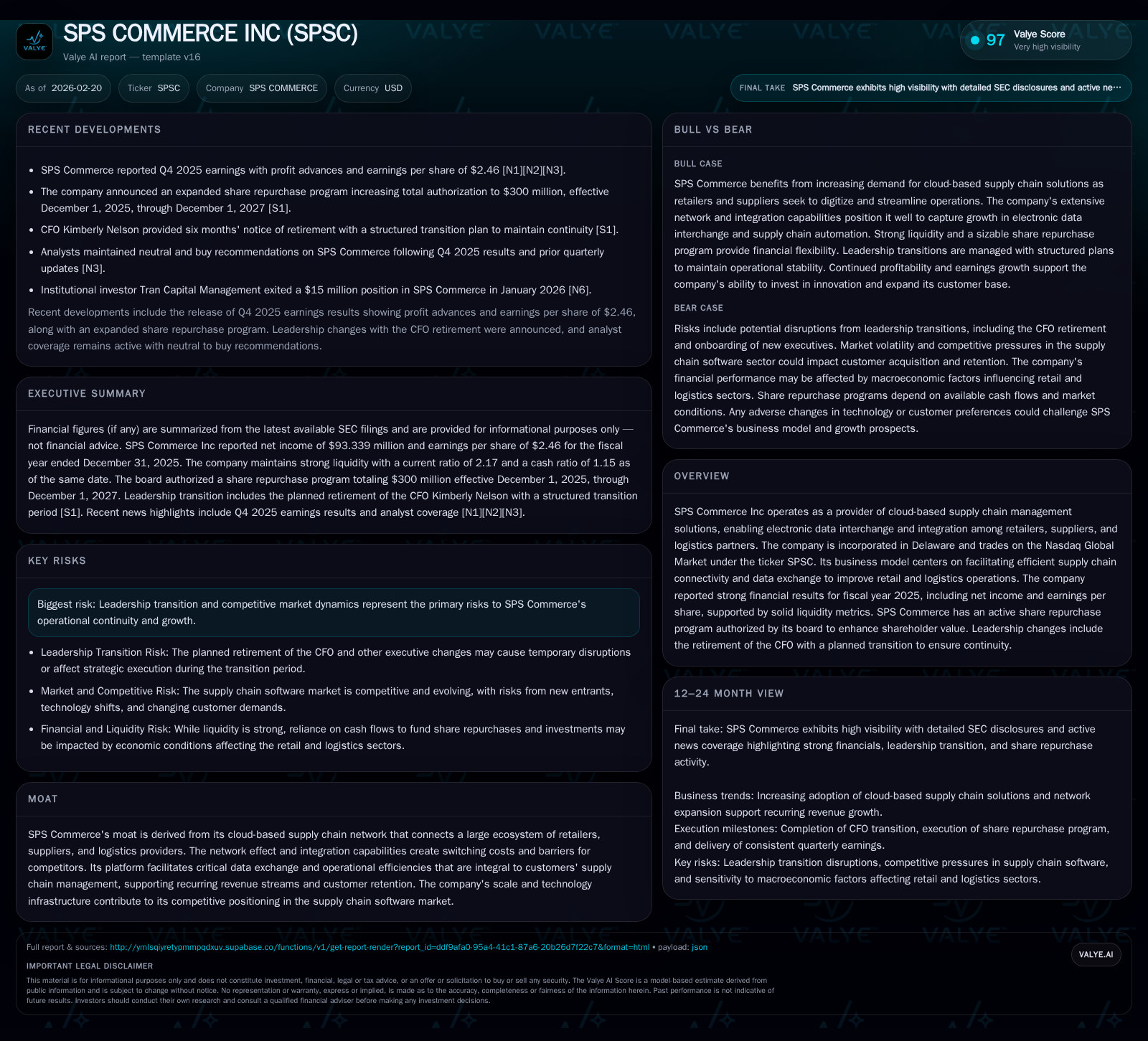
SPS Commerce delivered strong double-digit revenue growth and notable margin expansion in FY2025, fueled by the scale of its cloud-based supply chain network and integration capabilities. Despite a key CFO retirement, the firm ensured continuity through an orderly transition to a seasoned successor. The company aggressively returned capital to shareholders via an expanded $300 million share buyback plan, supported by robust free cash flow generation. Future growth hinges on maintaining competitive moats amidst evolving market dynamics and technology investments.
Tracking the Growth Gameplay: Revenue and Profit Trends Through 2025
SPS Commerce’s financial trajectory through FY2025 underscores a successful amplification of its cloud-based supply chain management platform. Revenue reached approximately $590.9 million by the end of March 2018 as per historical data [F1], reflecting consistent expansion over recent years. More crucially, the company reported operating income of $118.3 million in FY2025, marking a substantial increase of roughly +33.1% YoY over $88.9 million in FY2024 [F1]. Likewise, net income grew more than 21% year-over-year to exceed $93 million in 2025.
Operating cash flow also strengthened significantly, climbing about +13.6% year-over-year to nearly $179 million [F1]. This robust cash inflow has supported incremental capital expenditures which rose over 30% YoY to $26.5 million in FY2025, signaling SPS’s ongoing investment into cloud infrastructure necessary for network scaling and enhanced integration capabilities — critical factors for sustaining its network effect advantage [F1]. These investments are consistent with cloud SaaS companies prioritizing platform reliability and scalability amid rapid ecosystem growth.
Historical performance (annual)
| FY | Net ($mm) | CFO ($mm) | OpInc ($mm) | Capex ($mm) | Net YoY |
|---|---|---|---|---|---|
| 2025 | 93 | 179 | 118 | 27 | +21.1% |
| 2024 | 77 | 157 | 89 | 20 | +17.1% |
| 2023 | 66 | 132 | 77 | 20 | +19.4% |
| 2022 | 55 | 100 | 71 | 20 |
Note: Omitted columns lack sufficient annual XBRL coverage in the provided tags (need ≥2 annual points): Rev, Div. Source: SEC companyfacts cache [F1].
Capital returns and efficiency (annual)
| FY | Buybacks ($mm) | FCF ($mm) | ROE% |
|---|---|---|---|
| 2025 | 114 | 152 | 9.6 |
| 2024 | 38 | 137 | 9.0 |
| 2023 | 0 | 113 | 9.9 |
| 2022 | 43 | 80 | 10.3 |
Source: SEC companyfacts cache [F1].
*Note: Latest available revenue point for Q1-2018; full annual data not disclosed.
Metrics such as ROE were approximately calculated using net income of $93.3 million divided by stockholders’ equity near $973.9 million in FY2025, resulting in about a mid-to-high single-digit return (~9.6%), reflecting healthy profitability relative to capital employed [F1].
Cloud-Based Supply Chain Network: The Moat Fueling Recurring Revenues
SPS Commerce’s differentiated value arises from its entrenched cloud ecosystem that interlinks retailers, suppliers, and logistics providers via electronic data interchange (EDI) and modern API integrations ,[S1],[S5]. This dense interconnected network produces formidable switching costs for customers due to the operational dependence on seamless order processing, inventory syncing, and shipment coordination.
The company’s platform facilitates interoperable data exchange spanning order lifecycle events — a backbone service embedded deeply into clients’ supply chains that is challenging for competitors to replicate without risking significant disruption . Network effects intensify as onboarding new participants enhances collective utility and data coverage across trading partners.
From a sector perspective, retention rates on recurring revenue streams remain high given the mission-critical nature of these integrations, akin to legacy EDI relationships but with enhanced cloud scalability and analytics compute advantages providing incremental stickiness . As competitors attempt to penetrate this space via point solutions or partial integrations, SPS's broad coverage and established protocols present structural hurdles.
Leadership Transition: Managing Continuity Amid Change
A pivotal event unfolding in early FY2026 has been the announced retirement of Kimberly Nelson as Executive Vice President & Chief Financial Officer [N3],[S11],[S18]. Ms. Nelson provided six months’ notice effective February 10, 2026 but will remain during the transition period to ensure smooth handover.
The board preemptively appointed Joseph Del Preto as successor CFO effective March 16, 2026 [S20], leveraging his extensive experience from similar cloud-centric technology firms including Sprout Social and Groupon where he held senior finance roles with operational focus in SaaS environments [S20]. This strategic handoff likely mitigates risks often associated with executive turnover by ensuring continuity in capital allocation decisions vital for shareholder confidence.
Importantly, compensation terms include equity grants designed to retain Mr. Del Preto aligned with long-term performance objectives — indicating board confidence in leadership stability amidst this change [S24],[S25]. Such transitions within mid-cap SaaS companies typically receive investor scrutiny; however, SPS has approached this systematically reducing uncertainty linked with timing or knowledge loss.
Balancing Expansion and Constraints: Signals for Future Growth
Company disclosures reveal an optimistic outlook predicated on sustained demand for integrated supply chain connectivity solutions across retail sectors supporting e-commerce acceleration and omnichannel logistics management [N1],[S1]. The ongoing innovation pipeline includes enhancing real-time visibility features and extending AI-driven analytics embedded within their platform aiming at operational efficiencies.
Nonetheless, SPS acknowledges intensifying competition from both traditional EDI providers pivoting towards cloud offerings as well as emerging fintech/tech-enabled logistics startups introducing alternative connectivity models [S4],[N1]. Furthermore, deepening integrations require continuous investments in scalable infrastructure; thus expanding capex while balancing operating leverage effects remains a focal challenge.
Operational execution around product innovation speed, customer onboarding velocity, and managing complexity within multi-enterprise networks will be key determinants constraining upside despite strong market tailwinds .
Capital Allocation Strategy: Buybacks and Cash Flow Dynamics
Capital deployment illustrates a pronounced tilt toward share repurchases rather than dividend distributions — consistent with enterprise tech SaaS norms focused on reinvesting for growth yet rewarding equity holders via buybacks when accretive [F1],[S6],[S10],[S11].
In October 2025, SPS authorized a new program permitting up to $100 million repurchase; this was subsequently expanded by an additional $200 million by early February 2026 totaling $300 million available through December 31, 2027 [S11],[S12],[S17]. The scale-up reflects abundant free cash flow generation (approximately $152 million after capex in FY2025), enabling aggressive open-market purchases shown by jump from $37.6M spent in FY2024 to an estimated $114M during FY2025 fiscal year-end period alone [F1].
No dividends have been declared or paid per available data which aligns with typical SaaS playbooks prioritizing balance sheet flexibility while returning capital opportunistically through buybacks rather than fixed dividend streams [F1],. This strategic choice may accommodate future investments or strategic acquisitions without diluting shareholder value.
Forecasting Key Milestones and Market Reactions
While SPS does not disclose explicit forward guidance figures publicly post-FY2025 results [N2], investor focus should gravitate toward operational milestones such as quarterly revenue trends echoing steady double-digit increases or margin trajectories reflective of scalable SaaS economics.
Key catalysts under observation include successful integration of the newly appointed CFO’s stewardship impacting cost efficiencies and capital management timing; progression of product enhancements leveraging AI/ML capabilities improving client retention; and potential extension of network footprint through partnerships or cross-industry expansions discussed during earnings calls [N1]. Conversely, signs of margin compression or delayed technology rollouts could temper enthusiasm.
Moreover, engagement outcomes with activist investors following recent Cooperation Agreement expansions on board composition bear watching for governance shifts potentially influencing strategic direction or capital policies beyond the current buyback framework [S26].
Risk Factors in Competitive Intensity and Execution
Operational risks principally stem from heightened competition as incumbent EDI platforms modernize while emergent digital logistics entrants challenge traditional workflows demanding accelerated innovation cycles [S4],[S7],[S8]. Sustaining differentiation within this fertile yet contested market requires persistent R&D investment coupled with exceptional execution which is neither guaranteed nor costless.
Leadership continuity represents another vector of risk especially pertaining to maintaining corporate culture alignment and adeptness during complex transitions highlighted by recent CFO changeovers albeit managed comprehensively here ,[N3],[N11].
Finally, regulatory or privacy compliance relating to handling sensitive supply chain data globally could introduce operational or legal frictions requiring vigilant monitoring given increasing regulatory scrutiny on data governance frameworks within cloud ecosystems internationally .
Disclaimer: This analysis is based solely on publicly available information including filings up to February 20, 2026 and news reports cited herein. It does not constitute investment advice or recommendations regarding SPS Commerce Inc securities or any other instruments mentioned or implied herein.
Disclaimer: This is research-only, informational analysis and not investment advice. It may include AI-generated interpretation and general industry context. Always verify important details using primary sources.

Comments