
SLM Corp’s Strategic Funding Shift and Regulatory Challenges Shape Growth Outlook
Sallie Mae’s evolving private education loan business faces growth opportunities alongside risks from regulatory changes and capital management strategies.
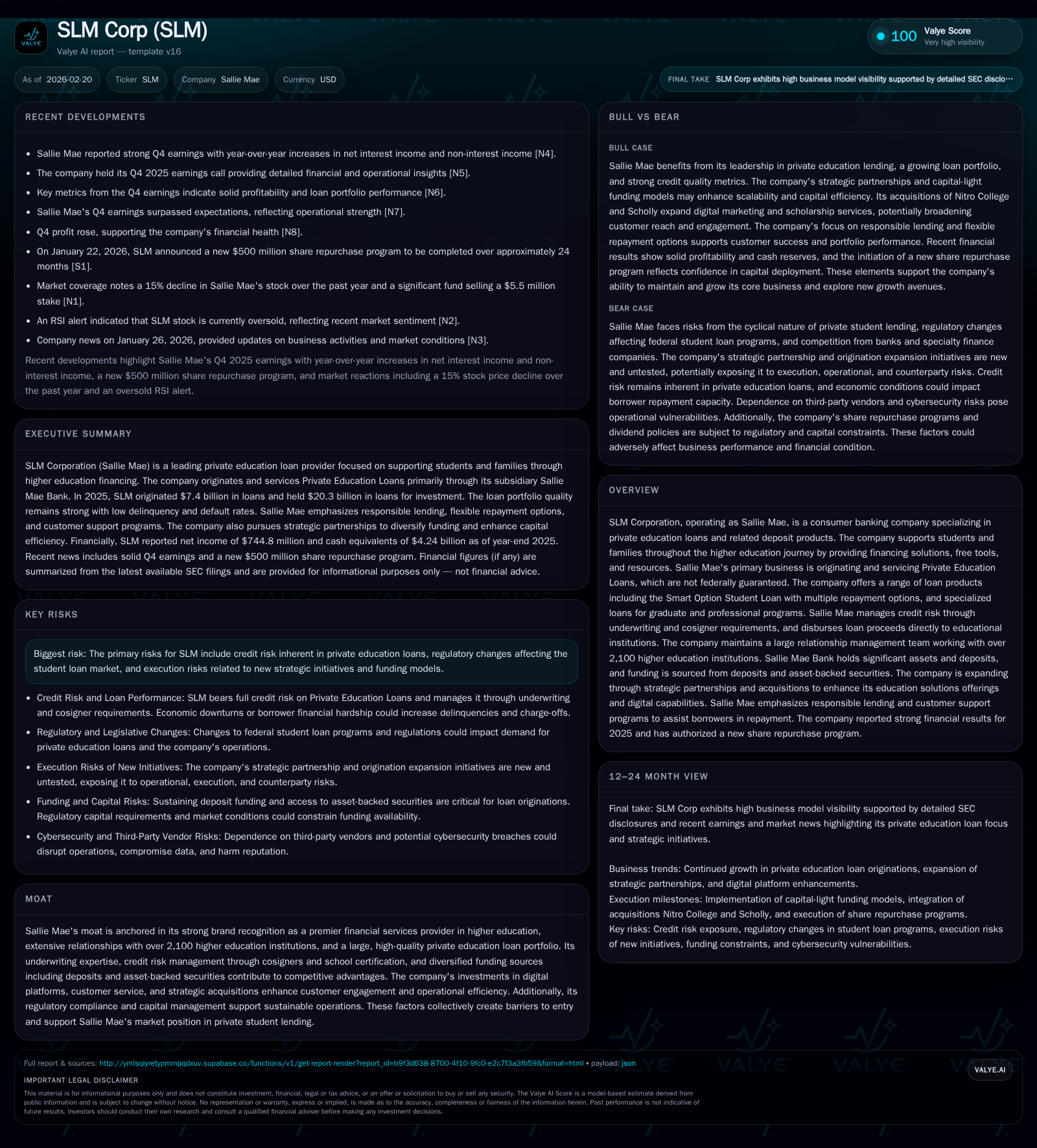
SLM Corp, operating as Sallie Mae, has steadily grown its private education loan portfolio, leveraging strong institutional relationships and underwriting expertise. Its 2025 net income rose 22% year-over-year, supported by loan originations increasing 6%. A new $500 million share repurchase program underscores capital return priorities, while strategic partnerships aim to diversify funding sources. Regulatory headwinds from recent federal student loan reforms and evolving consumer protection laws may cap growth, and the company faces operational risks from technology and AI adoption. Monitoring loan performance metrics, new strategic initiatives execution, and regulatory developments will be critical in assessing Sallie Mae’s future trajectory.
Past Growth and Historical Performance
SLM Corporation (Sallie Mae) has recorded a notable upward trajectory in financial performance over recent years. Net income advanced sharply from a loss of $77 million in FY2022 to $168 million in FY2023, then accelerated further to $608 million in FY2024 before peaking at $745 million in FY2025 [F1]. This growth aligns with expanding private education loan originations which reached approximately $7.4 billion in 2025, a 6% increase compared to the previous year [S19].
The company's private education loans portfolio held for investment stood at roughly $20.3 billion as of December 31, 2025, underscoring Sallie Mae's market leadership and scale [S19]. Substantial deposit balances at Sallie Mae Bank—approximately $21.5 billion—support funding flexibility [S19]. Despite improving net income figures, operating cash flow remained negative during the period (e.g., -$399 million in FY2025), reflecting working capital demands inherent in running a finance-centric operation with significant loan originations and repayments [F1].
Historical performance (annual)
| FY | Net ($mm) | CFO ($mm) | Net YoY |
|---|---|---|---|
| 2025 | 745 | -399 | +22.4% |
| 2024 | 608 | -329 | +261.1% |
| 2023 | 168 | -145 | +318.6% |
| 2022 | -77 | 5 |
Note: Omitted columns lack sufficient annual XBRL coverage in the provided tags (need ≥2 annual points): Rev, OpInc, Capex, Div, FCF, ROE%. Source: SEC companyfacts cache [F1].
Capital returns and efficiency (annual)
| FY | Buybacks ($mm) |
|---|---|
| 2025 | 369 |
| 2024 | 248 |
| 2023 | 350 |
| 2022 | 713 |
Source: SEC companyfacts cache [F1].
Note: Revenue and operating income metrics not provided.
Business Model and Moat
SLM operates as the premier brand in private education lending with a moat anchored by its strong brand recognition among students and families, robust relationships with over 2,100 higher education institutions, and its sizable loan portfolio. The Smart Option Student Loan dominates the product suite featuring flexible repayment plans—interest-only payments during school or fixed payment options—and underwriting standards that emphasize cosigners (92.8% of loans cosigned in recent vintages) and school certification preventing excess borrowing.[S8][S16]
By disbursing proceeds directly to educational institutions rather than borrowers themselves, Sallie Mae enforces disciplined use of funds aligned with school costs.[S8] The bank subsidiary offers deposit products that diversify funding sources beyond asset-backed securities (ABS), thereby enhancing liquidity resilience.[S6]
Future Growth Prospects
SLM targets growth through multiple vectors:
- Origination expansion supported by digital platform investments and branding as an education solutions company.
- Strategic partnerships enabling capital-efficient models where loans are sold but serviced by Sallie Mae on a fee basis.[S6]
- Developing new graduate-school-specific loans such as MBA, law school, medical programs as well as niche products like the Airline Career Loan launched recently.[S16]
However, growth faces potential caps from federal regulatory changes under H.R.1 enacted July 2025 effective July 2026 that tighten graduate borrowing limits, impose lifetime caps across all federal programs, overhaul repayment plans to income-based assistance capped at lower percentages of adjusted gross income with extended forgiveness timelines, and phase out prior income-driven repayment plans by mid-2028.[S27]
Given these constraints reducing availability or attractiveness of federal funding alternatives for students could either divert demand toward private loans or suppress overall borrowing if other aid compensates. Regulatory scrutiny is also intensifying around state-level consumer protection laws targeting student lending practices.[S27]
Financial Milestones and Guidance
Explicit quantitative guidance is not provided currently; however:
- The newly authorized Share Repurchase Program allows up to $500 million over two years starting January 2026 reinforcing capital return focus [S28].
- Organic origination volume gains were reported at +6% in calendar year 2025 supported by higher net interest income and non-interest income growth noted during Q4 earnings calls [N1][N2][N11].
- The Private Education Loan portfolio delinquency remained low (4% >30 days past due) while net charge-offs stabilized near historical norms (2.15%), reflecting ongoing credit discipline [S8].
Analysts should monitor pipeline volume trends aligned with academic calendar peaks (Q3 for fall semester), delinquencies especially around economic uncertainties or enrollment fluctuations, effectiveness of strategic partnership funding models being rolled out,[S6][S22] and regulatory landscape developments that might alter lending economics or compliance burdens.
Returns and Capital Allocation
SLM demonstrated strong equity returns (~30% ROE computed as FY25 net income over equity) highlighting efficient capital deployment given reported equity of approximately $2.45 billion at YE25 [F1]. The company pursues balanced capital deployment via sizeable share repurchases totaling approximately $369 million in FY25 complemented by steady dividend declarations primarily funded through Bank dividends ($700 million paid by Bank in FY25).[S4][F1]
Repurchases have been executed using various methods including open market purchases assisted by trading plans complying with SEC regulations.[S28] Despite negative operating cash flows reflecting timing effects related to lending operations, external funding sources like deposits and ABS issuance facilitate liquidity.[S6]
The bank holds adequate capitalization regulated under Utah industrial bank standards overseen by FDIC/CFPB regulators with annual stress testing performed despite absence of formal Dodd-Frank stress rules applicable directly to the Bank.[S4][S26]
Risk Profile and Operational Challenges
Primary risks include:
- Credit risk inherent in non-federally guaranteed private education loans managed through stringent underwriting yet exposed during enrollment downturns or macroeconomic shocks.[S8]
- Regulatory uncertainties from federal reforms (H.R.1), evolving state consumer protection laws imposing operational adaptations potentially increasing compliance costs or constraining product offerings.[S27]
- Reputation risk heightened by public/social media scrutiny impacting brand perception crucial for originating loans via financial aid office partnerships.[S1]
- Technological risks involving system outages or failures affecting transaction processing capabilities translating into customer service risks plus cyber security threats given reliance on third-party vendors for servicing infrastructure.[S1][S18][S23]
- Emerging challenges from AI integration governed by rapidly evolving regulatory frameworks requiring careful implementation oversight to mitigate legal or reputational harm.[S21][S22]
- Execution risks accompanying novel strategic partnerships for private credit funding which remain untested at scale potentially impacting margin stability or operational complexity.[S9][S22]
Sector Context (Analysis)
Private education lending markets tend to exhibit strong seasonality linked tightly to academic calendars; Q3 sees peak originations before fall semesters begin while Q1 displays a smaller peak tied to spring intake periods.[S19] Competitive dynamics hinge on pricing relative to federal alternatives (both rate level and product features). Provisioning against credit losses requires ongoing vigilance due to concentrated exposure toward younger demographics whose employment prospects vary widely post-graduation.
Deposit betas reflect sensitivity of deposit costs as banks like Sallie Mae offer high-yield savings accounts; managing these liabilities affects net interest margins especially when ABS funding composes about one-quarter of total loan funding creating a need for asset-liability matching sophistication.[S6]
Conclusion
SLM Corporation leverages enduring brand strength and extensive institutional relationships to sustain leadership within the growing yet evolving private education loan sector. Recent financials showcase robust profitability gains albeit tempered by persistent operating cash consumption inherent in lending operations. New strategic initiatives focusing on diversified funding models via private credit partnerships offer potential catalysts but harbor execution risks amidst complex regulatory landscapes reshaped by sweeping federal reforms effective mid-2026. Capital allocation through dividends combined with measured share repurchases reflects management’s balanced approach toward shareholder returns while maintaining sufficient regulatory capital buffers. Monitoring key indicators such as loan origination volumes timed with academic cycles, delinquency rates amid macroeconomic pressures, technology integration success including AI governance frameworks, plus evolving compliance mandates will be essential for comprehending SLM’s near-to-medium term dynamics.
This report is for informational purposes only and does not constitute investment advice or recommendations regarding any securities mentioned herein.
Disclaimer: This is research-only, informational analysis and not investment advice. It may include AI-generated interpretation and general industry context. Always verify important details using primary sources.

Comments