
Coca-Cola Consolidated's Growth Plateau and Leverage Surge Following Major Repurchase
Exclusive Coca-Cola bottler faces growth constraints amid hefty debt burden from stock repurchase.
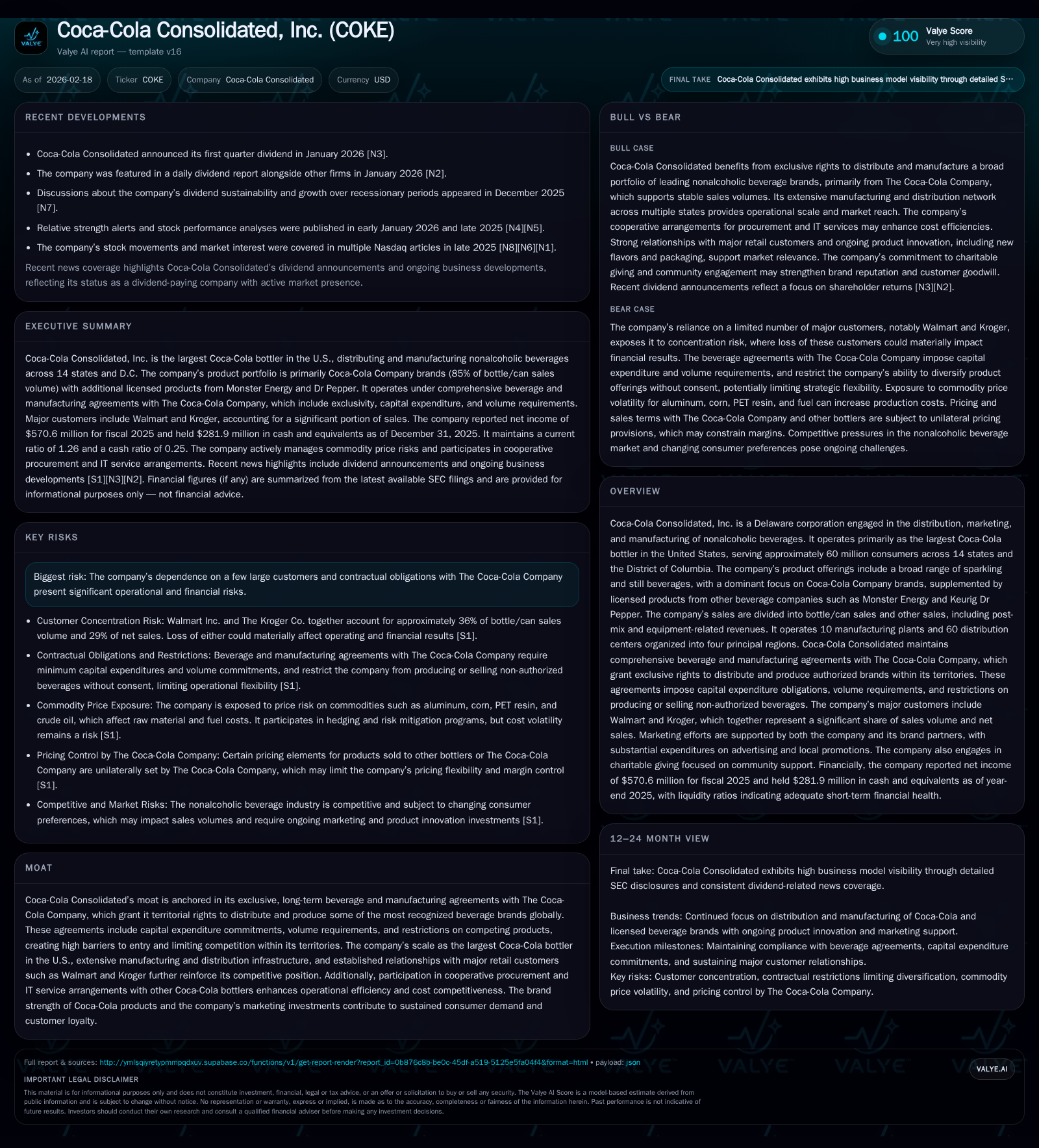
Coca-Cola Consolidated, Inc. (COKE) operates as the largest U.S. Coca-Cola bottler, serving roughly 60 million consumers across 14 states plus DC. Its historical growth has been steady but moderate, driven by strong brand associations and territorial exclusivity under long-term agreements with The Coca-Cola Company. However, net income declined nearly 10% in 2025 due to higher interest expenses following a $2.4 billion share repurchase funded largely through new term loans, pushing equity into negative territory and compressing return on equity. Future growth is tethered to product innovation within its regional footprint and pricing power amid cost inflation pressures, yet capital allocation priorities now tilt toward debt servicing over dividends or buybacks.
Overview
Coca-Cola Consolidated, Inc., incorporated in 1980 with roots dating to 1902, is the largest independent bottler for The Coca-Cola Company in the United States. It serves approximately 60 million consumers across a swath of 14 states plus the District of Columbia. Its product array spans both sparkling beverages—led by flagship Coca-Cola brands—and a growing roster of still beverages including energy drinks like Monster Energy, premium waters such as Topo Chico, and ready-to-drink options like BODYARMOR.
The company operates ten manufacturing plants alongside sixty distribution centers organized around four primary regions: Carolinas, Mid-Atlantic, Mid-South, and Mid-West. Its business model thrives on exclusive long-term beverage and manufacturing agreements with The Coca-Cola Company granting territorial rights complemented by capital expenditure commitments and volume requirements.
Historical Performance
Over the past four fiscal years through 2025, Coca-Cola Consolidated demonstrated steady growth in operating income with more variable net income results influenced by financial activities:
Historical performance (annual)
| FY | Net ($mm) | CFO ($mm) | OpInc ($mm) | Capex ($mm) | Net YoY |
|---|---|---|---|---|---|
| 2025 | 571 | 932 | 951 | 312 | -9.9% |
| 2024 | 633 | 876 | 920 | 371 | +55.0% |
| 2023 | 408 | 811 | 834 | 282 | -5.1% |
| 2022 | 430 | 555 | 641 | 299 |
Note: Omitted columns lack sufficient annual XBRL coverage in the provided tags (need ≥2 annual points): Rev. Source: SEC companyfacts cache [F1].
Capital returns and efficiency (annual)
| FY | Div ($mm) | Buybacks ($bn) | FCF ($mm) |
|---|---|---|---|
| 2025 | 87 | 2.6 | 620 |
| 2024 | 186 | 0.6 | 505 |
| 2023 | 47 | 528 | |
| 2022 | 9 | 256 |
Source: SEC companyfacts cache [F1].
[F1]
Operating income showed consistent expansion driven primarily by volume gains, product mix optimization toward higher-margin still beverages like energy drinks, and operational improvements through shared services platforms such as CCBSS for procurement efficiencies.
Net income volatility notably reflects financing impacts rather than core operations alone; the steep increase in share repurchases financed by bridge and term loans in late 2025 led to higher interest expenses weighing on net profit despite operating margin expansion.
Drivers Behind Historical Growth
- Exclusive Bottling Rights: Long-term comprehensive beverage agreements (CBAs) underpinning exclusive distribution territories have safeguarded Coca-Cola Consolidated from competition within its service area.
- Diversified Beverage Portfolio: While heavily weighted toward traditional carbonated soft drinks (~85% of bottle/can volume), the growing share of still beverages—including licensed brands like Monster Energy and Keurig Dr Pepper products—has boosted revenue quality.
- Scale and Infrastructure: Ten manufacturing plants producing bottle/can formats paired with extensive North American distribution capabilities enhance route efficiency and availability.
- Collaborative Procurement: Membership in CCBSS enables buying leverage across multiple raw materials (e.g., aluminum cans, plastic bottles), reducing input costs.
- Strong Retail Partnerships: Major customers Walmart (21% bottle/can volume;
17% net sales) and Kroger (15% volume; ~12% net sales) represent significant sales anchors but also concentration risk.
Future Growth Prospects
The company outlines several avenues potentially fueling sustainable growth:
- Innovation Pipeline: Introduction of new flavors like Sprite + Tea and POWERade Powerwater variants, along with novel packaging formats (including enhanced glass bottles) aimed at health-conscious consumers[N1][S9]. Planned launches in early-to-mid 2026 include Coca-Cola Cherry Float and FLRT Energy Drinks.
- Expanded Still Beverage Sales: Continued emphasis on non-carbonated segments such as ready-to-drink coffee (Dunkin’ Coffee), enhanced water (BODYARMOR), and vitamin-infused water targets evolving consumer preferences.
- Territorial Optimization: Ongoing network adjustments through NPSG governance intend to improve plant-to-distribution center sourcing efficiency[S26].
- Sustainability Commitments: Investments aimed at recyclable packaging expansion align with regulatory trends favoring environmental responsibility.
Challenges include:
- Customer Concentration: Heavy reliance on one-third of net sales from just two customers limits bargaining room; loss or significant renegotiation could pose material risks[S8][S14].
- Input Cost Inflation: Commodity price sensitivity—particularly aluminum cans, PET resin used for plastic bottles, high-fructose corn syrup—inflates cost of goods sold. The company estimates a potential cost increase of $35-$40 million annually if these rise by an additional ten percent[S1].
- Interest Rate Sensitivity: Variable rate debt exposure means rising rates materially increase financing costs; a one percent hike would add roughly $13.5 million annually to interest expense based on current borrowings[S1].
- Contractual Requirements: Capital expenditure mandates tied to beverage agreements impose ongoing investment obligations restricting flexibility[S1].
Forecasts / Milestones / What to Watch For
The company has not provided forward-looking guidance or explicit milestones beyond announcing upcoming product launches described above[N1][S9]. Analysts should monitor:
- Quarterly updates for incremental gains from new products launched in early 2026.
- Changes in commodity cost trends affecting gross margin profiles.
- Interest expense evolution related to recent debt issuances.[S6][S10]
- Customer relationship developments or contractual amendments impacting territorial exclusivity.
- Capital expenditures relating to manufacturing plant upgrades as influenced by strategic supply chain realignments under the NPSG agreement.[S26]
Returns & Capital Allocation
Notably altered by the aggressive financial strategy adopted in late 2025:
- Leverage Increase & Equity Impact: A $2.4 billion share repurchase using cash plus a $1.35 billion term loan facility caused equity to swing negative (-$740 million at fiscal year-end), distorting traditional profitability ratios such as ROE (approximate calculated ROE: -77%) due mainly to elevated debt balances[F1][S19].
- Operating Cash Flow & Free Cash Flow: Consistent strong operating cash flows ($931.9M in 2025) allowed coverage of capital expenditures ($312M), producing positive free cash flow near $620 million[F1].
- Dividend Policy: Dividends paid dropped substantially to $87 million in 2025 from $186 million prior year alongside heightened debt loads as management prioritized deleveraging over shareholder payouts[S19][F1][N2][N3].
- Share Repurchases: The massive $2.6 billion buyback dwarved all previous years’ repurchase activity dramatically reshaping the capital structure[F1][S19].
- Debt Profile: Post-repurchase debt includes secured term loans maturing across periods from three to seven years bearing variable rates sensitive to market interest fluctuations[S6][S10].
Capital allocation now distinctly favors balance sheet repair over dividend growth or further buybacks given interest-bearing liabilities accrued.
Sector Perspective (Analysis)
The U.S. nonalcoholic beverage industry remains highly competitive with evolving consumer tastes shifting demand from sugary carbonated drinks toward still beverages perceived as healthier or more functional—energy drinks being a prime example. Bottlers like Coca-Cola Consolidated operate complex production-distribution systems which must balance cost containment against ongoing innovation cycles requiring local market responsiveness. Leveraged recapitalizations are common but carry risk profiles sensitive to credit markets; commodity price volatility especially persists as a headwind given reliance on aluminum cans (54% of bottle/can volume packaged in cans) and plastic bottles. Margin stability depends heavily on negotiating pricing pass-throughs without eroding volumes—a delicate tradeoff amid inflationary pressures impacting consumer purchasing power.[S1]
Risk Factors Summary
Key risks encompass customer concentration—with Walmart and Kroger jointly responsible for about one-third of total sales—and contract dependencies on The Coca-Cola Company’s stringent beverage supply agreements that enforce capital requirements and limit operational latitude[S4][S8]. Commodity price swings can materially affect input costs causing cost push inflation that could pressure margins absent timely price adjustments[S1]. Lastly, substantial recent leverage exposes profitability metrics to rising interest rates which would increase annual financing charges dramatically.[S1]
Disclaimer
This report is for informational purposes only without any offer or solicitation for purchase or sale of securities or investment advice. It is based solely on publicly available data as of February 18, 2026. Readers should perform their own due diligence before making any business decisions related to Coca-Cola Consolidated, Inc.
Disclaimer: This is research-only, informational analysis and not investment advice. It may include AI-generated interpretation and general industry context. Always verify important details using primary sources.

Comments