
Title Insurance Innovator First American Financial Unveils Strong Earnings Growth and Efficiency Advances
First American reports a notable 21.6% revenue increase and efficiency improvements in 2025, driven by title insurance strength and technology investments.
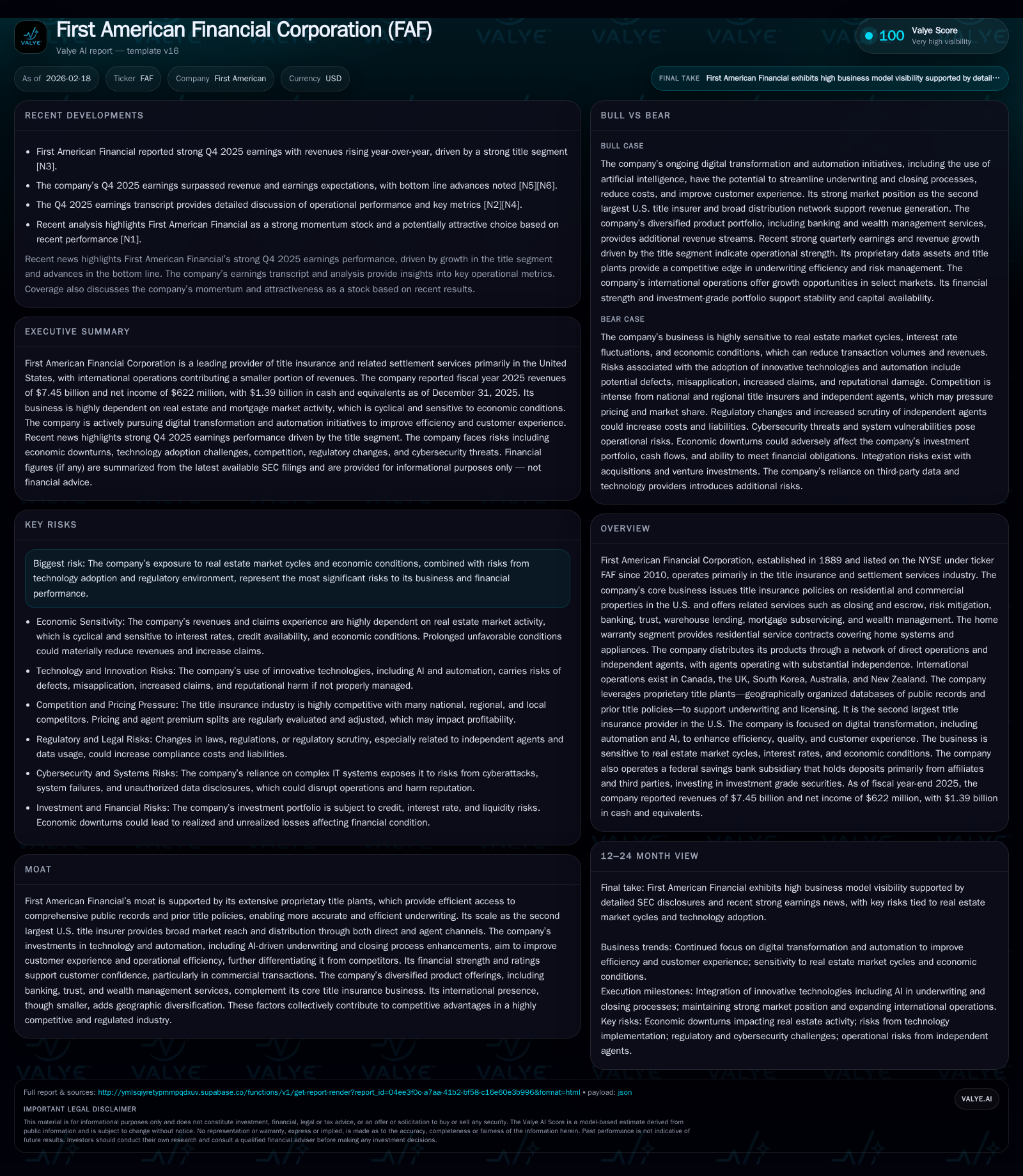
First American Financial Corp (FAF), a stalwart in title insurance since 1889, posted robust financial results in fiscal year 2025, highlighted by a 21.6% rise in revenue to $7.45 billion and a 374% surge in net income to $622 million [F1]. The company’s core title insurance and settlement services segment remains its principal driver, underpinned by proprietary title plants and increased automation initiatives utilizing AI technology [S6][S8]. Despite industry cyclicality and regulatory complexities posing risks, FAF has demonstrated disciplined capital allocation with steady dividends around $220 million annually and measured share repurchases, while generating strong free cash flow that supports both growth investments and shareholder returns [F1][S7]. Moving forward, key industry indicators to watch include transactional volumes, regulatory changes impacting pricing, and the pace of digital transformation within the title insurance ecosystem.
Turning Points: Revenue Growth and Profitability Trends Through Recent Years
First American Financial Corp (FAF) illustrated a compelling financial rebound in fiscal year 2025 after uneven market conditions from 2022 through 2024. Revenues climbed decisively by approximately 21.6% year-over-year to $7.45 billion in FY2025 compared to $6.13 billion in FY2024, recovering ground lost amid prior real estate market headwinds [F1]. Net income followed an even more striking trajectory, surging over threefold to $622 million from $131 million the previous year — driven by operational leverage amid higher transactional volumes and improvements in claims management.
Operating cash flow remained resilient at approximately $951 million, up nearly 6% vs. prior year, signaling solid fundamental cash generation despite earlier pandemic-related economic uncertainty. Concurrently, capital expenditures declined modestly by about 14%, down to approximately $188 million, indicating better capital efficiency likely supported by digital transformation initiatives.
This performance reflects FAF’s ability to navigate cyclical fluctuations inherent in the real estate market while emerging leaner due to process automation and tighter cost controls. Equity holders saw book value expansion as stockholders’ equity increased steadily from $4.67 billion in FY2022 to about $5.50 billion by fiscal year-end 2025.
Historical performance (annual)
| FY | Rev ($bn) | Net ($mm) | CFO ($mm) | Capex ($mm) | Rev YoY | Net YoY |
|---|---|---|---|---|---|---|
| 2025 | 7.5 | 622 | 951 | 188 | +21.6% | +374.3% |
| 2024 | 6.1 | 131 | 898 | 218 | +2.1% | -39.5% |
| 2023 | 6.0 | 217 | 354 | 263 | -21.1% | -17.6% |
| 2022 | 7.6 | 263 | 780 | 260 |
Note: Omitted columns lack sufficient annual XBRL coverage in the provided tags (need ≥2 annual points): OpInc. Source: SEC companyfacts cache [F1].
Capital returns and efficiency (annual)
| FY | Div ($mm) | Buybacks ($mm) | FCF ($mm) |
|---|---|---|---|
| 2025 | 223 | 122 | 763 |
| 2024 | 221 | 69 | 679 |
| 2023 | 217 | 73 | 91 |
| 2022 | 217 | 441 | 520 |
Source: SEC companyfacts cache [F1].
Note: Operating income data not available from provided disclosures.
The Title Insurance Engine: Core Segment Drivers and Market Position
FAF's principal value creation engine is its title insurance and settlement services segment, accounting for more than 93% of total consolidated revenues as of the end of fiscal year 2025 [S6][S8]. This segment's revenues stem from issuing title insurance policies on residential and commercial properties across the United States, leveraging proprietary geographically organized title plants—databases aggregating public land records—that enable more rapid and accurate underwriting relative to typical name-based public indexes.
These title plants also index prior title insurance policies creating further efficiencies in risk assessment. Title insurance policies typically involve large ticket transactions where lenders require coverage against defects or liens on property titles.
FAF distributes policies primarily through a two-pronged channel strategy: directly operated offices staffed with sales representatives targeting real estate intermediaries such as mortgage originators and brokers; alongside a broad network of independent agents who operate with significant autonomy issuing policies on FAF’s behalf under agency agreements that include stipulated underwriting authority levels [S16][S18].
Complementing core issuance are closing/escrow services which help facilitate property transfers securely and efficiently; banking services including trust, warehouse lending deposits (mainly short-term escrow funds held during closings); mortgage subservicing; and wealth management solutions aimed at clients engaged broadly in real estate transactions or investments.
Internationally, FAF maintains smaller but growing operations across Canada, the UK, Australia/New Zealand, and South Korea—markets where title insurance exists with localized structural differences but where FAF leverages its data expertise plus tailored risk mitigation products [S18].
Competitive positioning hinges on service quality — quick turnaround times in underwriting decisions aided by comprehensive data assets — pricing discipline responsive to shifting markets/regulations — and financial strength enabling confidence especially among commercial real estate stakeholders who require robust coverage backing.
Strategic Technological Innovation: AI Automation and Title Plant Advantages
FAF has embraced technology as a linchpin for deepening its competitive moat amidst industry consolidation pressures combined with growing customer expectations for instant information access coupled with lower risk exposure [S6][N1]. The company’s digital transformation initiatives prominently feature artificial intelligence-powered automation tools that accelerate underwriting decisions traditionally reliant on manual records examination.
Automated underwriting algorithms now digest large datasets within FAF’s proprietary title plants along with external public record inputs to evaluate risk profiles swiftly while preserving precision—a critical factor since underwriting often requires nuanced judgment exercised at multiple organizational layers given decentralized agent authority structures [S2][S6]. Additionally, closing/escrow workflows have been streamlined through digital platforms reducing time-to-close while enhancing communication clarity between buyers, sellers, lenders, and agents.
Intellectual property protections combining patents for technical innovations alongside trade secrets around data processing enhance barrier-to-entry attributes against other providers attempting replication at scale.[S6]
The increased use of AI also extends into fraud detection mechanisms vital given rising cyber threats targeting fund transfers associated with property transactions [S24][S29]. By automating both manual tasks (title searches & examinations) and complex evaluations (risk decisioning), FAF effectively reduces operational costs while boosting customer satisfaction metrics.
Emerging Risks: Navigating Market Cycles, Regulatory Landscape, and Integration Challenges
Despite technological gains bolstering underlying operations resilience, FAF faces several notable headwinds tied primarily to macroeconomic sensitivity inherent in real estate volume cycles alongside intensifying regulatory scrutiny across markets served.
The degree of dependence on transactional volume makes costly economic slowdowns or interest rate spikes a foremost risk as these factors can curtail home purchase/refinance activity dampening new policy issuance rates significantly [S19][N2]. Moreover,title insurance rates are subject to state-specific regulatory approval processes potentially hampering rapid price adjustments essential during volatile periods or escalating claims cost environments [S26][S25].
Heightened governmental investigations into industry practices—whether via state insurance departments or federal agencies such as CFPB—add compliance complexity raising operational costs plus litigation exposure risks given recent class-action lawsuits targeting certain settlement practices [S10][S17]. Privacy regulations mandating stringent data handling protections also demand continuous investment while exposing FAF to breach consequences if inadequately managed [S24][S29].
Furthermore,Faf’s recent acquisitions pose integration risks that may divert managerial focus amid varying operational cultures especially within international units less tightly aligned yet requiring convergence into enterprise-wide enterprise risk management frameworks—and sustaining centralized oversight of underwriting standards despite agent-level autonomy remains challenging but crucial for consistent loss mitigation [S21].[S28]
Capital Stewardship: Dividend Discipline, Share Repurchases, and Cash Flow Management
The company exhibits conservative yet shareholder-friendly capital allocation balanced against ongoing strategic investment needs.[F1][S7] In fiscal year 2025,the firm distributed roughly $223 million in dividends—consistently stable over past four years—and executed share repurchases totaling approximately $122 million—a roughly twofold increase compared to prior year but considerably below peak levels seen previously ($441 million in FY2022). These moves underscore measured program discretion reflective of current market conditions paired with growth priorities.
Operating cash flows have exhibited steady improvement rising from about $780 million in FY2022 to nearly $951 million most recently.FCF approximates $762.5 million after capital expenditures which themselves have been reduced versus peak capex years evidencing improved asset utilization efficiency.[F1]
An estimated Return on Equity near an attractive ~11.3% complements these findings substantiating effective use of capital relative to earnings generation benchmarks typical for the sector.FAF maintains disciplined leverage levels conforming with regulatory parameters applicable especially for its bank subsidiaries providing trust/deposit functions.[S7]
This capital stewardship posture positions it well for continued innovation funding including AI deployments alongside opportunistic acquisitions while sustaining rewarding shareholder distributions without compromising financial robustness.
What to Monitor Next: Key Milestones, Competitive Dynamics, and Industry Signals
While specific milestones or forward-looking expectations were not detailed explicitly in the provided SEC filings or news transcripts,[N#],[S#] FAF's ongoing strategic priorities clearly focus on accelerating digital transformation initiatives including expanded AI-enabled underwriting automation; increasing operational efficiency; deepening penetration within both domestic markets via agency enhancements as well as growing select international footprints; managing regulatory compliance rigorously amidst evolving frameworks; maintaining disciplined capital allocation balancing dividends with opportunistic buybacks; and leveraging scale advantages as the second largest U.S. title insurer.[S8][N1]
Upcoming quarterly earnings releases will be crucial barometers tracking premium growth momentum particularly whether strong Q4 results translate into sustained FY26 top-line expansion.[N2][N3] Regulatory developments demand close attention given their potential impact on allowable pricing agility or capital requirements which could alter earnings or cash contributions.[S26]
Competitively,the pace of digitization adoption among peers plus consolidation trends within the U.S.title insurance market remain key vectors influencing FAF’s relative positioning.Further integration outcomes concerning recently acquired entities will be visible through operational metrics e.g., claims ratios or speed of closing cycle advancements.[N1][N4]
Macro signals influencing residential/commercial real estate demand cycles such as mortgage interest rate trends,new housing starts statistics,and refinancing volumes will materially shape the addressable market size driving primary revenue streams.Further advances embedding AI deeper into underwriting process could yield margin expansion opportunities but depend heavily on managing associated implementation risks carefully.[S6]
In sum,Faf commands significant advantages through its combination of scale,data assets,and technological investment fueling operational efficiency gains amidst an evolving industry landscape characterized by cyclical pressures balanced against innovation-fueled differentiation.
Disclaimer: This analysis is based solely on publicly available information including SEC filings [S#], recent news reports [N#],and company financial statements indexed via XBRL tags [F1]. It does not constitute investment advice or recommendations.
Disclaimer: This is research-only, informational analysis and not investment advice. It may include AI-generated interpretation and general industry context. Always verify important details using primary sources.

Comments