
Growth and Governance: The Evolution of QDM International’s Post-Telemedicine Era
QDM International shifted from telemedicine to insurance brokerage, driving substantial revenue and profitability gains through YeeTah.
Since divesting its telemedicine assets in 2020 and shedding its CRM SaaS venture in 2023, QDM International has refocused as a Hong Kong-based insurance broker via its subsidiary YeeTah. The company reported a robust revenue increase of 32% and a more than doubling of net income in fiscal 2025, underpinned by commission revenue from diversified insurance products and MPF intermediary services. Despite customer and sub-broker concentration risks, QDM has leveraged regulatory licensing barriers to build a narrow moat, while maintaining strong operating cash flow and a clean balance sheet. Absent formal guidance, ongoing monitoring of geopolitical risks and client diversification efforts remain key for future growth sustainability.
From Healthcare Kits to Commission Commissions: Company Evolution Overview
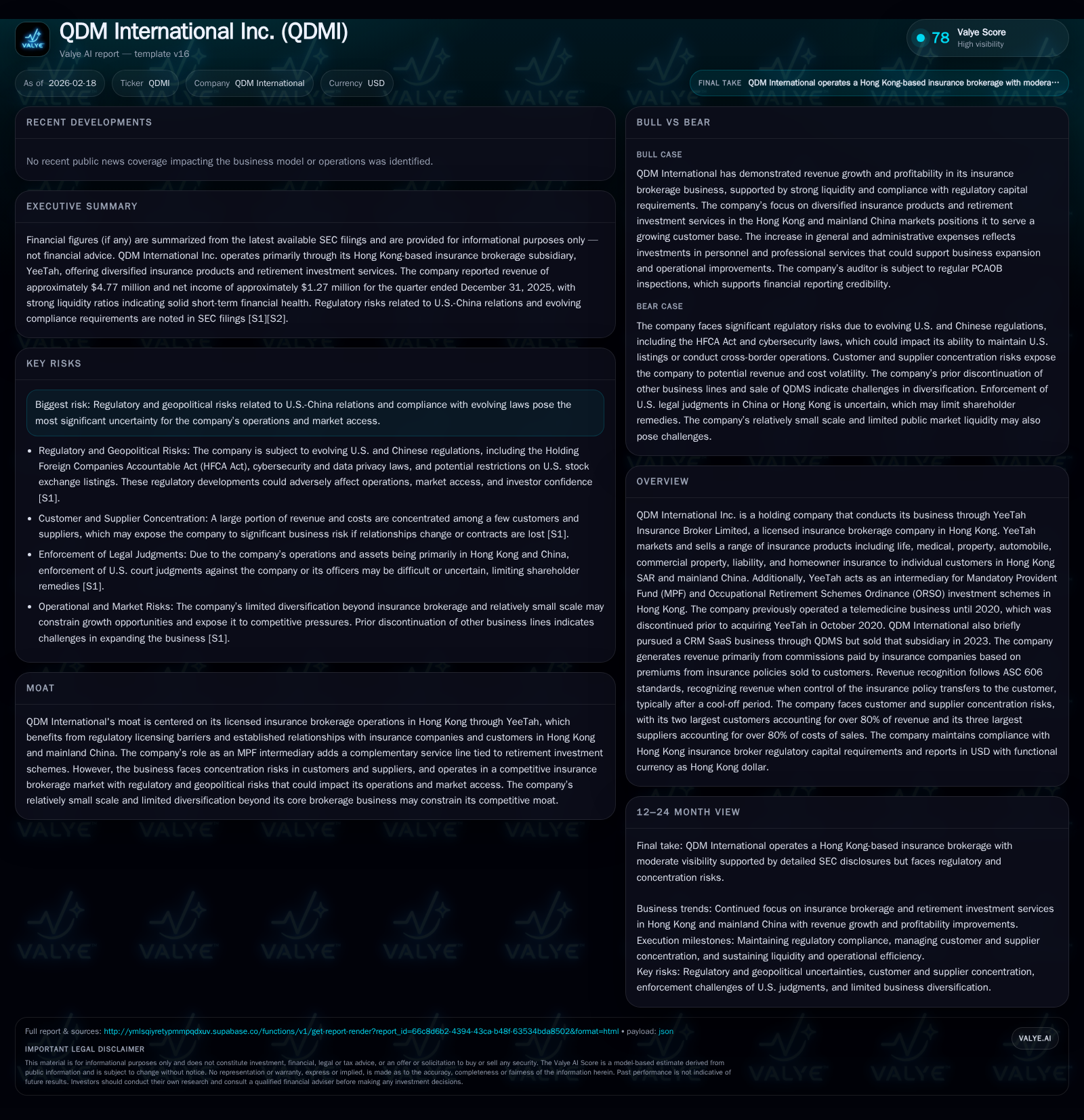
QDM International Inc. (QDMI) has undergone a significant corporate transformation since its original business model centered on telemedicine kits provided to schools. The Company discontinued all telemedicine operations by 2020, effectively becoming a non-operating shell until the October 2020 acquisition of YeeTah Insurance Broker Limited—a licensed Hong Kong insurance brokerage firm. This transaction marked a strategic pivot from healthcare technology toward financial intermediation specializing in insurance products covering life, medical, property, automobile, commercial property, liability, and homeowners insurance markets targeting individuals in Hong Kong SAR and mainland China [S1][F1]. In addition to insurance brokering commissions, YeeTah acts as an intermediary for the Mandatory Provident Fund (MPF) and Occupational Retirement Schemes Ordinance (ORSO), both key retirement savings vehicles regulated by Hong Kong authorities.
The Company briefly explored SaaS-based Customer Relationship Management software solutions through its wholly owned subsidiary QDMS after acquiring it in late 2021 but divested this unit in October 2023 after determining the venture was non-core [S6]. This retreat fully concentrates QDMI's revenue engines on the YeeTah brokerage operations which benefit from regulatory licensing barriers typical within Hong Kong's financial services regime—these create high entry hurdles fostering defensible client-insurer relationships .
Historic Revenue Acceleration Driven by YeeTah Acquisition and Market Focus
Historical financials demonstrate a sharp inflection post-YeeTah acquisition with revenues expanding from $6.37 million FY24 to $8.38 million FY25—a year-over-year increase of roughly +31.7% [F1]. This reflects increased commission income from newly expanded insurance product portfolios and deeper penetration of existing client bases. Notably, the Company enhanced revenue streams from referral commissions tied to investment products made available through partnerships with trust companies under HK regulation [S27].
Operating income accelerated even more meaningfully—topping $5.9 million in FY25 compared to $1.8 million prior—reflecting improved operating leverage as referral fee costs dropped significantly following regulatory mandates limiting excessive fee payments issued by the Hong Kong Insurance Authority in May 2024 [S21]. Net income followed suit rising over +200% YoY to approximately $4.82 million [F1]. These top-line growth drivers underpinned by commission percentage fees on premium volumes are typical of well-regulated brokerage business models where scale amplifies margins due to fixed general & administrative expense components.
Historical performance (annual)
| FY | Rev ($mm) | Net ($mm) | CFO ($mm) | OpInc ($mm) | Rev YoY | Net YoY |
|---|---|---|---|---|---|---|
| 2025 | 8 | 5 | 4 | 6 | +31.7% | +208.3% |
| 2024 | 6 | 2 | 2 | 2 | ||
| 2022 | 0 | 0 | 0 | 0 | -44.1% | -22.9% |
| 2021 | 0 | 0 | 0 | 0 |
Note: Omitted columns lack sufficient annual XBRL coverage in the provided tags (need ≥2 annual points): Capex, Div, Buybacks. Source: SEC companyfacts cache [F1].
Capital returns and efficiency (annual)
| FY | FCF ($mm) | ROE% |
|---|---|---|
| 2025 | 4 | 54.6 |
| 2024 | 2 | 45.8 |
| 2022 | 0 | 56.1 |
| 2021 |
Source: SEC companyfacts cache [F1].
Note: Capex data insufficient for trend analysis beyond these two years.
Customer and Supplier Concentration: Double-Edged Sword in Brokerage Dynamics
Despite positive momentum, concentration risks remain material due to reliance on a limited number of large customers providing approximately eighty percent of total revenues—two largest clients contributed about 68% and 12%, respectively during FY25 [S5][F1]. On the cost side, about seventy percent of cost of sales were concentrated among three sub-brokers emphasizing supplier dependency typical among boutique brokerage firms that outsource portions of client servicing or underwriting referral functions.
This client-supplier concentration compounds operational leverage effects but also exposes earnings stability to the retention or loss of these major accounts or contractual terms shifts—common risks within small-scale niche intermediaries bound tightly by their regulatory licenses.
Regulatory Landscape and Geopolitical Tensions Impacting Market Access
Operating primarily through Hong Kong offices exposes QDM International to regulatory frameworks that simultaneously protect licenced brokers while posing evolving compliance challenges linked to wider U.S.–China geopolitical tensions [S7]. The Holding Foreign Companies Accountable Act (HFCA) enacted by US regulators imposes audit transparency requirements checked through PCAOB inspections.
Encouragingly for QDMI investors, its auditor ZH CPA LLC remains off the restricted PCAOB Determination List and underwent regular inspections as recently as early-to-mid-2025 [S1]. Nevertheless, uncertainty around potential future restrictions or compliance costs persists given shifting rules governing foreign audit access. This could affect investor confidence and trading liquidity given broader market skepticism toward US-listed mainland Chinese-related companies facing similar constraints.
Profitability Metrics, Cash Flow Strength, and Equity Returns Since Transition
QDM International’s profitability metrics illustrate strong operational improvements post-pivot: ROE calculated approximately at an impressive ~54.6% using FY25 net income against closing equity base [F1]. The company's service model demands minimal capital expenditures ($92k capex in FY24 & FY25) aligning with typical brokerage peers whose cost structures emphasize human capital rather than asset-heavy investments.
The surge in operating cash flow—reaching over $4 million in FY25 versus about $2.2 million the year prior—demonstrates significant cash conversion strength supporting internally funded growth initiatives without resorting heavily to external debt [F1].
Capital Strategy Choices: Stock Issuances, Absence of Dividends, and Debt Posture
QDM International's capital allocation has focused primarily on equity financing enhancements rather than shareholder distributions or debt expansion. The company completed a public offering in March 2023 yielding $2.34 million gross proceeds from common stock sales at sub-$0.01 per share pricing [S6][F1]. A notable authorized shares increase along with a subsequent forward split (10-for-1 effective April 2024) better positions liquidity though no dividends have been declared nor repurchase programs implemented given the firm's current size and retained earnings deployment focus [S13][F1].
Debt funding remains minimal with related party loans converted partially into Series B Preferred Stock owned predominantly by CEO Huihe Zheng [S25], illustrating internal capital recycling rather than third-party leverage raising overall balance sheet conservatism.
Future Catalysts and Risks: What Investors Should Monitor
QDMI has not provided explicit near-term guidance; however key potential catalysts include successful diversification away from client concentration toward broader retail distribution across Hong Kong-mainland China corridors; continued favorable policy reforms within MPF/ORSO intermediary frameworks enhancing fee earning potential; and full adaptation to evolving transparency norms regarding auditor inspections which sustain investor trust.
Conversely, geopolitical flashpoints around U.S.-China relations remain wildcards capable of triggering regulatory hurdles or investor sentiment shocks applying pressure on share liquidity/access [S7]. Monitoring quarterly disclosures for customer mix shifts or new partnership announcements will be critical forward-looking signals.
Concluding Thoughts on Moat Durability and Growth Sustainability
QDM International’s narrow moat emerges principally from its licensed status as a Hong Kong insurance broker coupled with entrenched customer links within complex regulated financial services environments that are not easily replicated due to entry barriers enforced by authority oversight. Nonetheless, the company's relatively modest scale and concentrated revenue base pose ongoing scalability challenges that may limit medium-term competitive advantage especially amid intensifying compliance costs heightened by cross-border political uncertainties. Achieving sustainable growth will likely hinge on deepening client diversification, abiding regulatory developments judiciously, and potentially scaling service offerings within complimentary retirement scheme intermediation segments.
Disclaimer: This report is for informational purposes only; it does not constitute investment advice or recommendations.
Disclaimer: This is research-only, informational analysis and not investment advice. It may include AI-generated interpretation and general industry context. Always verify important details using primary sources.

Comments