
American Airlines Faces Operational Headwinds Despite Scale and Capital Resources
American Airlines confronts a steep earnings decline and margin pressures driven by fuel volatility and labor costs, while investing heavily in fleet modernization amid challenging regulatory and market dynamics.
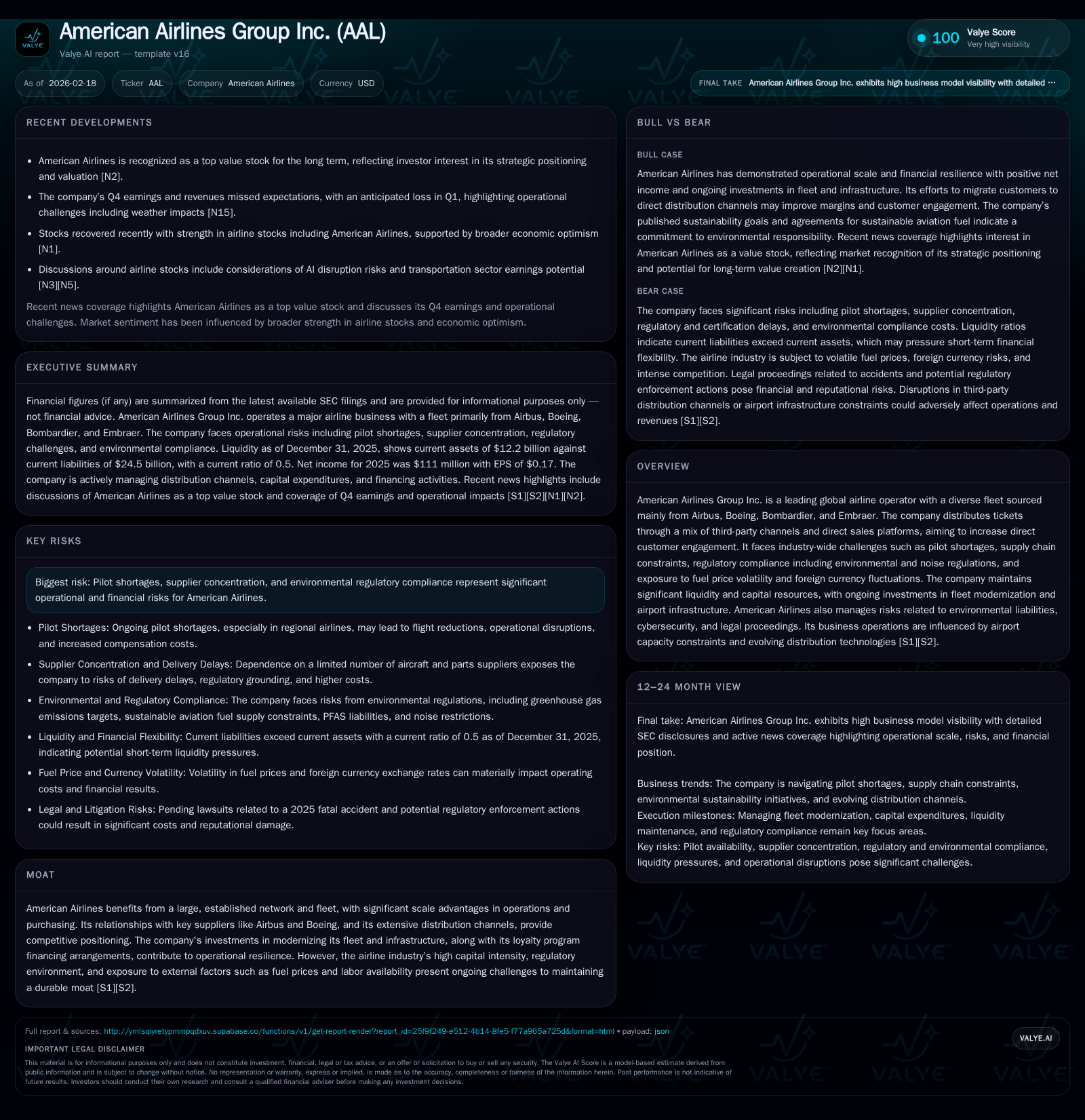
In 2025, American Airlines experienced a significant contraction in operating income alongside rising operational costs, particularly labor-related and regional expenses. The company is responding with substantial capital expenditures on fleet upgrades and airport infrastructure, financed through active debt management and liquidity preservation. Risks including pilot shortages, environmental regulations, fuel price exposure, and competitive distribution dynamics complicate its recovery trajectory. Monitoring quarterly results and cost controls will be critical to assessing progress.
2025 Performance in Review: Earnings Decline and Cost Dynamics
American Airlines Group Inc. delivered a markedly weaker financial performance in fiscal year 2025 compared to the prior year. Operating income contracted by approximately 44%, falling from $2.61 billion in 2024 to $1.47 billion in 2025 [F1]. Meanwhile, net income plunged nearly 87%, reaching just $111 million [F1]. This sharp earnings deterioration signals significant margin pressures despite the airline's scale.
Operating cash flow also declined by a notable 22%, registering $3.1 billion versus $4.0 billion in the prior year [F1]. Concurrently, capital expenditures surged over 40% to $3.78 billion as the airline invested aggressively in fleet renewal and infrastructure enhancements [F1]. The widening gap between operating cash flow and capex contributed to a negative free cash flow position of roughly -$680 million . Such cash flow pressures highlight the firm's prioritization of future capacity growth over immediate liquidity expansion.
Historical performance (annual)
| FY | Net ($mm) | CFO ($bn) | OpInc ($bn) | Capex ($bn) | Net YoY |
|---|---|---|---|---|---|
| 2025 | 111 | 3.1 | 1.5 | 3.8 | -86.9% |
| 2024 | 846 | 4.0 | 2.6 | 2.7 | +2.9% |
| 2023 | 822 | 3.8 | 3.0 | 2.6 | +547.2% |
| 2022 | 127 | 2.2 | 1.6 | 2.5 |
Note: Omitted columns lack sufficient annual XBRL coverage in the provided tags (need ≥2 annual points): Rev, Div, Buybacks. Source: SEC companyfacts cache [F1].
Capital returns and efficiency (annual)
| FY | FCF ($mm) | ROE% |
|---|---|---|
| 2025 | -680 | -3.0 |
| 2024 | 1300 | -21.3 |
| 2023 | 1207 | -15.8 |
| 2022 | -373 | -2.2 |
Source: SEC companyfacts cache [F1].
Note: Dividend payments under recent years are minimal; ROE approximated near -3%. Buyback activity has been limited.
Drivers Behind Operating Income Contraction
The compression in operating profitability stemmed chiefly from elevated labor costs, increased regional operating expenses, and supply chain disruptions that impacted maintenance and parts availability [S1][N3]. Salaries, wages and benefits expanded by nearly 10%, reflecting iterative contractual wage increases and extended labor agreements finalized in late-2024 [S14]. Regional expenses rose over 8% concomitant with a year-over-year regional ASM (Available Seat Mile) increase of roughly 10%, indicating expansion but at higher cost intensity.
Despite an overall decrease in aircraft fuel expenditures by approximately $700 million due to an 8% lower average jet fuel price per gallon ($2.39 vs $2.60) [S14], these savings failed to offset the stark rise in other operating costs.
The unit cost metric CASM (Cost per Available Seat Mile) increased modestly by roughly 0.8% to 17.76 cents in ’25 from ’24 [S1]. Excluding fuel and special items, CASM rose substantially more—by about 4.6%—underscoring the underlying inflationary pressure on pay rates, regional service fees, and other operational areas.
Fuel Price Volatility and Labor Costs: Key Margin Pressures
Fuel remains an outsized variable cost for American Airlines; however, unlike some peers, the company currently does not operate a significant hedging program against jet fuel price fluctuations which intensifies earnings exposure to commodity swings [S2][S1]. The supply chain irregularities contributing to maintenance delays further exacerbate cost volatility.
Labor constraints constitute another critical challenge affecting both cost structures and service reliability [S7]. Pilot shortages continue to limit expansion efforts on certain routes and force a reliance on higher-cost overtime and recruitment incentives [S7]. These factors heighten vulnerability to operational disruptions during peak travel periods.
Fleet Modernization and Infrastructure Investments Supporting Future Capacity
In response to evolving network demands and aging equipment risks, AAL accelerated fleet renewal with approximately a +40% jump in capex year-over-year totaling nearly $3.8 billion [F1][S22]. Noteworthy procurement includes:
- Purchase of multiple aircraft types: Boeing 737 MAX (23 units), Embraer E175 (12 units), Bombardier CRJ900 (8 units), Boeing 787-9 (6 units), Airbus A321XLR (5 units), plus lease repurchases for Boeing models [S16].
- Investment in airport terminal modernization notably at Los Angeles International Airport terminals T4/T5 as part of broader hub infrastructure upgrades aiming at efficiency gains [S22][S6].
These capital allocations were supported by diversified financing activities involving equipment loans issuance (~$1.2B), issuance of Enhanced Equipment Trust Certificates (EETCs) amounting to nearly $978 million proceeds secured on aircraft collateral, alongside revolving credit enhancements [S4][S5][S10]. The use of sophisticated off-balance-sheet trusts for aircraft financing helps spread maturities and lower borrowing costs amid high industry capital intensity.
Liquidity Position and Debt Structure: Managing Financial Flexibility
AAL’s liquidity remains substantial at $9.2 billion comprising unrestricted cash/short-term investments ($5.8B) complemented by ~$3.4B available revolver capacity as of December-end ‘25 [S4][F1]. This liquidity pool serves as a buffer against cyclical shocks and supports ongoing working capital needs.
The airline proactively refinanced portions of its debt portfolio during the year including early repayments amounting to nearly $1.42 billion targeting high-coupon secured notes alongside incremental term loans under the AAdvantage financing facility aimed at reducing interest margins [S4][S7]. Covenants tied to loan-to-value (LTV) ratios imposed on collateralized borrowings require frequent asset appraisals; current compliance leaves room for resilience but mandates attentiveness given increased leverage levels embedded within growing capex commitments [S8][S18].
Capital Allocation Decisions: Dissecting Dividends, Buybacks, and Capex Trends
Shareholder distributions remain modest reflecting the operational challenges faced: dividend payouts have been sparse post-pandemic with last meaningful dividends occurring pre-2021; buyback activity dwindled sharply with only around $21 million repurchased in FY22 and negligible figures thereafter [F1][S13][S17].
This shift underscores a capital allocation tilted toward growth investments rather than shareholder returns amid stressed profitability metrics — notably approximate ROE turned negative (-3%) reflecting subdued net income relative to equity base .
With structural headwinds pressuring margins coupled with large-scale modernization spending underway, cash flows are prioritized for sustaining long-term competitiveness rather than boosting near-term earnings per share through repurchases.
Risks from Regulatory Compliance, Environmental Goals, and Labor Market Constraints
Environmental regulation poses an intensifying risk vector for American Airlines going forward [S26]. The company has publicly committed to greenhouse gas emission reductions primarily via increasing incorporation of Sustainable Aviation Fuel (SAF) into its mix; however SAF production scales remain insufficient industry-wide with prices significantly above conventional jet fuel levels [S1][S26].
Long-term compliance requires engagement with SAF producers potentially entailing capital investments or purchase commitments exposed to technology execution risks given developmental status of some production facilities [S26]. Increasing emissions scrutiny also exposes AAL to reputational risks around accusations of greenwashing that could trigger litigation or regulatory action.
Airport slot constraints at key hubs such as ORD or LAX represent additional operational bottlenecks that limit schedule flexibility amidst ongoing capacity rebuilds after pandemic disruptions [S6]. Labor markets remain tight especially for pilots where shortages dampen service restoration efforts affecting demand fulfillment ability [S7].
What to Watch: Upcoming Milestones and Financial Guidance Signals
American Airlines’ near-term outlook hinges on several indicators:
- Quarterly earnings trajectory particularly margin improvement excluding non-recurring items will reveal success of ongoing cost management initiatives [N2][N3][S3].
- Stabilization or growth in operating cash flows relative to capex intensity signals the sustainability of current investment pace without compromising liquidity buffers.
- Efficacy of digital transformation programs advancing direct ticket sales influencing ancillary revenue capture amidst third-party distribution channel shifts remains critical given higher costs associated with GDS reliance [S6].
- Progress on securing economical SAF supplies coupled with navigated regulatory compliance will be material to long-term environmental risk mitigation.
- Resolution or escalation of labor contract negotiations including pilot staffing trends will markedly influence capacity growth potential. Monitoring these factors closely will provide clarity on whether American can translate its scale advantages into durable profitability strides despite prevailing industry headwinds.
This analysis is based solely on publicly available information including SEC filings ([F1], [S#]) and reputable news sources ([N#]). It does not constitute investment advice or recommendations.
Disclaimer: This is research-only, informational analysis and not investment advice. It may include AI-generated interpretation and general industry context. Always verify important details using primary sources.

Comments