
Industrial Logistics Properties Trust's Turnaround Amid Capital and Tenant Challenges
ILPT shows a rebound in operating cash flow amid debt pressures and tenant concentration risks affecting its growth and capital strategy.
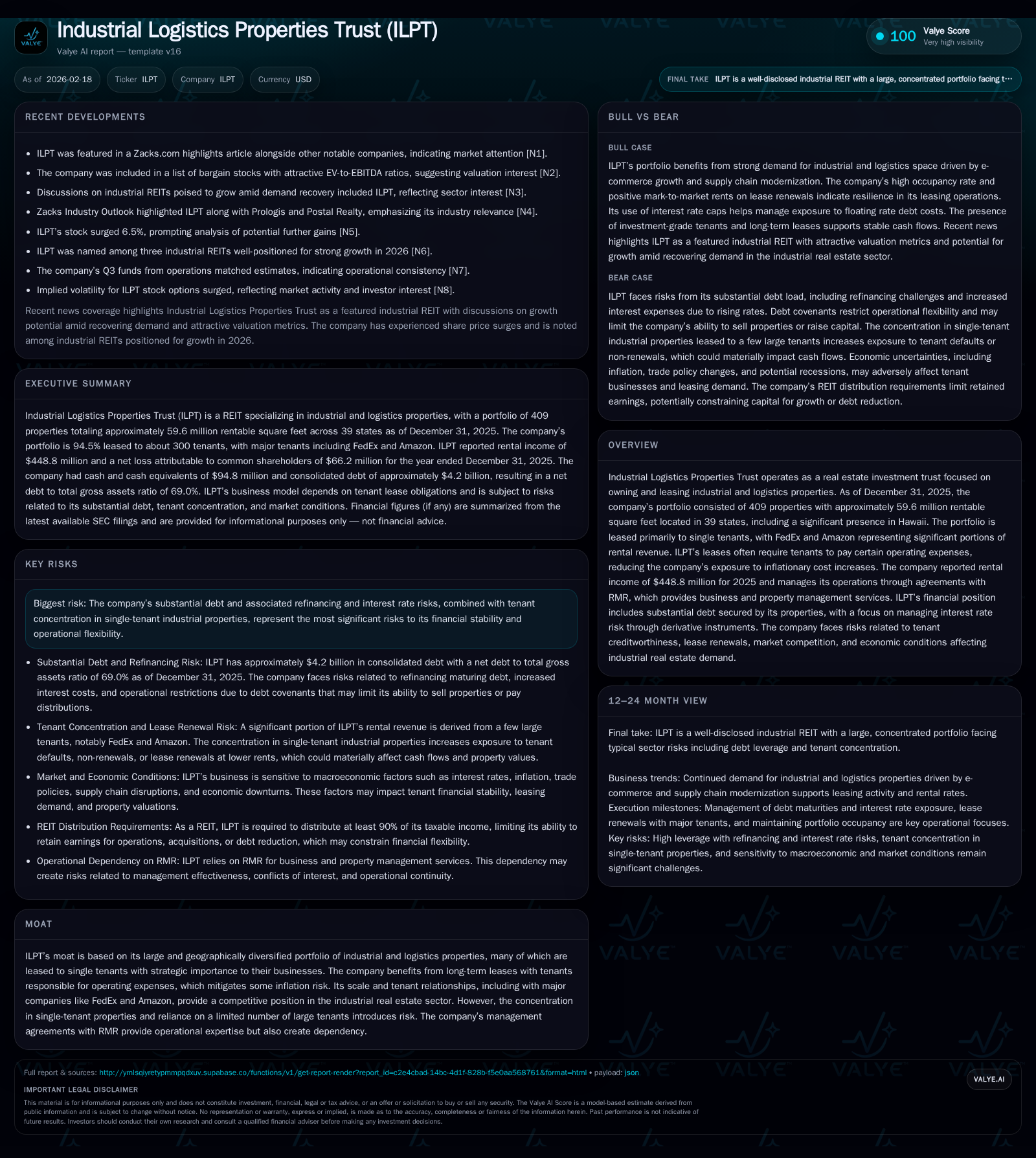
Industrial Logistics Properties Trust (ILPT) has demonstrated a notable recovery in operating cash flow in 2025 compared to previous years, moving away from deep net losses, yet continues to face significant challenges related to its high leverage and concentration of rental income from a few major tenants like FedEx and Amazon. The company's long-term leases, largely single-tenant net lease structures with expense responsibilities shifted to tenants, help offset inflationary pressures but introduce tenant risk concentration. Substantial debt maturing in coming years and restrictive covenants limit capital flexibility, impacting dividend sustainability and capital allocation decisions. Future growth will depend on successful refinancing, tenant retention, and market dynamics within the industrial logistics real estate sector.
From Deep Losses to Operating Cash Flow Recovery: ILPT’s Historical Performance
Industrial Logistics Properties Trust (ILPT) has shown marked improvement in its cash flow generation over recent years despite still posting net losses. The company recorded an operating cash flow (net cash provided by operating activities) of approximately $60.7 million for fiscal year 2025, a dramatic increase of nearly 3000% compared to just under $2 million in 2024 [F1]. This surge primarily reflects lower interest expenses after repaying a costly floating rate loan, as well as improved reimbursements from tenants under net lease structures.
Net income for the same period was still negative at -$66.2 million but improved from a loss of nearly -$95.7 million in 2024 — showcasing operational leverage effects despite ongoing non-cash charges such as depreciation and impairment losses typical in real estate investment trusts (REITs).
Capital expenditures fell sharply to just $1.74 million in 2025 from $6.47 million the year prior, which alongside the operating cash flow improvement enabled ILPT to generate positive free cash flow approximating $58.9 million last year (operating cash flow minus capex) [F1][S4]. However, equity declined from $562 million at end-2024 to approximately $490 million at end-2025 due to cumulative losses reducing net asset value (NAV), which risks pressuring capital ratios.
The table below summarizes key metrics:
Historical performance (annual)
| FY | Net ($mm) | CFO ($mm) | Capex ($mm) | Net YoY |
|---|---|---|---|---|
| 2025 | -66 | 61 | 2 | +30.8% |
| 2024 | -96 | 2 | 6 | +11.4% |
| 2023 | -108 | 6 | 1 | +52.4% |
| 2022 | -227 | 83 | 3 |
Note: Omitted columns lack sufficient annual XBRL coverage in the provided tags (need ≥2 annual points): Rev, OpInc. Source: SEC companyfacts cache [F1].
Capital returns and efficiency (annual)
| FY | Div ($mm) | Buybacks ($) | FCF ($mm) |
|---|---|---|---|
| 2025 | 8 | 451000 | 59 |
| 2024 | 3 | 312000 | -5 |
| 2023 | 3 | 163000 | 5 |
| 2022 | 44 | 242000 | 81 |
Source: SEC companyfacts cache [F1].
Note: Operating income data is not available beyond Q3 of FY2018; revenue data unavailable from provided tags.
This progression highlights ILPT's shift towards stronger operational cash generation and tighter cost management while underscoring challenges with profitability and balance sheet erosion.
Tenant Concentration and Lease Structures as Growth Drivers and Risk Factors
ILPT maintains a sizable portfolio comprising approximately 409 industrial logistics properties totaling roughly 59.6 million rentable square feet spread over 39 states with a meaningful cluster in Hawaii accounting for close to 28% of annualized rents [S26]. Its leasing model predominantly involves single-tenant net leases where tenants bear responsibility for most operating expenses including property taxes, insurance, and maintenance costs.
This arrangement inherently diminishes ILPT's direct exposure to rising inflation or cost pressures but also concentrates lease renewal risk within a limited set of large tenants—specifically FedEx Corporation and Amazon.com Services which combined represent approximately 35% of annualized rental revenue (FedEx ~28%, Amazon ~7%) [S26][N4]. Such tenant concentration necessitates diligent credit risk management since any financial distress or downscaling by these anchor tenants could materially disrupt ILPT's rent collections.
Compared with multi-tenant industrial REITs often exposed to varied sectors or smaller-scale clients, ILPT relies heavily on commercial relationships with these corporates closely linked to supply chain efficiencies—a domain reflecting both secular growth potential given e-commerce expansion and cyclical sensitivity tied to macro trade environments [N2][N4].
The company's prolonged lease durations coupled with structured recoveries from tenants cushion volatility but pose rollover risk that investors should monitor especially when dominant accounts come up for renewal.
Capital Structure Pressures: Managing Substantial Debt Amid Refinancing Uncertainties
A defining feature constraining ILPT's strategic options is its significant indebtedness standing at around $4.2 billion on secured mortgages as of December 31, 2025—equating to a gross asset leverage ratio near 70%, considering accumulated depreciation adjustments [S6][F1]. The debt comprises multiple tranches:
- A recently issued fixed rate mortgage loan of $1.16 billion secured across over 100 properties charging about 6.40% interest maturing mid-2030,
- A Mountain JV affiliated floating rate loan for $1.4 billion maturing March 2026 with an interest rate capped near SOFR + ~2.77%,
- Fixed rate loans ranging from around $650 million to $700 million maturing between late-2029 and early-2030s,
- Other smaller fixed-rate tranches spanning through late-2030s maturities [S10][S11].
The substantial principal repayments required as early as 2026 exceed $1.4 billion placing immediate refinancing focus on debt service coverage ratios amidst a volatile rate environment where upward repricing risks exist despite hedging via interest rate caps [S20][S19]. Covenants embedded within loan agreements restrict asset sales without lender approval which further limits flexibility earmarked for deleveraging or opportunistic investments [S9].
Although the repayment of an expensive floating rate loan in June 2025 improved interest expense cost dynamics leading to improved operability [S11], the looming maturity risk combined with layered extension options places refinancing success as pivotal for sustaining operations without extraordinary financial strain.
Dividends, Buybacks, and Capital Allocation in a Constrained Environment
Reflecting typical REIT payout obligations requiring distribution of at least 90% of taxable income, ILPT maintained dividends totaling approximately $8 million during calendar year 2025 despite net losses—indicating utilization of available cash balances formed from operations or other financing sources [F1][S8]. Quarterly dividends stand at roughly $0.05 per share reflecting a cautious stance amid limited earnings retention capability.
Share repurchases remain nominal, aggregating less than half a million dollars annually over recent years—seen more as tactical compensation-related transactions tied to share awards vesting rather than purposeful capital return programs [F1][S14]. Given high leverage levels and refinancing demands, significant buyback activity would be imprudent given governance covenants restraining excess cash deployment.
Consequently, internal capital allocation prioritizes servicing debt commitments while preserving liquidity buffers rather than aggressive growth via acquisitions or large-scale redevelopment reflecting constrained free cash flow reinvestment capacity typical among leveraged industrial REITs [S8][S25].
Future Growth Outlook: Portfolio Diversification, Tenant Retention, and Market Conditions
Looking forward, industry narratives suggest recovering demand within industrial logistics real estate driven by structural supply chain shifts including e-commerce growth bolstering warehouse utilization rates nationally [N2][N4]. However, ILPT's growth trajectory is tempered by its concentrated portfolio composition where upsides depend heavily on:
- Successful negotiation of lease renewals or new leasing arrangements maintaining anchor tenants’ occupancy,
- Ability to expand beyond existing core markets diversifying geographic income sources,
- Navigating near-term macroeconomic headwinds such as inflation volatility or tariff policy shifts impacting tenant operations [N5][S27].
Maintaining occupancy close to full levels benefits rental resets congruent with market rates while mitigating vacancy risks vital for sustaining revenue streams underpinning operational cash flows.[N2]
Renewal timing alignment is critical given many leases coincide with principal debt maturities creating potential liquidity mismatches if voluntary early terminations occur.[S15] Moreover, market rent escalations will be pressured if broader economic slowdowns constrain industrial rent growth which could cap upside potential.
What Investors Should Watch: Debt Maturities, Lease Renewals, and Operational Dependencies
Investors assessing ILPT should focus on several upcoming milestones that predicate the firm's financial resilience:
- The repayment or refinancing outcome of the Mountain Floating Rate Loan coming due March 2026 poses immediate refinancing risk; any unfavorable terms could increase funding costs or squeeze liquidity.[S20]
- Lease expirations concentrated among FedEx and Amazon warrant scrutiny regarding creditworthiness trends amid evolving sector economics.[S15]
- Monitoring compliance status against restrictive covenants especially those governing allowed leverage thresholds or property sale approvals is vital given possible implications on operational flexibility.[S9]
- RMR management agreement continuity remains key operationally; any disruption could affect property management execution efficiency.[S1]
- Macroeconomic factors including interest rate trajectories impacting refinancing costs alongside trade policy evolution affecting tenant business models could materially influence future returns.[S21][N1]
Proactive risk management strategies around these facets will determine whether ILPT can sustain its turnaround momentum toward profitable scaling amid current credit constraints.
This analysis is based on publicly available data up to February 18, 2026 (including SEC reports and verified news sources). It aims solely at providing insight into Industrial Logistics Properties Trust’s financial performance and strategic context without offering investment advice or recommendations.
Disclaimer: This is research-only, informational analysis and not investment advice. It may include AI-generated interpretation and general industry context. Always verify important details using primary sources.

Comments