
TrueBlue’s Turnaround: From Operating Losses Toward Scalable Growth
TrueBlue works to reverse years of operating losses by expanding sales and leveraging proprietary tech in a cyclical staffing market.
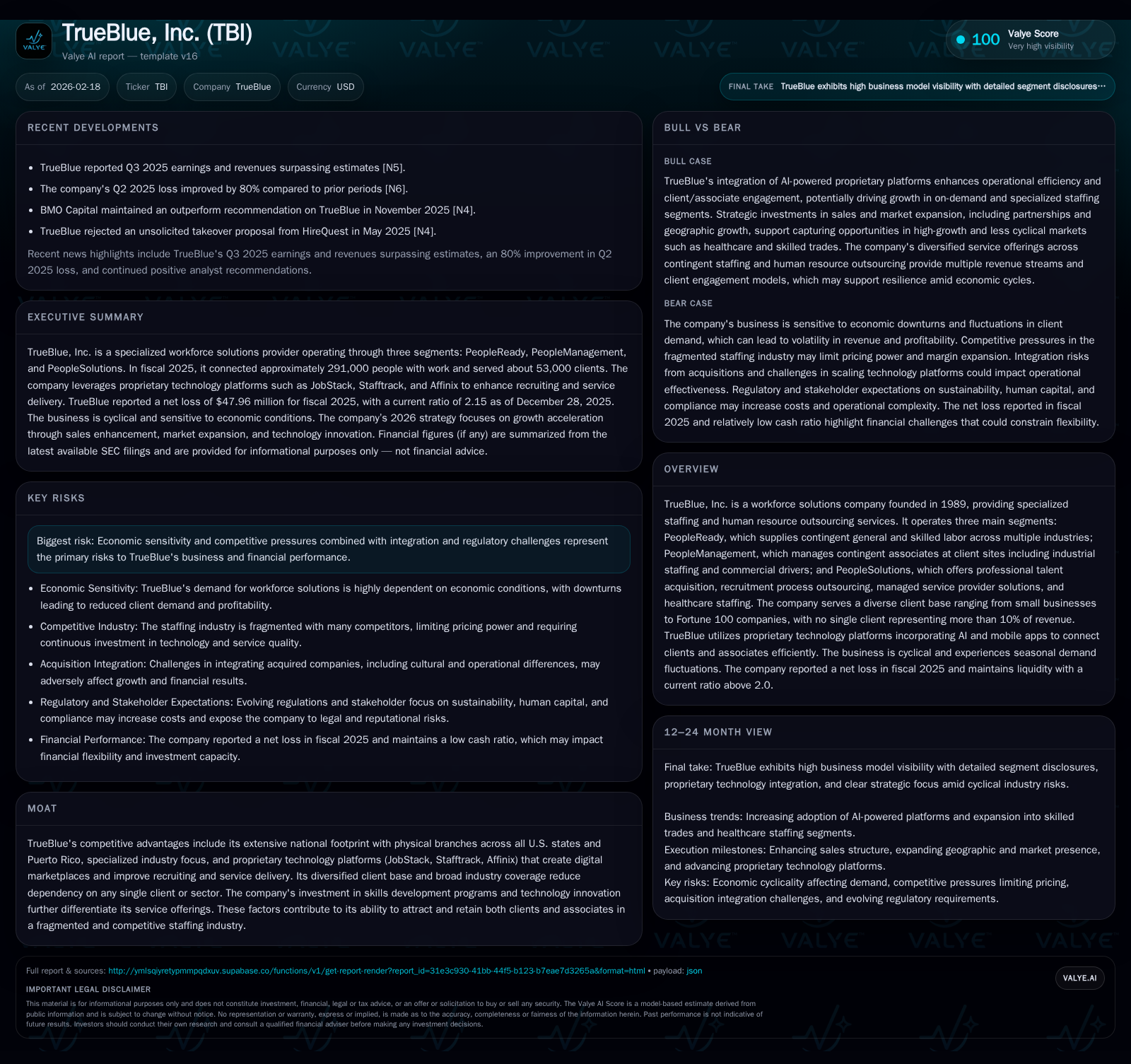
TrueBlue, Inc. has faced persistent operating losses from FY2022 through FY2025 despite revenue resilience supported by its broad national footprint and diversified client base. The company's three segments—PeopleReady, PeopleManagement, and PeopleSolutions—each contribute differently to overall performance, reflecting exposure to cyclical industries and contractual variability. Recent strategic initiatives prioritize restructuring the sales organization into territory-based models alongside continued investments in AI-enabled proprietary platforms such as JobStack, Stafftrack, and Affinix to enhance client acquisition and associate engagement. Nonetheless, macroeconomic risks, including labor shortages and supply chain issues, pose ongoing demand volatility. Capital allocation reflects a focus on balance sheet stabilization amid negative operating cash flow and suspended buybacks. Monitoring execution of growth initiatives and margin trends will be key milestones for fiscal 2026.
Financial Performance Evolution: Revenue, Profitability, and Cash Flow Trends
TrueBlue's financial history over the last four years underscores significant operational challenges compound by industry cyclicality. The company reported revenues holding steady at approximately $354 million in FY2025 [F1], reflecting the resilience of its national footprint and diversified sector exposure amid a volatile economic backdrop. However, operating income swung from a positive $72.2 million in FY2022 to consecutive losses thereafter: -$23.9 million (FY2023), deepening to -$92.8 million (FY2024), before improving notably to -$46.6 million (FY2025), a nearly 50% reduction in operating loss year over year [F1]. Net income trends mirror this trajectory with FY2025 net loss of $48 million representing a rebound from the $126 million loss in FY2024.
Operating cash flow deteriorated significantly from positive $120.5 million in FY2022 to negative $58 million in FY2025 [F1], reflecting working capital strain driven by payroll funding ahead of client receipts amid revenue volatility. Capital expenditures likewise retracted by roughly one-third over this period to $15.7 million in FY2025 as management curtailed discretionary spend.
Historical performance (annual)
| FY | Net ($mm) | CFO ($mm) | OpInc ($mm) | Capex ($mm) | Net YoY |
|---|---|---|---|---|---|
| 2025 | -48 | -58 | -47 | 16 | +61.9% |
| 2024 | -126 | -17 | -93 | 24 | -787.2% |
| 2023 | -14 | 35 | -24 | 31 | -122.8% |
| 2022 | 62 | 121 | 72 | 31 |
Note: Omitted columns lack sufficient annual XBRL coverage in the provided tags (need ≥2 annual points): Rev, Div. Source: SEC companyfacts cache [F1].
Capital returns and efficiency (annual)
| FY | Buybacks ($mm) | FCF ($mm) | ROE% |
|---|---|---|---|
| 2025 | 0 | -74 | -17.5 |
| 2024 | 21 | -41 | -39.9 |
| 2023 | 34 | 3 | -3.1 |
| 2022 | 61 | 90 | 12.5 |
Source: SEC companyfacts cache [F1].
Note: Exact revenue figures for FY2023-24 not disclosed separately; YoY revenue changes omitted where unavailable.
This financial evolution tells a story of TrueBlue navigating sharp downturns linked to industry volatility while initiating early signs of operational recovery.
Operational Drivers Behind Performance Shifts: Segment Contributions and Market Exposure
TrueBlue operates through three distinct segments that shape its revenue and margin profile: PeopleReady, PeopleManagement, and PeopleSolutions [S4][S7]. Each segment caters to different client needs across various industries with distinct risk-return profiles.
PeopleReady serves the largest volume of associates (~130K) delivering short-term contingent general and skilled labor primarily across construction, transportation, manufacturing, retail, hospitality, and energy sectors [S12]. This segment's transient workforce model faces seasonality peaks in Q3-Q4 aligning with outdoor construction work and holiday retail logistics [S18]. PeopleReady benefits from its nationwide branch network complemented by JobStack®, an AI-powered mobile app that digitizes the matching process between associates and employers improving fill rates amid cyclical demand fluctuations.
PeopleManagement focuses on managing contingent workforces at client sites through multi-year contracts serving ~38K people [S7]. Its Staff Management® and SIMOS® brands specialize in industrial staffing for manufacturing/warehousing requiring higher operational integration on productivity-pricing models that link compensation to output metrics [S10]. Commercial driver management under the Centerline brand adds additional complexity serving transportation sectors via flexible drivers or full outsourcing models [S7]. This division blends operational scale with customer-specific customization but wrestles with wage inflation pressures impacting margins.
PeopleSolutions is TrueBlue's professional talent acquisition arm providing RPO (recruitment process outsourcing), MSP (managed service provider), talent advisory services plus healthcare staffing through Healthcare Staffing Professionals (HSP). With approximately 123K connected workers globally including North America, UK, Australia [S12][S17], this segment delivers higher-value but longer-duration contracts spanning multiple markets including tech and professional services with pricing based on hire fees or consulting arrangements [S17]. Its proprietary Affinix® platform leverages AI-driven recruitment marketing enabling faster sourcing pipelines suited for complex hiring requirements.
Client concentration risk remains limited; no single client accounts for more than 10% of revenue while top ten clients represent about a quarter of revenues providing diversification [S4]. Industry exposure is broad but weighted toward cyclical sectors vulnerable to macroeconomic shifts — construction activity halts can quickly depress PeopleReady volumes; supply chain disruptions impact manufacturing staffing [S14][S16].
Strategic Growth Initiatives: Enhancements in Sales Organization and Technology Platforms
TrueBlue’s fiscal 2026 strategy accelerates growth ambitions focusing on expanding its sales capacity through a territory-aligned reorganization intended to increase geographic penetration particularly within underpenetrated markets [S6][S8]. This newly implemented model aims to improve cross-selling between business units enabling bundled workforce solutions tailored per client ecosystem.
Strategic partnerships such as collaborations with group purchasing organizations serve as channels unlocking broader enterprise account access facilitating new client acquisition momentum beyond traditional staffing buyers [S6]. Sales expansion emphasizes high-growth verticals like skilled trades—which include renewable energy deployment programs—and healthcare roles bolstered by recent acquisitions such as Healthcare Staffing Professionals completed earlier in calendar year 2025 [S8].
Technology innovation forms an indispensable element underpinning these efforts:
- JobStack® enables associates to find contingent work swiftly via an AI-enhanced digital marketplace that also integrates client job posting efficiencies enabling faster order fills while reducing recruiter workload; continual feature enhancements aim at improving user experience driving growth [S13].
- Stafftrack® powers PeopleManagement’s on-site workforce management providing near real-time analytics addressing fluctuating supply chain demands aiding clients’ operational excellence objectives; its mobile app engages associates with scheduling flexibility and rewards incentivization schemes increasing retention within contingent pools [S13].
- Affinix®, deployed mainly within PeopleSolutions’ RPO/MSP contexts optimizes candidate sourcing using predictive analytics combined with recruitment marketing automations reducing time-to-hire while delivering candidate experience improvements crucial for talent attraction in competitive labor markets [S17].
This triad of proprietary tools embodies sector-native digital marketplaces connecting contingent labor supply-demand dynamically—a significant competitive moat amid an otherwise fragmented staffing industry domain characterized by local/regional competitors lacking sophisticated technology investment [S29][S5].
Cyclical Risks and Sector Sensitivities: Economic Headwinds Impacting Demand
The staffing industry’s inherent cyclicality underpins TrueBlue’s operational risks as corporate hiring behaviors fluctuate markedly with macro conditions [S18][S14]. Periods of economic contraction trigger immediate reduction in contingent workforce utilization as companies reduce variable costs first by cutting temporary positions before freezing permanent hires.
Heightened interest rates have acted as growth headwinds constraining capital spending across construction and manufacturing—two prominent end-markets with outsized influence on PeopleReady volumes [S14][N3]. Additionally, ongoing supply chain disturbances continue to suppress manufacturing throughput prompting postponements or cancellations lowering associated labor needs [S16]. Similarly, inflationary pressures drive wage cost increases often outpacing ability to realize immediate billing rate hikes creating margin compression.
Governmental funding volatility further complicates demand forecasting especially within segments dependent on public-sector projects or healthcare staffing reimbursed partly through regulated budgets which may contract or delay payment cycles affecting cash flow timing [S14][S15].
Despite these risks TrueBlue deploys robust risk management focused on compliance oversight amidst regulatory complexities spanning multiple jurisdictions ensuring contractual safeguards pass incremental costs fully onto clients mitigating profit erosions where feasible [S15][S9]. However, economic softness remains primary risk factor dampening near-term growth prospects making monitoring demand signals paramount.
Capital Allocation Patterns: Balance Sheet Health, Repurchases, and Cash Flow Management
Financial discipline accompanying TrueBlue’s turnaround endeavor manifests visibly through conservative capital allocation practices amid challenging earnings performance.
The company’s balance sheet exhibits solid liquidity positioning evidenced by a current ratio north of 2x at fiscal year-end 2025 ($298M current assets vs $139M current liabilities) furnishing ample working capital buffer despite negative operating cash flows totaling nearly -$58 million that year [F1][S11][S19]. Coupled with reduced capital expenditures down more than one-third relative to peak years underscores management’s prioritization of cash preservation during earnings recovery phase rather than aggressive expansion investment.
Share repurchases have been suspended completely after completing modest buyback programs averaging roughly $21 million annually across the prior two years but halting entirely in FY2025 contrasted against even larger expenditures above $60 million in FY2022 indicating shift toward financial prudence amid losses [F1][S22][S26][S28]. Dividend information is not disclosed suggesting absence or minimal payout policy consistent with capital conservation objectives.
Return on equity registered approximately negative 17.5% reflective of persistently negative net income relative to shareholders’ equity base around $275 million at year-end FY2025 highlighting profitability challenges still unresolved though improved from deeper losses previously recorded [F1]. These markers portray cautious stewardship intent on deleveraging operating inefficiencies while rebuilding foundation for sustainable free cash flow generation going forward.
Competitive Positioning: Differentiating Through Innovation and Industry Focus
TrueBlue sets itself apart principally through its expansive nationwide physical presence spanning all U.S states plus Puerto Rico securing unmatched local market insights seldom matched by online-only or regional competitors across workforce solutions spectrum [S4][S29]. This core logistical advantage supports rapid service delivery essential within labor-intensive industries reliant on timely fill rates.
Complementing physical reach are differentiated proprietary technology suites—the JobStack mobile app stands out as an AI-enabled digital marketplace connecting associates with jobs seamlessly offering clients transparency into bill rates plus streamlined job postings forming a unique two-sided platform rarely replicated at scale among peers [S13][S29]. Stafftrack permits granular real-time workforce deployment analytics facilitating productivity-based pricing models preferred among industrial customers seeking cost certainty aligned with output enhancements encompassing warehousing throughput optimization critical for seasonal surges.[S10]
Affinix brings further upscale capabilities addressing professional recruiting challenges where candidate scarcity requires refined sourcing techniques enhanced by AI-driven predictive analytics elevating placement efficiency within competitive categories like healthcare professionals via HSP brand offering multi-tiered temporary/permanent staffing options integrating employer branding elevating recruitment success probabilities substantially compared to legacy RPO processes relying heavily on manual interventions.[S17]
This tri-segment synergistic model leverages specialized domain expertise blending scalable low-touch contingent work enabled digitally alongside bespoke integrated managed services catering diverse client sophistication levels reinforcing TrueBlue’s defensible market position within an inherently fragmented competitive landscape lacking dominant incumbents.[S5]
Outlook and Key Milestones to Monitor in Fiscal 2026
While explicit quantitative guidance remains undisclosed publicly as of early fiscal 2026 release dates management commentary relays intent to continue building growth momentum through mature execution of stepped-up sales function investments alongside ongoing technical platform enhancements aimed at shortening time-to-fill metrics thereby enhancing gross margins incrementally over coming quarters [N3][S3][S6].
Investors should focus closely on quarterly reporting updates that reflect:
- Sales expansion effectiveness measured by new client wins particularly within targeted upward markets such as renewable energy skilled trades plus healthcare placements,
- Adoption curves reflecting increased usage rates of JobStack for Business users indicating penetration beyond existing nostalgic branch-dependent channels,
- Margin trajectory evidenced by incremental operating profit improvements signaling progression toward break-even status,
- Macro indicators impacting demand such as volume trends reported across construction/logistics sectors,
- Any meaningful shifts in wage-related cost pass-through efficacy preserving pricing power under inflationary pressures.
Risks remain elevated due to potential economic softening which could stall backlog replenishment or intensify competition from regional providers or online staffing marketplaces eroding pricing dynamics unexpectedly making conservative financial stewardship advisable throughout transition phase heading into late fiscal calendar periods.[N3]
Disclaimer: This analysis is based solely on publicly available information including SEC filings dated through February 18, 2026, company-provided data sets and relevant news reports cited herein. It does not constitute investment advice or recommendations but aims solely to provide detailed company- and sector-specific insights.
Disclaimer: This is research-only, informational analysis and not investment advice. It may include AI-generated interpretation and general industry context. Always verify important details using primary sources.

Comments