
SoFi Technologies' Balancing Act Between Digital Expansion and Regulatory Compliance Costs
SoFi’s integrated fintech platform fuels growth but regulatory and capital challenges temper margins and cash flow.
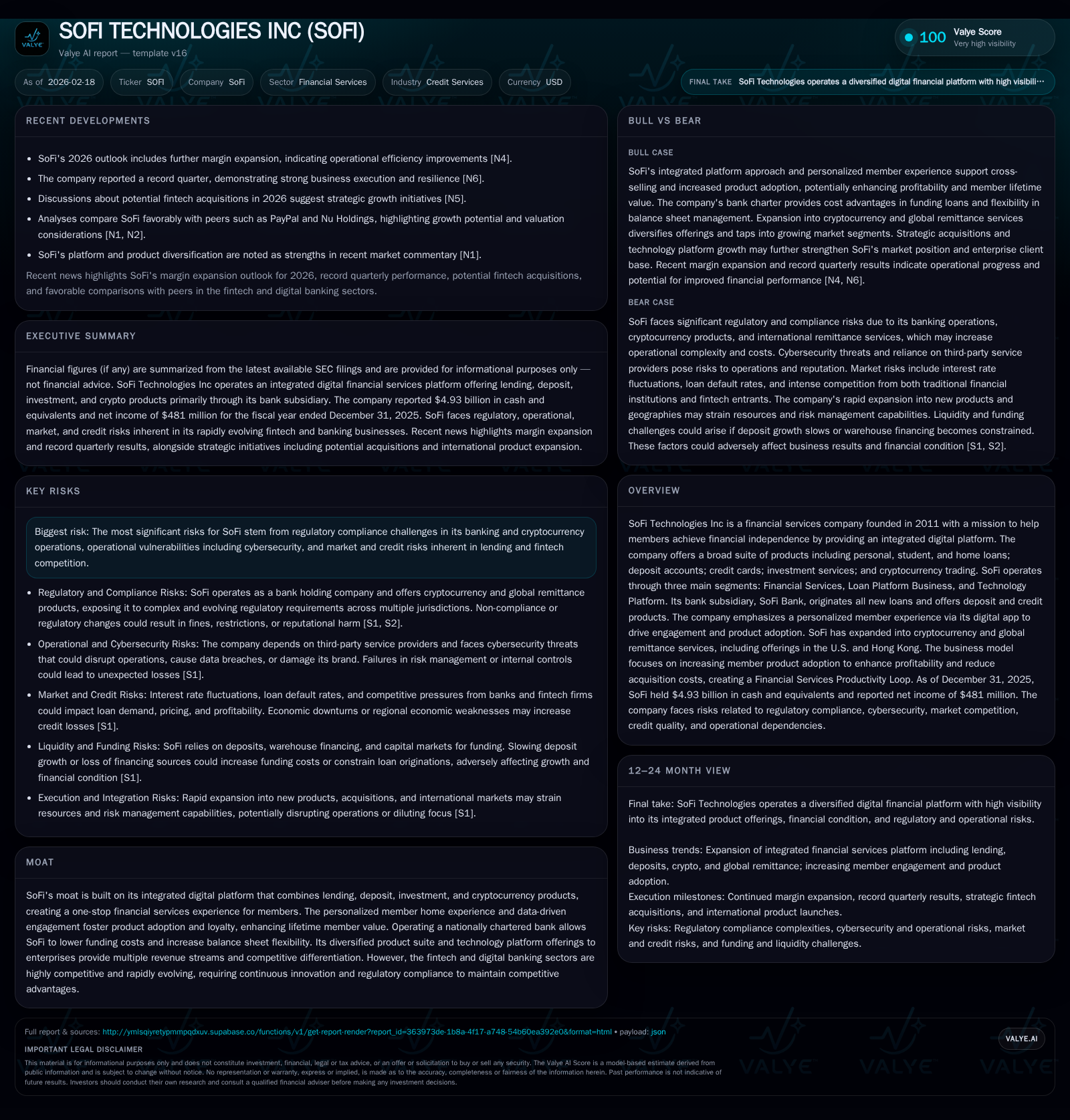
Since its founding in 2011, SoFi Technologies has transformed into a multi-product digital financial services platform offering loans, deposits, investments, and crypto trading. The company’s growth has accelerated notably in recent years driven by increased member product adoption and its bank charter, which lowers funding costs. However, despite achieving profitability by 2024–2025, SoFi faces significant regulatory risk and negative operating cash flow pressures that challenge sustainable margin expansion. Capital needs and ongoing technology investments remain material as SoFi strengthens its market position amid intense fintech competition.
Company Overview and Historical Growth
SoFi Technologies Inc was founded in 2011 with the mission to enable financial independence for its members by delivering an integrated fintech experience. Initially focused on student loan refinancing, SoFi has evolved into a broad digital financial ecosystem including personal loans, student loans, home loans via recent mortgage-related services acquisition, deposit accounts through its nationally chartered SoFi Bank subsidiary, brokerage and investment accounts (including robo-advisory), credit cards, cryptocurrency trading, and enterprise technology platforms [S8][S9].
This transformation significantly expanded the addressable market while intensifying competitive pressure requiring continuous innovation. SoFi's business model centers on a "financial services productivity loop" where deepening member relationships drive new product adoption at lower acquisition costs.
Recent financial performance illustrates this shift. The company reported net losses exceeding $300 million annually through fiscal years 2022-2023 but turned profitable in both 2024 ($499 million net income) and 2025 ($481 million), demonstrating rapid operational leverage gains alongside growing scale [F1]:
Historical performance (annual)
| FY | Net ($mm) | CFO ($bn) | Capex ($mm) | Net YoY |
|---|---|---|---|---|
| 2025 | 481 | -3.7 | 242 | -3.5% |
| 2024 | 499 | -1.1 | 154 | +265.8% |
| 2023 | -301 | -7.2 | 111 | +6.1% |
| 2022 | -320 | -7.3 | 93 |
Note: Omitted columns lack sufficient annual XBRL coverage in the provided tags (need ≥2 annual points): Rev, OpInc, Div. Source: SEC companyfacts cache [F1].
Capital returns and efficiency (annual)
| FY | Buybacks | FCF ($bn) | ROE% |
|---|---|---|---|
| 2025 | -4.0 | 4.6 | |
| 2024 | -1.3 | 7.6 | |
| 2023 | 0 | -7.3 | -5.7 |
| 2022 | 0 | -7.3 | -6.2 |
Source: SEC companyfacts cache [F1].
Revenue data is not available from the provided tags; however, earnings improvements stem from product cross-sell and improved funding costs following the bank charter acquisition.
Operating cash flows highlight ongoing investment needs. Operating cash flows were deeply negative across recent years: -$7.26 billion in 2022 improving slightly to -$7.23 billion in 2023 before improving to -$1.12 billion in 2024 but rising again to -$3.74 billion in 2025. These outflows largely reflect customer acquisition costs and loan originations funded by borrowings prior to full deposit inflows ramping [F1]. Capital expenditures rose significantly from approximately $154 million in 2024 to $242 million in 2025 as SoFi invests heavily into its digital infrastructure—including proprietary underwriting technologies enhancing internal loan origination processing versus previous outsourcing [F1][S22].
Equity capital increased substantially to $10.49 billion at end-2025 compared with $6.53 billion the prior year; this cushion supports ambitious growth plans but moderates near-term returns given historical losses prior to profitability emergence [F1]. Approximate return on equity using latest net income over equity stands modestly at about 4.6%, indicating margin compression typical of rapid fintech build-outs transitioning business models [F1].
No dividends have been declared recently nor has management engaged materially in share repurchases aside from minor activity before FY21—highlighting a preference for reinvestment over shareholder returns currently [F1].
Business Segments & Competitive Positioning
SoFi reports three primary segments: Financial Services (lending & deposit products), Loan Platform Business (loan origination facilitation with third parties), and Technology Platform (enterprise SaaS offerings). The bank subsidiary originates all new loans funded partially by low-cost deposits enabling better margins versus wholesale funding channels such as securitizations and warehouse facilities used historically [S8][S12].
The company markets itself as a "one-stop shop" designed around an integrated digital native membership experience—known as the "member home"—which personalizes daily user interactions with prioritized financial tasks using behavioral data insights. This approach generates higher engagement rates per user than traditional banking apps [S9], fostering superior cross-sell ratios across loan products, investing products (including cryptocurrencies), credit cards, and savings vehicles.
Integration of cryptocurrency functionality within the ecosystem is a notable differentiator capturing younger demographics but introduces regulatory complexities due to evolving laws covering custody, trading activities, anti-money laundering frameworks, and consumer protection enforcement actions [S2][S4][S10][S14][N10].
In addition to consumer members generating primary revenues via interest spreads on loans and fee income from deposit/investment accounts, SoFi also earns revenue through its technology platform licensing clients including third-party fintechs seeking white-label or API-driven product capabilities leveraging SoFi's development efforts—a B2B aspect diversifying revenue streams but dependent on strong operational reliability given fintech partnership SLAs [S8].
Regulatory Environment & Risks
Federal and state regulations are among the most significant constraints affecting SoFi’s operating model. As a bank holding company with a national charter bank subsidiary plus broker-dealer registrations involved in investment advisory and securities clearing activities under SEC/FINRA oversight, the company must comply with extensive rules governing fair lending (e.g., FHA/ECOA), anti-money laundering (AML), consumer protection laws enforced by CFPB among others, as well as varied state-level licenses for lending operations [S4][S6][S10][S17][S25].
Crypto-related offerings magnify compliance complexity because jurisdictions impose different licensing requirements covering custody or trading activities requiring costly monitoring regimes risking fines or forced limitation of services if regulatory expectations evolve adversely [S2][N10][N3]. Frequent regulatory inquiries impose substantial operational resource burdens evident from FINRA findings relating to securities lending supervision as recently as late 2023 [S14].
Discrimination risk arises since automated underwriting tools might inadvertently produce disparate impacts triggering regulatory scrutiny or lawsuits under fair lending laws despite absence of intent; this exposes SoFi potentially to material damages or penalties alongside reputational harm if not carefully mitigated through model validation efforts described extensively in filings [S4][S15].
Legal settlements related to prior unlawful lending practices highlight persistent vigilance requirements; while immaterial individually such matters cumulatively increase legal overheads reallocating capital away from product innovation or marketing expansions driving organic growth [S5]. Compliance failures could result not only in fines but loss of licenses restricting key revenue channels like student loan refinancing or mortgage origination businesses crucial for diversification strategies post-Wyndham acquisition [S16][N4].
Congressional attention on junk fees across banking products raises risks of policy-driven pricing compression impacting profitability as well [S17][N11].
Capital Structure & Liquidity Considerations
Operating cash flows remain strongly negative reflecting continuing growth mode where new lending volume outpaces financing inflows until deposits catch up given banking charter advantages taking several quarters or more to fully normalize funding cost benefits [F1][S11][S20][S21].
Debt financing largely comes through securitizations and warehouse lines wherein certain borrower credit characteristics limit eligibility requiring prudent portfolio management lest liquidity constraints impair origination capabilities or require holding lower-yielding assets on balance sheet harming returns further.[S23]
Equity injections during recent years have increased equity from approximately $5.2 billion level at end-2022 up to $10.5 billion by close of 2025 providing resilience against restrictive covenant breaches or potential spikes in delinquency due to macroeconomic shocks.[F1]
Future capital raises may be required depending on growth execution speed plus regulatory capital adequacy tests affecting banks’ dividend capacity or share repurchase plans although none currently indicated.[N3] Management emphasizes margin expansion through scale efficiencies aiming for sustainable profitability improvement but remains cautious about cost discipline amid increasing compliance expenditures.[N3]
No dividends or buybacks occurred recently confirming all excess cash reinvested into business initiatives consistent with typical fintech growth stage companies prioritizing market share gains over shareholder payouts.[F1]
Future Growth Prospects & Outlook
SoFi’s future prospects hinge upon successfully growing member counts while increasing average products per member leveraging proprietary app engagement tools driving cross-sell ratios upward.[N3] Expansion opportunities reside especially in home mortgage vertical fueled by recent acquisition plus continued iteration on crypto offerings tapping emerging digital asset client segments.[N10]
Maintaining low-cost deposit funding via SoFi Bank is critical for sustaining attractive net interest margins creating a pathway toward durable profit generation amidst intense competition from both incumbents expanding digital capabilities as well as challenger fintechs like Nu Holdings or PayPal targeting overlapping customer bases[N2][N8][N9]. The technology platform segment additionally presents upside diversification potential if enterprise customers increase adoption of embedded finance solutions reducing reliance on volatile retail lending revenue streams[S8].[N6]
Key risks balancing these prospects involve navigating unpredictable regulatory developments especially given shifting political priorities over cryptocurrency regulation,[N13] managing credit risk under varying macroeconomic conditions affecting borrower creditworthiness,[S29] avoiding operational failures particularly related to critical loan servicing or payment processing technology that could compromise brand trust,[S22] plus preserving sufficient liquidity sources amid capital markets volatility potentially impacting fundraising conditions.[S11]
Analytically important milestones going forward include quarterly displays of improving operating cash flow trends signaling better funding cost absorption,[N3] incremental gains in non-loan revenue mix highlighting progress toward platform diversification,[N4],[N13] plus transparent commentary around any material shifts in regulatory exposure or remedial actions taken following audits.[N11]
Summary Table: Selected Financial Metrics (Annual)
| FY | Net Income ($M) | Operating Cash Flow ($B) | Capex ($M) | Equity ($B) | Net Income YoY % | CFO YoY % | Capex YoY % |
|---|---|---|---|---|---|---|---|
| 2022 | -320 | -7.26 | 93 | 5.21 | N/A | N/A | N/A |
| 2023 | -301 | -7.23 | 111 | 5.23 | +6.0% | -0.38% | +19% |
| 2024 | +499 | -1.12 | 154 | 6.53 | NMF | +84% | +39% |
| 2025* | +481 | -3.74 | 242 | 10.49 | -3.5% | -234% | +57% |
| *Latest full year results based on fiscal year ended December. |
- Revenue data not available from provided XBRL tags.
- Dividends paid data not available from provided tags.
- Recent share repurchases minimal except small amount pre-FY21.
- Approximate ROE based on latest annual net income over equity ~4.6%.
- Free cash flow remains negative (~-$3.98 billion) given large operating outflows exceeding capex investments.
Conclusion
SoFi Technologies exemplifies a modern fintech hybrid balancing rapid multi-product expansion with cost realities imposed by heavy regulation—intensified after acquiring a national banking charter coupled with entry into cryptocurrency domains. Its progression into sustained profitability indicates operational scale advantages activated through enhanced member engagement automation fostering product layering within an integrated app platform. Nevertheless,the simultaneous challenge remains profound operating cash outflows amid substantial investment allocations highlighting that free cash flow breakeven is yet distant depending on broader sector credit conditions plus market volatility impact on funding mechanisms.The company must navigate acute risks around regulatory enforcement especially linked to consumer protections,fair lending rules,and digital asset compliance which translates into elevated ongoing administrative overheads.Rather than investor returns today,the priority clearly tilts toward reinvesting capital into technology,membership scale,and risk management frameworks needed for durable competitive differentiation within fiercely contested US fintech markets.Investors should watch how effectively margins stabilize alongside improved liquidity profiles plus any external shocks related to compliance developments that could disrupt momentum.Sustainable long term value creation derives fundamentally from merging tech-led member intimacy with robust risk governance across complex financial ecosystems.SoFi represents an insightful case study within evolving credit services where agility confronts structural complexity.
Disclaimer: This report is prepared solely for informational purposes without any recommendation or solicitation regarding securities transactions. It reflects public data interpretation without guaranteeing accuracy or predicting future outcomes.
Disclaimer: This is research-only, informational analysis and not investment advice. It may include AI-generated interpretation and general industry context. Always verify important details using primary sources.

Comments