
Norris Industries Battles Tight Liquidity and Modest Production Gains in Texas E&P Portfolio
Q1 2026 operations reflect selective well work-overs and production scaling tied to spot pricing amid constrained liquidity.
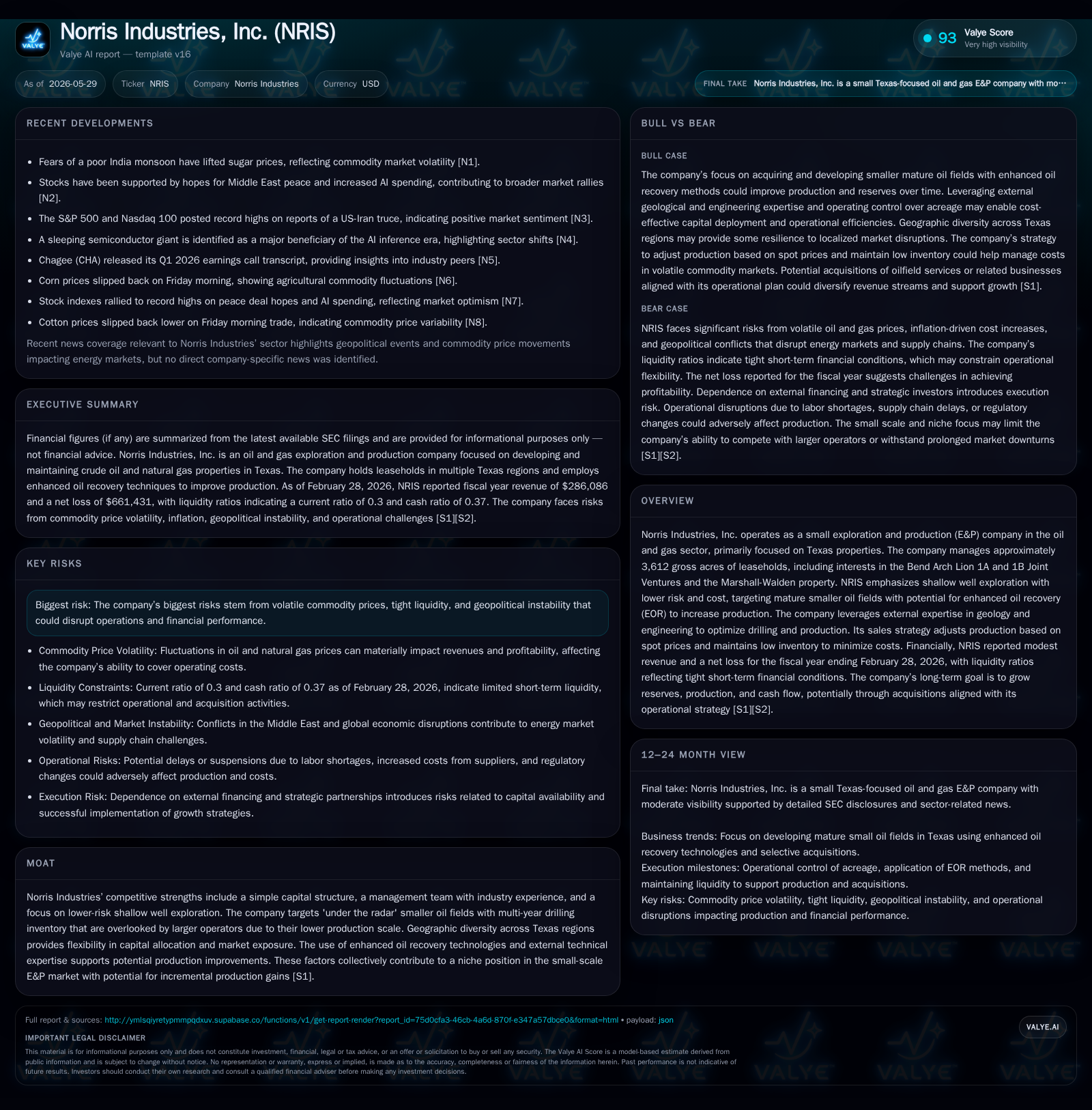
Norris Industries continues its disciplined, low-risk approach focusing on shallow wells in modestly sized Texas oil fields. The company’s latest quarter shows measured production adjustment aligned with volatile commodity prices, managing inventory near zero to minimize costs. Despite operational focus and incremental gains via enhanced oil recovery, tight liquidity—with a current ratio of approximately 0.3—and ongoing net losses constrain flexibility. Strategic growth hinges on capital access to acquire underexplored leaseholds and implement enhanced recovery technologies in ‘under the radar’ properties.
Latest Operating Update: Strategic Work-Overs and Production Flexibility
Norris Industries’ Q1 2026 (period ended February 28) operating report underscores a tactical phase focused on well work-overs within its existing Texas leases [S2]. This activity signals an emphasis on improving production efficiencies over aggressive new drilling. The Company explicitly aligns production levels with spot prices—scaling back output when prices are depressed and increasing when favorable—to maintain cash flow discipline [S1]. Inventory management follows a lean approach, keeping crude stock on hand minimal or nearly zero to avoid storage and associated holding costs [S1]. This approach reduces fixed costs but also caps immediate ramp-up potential should demand spike.
The strategy is adapted amid ongoing macro uncertainties including lingering pandemic effects, Middle East geopolitical tensions (Israel-Hamas conflict and Iran responses), and inflationary pressures impacting operating costs [S1][S4]. Such factors affect both sales realized per barrel and input prices for materials and services necessary for operations.
Business Model: Niche Focus on Underexplored Small-Scale Texas Fields
Established in 2014 with headquarters in Weatherford, Texas, NRIS specializes in small-scale exploration & production (E&P), concentrating on mature oil and gas properties in Central West Texas regions like the Bend Arch-Fort Worth Basin [S5][S10]. The company holds approximately 3,612 gross acres across multiple leaseholds including the Bend Arch Lion 1A/1B Joint Ventures and the Marshall-Walden property [S5]. Most of these assets comprise smaller fields traditionally unattractive to majors requiring high-output wells (typically >300 bopd) for economic viability [S7].
The business targets shallower wells (<5,000 feet depth), which reduces drilling risk and expense per well compared to deep resource plays favored by larger competitors [S13]. Emphasis on applying Enhanced Oil Recovery (EOR) techniques aims to extract additional hydrocarbon volumes from existing reservoirs, supplementing organic growth through incremental production improvements rather than volume scale alone [S6][S13]. Technical expertise is supplemented by external petroleum geologists and engineers who contribute specialized knowledge in reservoir evaluation, well completion optimization, and fracture stimulation analytics [S19].
Strategic acquisitions focus on mature properties with low baseline production but potential improvement through redevelopment and operational efficiencies—a model paralleling many successful small-cap independents that exploit overlooked acreage with multi-year drilling inventories not easily accessible at public auctions [S7][S13]
Competitive Positioning within the Small Producer Segment
Within the small independent producer ecosystem, Norris Industries establishes a niche through simple corporate structure and geographic diversification across several Texan basins [S16][S7]. Control over leaseholds permits operational flexibility adjusting capital deployment based on results or market conditions without binding contractual drilling obligations typical within larger resource plays. This nimbleness is critical given the company’s relatively modest financial bandwidth.
Technology adoption—including use of 3D seismic data, satellite hydrocarbon imaging, and multi-disciplinary consultant collaboration—enhances exploratory accuracy beyond what might be expected at this scale; however, NRIS still trails larger peers with greater integrated resources. Its competitive moat consists mainly of “under the radar” asset targeting—leases with sub-300 bopd wells that carry latent reserve potential—but no major competitor scale or premium distribution channels ().
Growth Drivers: Enhanced Oil Recovery and Selective Acquisition Execution
The company’s tactical path forward involves applying cutting-edge EOR techniques to its existing portfolio and potential acquisitions that fit its low-risk profile [S6][S13]. Advances in reservoir stimulation technology combined with data-driven well planning may improve initial production rates and ultimate recovery factors.
Selective acquisition remains a cornerstone strategy contingent on aligning acquisitions with disciplined capital deployment. The ability to secure financing—whether through equity markets or debt facilities—is critical here; without adequate funding sources, growth initiatives stall [S6][S22]. The involvement of majority owner Patrick Norris via JBB Partners provides some credit line access but does not eliminate intrinsic funding risk given no formal obligation exists for continued support [S22].
Incremental reserve additions from reacquired working interests or mineral rights expansions could boost mid-term cash flow if executed efficiently [S6][S10]. Moreover, divesting non-core or higher-cost producing assets sharpens focus on higher-margin core holdings enhancing return metrics over time
Risk Factors: Commodity Volatility, Financial Constraints, Geopolitical Instability
Primary risks weigh heavily on commodity price fluctuations given their outsized impact on revenue generation for a small producer reliant on spot sales dynamics [S1]. Despite recent commodity price rallies driven by supply disruptions (Iran conflict escalating Middle East tensions), volatility remains extreme which compresses margin predictability.
Underlying financial fragility is apparent in the Company’s liquidity position: a current ratio near 0.3 (current assets approx $69K vs liabilities $228K as of Q1 end) reflects significant short-term solvency pressure [F1]. Net losses totaling around $661K for fiscal year ending February 2026 further stress operational sustainability absent additional capital infusion [F1][S22]. Dependency on principal shareholder funding—without any binding commitment—poses material execution risk if external financing cannot be secured timely.
Additional challenges include sector-wide inflation driving up operating costs—especially labor, equipment rentals and fuel—and regulatory compliance costs typical for public energy companies subject to SEC reporting demands [S23]. Disruptions from local subcontractors or supply chain bottlenecks related to geopolitical unrest also present operational headwinds [S4][S22]. Lastly, the company lacks insurance coverage against certain liabilities that could impair reserve capital if realized [S21].
Outlook and Key Milestones Ahead
Management articulates priorities around refining portfolio quality by shedding non-core high-cost assets while investing selectively where EOR can create tangible lift [S6][S10]. Maintaining access to credit lines—including the $1 million facility with JBB Partners—is vital for seizing acquisition opportunities when available [S22].
Upcoming milestones worth watching include drilling outcomes of projects applying EOR technologies—with success potentially measurable via improved initial production rates or reserve booking increases—as well as any executed acquisitions expanding leasehold control.
Regulatory interaction remains an important consideration as evolving reporting standards may increase overhead yet also enhance transparency—a double-edged sword affecting investor perception of governance maturity [S23].
Financial Health Snapshot: Navigating Tight Liquidity
Latest financial disclosures detail a quarterly revenue run-rate slightly above $286K juxtaposed against an operating loss of over $544K resulting in net income negative $661K at quarter end [F1][S2]. The balance sheet shows current assets of approximately $69K against current liabilities of $228K, yielding a current ratio near 0.3, indicating tight short-term liquidity [F1].
Cash & equivalents were around $84.5K as per last available data but do not suffice alone to cover near-term obligations absent revenue acceleration or expense reduction programs [F1]. Total debt figures are dated but imply leverage remains substantial relative to cash on hand; continued dependence on shareholder funding lines raises concerns about sustainable capitalization levels going forward [F1][S22].
This financial backdrop highlights execution risk related to funding growth plans versus sustaining current operations amid industry cost pressures.
Disclaimer: This analysis is based solely on disclosed SEC filings up to Q1 2026 and does not constitute investment advice or research views. Financial metrics are drawn directly from reported data without speculative extrapolation.
Disclaimer: This is research-only, informational analysis and not investment advice. It may include AI-generated interpretation and general industry context. Always verify important details using primary sources.

Comments