
North European Oil Royalty Trust's Stable Cash Flows and Legacy Concession Insights
A review of NRT’s royalty income performance anchored in a longstanding German concession operated by multinational energy firms.
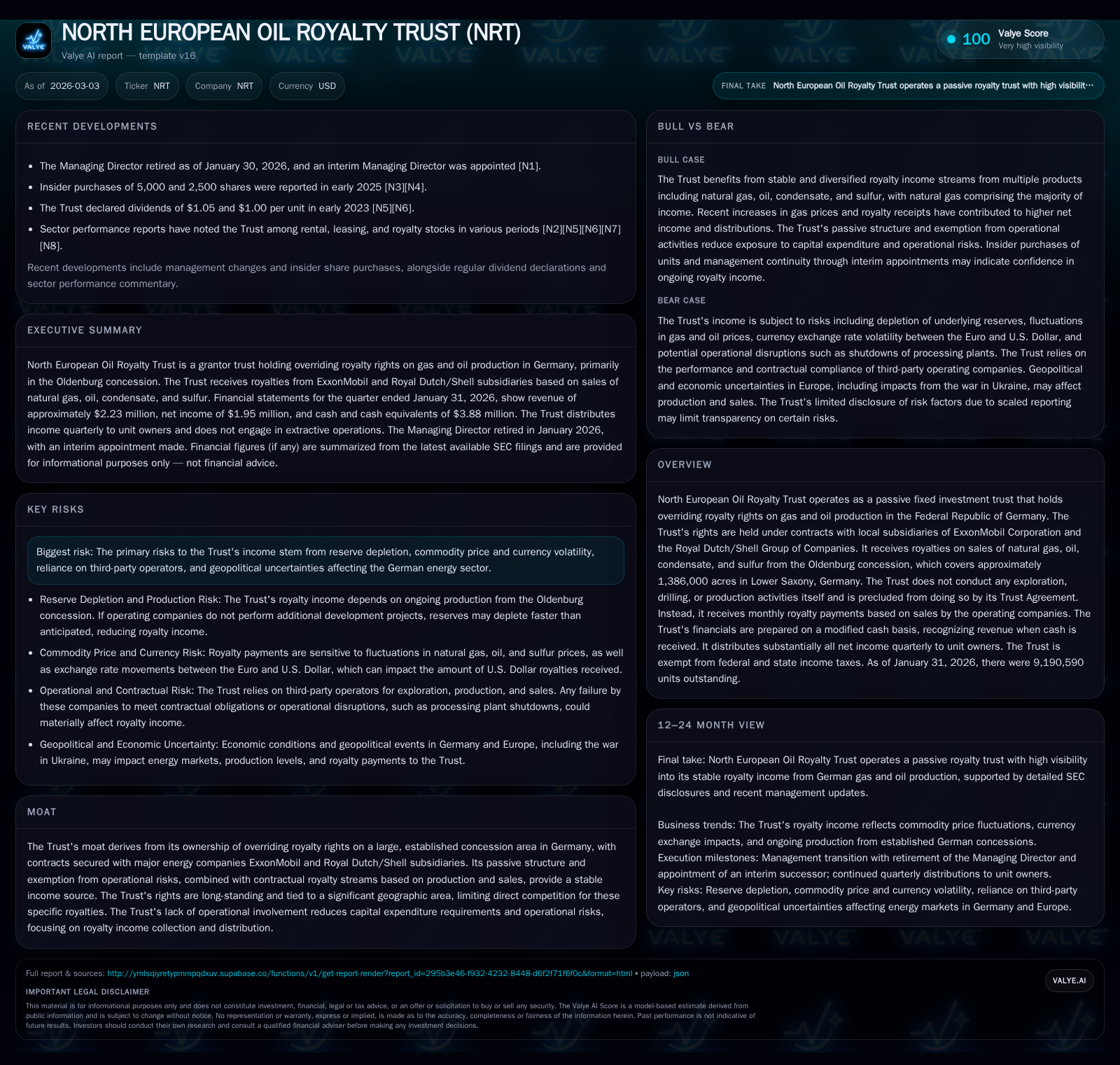
North European Oil Royalty Trust (NRT) operates as a passive holder of overriding royalty rights on oil and gas production within Germany's Oldenburg concession. Its financials reflect stable royalty inflows driven predominantly by natural gas sales with limited operational risk, as it relies on ExxonMobil and Royal Dutch Shell subsidiaries to operate the fields. The Trust distributes nearly all net income quarterly to unit holders and maintains a strong liquidity position with no debt. Future cash flow is subject to reserve depletion risks and commodity price and currency fluctuations tied to the Euro-Dollar exchange.
Historical Financial Performance and Revenue Drivers
North European Oil Royalty Trust (NRT) is a passive grantor trust holding overriding royalty interests on gas, oil, condensate, and sulfur sales from the Oldenburg concession in Lower Saxony, Germany. Its revenues come almost exclusively from monthly royalty payments based on sales reported by local German subsidiaries of ExxonMobil Corporation and Royal Dutch/Shell Group [S7].
Natural gas constitutes approximately 93% of cumulative royalties received in fiscal 2025 [S7]. The gas comprises 'sweet' gas requiring minimal treatment and 'sour' gas processed at a desulfurization plant before sale [S20].
Financial statements reveal year-over-year increases in royalties collected. For the nine months ended July 31, 2025, royalties were about $5.59 million versus $5.12 million for the same period in 2024 [S6]. Operating expenses remain low relative to revenues; Q3 fiscal 2025 expenses were approximately $180K compared to $164K year-over-year [S6]. Net income rose consistently with revenue growth.
Historical performance (annual)
| FY |
|---|
| 2026 |
Source: SEC companyfacts cache [F1].
Note: Distributions per unit approximate quarterly payout figures.
Operational Structure and Royalty Rights Framework
NRT functions solely as an investor holding overriding royalty interests with no involvement in exploration or production activities; its Trust Agreement prohibits such operations [S7]. This eliminates capital expenditure requirements for the Trust.
The royalty rights derive from contracts with Mobil Erdgas-Erdol GmbH (ExxonMobil's German subsidiary), Oldenburgische Erdolgesellschaft (OEG)—owned two-thirds by ExxonMobil and one-third by Royal Dutch/Shell—and BEB Erdgas und Erdol GmbH which administers the OEG concession [S7,S21]. The Trust receives fixed percentage royalties based on gross proceeds less specified deductions under defined agreements [S7,S21].
Since 2002, ExxonMobil Production Deutschland GmbH (EMPG) consolidates exploration and production activities within the concession while sales remain handled by Mobil Erdgas or BEB [S7,S20]. Monthly royalty payments are based on reported sales volumes subject to biannual reconciliations ensuring alignment with actual field data.
Commodity Pricing and Currency Effects
Natural gas accounts for about 93% of NRT’s royalty income as of fiscal year-end [S7]. Pricing bases were amended in 2016 to align royalty calculations with the German Border Import Gas Price (GBIP), increased by fixed percentages (1% for Mobil contracts; 3% for OEG agreements), removing prior deductions related to transportation/storage costs [S21]. This aims to reduce disputes and enhance pricing transparency.
Two main types of natural gas affect net royalties indirectly via processing costs: sweet gas sold after minor treatment versus sour gas processed at Grossenkneten where contaminants are removed converting hydrogen sulfide into solid sulfur sold separately [S20]. Sulfur royalties contribute marginally compared to primary fuels.
Royalties are paid in Euros but reported in U.S. Dollars,[F1][S7] so EUR/USD exchange rate fluctuations directly impact distributable USD amounts upon conversion at receipt.
Growth Outlook Within the Oldenburg Concession
Covering approximately 1.386 million acres largely encompassing former Grand Duchy territories within Lower Saxony,[S7] this long-established concession benefits from infrastructure managed via ExxonMobil-Shell joint ventures [S7,S14,S17]. However, NRT has no control over development or drilling plans.
EMPG has not drilled new wells since at least 2014 nor scheduled upcoming drilling activity,[S20] implying future growth depends on enhanced recovery initiatives or extensions driven by market conditions rather than new reserves directly controlled by NRT.
Reserve depletion remains an inherent limitation; without additional development projects by operators production decline could accelerate impacting future royalties negatively [S14,S17].
Risks: Reserve Depletion & Market Dynamics
Key risks include declining reserves reducing production volumes feeding royalty calculations,[S14,S17] compounded by natural gas price volatility despite GBIP indexation.
Currency risk arises from Euro-denominated receipts converting into fluctuating USD amounts affecting net income consistency.[S7]
Operational risks stem from reliance on third-party operators meeting contractual obligations without direct Trust control.[S14]
Geopolitical uncertainties such as European energy policy shifts toward cleaner energy sources may influence production profiles or taxation regimes affecting hydrocarbon extraction in Germany.[S14,S17]
Capital Allocation: Distribution Policy & Returns
The Trust distributes substantially all net income quarterly to unit holders as mandated by its agreement.[S8] There are no share repurchases or reinvestment activities.
Net income per unit has shown steady growth aligned with rising royalties,[F1][S6] supporting consistent distribution increases.
Return metrics focus on cash flow yields derived from distributions given the trust structure.[S8]
Liquidity & Capital Structure Stability
As of January 31, 2026 cash and equivalents totaled approximately $3.88 million with no debt reported,[F1][S4,S9] reflecting strong liquidity relative to operating expenses mainly comprising Trustee fees and administrative costs.
The Trust corpus remains nominally valued given amortized book values hold negligible relation to proven reserves; distributions are funded entirely through ongoing cash collections rather than asset appreciation [S15,S26,S29].
Key Metrics for Future Monitoring
Analysts should monitor:
- Operator-reported sales volumes indicating physical production trends,
- Movements in GBIP underpinning royalty rate calculations,
- Euro-to-US Dollar exchange rate fluctuations affecting distributable USD amounts,
- Any announced drilling or development initiatives signaling reserve replenishment prospects,
- Regulatory developments impacting fossil fuel activities within Germany,
- Year-end reconciliation adjustments affecting prior period royalty payments.
These factors collectively shape sustainability prospects for NRT’s historically stable yet finite asset-backed income stream.
Disclaimer: This analysis is based solely on publicly available information from cited sources without investment recommendations or forecasts beyond documented company disclosures.
Disclaimer: This is research-only, informational analysis and not investment advice. It may include AI-generated interpretation and general industry context. Always verify important details using primary sources.

Comments