
L.B. Foster's Modest Earnings Growth Contrasts with Rising Capital Returns and Competitive Challenges
The 2025 annual report reveals a mix of moderate operational improvement, evolving segment dynamics, and ongoing execution risks for L.B. Foster.
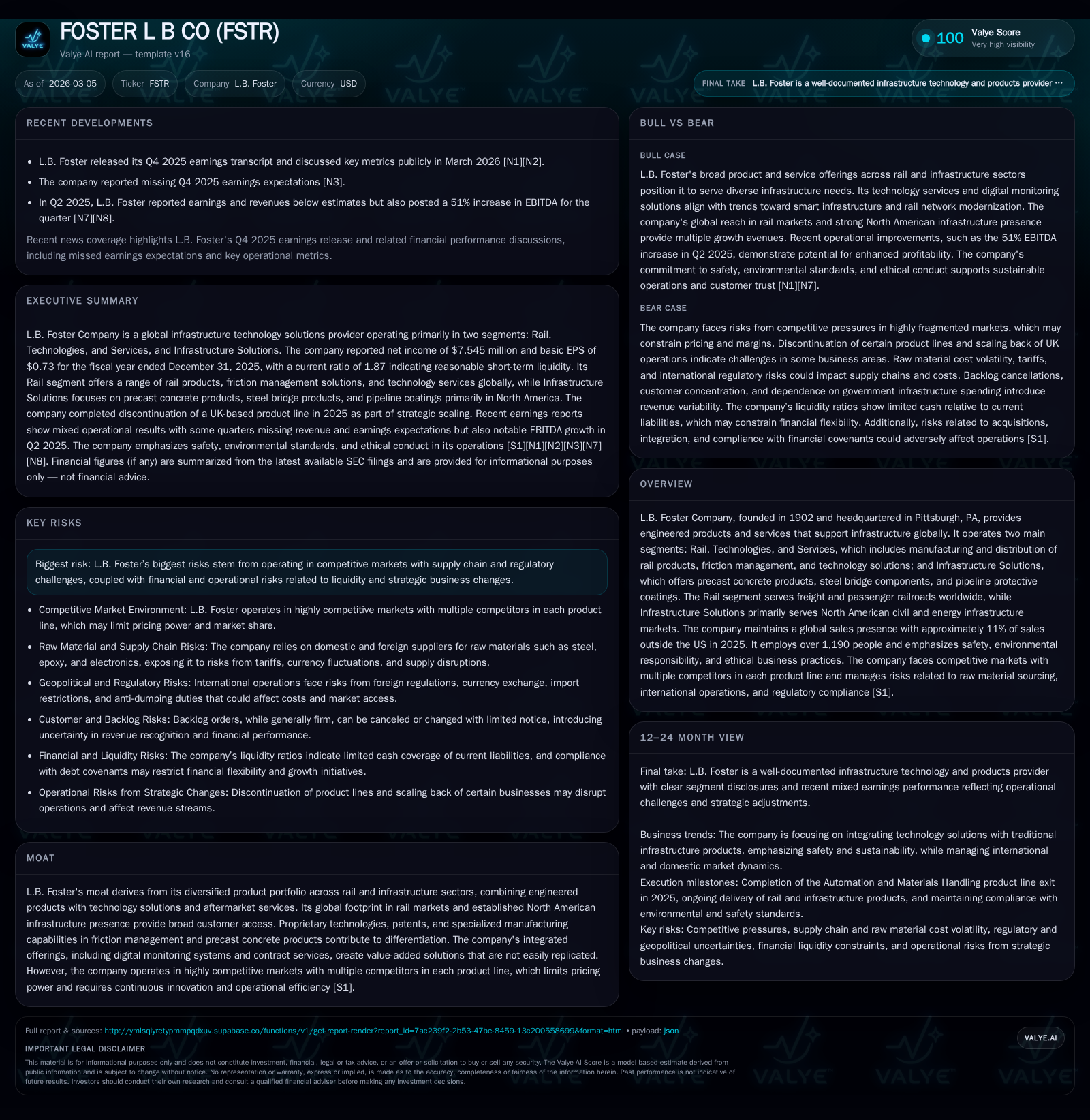
L.B. Foster Company reported a 10.9% revenue increase for fiscal 2025, driven by growth in its Infrastructure segment as Rail declined as a share of total sales. Operating income grew 6.7%, but net income declined sharply due to discrete factors. Robust operating cash flow generation enabled meaningful share repurchases and capital investments, supporting a 4.3% approximate ROE. The firm faces competitive pressures, supply chain volatility, regulatory risks, and integration challenges amid efforts to optimize its product portfolio and respond to market demands. Key areas to watch include backlog evolution, execution on strategic divestitures, and margin sustainability.
Historical Performance Overview
L.B. Foster Company has steadily grown its revenue base following a challenging period culminating in losses during 2022. For fiscal year (FY) 2025, the company reported revenues of approximately $536 million, representing a healthy increase of nearly +11% year-over-year from the prior comparable period [F1]. This revenue growth coincided with operational improvements reflected in operating income rising from $20.5 million in FY24 to roughly $21.9 million in FY25 (+6.7%) [F1]. Notably though, net income suffered an unexpected sharp contraction down to $7.5 million compared to over $42 million in the previous year - a steep decline exceeding -80%, attributable likely to non-operating charges or tax changes detailed in filings [F1][N1].
Strong operating cash flow generation was another bright spot; at approximately $35.6 million it showed a robust +57% increase versus FY24 [$22.6 million] [F1]. Capital expenditures (capex) increased modestly (+6.5%) to roughly $10.4 million while the company pursued an aggressive buyback program totaling about $16.5 million for the year [F1]. After accounting for these cash uses, L.B Foster’s free cash flow is estimated at around $25 million - providing substantial liquidity [F1]. With shareholders’ equity approximating $175 million at year-end 2025, the computed return on equity stood near 4.3%, indicative of modest profitability amidst investment in restructuring and growth efforts [F1].
Historical performance (annual)
| FY | Net ($mm) | CFO ($mm) | OpInc ($mm) | Capex ($mm) | Net YoY |
|---|---|---|---|---|---|
| 2025 | 8 | 36 | 22 | 10 | -82.4% |
| 2024 | 43 | 23 | 21 | 10 | +2833.5% |
| 2023 | 1 | 37 | 9 | 5 | +103.2% |
| 2022 | -46 | -7 | 8 |
Source: SEC companyfacts cache [F1].
Capital returns and efficiency (annual)
| FY | Buybacks ($mm) | FCF ($mm) | ROE% |
|---|---|---|---|
| 2025 | 17 | 25 | 4.3 |
| 2024 | 8 | 13 | 24.1 |
| 2023 | 3 | 32 | 1.0 |
| 2022 | 0 | -33.2 |
Source: SEC companyfacts cache [F1].
Table reflects selected FY data where available; YoY calculated where data allows [F1]
Business Segments and Geographic Footprint
L.B Foster operates two main business segments: Rail Technologies and Services (“Rail”), which accounted for around 57% of net sales in FY25 down from roughly 62% in FY24; and Infrastructure Solutions (43% of sales up from about 38%) [S4][S11]. This shift suggests growing traction or strategic emphasis on Infrastructure as Rail orders were comparatively flat or slower growing.
The Rail segment encompasses manufacturing and distribution of rail products including ties, fasteners, insulated joints (Allegheny Rail Products), friction management products designed to improve fuel efficiency and reduce maintenance costs, plus advanced technology services such as Total Track Monitoring systems that enable digital condition monitoring globally [S6][S7]. Geographic coverage extends worldwide with sales offices across North America, South America, Europe, and Asia — international business constituted approximately 11% of total revenues during the reporting period [S10][S11].
Infrastructure Solutions deliver primarily North American civil infrastructure offerings including precast concrete products under the CXT® brand which supplies park restrooms and utility buildings with multiple customizations available [S26]. Other units provide steel bridge components fabricated mainly from Bedford PA locations for highways and transit infrastructure; protective pipe coatings targeting oil & gas pipelines; plus threading for water well pipe largely focused on agricultural applications within North America [S26][S10]. Recent strategic moves involved discontinuing select Automation and Materials Handling product lines based in the UK as part of cost optimization plans completed by end-2025 [S4].
Growth Drivers & Constraints
Future revenue growth is likely pinned on continued expansion within Infrastructure Solutions segments given their increasing mix contribution alongside steady rail market presence worldwide [N1][S11]. Infrastructure benefits from public funding focusing on civil projects – such as bridges, parks upgrades backed by federal/state stimulus – yet remains susceptible to delays or cutbacks tied to political/economic cycles [S12][S22]. Rail markets hinge heavily on freight and passenger railroad capital expenditures which have mid-to-long term variability influenced by commodity prices, regulatory safety mandates requiring technology upgrades (e.g., AI-enabled track monitoring), and aftermarket service demand for friction management products helping customers lower OPEX [S6][N1].
However, several factors may cap growth or introduce volatility:
- Supply chain issues affecting raw materials like steel or epoxy coatings critical for both segments may generate price spikes or shortages given global trade tensions ([S28],[S27]).
- Competitive pressures are intense with no dominant player offering L.B Foster’s exact product breadth; pricing power is limited prompting need for innovation investment especially within technology services [S11],[S27].
- Regulatory compliance risks including environmental liabilities associated with past industrial site contamination remain potential financial exposures [S22],[S15].
- The company must successfully manage further acquisitions/divestitures without integration hiccups or loss of key clients/staff – significant risks acknowledged explicitly by management [S1],[S19].
- Currency fluctuations hurt international profitability even as overseas markets grow slowly [S20],[S26].
Forecasts & Strategic Expectations
While explicit forward guidance has not been published post-FY25 release as per current disclosures [N1],[S3], key indicators suggest management focus will be on sustaining margin improvement whilst carefully managing capital allocation priorities including:
- Maintaining disciplined share repurchases aiming at enhancing shareholder value demonstrated by doubling buyback spend versus prior years despite lower net earnings [F1].
- Incremental investments into precast concrete factory capabilities favored by new environmental tech licensing such as ENVIROCAST® supporting faster deployment/build flexibility aimed at commercial infrastructure customers [S26].
- Continued scaling down or optimizing less profitable geographic/product lines like the UK automation exit so resources concentrate on higher-margin core segments. Investors should monitor upcoming quarterly releases for backlog updates—currently firm though subject to occasional customer adjustments—which may presage order trends particularly involving new technology rollout opportunities within rail monitoring systems [S9],[N1].
Capital Allocation & Financial Returns
Liquidity remains solid evidenced by a healthy current ratio (~1.87) balancing working capital needs with debt obligations (details show measured leverage control though covenants remain restrictive vs peers) [F1],[S14],[S24]. Operating cash flow strength exceeding capex requirements enables sustained buybacks supporting long-term capital returns strategy even as net income exhibits episodic volatility arising from non-recurring charges or tax effects.
Key financial metrics profile L.B Foster’s conservative approach: ROE hovers modestly above low single digits (~4.3%), reflecting medium-margin industrial manufacturing combined with technology service components amid competitive pressures; free cash flow near $25 million underpins flexibility for reinvestment or shareholder returns programs [F1]. During FY25 the company repurchased almost twice as many shares compared to FY24 depreciating equity base while retaining capital expenditures at levels just above maintenance capex trends observed since FY23 – signaling incremental capacity building aimed at long-term growth rather than austerity retreat alone.
Risks Summary & Mitigations
Principal risks include:
- Operational execution risks tied to acquisition/divestiture management complexity affecting financial results unpredictably.
- Intense competition across diverse products requiring continuous product innovation especially incorporating digital technologies.
- Exposure to supply chain interruptions particularly raw materials dependent sectors aggravated by tariffs/trade uncertainties.
- Environmental remediation liabilities stemming from legacy operations demanding ongoing compliance vigilance.
- Foreign currency fluctuations hurting international results despite growing overseas footprint.
- Potential labor union negotiations affecting manufacturing operations though currently limited labor representation exists. Management highlights concerted efforts focused on mitigating these through robust corporate governance frameworks emphasizing safety, quality controls, ethical conduct standards aligned with ISO certifications fostering operational excellence while simultaneously advancing digital transformation initiatives essential for future railway ecosystem modernization goals [S17],[S18],[S24].
Conclusion & Monitoring Points
L.B Foster emerges from recent years showing modest but steady progress operationally supported by strong free cash flow enabling meaningful shareholder returns via buybacks alongside selective reinvestment in capacity expansion across infrastructure-focused product lines. However margins remain constrained by competitive pressures while net income volatility underscores sensitivity to one-time items needing monitoring going forward. Upcoming milestones worth watching include backlog developments signaling demand momentum shifts; outcomes from recently scaled-back UK operations clarifying portfolio impacts; incremental progress integrating technology solutions expanding rail digital services footprint; pending regulatory changes potentially affecting cost structures; plus evolving supplier dynamics influencing raw material availability/costs internationally. Overall L.B Foster’s diversified business model grounded in engineered rail & infrastructure products coupled with aftermarket service contracts provides resilience but requires consistent focus on innovation efficiency balance across margins expansion targets amid volatile macroeconomic/regulatory backdrops.
This analysis aims solely at providing an informed synthesis based strictly on disclosed company filings and publicly available information as of March 2026 without imparting investment recommendations.
Disclaimer: This is research-only, informational analysis and not investment advice. It may include AI-generated interpretation and general industry context. Always verify important details using primary sources.

Comments