
Hardware-Light, License-Heavy: Examining Research Frontiers’ SPD Technology Commercialization
Research Frontiers Inc. maintains a licensing-based royalty model for its SPD-Smart technology amid ongoing losses and international revenue concentration.
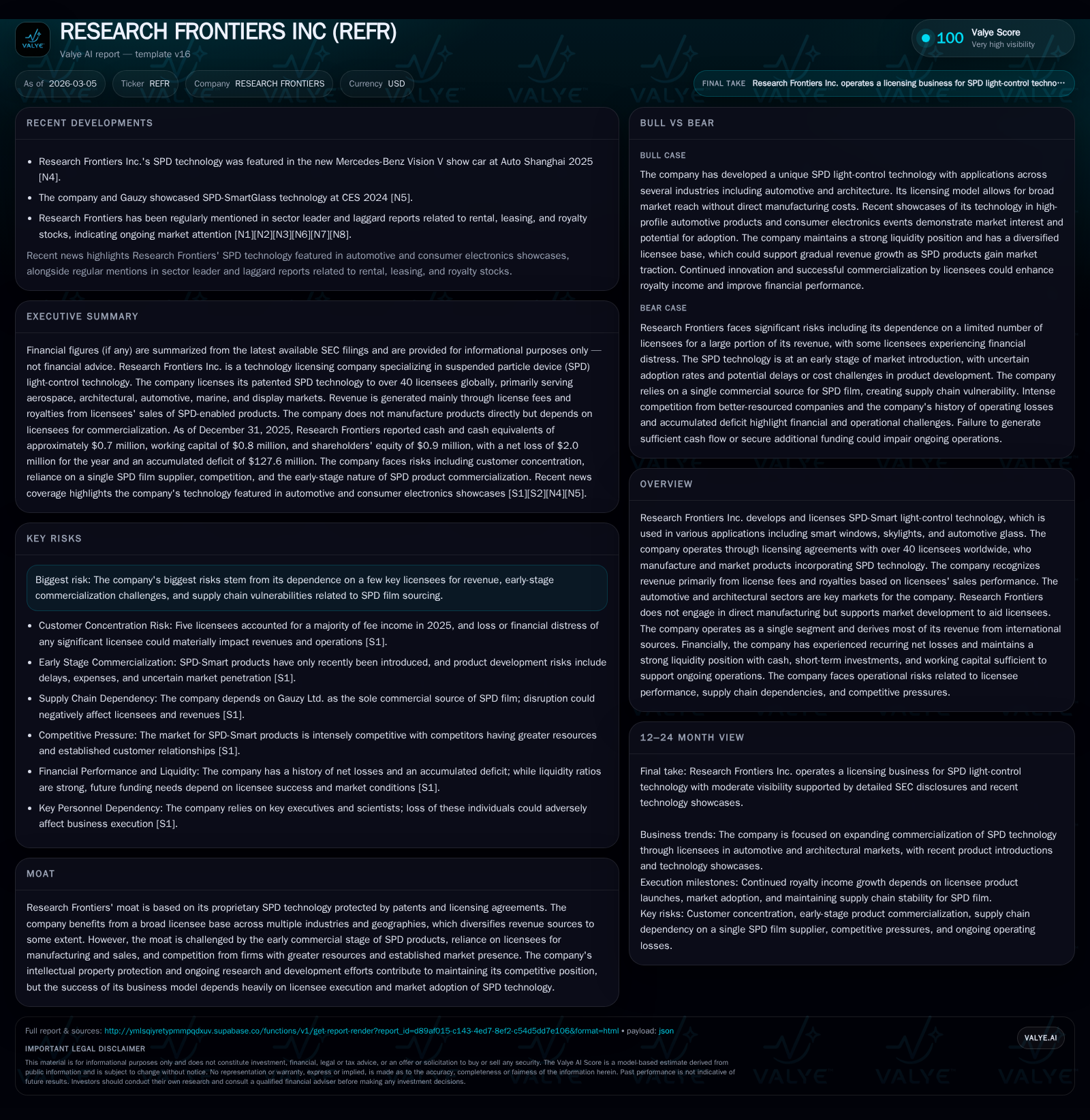
Research Frontiers Inc. operates a distinctive business model focused on licensing its proprietary SPD-Smart light-control technology to over 40 global licensees rather than direct manufacturing. Despite modest revenue growth of 2.9% in 2025, the company has recorded persistent net losses driven by heavy research and development investments and operational inefficiencies inherent in early commercialization stages. Approximately 78% of revenues originate internationally, reflecting diversified geographic exposure but also reliance on licensees' execution capabilities. Cash flows remain negative with limited capital expenditures, while liquidity appears adequate for the foreseeable future based on management assumptions. Key risks include concentration among few licensees, slow technology diffusion in competitive smart glass markets, and supply chain vulnerabilities in critical SPD film components.
Historical Financial Trajectory: Growth Drivers and Persistent Losses
Research Frontiers' financial history through FY2025 paints a picture of a company with innovative technology but struggling to translate this into profitability. Revenues have experienced gradual growth since 2017, moving from roughly $279K to about $381K in FY2019 [F1]. The latest available data show total revenues around $381K with an annual increase of just under 3% (2.9%) compared to prior periods [F1].
Despite top-line expansion, operating income worsened significantly to a loss of approximately $2.13 million in FY2025, a near 48% deterioration YoY [F1]. This reflects heightened research and development outlays aimed at furthering the proprietary SPD-Smart technology platform alongside ongoing operational expenses that exceed royalty inflows.
Net losses mirror this trend with a $2.05 million deficit for FY2025 compared to $1.31 million in the previous year—a substantial increase in net loss (56%) [F1]. Operating cash flow further emphasizes operational challenges: CFO turned more negative by 68.5% YoY to nearly -$1.33 million in 2025 [F1], underscoring cash burn consistent with early-stage commercialization dynamics.
Capital expenditures remain nominal (around $726) consistent with the company's licensing-focused business: there is low fixed asset intensity as physical manufacturing is undertaken by licensees [F1].
Historical performance (annual)
| FY | Net ($mm) | CFO ($mm) | OpInc ($mm) | Capex ($) | Net YoY |
|---|---|---|---|---|---|
| 2025 | -2 | -1 | -2 | 726 | -56.0% |
| 2024 | -1 | -1 | -1 | 1623 | +31.3% |
| 2023 | -2 | -2 | -2 | 1558 | +28.5% |
| 2022 | -3 | -2 | -3 | 1271 |
Source: SEC companyfacts cache [F1].
Capital returns and efficiency (annual)
| FY | FCF ($mm) | ROE% |
|---|---|---|
| 2025 | -1 | -219.1 |
| 2024 | -1 | -50.4 |
| 2023 | -2 | -54.2 |
| 2022 | -2 | -55.6 |
Source: SEC companyfacts cache [F1].
Overall, while royalty revenues show slight improvement reflecting licensee activity, they have yet to offset high R&D investments causing recurring losses.
Expanding Royalty Revenues: Licensee Performance and International Footprint
Research Frontiers derives nearly all its revenue from licensing patented SPD-Smart technology through over 40 licensees worldwide [S5][S11]. These licensees span multiple value chain roles such as film manufacturers, electronics providers powering the light-control functionalities, component laminators, and original equipment manufacturers producing finished "smart" glass products including windows and automotive skylights.
Geographically, revenues are predominantly international — approximately 78% originated outside the United States in recent periods [S4][S11]. Key regions include Europe and Asia where architectural glazing markets increasingly pursue energy-efficiency and comfort solutions incorporating SPD films.
Revenue dependency on licensee commercialization velocity crystallizes as a critical factor: the timeliness and scale at which licensees convert licenses into end-product sales directly drives royalty streams [S1]. Moreover, slower than anticipated uptake or supply chain bottlenecks within licensees' production can cap growth prospects.
Concentration risk exists but is somewhat mitigated by the breadth of licensees across diverse industries like aerospace and marine beyond core architectural and automotive sectors [S5][S11]. License agreements consistently embed royalties linked to volume sold rather than flat fees providing scalable upside contingent on effective market penetration.
Technology Adoption Challenges and Market Development Constraints
While the patent moat surrounding Research Frontiers’ suspended particle device technology secures innovation exclusivity, the company faces systemic challenges inherent to early-stage diffusion of smart glass technologies [S1]. The smart glass segment globally is characterized by fragmented competitors including larger incumbents able to invest heavily in marketing and distribution channels.
SPD film sourcing represents a notable supply chain vulnerability: raw materials must meet exacting optical standards while maintaining production scale reliability [S1]. Any disruptions at these upstream providers inevitably delay licensees' manufacturing timelines thus constraining royalty flow.
Further complicating adoption are layered electronics manufacturing requirements embedded within smart window fabrication—a complexity requiring tight alignment between multiple value chain players external to Research Frontiers itself [S1]. Consequently, despite strong IP protection via patents and continuous R&D efforts for incremental improvements, converting R&D advantage into commercial success hinges largely on external actors' traction.
Financial Outlook and Investor Watchpoints
Explicit guidance remains scarce; however, per recent filings management underscores working capital adequacy covering foreseeable funding needs assuming stable or increasing royalty collections [S1][S3]. The company’s capital raise via private subscription agreements noted in early 2026 aims to bolster liquidity amidst ongoing commercialization efforts [S3].
Investors should monitor key metrics such as quarterly royalty payments reflective of licensee sales velocity and deferred versus recognized revenue arising from complex multi-year license agreements [S16]. Additionally, macroeconomic factors influencing construction activity or automotive production volumes represent indirect growth drivers or headwinds impacting underlying licensee demand.
From an operational perspective watch for any material breakthroughs in product development announced under the New Improvements performance obligation that might unlock additional licensing opportunities or expand addressable markets beyond existing domains outlined [S16].
Absent firm revenue forecasts growth prospects depend primarily on successfully scaling licensee production runs for existing technologies while navigating supply chain risks.
Capital Allocation, Liquidity Status, and Return Metrics
Research Frontiers exhibits typical characteristics of asset-light intellectual property licensors: minimal capital expenditure requirements reflect no direct manufacturing facilities maintained [F1][S7][S26]. Cash balances stood at approximately $664K at fiscal year-end 2025 after funding operating losses totaling around $2 million annually [F1][S1]. Working capital measured roughly $0.8 million yielding a healthy current ratio (~3.84), indicative of sufficient short-term liquidity relative to liabilities near $298K [F1].
The accumulated deficit surpasses $127 million due predominantly to years of net loss accrued through ongoing R&D investment cycles with negligible dividends or buybacks executed historically [F1][S6]. This accumulated deficit underscores continued economic losses generating deep negative book equity positions.
ROE calculated from latest net income relative to shareholders’ equity stands near negative 219%, illustrating lack of profitability despite small scale top-line growth [F1]. Financing historically sourced mainly from equity issuances as documented through subscription agreements highlight ongoing capital needs paired with absence of substantial debt levels [S3][S13].
Overall capital allocation aligns with sustaining R&D programs targeting new intellectual property enhancements while maintaining market development activities through marketing support rather than direct production investment.
Risks Intrinsic to Research-Driven and Licensing-Focused Model
The business model's dependency on successful commercial execution by third-party manufacturers creates intrinsic bottlenecks translating cutting-edge IP into profitable operations [S1]. Key risks involve concentration among certain major licensees whose underperformance could disproportionately impact revenue streams given limited direct control over their manufacturing capacity or sales efforts.
Long timelines typical for commercializing patented smart materials exacerbate uncertainty around timing for positive cash flow realization while opening windows for competitive encroachments especially from better-capitalized firms targeting similar architectural or automotive glazing innovations.
Supply chain fragility remains salient particularly related to sourcing specialized SPD films requiring high optical precision; any delays here ripple downstream impacting both existing volume royalties and potential contract expansions.
Additional financing dependence highlights vulnerability if equity markets become less receptive or if royalty inflows fail to meet projections sufficient to self-fund operations long term—potentially forcing operational slowdowns detrimental to sustaining innovation momentum [S1].
This analysis synthesizes publicly filed data as of March 2026 without offering investment advice or forecasts beyond documented disclosures. Readers should consider inherent uncertainties detailed above when assessing Research Frontiers’ technological positioning alongside financial metrics characterized by recurring operating losses amid attempts to build sustainable royalty revenue bases through international licensing partnerships.
Disclaimer: This is research-only, informational analysis and not investment advice. It may include AI-generated interpretation and general industry context. Always verify important details using primary sources.

Comments